
Do you need a data warehouse? The case, the timing and the path to activation
Build a data warehouse when recurring decisions need joined history and shared definitions that your current tools cannot reliably provide, and someone can own the result. Include an activation path when the decision requires customer relationship management (CRM) fields, audiences or messages to change. Wait when a simpler report or integration solves the problem; company size and row count alone are poor triggers.
On this page
The useful starting question is concrete: which decision takes too long, uses unreliable numbers or cannot be made at all?
“We need a single source of truth” is too vague to scope. “We cannot tell which acquisition channels produce customers who remain active after 90 days” identifies the sources, missing joins and business outcome.
What would a warehouse do in your stack?
A warehouse stores analytical data and gives shared definitions a maintained place to run. It combines records from tools such as HubSpot, Stripe, Google Analytics 4 (GA4) and your application without taking over their operational jobs.
The CRM system still manages customer interactions. Billing still manages invoices and payments. The warehouse holds copies and derived models that connect those systems: campaign to signup, signup to account, account to paid outcome.
Our warehouse and customer data platform (CDP) work starts with those relationships and the decision they support. The build includes source ingestion, models, checks and the destination that will use the answer.
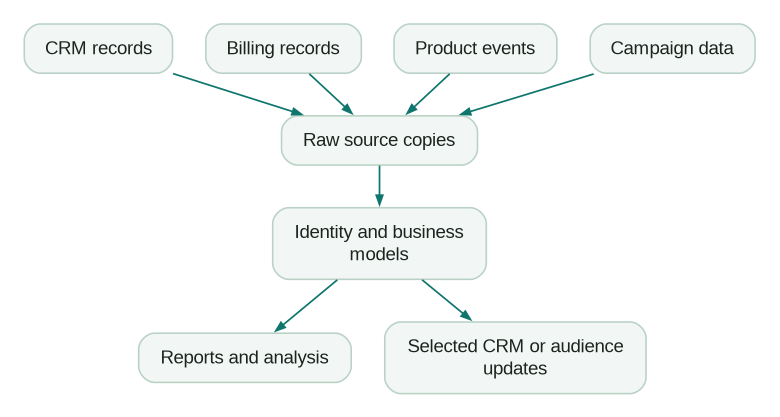
Read diagram as text
- CRM records to Raw source copies.
- Billing records to Raw source copies.
- Product events to Raw source copies.
- Campaign data to Raw source copies.
- Raw source copies to Identity and business models.
- Identity and business models to Reports and analysis.
- Identity and business models to CRM fields ad audiences and message triggers.
- CRM fields ad audiences and message triggers to Outcome recorded.
- Outcome recorded to Identity and business models
A report needs a named user and a decision. When the intended benefit is a change in customer treatment, scope what data activation means in practice as well: an owner, an eligible population, add and remove rules, and an outcome to measure.
That can be a narrow first release. A reviewed account-status field in the CRM may be more useful than ten dashboards with no agreed next action.
What do a warehouse and data activation solve together?
They connect a maintained customer model to a repeatable action and its outcome. The value comes from resolving identity, meaning and delivery across systems, rather than collecting every available table.
The State of Martech 2025 survey found warehouse or lakehouse integration among 56.2% of its 96 respondents. Its small-business category covered up to 250 employees, with 34% reporting integration, and the authors noted that respondents skewed toward advanced marketing operations. These are scoped practitioner-survey results, not a buying threshold for a five- or twenty-person company. Chiefmartec and MartechTribe's 2025 report.
One customer record across product, billing, CRM and ads
A product user, workspace, billing customer and CRM company can be different entities. Write the relationships explicitly: which people belong to which account, which billing record pays for it, and what happens after an account merge or email change.
Without that map, each system can report a different customer count for a defensible reason. A single customer view without an enterprise CDP and identity rules for web, app, CRM and billing make those joins inspectable. An unmatched record should remain visible rather than disappear from the report.
Metrics that finance, sales and marketing can reconcile
Write one definition per measure before splitting it by channel. Bookings, invoices, collected cash and recognised revenue answer different questions. Agree which one the decision needs, its time window and its exclusions.
Use written metric contracts, then reconcile Stripe revenue with CRM deals under the chosen definitions. A consistent channel chart built on the wrong money measure is still a wrong answer.
Audiences and fields that return to operational tools
Activation sends the accepted result to CRM fields, ad audiences, conversion signals or message triggers. Choose the route with reverse ETL sync design, which defines how warehouse changes reach another application. For paid-media use cases, test warehouse audiences for Google Ads, Meta and HubSpot, including who leaves an audience and when the destination reflects that removal.
AI answers that use approved definitions
An assistant can select a plausible raw field and still answer the wrong business question. Give it the accepted customer model, metric and permitted query route, then compare the answer with known results.
Why AI answers on marketing data go wrong separates readiness failures from the choice of platform. A semantic layer for AI can provide governed calculation paths, but the agent still needs tested access and evidence that it used the intended one. An assistant built around approved workflows is a later interface to that work, not the reason every company must buy a warehouse.
Which signals show that the current setup is becoming limiting?
Recurring reconciliation, missing product context, weak acquisition outcomes, missing history and repeated manual joins are useful triggers. Measure their burden and the decision they block before turning them into a platform purchase.
1. You reconcile the same numbers every month
Marketing reports one revenue total, finance reports another and the CRM reports a third. Each can be correct under a different definition.
The warehouse opportunity is to preserve the underlying records and make the bridge explicit: bookings, invoiced amounts, collected cash and recognised revenue are different measures.
First check whether the disagreement is only a definition problem. A shared metric document may resolve it without a new platform. Build when the reconciliation also requires recurring cross-system data work.
2. Product behaviour is missing from customer decisions
Sales knows who signed up but cannot see whether the account activated. Customer success sees subscription value but cannot distinguish healthy adoption from an unused annual contract.
A useful first model might contain one row per account with activation date, last meaningful activity, current subscription state and account owner. Sending selected fields back to the CRM can be more valuable than launching a large business intelligence (BI) project.
Do not sync every event into the CRM. Decide which derived signals a person can act on, how fresh they need to be and what happens when the signal becomes stale.
3. Your ad platforms optimise toward a weak outcome
If all signups look equally valuable to the advertising system, acquisition can favour cheap users who never become customers.
A warehouse can help join acquisition identifiers with qualified or paid outcomes. It does not guarantee that every outcome can be matched back to an ad interaction, and it does not remove consent or platform requirements.
The offline conversion import guide explains the operational path from a business outcome to a usable advertising signal.
4. You cannot reconstruct what was true last month
A CRM record usually shows its current state. Historical questions may require snapshots or change records: who owned the account at qualification, which stage a deal occupied at month end, or what subscription plan existed before an upgrade.
If your question depends on history, define the required capture now. Buying a warehouse later will not recreate source history that was never retained or exposed.
5. Manual joins have become a recurring dependency
One spreadsheet analysis is not a crisis. A weekly process that depends on one person copying five exports and repairing identifiers is a candidate for a maintained pipeline.
Measure the burden before automating it. Record preparation time, correction time, failure frequency and the decisions delayed. This gives the project a baseline and helps distinguish inconvenience from a real operating constraint.
When should you wait?
Wait when the important questions can already be answered accurately inside one or two tools, the cadence is manageable and nobody can own another system. A clean CRM and a controlled billing export can be sufficient for a young business.
Also wait when the team has not agreed on lifecycle or revenue definitions. A warehouse preserves data; it cannot decide whether a sales-accepted lead belongs in qualified pipeline. Resolve that business question before automating the calculation.
Set a review trigger: recurring reconciliation exceeding a chosen workload, a new product-led sales motion, or a repeated decision requiring three systems and historical state. The startup stage guide explains where a warehouse usually lands in the sequence; funding stage alone does not establish need.
What can you do now to make a later move cheaper?
Keep these early decisions that make a later warehouse cheaper in the current operating process:
- Preserve stable product, CRM and billing identifiers and their mappings.
- Use one campaign taxonomy across the tools that record acquisition.
- Retain permitted billing exports and monthly CRM-stage snapshots from now on.
- Record customer consent by channel so later audiences can apply the right rules.
- Write the definitions of the three core metrics the team actually uses.
Historical state that the source never retained or exposes later cannot be recreated by a new connector. Preserve the relevant evidence within the business's agreed access and retention rules.
What does a small-team operating budget look like?
Budget the full operating process and separate cash spending from internal capacity. The following hypothetical monthly model uses existing staff for maintenance; it is not a vendor quote or market average.
Illustrative monthly costs in USD. The staff rate is an assumed USD 70/hour and payroll is unchanged.
| Item | Monthly economic cost, USD | Incremental cash, USD | Assumption |
|---|---|---|---|
| Warehouse storage and compute | 60 | 60 | Bounded workload |
| Connectors or ingestion hosting | 180 | 180 | Required sources only |
| Reporting and orchestration tools | 60 | 60 | Selected operating tools |
| Maintenance and review | 420 | 0 | Six existing-staff hours at USD 70/hour |
| Total | 720 | 300 | Economic cost includes staff capacity |
Check what managed connectors like Fivetran cost for the actual source workload. Replacing a contracted maintenance invoice with internal time would change the cash treatment, so identify who performs the work before copying this model.
If the system removes 18 internal hours at the same rate, it recovers USD 1,260 of capacity. Subtracting USD 720 of operating economic cost leaves USD 540 of monthly economic value before implementation. The cash view still spends USD 300 monthly because no existing invoice or salary payment is reduced in this example.
If only six hours disappear, gross recovered capacity is USD 420 and monthly economic value is negative USD 300. The project might still supply a necessary capability, but it does not pay back on this time-saving case.
Whether a data warehouse is worth it therefore depends on the work or decisions it actually changes. Count recovered hours only where someone will stop doing that work, and evidence any other benefit separately, as the formula below does.
Monthly economic value =
  usable capacity recovered
  + separately evidenced operational benefit
  - incremental cash operating costs
  - internal maintenance capacity

Simple economic payback months =
  one-time implementation cost / positive monthly economic value
This shortcut assumes benefits start immediately and stay constant. Build a defensible three-year ROI case, meaning return on investment, when rollout delay, cash versus capacity, adoption and discounted value matter. Use the line-by-line warehouse budget to replace the illustrative operating inputs with your own.
What do low-cost warehouse entry points actually provide?
Use entry plans to test the required workload and permissions, then price retention, ingestion and ownership. A low compute allowance does not make the complete production process free.
- BigQuery: the sandbox has a lifetime 10 GiB storage allowance that deletion does not restore, plus 1 TiB of query processing monthly. Objects expire after 60 days; streaming, data-manipulation statements and Data Transfer Service are unavailable. Use it deliberately for evaluation. Sandbox limits, BigQuery rates.
- Snowflake: virtual warehouses have a 60-second minimum on each start or resume, followed by per-second billing. Storage and other services are separate. Read the Snowflake introduction and warehouse cost by size alongside the compute rules.
- Redshift Serverless: AWS documents a default base capacity of 128 Redshift Processing Units (RPUs), with a 4-RPU configuration available subject to region and workload requirements. Check the chosen setting rather than assuming a new account uses the minimum. Capacity guidance.
- Databricks Free Edition: it is for non-commercial use and sits outside the support policy and service-level agreement. It can support learning, but should not be priced as a free commercial production warehouse. Free Edition limits.
How do a warehouse, a lake and an operational database differ?
A warehouse supports analytical questions over many records. A lake stores data in files, often in object storage, with tools that process it. An operational database serves application transactions such as creating accounts and updating orders.
Modern platforms overlap these categories. Choose the workload and operating requirements before the label. Structured query language (SQL) models can be a practical starting point for a marketing team joining CRM, billing and campaign records; a broader lakehouse design needs a reason such as existing architecture or additional engineering workloads.
Avoid sending heavy recurring analytics to the production application database without an agreed design. A replica or analytical copy can isolate that workload and provide a controlled place for business models.
Should you start with tools, a CDP, a warehouse or both?
Use the smallest path that can meet the decision's requirements and has an owner. Collection speed, joined history and operating responsibility can lead to different choices.
| Path | Choose it when | What must be owned | Trigger to reconsider |
|---|---|---|---|
| Tool-first | CRM reports and native integrations answer the recurring questions | Definitions and integration exceptions | Important joined history becomes unavailable or manual work repeats |
| CDP-first | Event collection and routing are the immediate job | Event definitions, identity, consent and destination behaviour | Financial or product history needs maintained cross-system models |
| Warehouse-first | Decisions need billing, CRM and product history with shared calculations | Ingestion, models, access and incidents | A low-latency collection need requires a separate route |
| Both | Collection and analytical requirements differ | The boundary and source of truth for each job | Duplicate identity or rules create inconsistent actions |
A customer data platform is not one fixed storage design. The CDP Institute distinguishes packaged, warehouse-native and hybrid architectures. A composable CDP built around the warehouse can add audience and activation functions, but those functions still need operating ownership.
Use whether you also need a CDP for the detailed comparison. An in-session trigger may justify an event-oriented path; a warehouse model refreshed later cannot be assumed to satisfy it. Test the complete delay and destination action rather than relying on the product category.
How do marketing tools connect to the warehouse?
Marketing tools connect to a warehouse in three ways: they query it in place, receive scheduled syncs from it, or send engagement data back to it. Warehouse-native marketing uses one or both of the first two routes, so eligibility is decided once in the warehouse model and each tool acts on that answer. Ask a vendor which route it uses, because latency, warehouse cost and deletion behave differently in each.
Query in place: Braze Connected Sources can build segments from warehouse queries without copying the underlying attributes into Braze. Confirm source permissions, query cost, refresh and the resulting membership; zero-copy does not establish that every downstream action is immediate. Connected Sources.
Scheduled pulls or reverse ETL: Braze Cloud Data Ingestion supports Snowflake, BigQuery, Redshift, Databricks and Microsoft Fabric. The default dashboard minimum is 15 minutes, with 5-minute scheduling available through support. Customer.io can query as often as every minute. These are scheduling capabilities, not guarantees of end-to-end freshness. Braze ingestion, Customer.io reverse ETL.
HubSpot Data Studio warehouse connectors require Data Hub Enterprise. A dedicated reverse ETL tool is another route when several destinations need the same accepted model. For either route, test updates, removals and the cost of repeat delivery. HubSpot warehouse connections.
Engagement feedback: Braze Currents streams engagement events to analytical systems. Its connector and event entitlements matter; the documentation says a connector is included in many pro and enterprise packages, so confirm the account's allocation. Bring relevant delivery and response evidence back into the warehouse to measure the action. Currents capabilities and access.
What is the path from the first source to the first activation?
Start with one decision, prove its data, release one useful output and close the feedback loop before expanding. Each phase needs a deliverable, an acceptance test and an owner.
- Name the decision and identity. A fictional 15-person software company wants to compare acquisition channels by 90-day retained customer value. The business owner defines the value window and action; the data owner confirms account, acquisition and billing identifiers. Exit when the question, population and joins are unambiguous.
- Land the required sources. The technical owner retains source history, original identifiers and ingestion timestamps for account creation, acquisition and billing. Exit when representative changes and source coverage reconcile. Use setting up a marketing data warehouse for implementation detail.
- Model people, accounts and money. The data and finance owners reconcile account counts and the agreed paid-value measure, while exposing unmatched records. Exit when documented tolerances hold. The warehouse design guide explains the maintainable layers.
- Release one report. The business owner uses it for a complete reporting cycle and a correction. Exit when the team can explain a changed number, trace it to evidence and make the intended decision.
- Release one activation. The destination owner tests add, update and removal rules with readback. Define a holdout or credible comparison before launch where feasible; otherwise label observed outcomes accordingly. Use the established reverse ETL contract and audience rules before enabling customer-facing actions.
- Record the outcome and decide what comes next. The technical owner brings back delivery and engagement evidence; the business owner checks the intended outcome and operating burden. Add the next justified use case rather than the next available connector.
Who owns the warehouse after launch?
Assign a business owner for meaning, a technical owner for operation and a destination owner for each action. An implementation partner can build and operate parts of the system, but ownership must survive a person's departure.
| Responsibility | Accountable owner | Minimum handover | Acceptance check |
|---|---|---|---|
| Metric and eligibility meaning | Business owner | Definitions, exclusions and decision purpose | Owner can explain a disputed result |
| Pipelines, models and incidents | Technical owner | Source inventory, model lineage, tests and recovery procedure | A controlled failure is detected and repaired |
| CRM fields, audiences and messages | Destination owner | Writer, mapping, add/update/remove rules and pause control | Expected state and action are confirmed in the destination |
Decide which system owns each CRM property before multiple writers are enabled. Keep a list of active syncs, their destinations and removal behaviour alongside model ownership and a failed-sync runbook.
A builder leaving should not leave the business with an unexplained spreadsheet, a personal login and no way to stop a writer. Test the handover: another authorised operator should be able to trace one change and explain the recovery path.
What should be agreed before you approve the build?
Approve a bounded project when the decision, accepted output, operating budget and owners are explicit. Use the checklist to separate a warehouse need from a simpler integration or definition problem.
Checklist
- A recurring decision cannot be answered reliably with the current tools.
- Cross-system joins, retained history or shared models are required.
- The relevant definitions and stable identifiers are agreed or in scope.
- Source totals and unmatched records will be reconciled.
- The budget separates incremental cash from internal capacity and includes implementation.
- The first report has a user, a decision and a correction test.
- The first activation, its owner and its removal rule are named when action is part of the case.
- Every metric definition, pipeline and destination field has an owner.
- Retention, deletion, access and regional requirements are understood.
- Recovery and handover work without the original builder's personal credentials.
At Martechdevs, we connect source systems to tested customer and revenue models, then carry the result into the report or activation your team owns. Start with the $99 martech audit, or request a warehouse implementation scope around the first decision and acceptance evidence.
Keep reading
Browse all Data Warehouse guides
 Data Warehouse
Snowflake Implementation: Plan the Phases, Price the Work and Connect Your Sources
Plan a Snowflake implementation in phases: security, ingestion, models, BI and handover, with current credit rates, cost lines and timeline drivers.
Jafrin Akter AloLast updated 16 min read
 Data Warehouse
BigQuery Implementation Mistakes: Fix Missing Data, Cost Surprises and Unreliable Reports
Fix missing GA4 exports, location mistakes, sandbox limits and costly raw scans with BigQuery diagnostics, reconciliation checks and recovery steps.
Jafrin Akter AloLast updated 14 min read
 Data Warehouse
dbt Implementation Mistakes: Fix Stale Models, Incremental Errors and Fragile Deployments
Fix stale dbt models, incremental errors, schema backfills and fragile deployments with practical tests, build-cost checks and a reliable handover plan.
Jafrin Akter AloLast updated 15 min read
Data warehouse & CDP
See the implementation scope, deliverables and acceptance checks.
Questions people ask
Can HubSpot be our data warehouse?
HubSpot can remain the operational customer system while reading data prepared elsewhere. Its Data Studio documentation lists Snowflake, BigQuery, Databricks, Amazon Redshift, Azure Synapse and Amazon S3 connections, with Data Hub Enterprise required for warehouse connectors. Connection requirements. Keep joined history and maintained analytical models where their requirements fit; connecting the warehouse to HubSpot does not make the two systems interchangeable.
Can GA4 be our warehouse?
GA4 supplies analytics collection and reporting, but it is not a general store for billing history, CRM relationships and business-wide models. Use the GA4 BigQuery export as one input when those joins are needed. Keep source identity, time and event definitions intact, then reconcile the accepted model against the original business records before using it for financial or customer decisions.
Do we need a data engineer on staff?
You need engineering responsibility and a business owner, but the technical work can be internal, contracted or shared with a partner. Someone must understand the joins, changes, failures and recovery. Managed infrastructure reduces server administration while leaving those responsibilities intact. Compare agency, in-house or freelancer ownership, and test whether the handover can be operated without the original builder.
Is there a data volume at which we need a warehouse?
There is no universal row-count trigger. PostHog's engineers offer the mid-millions as a rough heuristic, with growth and workload caveats. PostHog's warehouse discussion. Marketing teams can need joined billing, product and CRM history at smaller volumes, while a larger single-system dataset may need no new platform. Decide from the recurring question, retained history, operating burden and ownership.
Which data warehouse is best for a startup?
Pilot the platform that fits your existing cloud, sources, skills and workload. BigQuery can be a practical first evaluation for a Google-oriented marketing stack; Snowflake may suit stronger sharing or broader platform requirements. Use the Snowflake versus BigQuery comparison and the warehouse cost guide, then test one accepted report and activation before committing to a broader migration.
Sources
- Chiefmartec and MartechTribe: State of Martech 2025. Q1 2025 survey.
- CDP Institute: What is a CDP?.
- Google Cloud: BigQuery sandbox.
- Snowflake: Understanding compute cost.
- AWS: Redshift Serverless capacity.
- Databricks: Free Edition limitations.
- Braze: Connected Sources.
- Braze: Cloud Data Ingestion.
- Customer.io: Reverse ETL connections.
- HubSpot: Data Studio external data.
- Braze: Currents.
- PostHog: Why you should use a data warehouse. Published 26 January 2025.

Written by
Jafrin Akter AloData Engineer and Co-founder at Martechdevs and Growth and Analytics Partners
Jafrin writes practical guides to marketing technology, customer data, analytics and AI workflows. Martechdevs is a Growth and Analytics Partners company.