
CDP vs data warehouse: do you need both?
Data Engineer and Co-founder, martechdevs
Last updated 9 min read
A data warehouse gives you a place to combine, retain and analyse business data. A customer data platform adds capabilities for collecting customer events, resolving identities, building audiences and delivering data to operational tools. Products overlap, and a warehouse can underpin a CDP. Choose the capabilities your workflows need before deciding whether to buy one product, several components or both categories.
Last updated: 29 September 2026.
Suppose your team wants to email trial accounts that invited colleagues but have not completed setup. You need several things to work: the product events must arrive, users must map to accounts, eligibility must be calculated and the right recipients must enter the journey.
A warehouse can calculate the audience. Something still has to deliver it, respect suppression rules and confirm that the destination accepted the update.
Separate the jobs before comparing products
The term CDP can describe a bundle of capabilities rather than one fixed architecture. Inspect what the proposed product actually includes.
Collection captures events and records from websites, apps and servers.
Identity links records that belong to the same person or account under documented rules.
Modelling calculates useful traits, such as activation status or recent paid revenue.
Audience building selects eligible people or accounts for a business use.
Delivery sends events, attributes or audience membership to other systems.
Governance and operations manage access, consent-related rules, quality, deletion, failures and changes.
Segment's Connections documentation describes a source-and-destination pipeline, while its Unify product adds profile and identity capabilities with separate eligibility. That distinction is a useful reminder that an entry-level event-routing plan is not automatically the entire CDP. Connections overview and Unify overview.
Martechdevs' warehouse and CDP service maps these responsibilities to the actual workflow so the purchase does not leave a critical gap between a correct audience and a working campaign.
What the warehouse contributes
A warehouse is useful for joining customer data with information beyond the customer event stream: billing, finance, support, campaign costs and operational history.
It can preserve source records, support SQL transformations and expose shared business models. The team controls how an account, customer or revenue measure is defined.
It does not automatically provide a website SDK, a complete identity policy or every destination integration. Those capabilities need to come from products or maintained code around it.
The warehouse readiness guide helps decide whether cross-system analysis and retained history justify that foundation.
What reverse ETL contributes
Reverse ETL sends selected warehouse results into operational systems. A common example is syncing an account's activation status into the CRM or sending an eligible customer audience to a marketing platform.
RudderStack's documentation describes this flow in terms of a warehouse source, model, sync mode, destination and schedule. The sync mode matters because inserting, updating and removing records are different operations. Reverse ETL documentation.
A query that returns the right rows is only the first half of the job. You must also define the destination identifier, which fields can be overwritten and what happens when a row leaves the result.
For example, if a trial account converts, an onboarding audience should remove or suppress it according to the journey design. A sync that only adds members can leave yesterday's eligible accounts receiving today's irrelevant message.
Three common setups
1. A CDP without a separate warehouse project
This can fit a team whose immediate need is collecting product events and delivering them to a small number of tools. The selected CDP may also provide profiles and audience features, depending on the plan.
The advantage is a more packaged operational path. The limitation is that your analytical and historical requirements may eventually exceed the product's convenient data model or retention surface.
Evaluate export access and ownership of definitions before committing. If the team later needs to join billing and finance history, it should be clear how those records enter the architecture.
2. A warehouse plus activation tools
This can fit a team that already has reliable source ingestion and business models. Audience logic is calculated from the warehouse, then delivered through reverse ETL or another activation system.
The advantage is reuse of shared definitions. The operational burden is maintaining the source pipelines, models and syncs that the activation layer depends on.
Do not choose this setup merely because it looks modular. It works well when the team can own the interfaces between components and diagnose failures across them.
3. A CDP and a warehouse together
The CDP may collect and route events while the warehouse combines them with other business data. Derived traits can then flow back to operational tools.
This can be a sensible architecture when collection and analytics have distinct requirements. It becomes wasteful when two systems independently calculate the same identity or lifecycle state without an agreed authority.
Assign each definition one owner. If the warehouse decides activation, the CRM should consume that definition rather than recalculate a slightly different version from partial data.
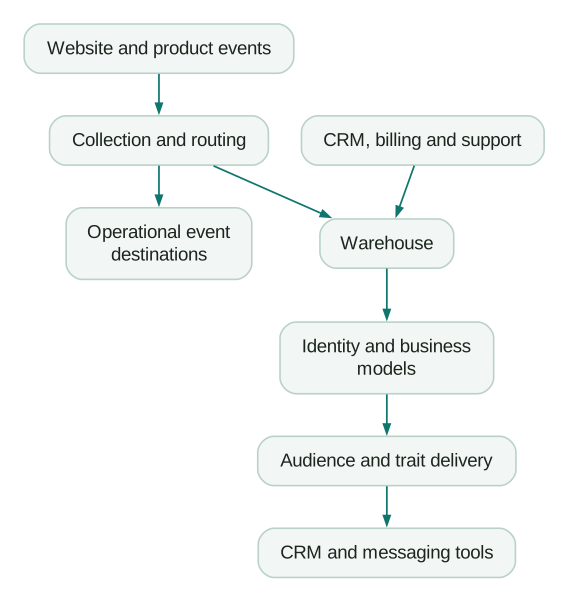
This is a reference pattern. Your product choices may combine several boxes, but the responsibilities still need to be explicit.
What warehouse-native CDP means in practice
A warehouse-native CDP uses the warehouse as a central foundation for customer models and activation. The exact boundary varies by vendor and feature.
RudderStack Profiles defines identity and features through configuration that generates warehouse SQL. Hightouch documents identity outputs and audience infrastructure built around warehouse data. RudderStack Profiles and Hightouch technical setup.
Ask where each operation runs and what data leaves the warehouse. Avoid interpreting “warehouse-native” as a guarantee that every byte and every computation stays there. For example, Hightouch distinguishes deterministic identity processing in the warehouse from probabilistic processing that can involve external processing. Identity resolution architecture.
Also ask what the vendor stores for operations: credentials, configuration, logs, cached results or payloads. The answer should come from the product's current architecture and agreement, not from a category label.
A worked example: build one activation journey
Consider a fictional SaaS business with 8,000 trial accounts. It wants to contact account owners when at least three colleagues have joined but no core workflow has been completed after seven days.
The audience definition requires:
- A stable account ID and creation timestamp.
- Valid account-user relationships.
- The agreed core workflow event.
- The current account owner and reachable recipient.
- Current subscription state and suppression conditions.
The warehouse produces 620 eligible accounts. Of those, 70 lack a reliable owner mapping, 40 are suppressed and ten have stale product data. That leaves 500 accounts ready for the defined activation step.
The delivery system accepts 485 records and rejects 15 because of destination validation errors. The correct operational report shows each stage: 620 initially eligible, 500 permitted and ready, 485 accepted.
Calling all 620 accounts “activated” would hide both data quality and delivery failures. Calling the 485 accepted records “emails sent” would also be premature because the messaging platform still applies its own journey and sending rules.
The architecture is successful when the intended customer action occurs correctly and the team can explain every exclusion and failure.
CDP vs CRM
A CRM manages operational relationships, ownership, opportunities and service activity. It is often the place people work with customer records.
A CDP can provide behavioural events, identity and audience capabilities around those records. A warehouse can combine CRM data with the rest of the business for analysis and derived signals.
For a small B2B company, the CRM may be enough until product activity or cross-system segmentation becomes important. Adding a CDP does not automatically improve an unclear lifecycle process.
If the immediate requirement is selected product signals inside HubSpot, read how to put product data in HubSpot. That is a more concrete scoping exercise than shopping for a broad customer-data category.
Compare total cost and latency
Price the same workflow in each design. Include collection volume, tracked users, identity or audience add-ons, destinations, warehouse compute, connector costs and operating effort.
Then specify latency at the business level. “Real time” is not a useful requirement until you define the maximum acceptable delay from source action to destination behaviour.
A daily customer health review may tolerate hours. Preventing a message immediately after a purchase may require a faster operational event path. A nightly warehouse audience alone may not meet that requirement.
Use a fictional budget comparison to expose tradeoffs. Suppose one packaged option costs $600 per month and requires two hours of maintenance at $80 per hour. Its operating total is $760. A modular option costing $250 in tools but requiring eight hours of maintenance totals $890.
Those numbers are illustrative, not vendor prices. The exercise shows why a lower subscription can still create a higher operating cost. It also works in reverse when the team already maintains the warehouse models and only needs a small additional sync.
For a vendor-level evaluation, use the Segment versus RudderStack comparison, which starts with their different billing units.
Questions that reveal a weak proposal
Ask the implementation team to demonstrate the journey of one record, including an update, a deletion and a failed destination write.
Which identifier does each system use? Where is the identity rule defined? Which source wins when attributes conflict? What removes someone from an audience? How does a retry avoid duplicate actions? What remains available when a vendor is replaced?
Ask the business owner a different set of questions. Who will use the audience? What will they change because it exists? Which exclusions are necessary? How will the team measure a useful outcome rather than merely a larger sync count?
A product demo should answer both sets. The interface can look simple while the unresolved rules remain substantial.
Decision checklist
- The required use cases are written as specific customer or account actions.
- Collection, identity, modelling and delivery each have an owner.
- Billing units reflect expected anonymous users, events and sync volume.
- Audience removal and suppression behaviour are defined.
- The destination can accept the required identifiers and fields.
- End-to-end latency meets the actual business requirement.
- Failed, excluded and unmatched records remain visible.
- Data export, retention and deletion behaviour are understood.
- The operating budget includes maintenance and change management.
At Martechdevs, we connect source systems to tested customer and revenue models, with documentation your team can maintain. Start with the free martech AI audit, or explore an AI assistant built around your approved workflows.
Questions people ask
Do we need Segment if we already have a warehouse?
Possibly, if you need its collection, routing, governance or profile capabilities. A warehouse does not replace an SDK or destination integration by itself. Compare the missing capability with the available alternatives before adding the full product bundle.
Can a warehouse replace a CDP?
It can underpin many of the same outcomes when combined with collection, identity and activation components. That is an architecture you must operate. The warehouse alone does not provide every CDP capability.
Is reverse ETL the same as a CDP?
No. Reverse ETL is a delivery capability from warehouse models to operational destinations. A CDP may include it alongside collection, identity and audience features. Some activation products expand into several of those areas.
Which setup is best for a small team?
Choose the smallest design that meets a valuable workflow and has a credible owner. A team without maintained warehouse models may benefit from a packaged path. A team with strong models may need only activation. Headcount alone does not settle the choice.
Will a CDP fix duplicate customer records?
It may provide identity tools, but you still need rules for legitimate relationships and conflicts. Shared emails, households, subsidiaries and multiple workspaces can create false merges. Test identity behaviour on those cases before letting merged profiles drive customer actions.
Sources
- Segment Connections overview. Accessed 29 September 2026.
- Segment Unify overview. Accessed 29 September 2026.
- RudderStack Reverse ETL. Accessed 29 September 2026.
- RudderStack Profiles. Accessed 29 September 2026.
- Hightouch technical setup. Accessed 29 September 2026.
- Hightouch identity architecture. Accessed 29 September 2026.
Written by
Jafrin Akter AloData Engineer and Co-founder, martechdevs
Jafrin Akter Alo is a data engineer and co-founder of martechdevs, where the team has delivered 74+ martech, data and growth stack implementations.