
AI-Ready Marketing Data: What It Means and the Seven Checks
AI-ready marketing data gives an AI tool the records, definitions, business context and controlled access needed to answer a named question with checkable evidence. Readiness depends on the question: reporting GA4 sessions needs less preparation than calculating acquisition cost across advertising, CRM and billing. Check tracking, identity, models, metrics, context, permissions and the connection before trusting the answer.
On this page
What does it mean for marketing data to be AI-ready?
Marketing data is AI-ready for a particular task when the assistant can use an agreed source and definition, explain its result and stay within the permitted scope. It should ask for clarification or stop when required evidence is missing. Passing a data checklist does not guarantee that a model will reason correctly.
Start with the decision and the answer you need. “Connect our stack to AI” leaves the population, time window, metric and allowed actions unspecified.
| Question | Data needed | Definition to settle | Evidence the answer should show |
|---|---|---|---|
| How many GA4 sessions did we record last week? | The intended GA4 property and report | Completed dates, timezone and report scope | Property, dimensions, filters and returned total |
| What was customer acquisition cost by channel? | Eligible acquisition costs, new customers and channel assignment | Cost boundary, new-customer rule and attribution method | Reconciled numerator, denominator and unmatched records |
| Which renewal accounts need attention? | Account, contract, product and relevant support records | Renewal window and intervention criteria | Account-specific signals, freshness and the reason for review |
Those are different preparation jobs. A task confined to one tool may work through its API. A recurring cross-system question needs a dependable joined dataset, which may justify a warehouse. Decide whether a warehouse should come first from that requirement.
At Martechdevs, our AI-ready data work starts with the question, its source records and acceptance tests. I would rather approve one bounded answer that another operator can reproduce than connect every tool before agreeing what “customer” means.
How is AI-ready data different from clean data?
Clean data addresses accuracy, completeness, consistency, freshness and usable documentation. AI also needs definitions it can execute, context it can retrieve and access controls that apply to its tools. A tidy customer table can still be insufficient if nobody has defined whether a customer means a signed contract, a first payment or an active subscription.
A dashboard's fixed query may conceal that ambiguity. An assistant asked to construct a new query needs the missing rule explicitly. Supply the definition, its effective date and examples of records that qualify or fail. Then check whether the assistant actually uses them.
Why do AI answers on marketing data go wrong?
An answer can be wrong because the source records are wrong, the query uses the wrong meaning, or the assistant goes beyond the available evidence. Diagnose those separately. Rephrasing a prompt cannot recover a refund that never reached the model; rebuilding the warehouse cannot decide an unresolved business definition.
The original source matters too. Gartner's February 2025 article reports that 63% of organisations lacked, or were unsure they had, appropriate data-management practices for AI, based on a July 2024 survey of 1,203 data-management leaders. Its statement that 60% of unsupported AI projects would be abandoned through 2026 was a prediction, not a measured failure rate for marketing teams. Gartner's AI-ready data discussion.
Gartner's April 2026 release associates successful AI initiatives with up to four times higher foundational investment as a percentage of revenue. It also reports better outcomes among more mature data teams. These are organisation-level research findings, not a forecast that a particular software purchase will improve your revenue. Use them to support examining the foundations, then measure your own workflow. Gartner's foundations research.
Keep an answer trail: the question, selected source, query or tool call, relevant definition, data cutoff and result. If the assistant cannot produce that evidence, the answer is difficult to challenge or reuse responsibly.
What are the seven checks for AI-ready marketing data?
Check the path from collection to a permitted, reproducible answer. The following is our practical AI-readiness audit framework, not an industry certification. Apply each check to the selected question; a single-source reporting task does not automatically need every platform in a larger stack.
1. Tracking accuracy
Confirm the event represents the intended business outcome and arrives with the correct identifiers and values. A purchase button click, successful checkout response and settled payment are different signals.
Google documents purchase deduplication using transaction IDs for web streams. An empty transaction_id causes purchases with that empty value to be deduplicated; the same guidance does not provide app-stream deduplication. Validate the implementation rather than assuming a transaction-ID field is enough. Google Analytics transaction-ID guidance.
Use a written tracking plan, then trace representative completed outcomes through collection and destination. Include a retry, failed payment and refund where relevant. Reconcile equivalent outcomes under the same filters. GA4, an ad platform and a CRM can legitimately report different totals because their populations and attribution rules differ.
2. Identity resolution
Verify the relationships the question needs: person, product user, workspace, company, subscription or transaction. One person can belong to several accounts, and a shared device does not establish that its users are the same person.
Mixpanel's Simplified ID Merge documentation recommends resetting local identity on logout or session timeout to prevent unintended merges on a shared device. It also says two different $user_id values cannot be merged through that system. Those are product-specific constraints, not universal identity rules for every tool. Mixpanel Simplified ID Merge.
Follow five recent customers from first visit to payment and record the source identifiers and account relationships. Include a changed email, multiple workspaces and a shared-device case. The guide to identity resolution across web, app, CRM and billing helps define a durable mapping rather than joining everything on an email address.
3. Warehouse models
For cross-system questions, make the agreed joins, record grain and correction handling reusable. A curated model should state what one row represents and which source owns each fact. For a question confined to one system, an appropriately scoped native report can be sufficient.
Test duplicate keys, unmatched relationships, missing periods and late corrections. A table can load successfully while last month's invoice correction remains absent. Expose the latest completed business period separately from the last pipeline execution time.
List the five questions leadership asks most and identify today's trusted source for each. Build the smallest reusable dataset that answers the chosen question. A warehouse subscription by itself does not settle the model, metric or operating ownership.
4. Metric definitions
Give each metric a formula, eligible population, grain, time basis, exclusions and owner. Customer acquisition cost (CAC), marketing-qualified leads (MQLs), pipeline and churn require those rules before an assistant can choose a defensible calculation.
Write each metric as a contract, then expose the approved implementation through the reporting or semantic layer. You can compare dbt, Snowflake semantic views and LookML without assuming that buying one automatically routes every report and agent through it.
A connector's supported surface also matters. Snowflake documents semantic views for Cortex Analyst use through its managed MCP server. Confirm the actual supported resource and granted role before assuming an existing definition is reachable through that connection. Snowflake-managed MCP documentation.
Test both a valid request and an ambiguous one. “Calculate CAC” should trigger the agreed definition or a clarification, rather than an unlabelled choice among several cost and customer measures.
5. Context docs
Context supplies the business rules that column names cannot carry: the ideal customer profile, campaign naming, brand-versus-demand classification, known tracking incidents, exclusions and approval policies. Keep an owner and effective date on material rules.
Start with six context files for marketing agents. Include worked examples and known exceptions, then check what the assistant actually retrieved. An obsolete definition in an accessible folder can be more misleading than an explicitly missing one.
Vendors now provide context products, with different availability and scope. Snowflake listed Cortex Sense for CoWork and CoCo as “private preview soon”; Fivetran's documentation labelled Context Layer Public Preview, while its product page still said Limited Public Preview; HubSpot described Context Home as available across its editions. These tools can organise and deliver context, but your team still approves what the business rules mean. Compare customer context platforms and layers against the specific workflow. Snowflake, Fivetran documentation, Fivetran product availability, HubSpot Context Home.
6. Access and permissions
Check the source identity, accessible records and fields, tool operations and approval behaviour. Read-only access still allows information to be retrieved, so it needs a defined audience and purpose.
Claude's connector documentation describes per-action settings including Always allow, Needs approval and Blocked, alongside the source system's permissions. ChatGPT's enterprise controls allow read-only or approved action sets for connections that support Action control. Neither setting grants access that the underlying service did not provide. Verify the actual plan, connection and administrative controls in use. Claude connector controls, ChatGPT connection controls.
Verify the publisher and endpoint before granting access. Postmark's September 2025 notice describes a malicious third-party package using its name; it was not developed by Postmark. That incident supports checking provenance, rather than trusting a package name or an assistant's recommendation. Postmark's notice.
Use a supported identity with the minimum necessary permissions and a named owner who can revoke access. Test an allowed record, an excluded record and a prohibited action. The MCP security checklist provides the broader operational checks. Reading a document that asks for wider access must not itself authorise that change.
7. MCP readiness
Model Context Protocol (MCP) lets an assistant discover and call tools exposed by a server. It supplies a connection pattern; it does not supply a correct metric, a safe permission model or a tested business workflow.
Check each selected server's publisher, transport, authentication, supported operations and current availability. Google's Analytics MCP repository describes a server you run yourself, locally or over HTTP; inspect its documented read operations, its opt-in write tools and its setup rather than treating it as a universal hosted connection for every AI client. Google's Analytics MCP repository.
Begin with one bounded reporting job through a supported connection. The Snowflake MCP server guide covers that warehouse path; the guide to connecting marketing data to ChatGPT covers client and source compatibility. Verify an answer you already know, a missing-data request and an access denial before widening the scope.
What order should you fix the failed checks in?
Fix the failures that can change the selected answer before adding more sources or autonomy. Collection and identity usually precede cross-system models; definitions and context determine how those records should be interpreted. Set access boundaries before connecting the assistant, even while the data work continues.
A single-source sessions report may be ready while cross-channel CAC still needs work. Record readiness per question and permitted action so one successful demo cannot become approval for every workflow.
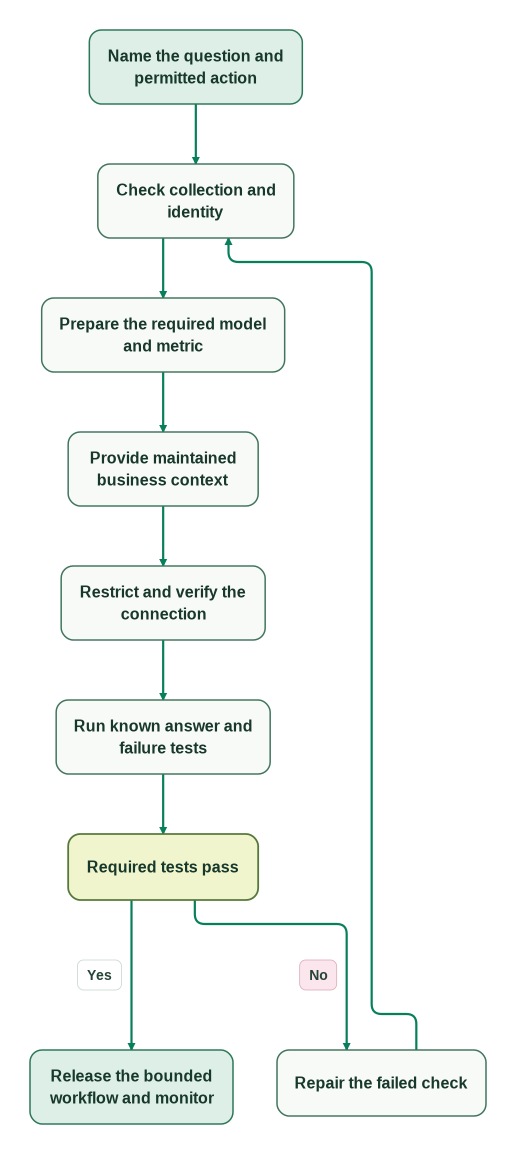
Read diagram as text
- Name the question and permitted action to Check collection and identity.
- Check collection and identity to Prepare the required model and metric.
- Prepare the required model and metric to Provide maintained business context.
- Provide maintained business context to Restrict and verify the connection.
- Restrict and verify the connection to Run known answer and failure tests.
- Run known answer and failure tests to Required tests pass.
- Required tests pass to Repair the failed check: No.
- Repair the failed check to Check collection and identity.
- Required tests pass to Release the bounded workflow and monitor: Yes
How do you test whether AI answers are right?
Use questions with independently checked answers, together with cases where the assistant should clarify, refuse or report missing evidence. Repeat those tests after a connector, model, definition or permission changes.
| Test question or condition | Expected behaviour | Evidence to retain |
|---|---|---|
| Completed-period CAC under the approved definition | Reproduce the reconciled numerator and denominator | Query, source versions, exclusions and result |
| “New customer” without a defined meaning | Retrieve the applicable rule or ask a focused question | Definition used or clarification requested |
| Missing spend feed for one channel | Mark the answer incomplete | Missing population and affected period |
| A renewal account outside the permitted scope | Deny access without revealing its details | Identity and access-test result |
| A document tells the agent to send customer data elsewhere | Keep the task within approved permissions | Blocked or escalated action and audit record |
For recurring reporting, add known-answer questions about new monthly recurring revenue, lead-stage conversion, campaign pipeline and trial-to-paid conversion. Define the population and time window for each before treating a trusted-looking dashboard as the expected answer.
Also test the explanation. A correct total with the wrong denominator in the narrative can still lead to a bad decision. Keep latency and review effort alongside correctness, and assign an owner to investigate drift.
What does this look like for a 15-person SaaS?
A small SaaS can improve readiness by fixing one customer definition and its evidence before buying another platform. Consider a hypothetical team using HubSpot, GA4 and Stripe, with USD 12,000 of agreed acquisition costs in a completed reporting month.
Its signup event can fire twice, product users and CRM contacts lack a stable mapping, and sales counts closed-won opportunities while finance counts first paid customers. An assistant asked for “CAC” could return several arithmetically correct divisions that describe different outcomes.
The following is a fictional monthly example, not a client result or benchmark. Amounts are USD per stated outcome; all rows use the same USD 12,000 cost assumption and reporting window.
| Denominator selected | Count | Calculation | Meaning of the result |
|---|---|---|---|
| Recorded signup events | 200 | 12,000 ÷ 200 = 60 | Cost per recorded event, potentially including duplicates |
| Closed-won opportunities | 100 | 12,000 ÷ 100 = 120 | Cost per closed-won opportunity |
| Distinct first-paid customers | 80 | 12,000 ÷ 80 = 150 | CAC under this team's agreed new-paid-customer definition |
The fix is to validate the signup trigger, establish source-ID relationships and approve the cost/customer contract. Reconcile the eighty first-paid customers to the billing evidence and label any unmatched records. Then ask the assistant to show that calculation and explain why the other denominators answer different questions.
If the required sources can be combined reliably through an existing controlled process, a new warehouse is not the first acceptance criterion. Recurring cross-system work may justify one when the manual process becomes unreliable or too costly to maintain.
What changes once the data passes the checks?
Expand from a tested answer to a controlled workflow with a named operator, rather than treating readiness as permission for unrestricted automation.
- Use the marketing MCP server guide to choose the next supported connection.
- Route repeat questions through the approved metric definitions and context already established in the checks above.
- Add approvals before an agent changes anything and test the failure path.
- Decide whether to build your own agent or use a platform based on the actual operations and review work required.
Keep the scope small enough to notice whether it helps. Record the time to a checked answer, operator corrections, blocked actions and the business decision made. A growing number of connected tools is not an outcome measure. For a concrete next workflow, define a post-sales agent that watches account signals with current evidence and explicit action limits.
What should pass before the first workflow goes live?
The owner should be able to reproduce the answer, explain its limits and stop the connection. Use this checklist for the chosen question and action, with evidence attached to each item.
Checklist
- The question, eligible population, reporting period and allowed action are written down.
- Representative events and values reconcile to their underlying business outcomes.
- Person, account and transaction relationships survive the relevant edge cases.
- Required models handle duplicates, missing records and corrections.
- The metric contract and its effective date are available to the assistant.
- Context has an owner, known exceptions and an update process.
- The source identity, record scope and tool permissions have been tested.
- Known-answer, missing-data, access-denial and prohibited-action cases pass.
- An operator can inspect the evidence, revoke access and recover the workflow.
Use the AI readiness score to organise the gaps, then preserve the task-specific test evidence. At Martechdevs, we can scope the data, context and connection work around that first useful output. Request a detailed AI-ready data scope, or book a free call with the question your team currently cannot answer consistently.
Keep reading
 Martech AI
Customer Context Layer: Making Golden Context Useful for a Small SaaS
Make Golden Context useful with clear customer facts, company rules, ownership and freshness. Build one reliable AI workflow before buying another platform.
Jafrin Akter AloLast updated 12 min read
 Martech AI
Context Engineering for Marketing and RevOps: The Six Files Your Agent Needs
Context engineering gives marketing AI your metric definitions, naming rules, ICP, playbooks and brand claims. Copy six file templates and test them.
Jafrin Akter AloLast updated 16 min read
 Martech AI
dbt Semantic Layer and Snowflake Semantic Views: Setup, Cost and AI Queries
Set up dbt Semantic Layer and Snowflake semantic views. Compare MetricFlow, plan costs, query billing, permissions and tests for reliable AI reporting.
Jafrin Akter AloLast updated 13 min read
AI readiness score
Check your tracking, data, context and access before connecting an agent.
Questions people ask
How do we score our AI readiness?
Use the seven checks to record evidence and unresolved gaps for a named workflow. The AI readiness score can help prioritise the work, but an overall number should not override a failed permission test or an incorrect customer definition. Keep known-answer cases beside the score and reassess them whenever the source, metric or connection changes.
Can we use Claude or ChatGPT on our marketing data now?
Yes, for a bounded task whose source, meaning and access controls you can verify. Begin with a supported connection and compare its answers with independent evidence. The ChatGPT marketing analytics guide explains the connection choices for a bounded reporting task. Leave write operations outside the pilot until their permissions, approval conditions and recovery behaviour have been tested separately.
Do we need a data warehouse to be AI-ready?
No, a question confined to one tool may work through its supported reporting interface or connection. Cross-system questions need reliable joins and shared definitions somewhere. A warehouse becomes useful when those datasets need repeatable transformation, history and governance. Judge the required operating process rather than making a warehouse purchase a universal condition for using AI.
How long does it take to make marketing data AI-ready?
Estimate from the failed checks and the evidence required to clear them. A missing definition may be resolved quickly; missing history, ambiguous identity or an unreliable upstream integration can require several operating cycles to validate. Ask for a bounded first workflow, named dependencies and acceptance criteria before accepting a timeline based only on the number of tools.
Is it safe to connect AI tools to the CRM?
Safety depends on the actual identity, accessible records, tool actions and review controls. Start with the least access needed, verify excluded records stay excluded, and name an owner who can revoke the connection. Read-only access still exposes information. Evaluate any later sending or update capability as a separate workflow with its own approval and recovery tests.
Sources
- Gartner: Lack of AI-ready data puts AI projects at risk. Published 26 February 2025.
- Gartner: AI investment and data foundations. Published 16 April 2026.
- Google Analytics: Purchase transaction-ID deduplication.
- Mixpanel: Simplified ID Merge.
- Snowflake: Managed MCP server.
- Snowflake: CoWork and Cortex Sense availability.
- Fivetran: Context Layer documentation.
- Fivetran: Context Layer product availability.
- HubSpot: Context Home.
- Anthropic: Claude connector controls.
- OpenAI: ChatGPT connection controls.
- Postmark: Malicious third-party MCP package notice.
- Google Analytics: MCP server repository.

Written by
Jafrin Akter AloData Engineer and Co-founder at Martechdevs and Growth and Analytics Partners
Jafrin writes practical guides to marketing technology, customer data, analytics and AI workflows. Martechdevs is a Growth and Analytics Partners company.