
What is Snowflake? A practical explanation for marketing and RevOps teams
Data Engineer and Co-founder, martechdevs
Last updated 9 min read
Snowflake is a cloud data platform where companies store, combine, analyse and share data. For a marketing team, it can connect campaign spend, CRM records, product activity and billing into consistent business models. It provides the infrastructure for that work, while your team remains responsible for the integrations, definitions and decisions that make the data useful.
Last updated: 28 September 2026.
Suppose Google Ads shows a successful campaign, HubSpot shows its leads and Stripe shows the customers who paid. You still cannot answer whether those customers activated, renewed or generated enough margin to justify the spend.
Snowflake can become the place where those records meet. The answer depends on how you connect them, which dates you compare and what you count as revenue.
Where Snowflake sits in a marketing stack
Think of three layers.
Your source tools run the business: advertising platforms deliver ads, the CRM tracks relationships, the product records activity and billing collects payments.
Snowflake holds analytical data and the models that connect it. A reporting tool, CRM sync or AI workflow uses those models to support a decision.
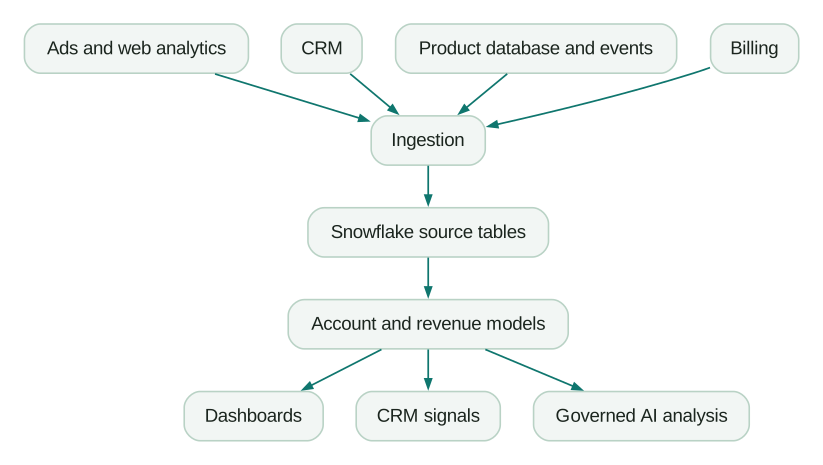
For a small team, the first valuable output may be a single account view. It tells sales which trial accounts activated, what plan they selected and whether a payment succeeded.
Martechdevs' data warehouse service covers this path from source systems to usable models and destinations. The platform is one component of the implementation.
Is Snowflake a warehouse, a database or a data lake?
It is a data platform with capabilities that span these categories. A common use is a data warehouse: storing structured information and querying it with SQL for analysis.
Snowflake also supports semi-structured and unstructured data, and it can work with Apache Iceberg tables whose files live in external cloud storage. Its architecture separates storage, compute and cloud services. Snowflake's architecture documentation.
For a marketing buyer, the useful distinction is the job you intend it to perform. Combining customer, campaign and revenue records is an analytical workload. Running the application that creates those records has different requirements.
Do not begin by migrating every operational system into Snowflake. Begin with the data required for a specific analysis or activation workflow, and keep each source's responsibility clear.
The vocabulary you need for a first conversation
Database and schema organise stored objects. A team might group source copies separately from reporting models so users can find the right version of a dataset.
Table holds records. A table could contain one row per invoice, account or event. Knowing which of those it represents is essential before joining it to another table.
View presents a queryable definition over data. It can give analysts a consistent interface without asking each person to reconstruct the same joins.
Virtual warehouse is Snowflake's term for compute used to run work such as queries. It does not mean the place where your tables are stored. You can suspend compute while retaining data.
Role controls access through granted privileges. A reporting role can have a narrower purpose than a role used to load or administer data. Snowflake documents the relationships between users, roles and privileges in its access control overview.
For your project brief, translate each term into an owner and a purpose. “Marketing reporting role” is useful only when somebody has specified which data it should expose.
What Snowflake can help marketing answer
Which acquisition channels produce valuable customers?
Join acquisition records to accounts and then to an agreed revenue measure. Compare cohorts after the same observation window so recent customers are not penalised for having less time to pay or renew.
Keep unmatched accounts visible. If a large share of revenue has no reliable acquisition link, the report should show that limitation. Redistributing unknown revenue across known channels creates precision that the data does not support.
Which accounts need a sales or success action?
Combine product signals, subscription state and CRM ownership. A useful model might identify accounts with several active users but no completed setup, or a paid account whose key workflow has stopped.
Define the action before creating the signal. A field that nobody knows how to interpret adds noise to the CRM. A field with a documented threshold, expiry and owner can support a repeatable process.
Why did pipeline or revenue change?
Historical snapshots and change records can distinguish new business from stage movement, amount corrections, expansion, contraction and churn.
These categories require explicit logic. A payment failure, a cancelled subscription and a refund are related events, but they are not interchangeable revenue measures.
Which numbers should AI be allowed to use?
Curated models can expose stable definitions to an assistant. Instead of asking a model to infer the business from hundreds of raw tables, give it a controlled view with known relationships and documented metrics.
The AI-ready data guide explains the preparation needed before natural-language access becomes dependable.
A worked example: from three systems to one decision
Consider a fictional B2B product with 400 accounts created in August. The CRM records acquisition source, the product database records activation and billing records payments.
The team defines activation as completing a specific core workflow within 14 days of account creation. Paid conversion means the account has a successful first payment within 30 days. Both measures use account grain.
Of the 400 accounts:
- 250 have a reliable acquisition source and activated within 14 days.
- 100 have a reliable source but did not activate within that window.
- 50 have no reliable acquisition source.
The warehouse should retain all 400 accounts. The 50 unmatched accounts are a measurement issue to investigate, not rows to remove from the denominator without explanation.
Now suppose paid conversion is 20% among the 250 activated accounts and 5% among the 100 non-activated accounts. That produces 50 and five paid accounts respectively.
The relationship suggests activation deserves investigation. It does not prove that forcing the activation event would cause the same increase in conversion. Customer intent, account size or use case could influence both.
The practical next step is to inspect the missing activation steps and design a test or operational intervention. Snowflake supports the analysis; the team still needs to make and evaluate the decision.
How Snowflake pricing works
There are several cost categories. Keep them separate in your estimate so a low storage figure does not hide the rest of the system.
Compute depends on workload and configuration
Virtual warehouses consume credits while running. Their size and runtime affect consumption. Snowflake bills this usage per second after a 60-second minimum on start or resume. Serverless features and other compute services are accounted for separately. Compute cost documentation.
A dashboard that refreshes repeatedly can keep compute active. A scheduled batch can use a shorter window. The best configuration depends on responsiveness requirements as well as cost.
Use your actual credit price and warehouse configuration in the estimate. Edition, cloud, region and commercial agreement can affect the price. Snowflake pricing options.
Storage includes more than the current rows
Snowflake calculates table storage using compressed data. Historical retention, Fail-safe, staged files and some clone-related storage can also contribute. Storage cost documentation.
A 100 GB CSV export does not automatically become 100 GB of billed table storage. Compression changes the size, while retained changes and other stored objects can add usage.
Specify retention according to recovery and analytical requirements. Retaining everything indefinitely creates cost and governance work without necessarily creating value.
Integrations and ownership remain separate
The Snowflake bill does not include every connector, BI subscription or hour spent repairing source changes. Add those costs when comparing it with another platform.
Here is a fictional estimate: 40 credits at an assumed $3 per credit produces $120 of warehouse compute. Add assumed monthly costs of $15 for storage and other platform usage, $180 for ingestion and $360 for maintenance. The total is $675.
This is a calculation template, not a current package price. Replace the assumptions with measured usage and the terms of your own agreement.
Put cost controls in place before broad access
Use automatic suspension, appropriate warehouse sizes and query timeouts. Limit who can create or resize compute. Configure resource monitoring for the warehouses it covers, and separately monitor services outside that coverage. Snowflake warehouse cost controls.
A budget notification and an enforced suspension are different controls. Decide which one applies to each workload and who responds when the limit is approached.
For a daily reporting pipeline, a hard stop might prevent a large bill but leave the morning report stale. The operating plan should describe both consequences, with a visible freshness indicator in the report.
What data sharing adds
Snowflake Secure Data Sharing allows a provider to expose selected database objects to another Snowflake account with read-only access. In the standard same-region sharing model, consumers query shared data without maintaining another stored copy; their compute usage still has a cost. Cross-region or cross-cloud distribution requires additional arrangements and can involve replication and related charges. Secure Data Sharing.
For marketing, this can matter when a partner or data provider already distributes useful datasets through Snowflake. It may reduce the need for repeated file transfers.
Evaluate the actual dataset, refresh cadence, permitted use and join quality. Convenient delivery does not establish that the data is accurate or appropriate for your purpose.
What Cortex and MCP add
Snowflake's AI capabilities can support structured-data analysis, retrieval and agent workflows. The managed MCP server provides a way for compatible clients to access configured tools. These capabilities depend on the objects, permissions and definitions you expose. Snowflake managed MCP documentation.
A natural-language interface does not remove the need to define “active customer” or “qualified pipeline.” It makes those definitions more consequential because more people can ask questions without inspecting the underlying SQL.
Read the Snowflake AI guide for the product distinctions and the Snowflake MCP guide for the connection model.
When a small team should evaluate Snowflake
Snowflake deserves evaluation when you need joined analytical data, have an owner for the implementation and see a concrete advantage in its ecosystem, sharing or platform capabilities.
If your immediate problem is mostly GA4 analysis and your team already works in Google Cloud, BigQuery may be a simpler first comparison. If your only unresolved issue is inconsistent CRM stages, fix the stages before buying infrastructure.
Use the warehouse readiness guide to decide whether the project is justified. Then compare the same representative workload in Snowflake and BigQuery.
Set up service access before scheduling ingestion. The Snowflake key-pair authentication guide covers credential migration, connector testing and rotation.
First-project checklist
- One business decision and its required measures are defined.
- Each source has a stable ID and a known record grain.
- Ingestion handles changes, deletions and failures.
- Source totals reconcile before reports are accepted.
- Historical capture matches the questions you need to answer.
- Access roles expose only the necessary data and operations.
- Compute, retention and service costs have owners.
- Reports show freshness and unmatched records.
- A maintenance process exists for source and metric changes.
At Martechdevs, we connect source systems to tested customer and revenue models, with documentation your team can maintain. Start with the free martech AI audit, or explore an AI assistant built around your approved workflows.
Questions people ask
Is Snowflake a CRM?
No. It can store CRM data for analysis and help calculate signals sent back to a CRM. Your customer relationship system still manages the operational records and workflows unless you deliberately build a different application around the data.
Does Snowflake automatically connect all our tools?
No. You need supported connectors, ingestion pipelines or other integration methods. Each source has its own permissions, available history and update behaviour. Include those details in the implementation scope.
Can a marketer use Snowflake without SQL?
They can consume dashboards, prepared views and natural-language interfaces built on Snowflake. Someone still needs to define and validate the underlying models. An accessible interface changes how people ask questions, not the responsibility for correct answers.
Is Time Travel a replacement for permanent reporting history?
No. Time Travel supports access to historical states within configured retention limits. Standard retention is one day; eligible Enterprise and higher permanent tables can use longer periods up to 90 days. Long-term business snapshots need a deliberate design. Time Travel documentation.
Do we need a full-time data engineer?
You need a capable owner for modelling, integration, security and failures. That responsibility can be internal or provided by a partner. The staffing decision depends on the breadth and criticality of the workloads, rather than the Snowflake account itself.
Sources
- Snowflake architecture. Accessed 28 September 2026.
- Access control overview. Accessed 28 September 2026.
- Compute costs. Accessed 28 September 2026.
- Pricing options. Accessed 28 September 2026.
- Storage costs. Accessed 28 September 2026.
- Warehouse cost controls. Accessed 28 September 2026.
- Secure Data Sharing. Accessed 28 September 2026.
- Managed MCP server. Accessed 28 September 2026.
- Time Travel. Accessed 28 September 2026.
Written by
Jafrin Akter AloData Engineer and Co-founder, martechdevs
Jafrin Akter Alo is a data engineer and co-founder of martechdevs, where the team has delivered 74+ martech, data and growth stack implementations.