
What is a composable CDP, and when should a small team pick one?
Data Engineer and Co-founder, martechdevs
Published 12 min read
A composable CDP combines customer-data functions around infrastructure your company controls, usually an existing data warehouse. Collection, identity resolution, customer models, audience building and activation can come from different services. It becomes useful when your team needs to reuse trusted customer definitions across several tools and can own the connections between those services. The buying decision is whether that control improves your workflows enough to justify the operating responsibility.
Last updated: 9 September 2026.
Suppose a SaaS customer upgrades from a trial to a paid plan. Billing knows immediately. The CRM still says trial. An onboarding sequence continues asking the customer to buy. The underlying problem is precise: the systems acting on the customer disagree about a state that matters.
A composable CDP is one way to connect that state to the right actions. A direct integration, a packaged CDP or a better use of the existing messaging tool might also solve it. Start by describing the workflow, its timing and its owner before choosing an architecture.
What the term means in practice
A customer data platform must do more than move a file. It needs a durable way to connect customer records, maintain useful profiles and make those profiles available to other systems.
The CDP Institute's current definition recognises own-store, warehouse-native and hybrid architectures. It emphasises responsibility for identity, persistent customer records and downstream usability. This is more useful for evaluating a system than assuming that a CDP must always maintain a separate vendor database.
In a composable implementation, your warehouse may hold the core customer models while other services handle collection, audience creation and delivery. Some vendors supply several of those components together. “Composable” does not require assembling a different vendor for every function.
The practical question is which parts your team can control, replace and inspect, and who owns the complete result when a customer receives the wrong message.
Identify the six responsibilities before selecting products
Collection brings in application events, database changes, billing records and CRM data. Define event meaning, permitted fields and source identifiers. A reusable tracking plan helps keep those decisions consistent.
Storage and history retain source records and modelled data under the required access and retention rules. The warehouse is the analytical foundation, but it does not automatically supply an audience interface or reliable delivery to another application.
Identity resolution connects records to the appropriate person, account or workspace. A B2B account and the people using it need distinct models. Establish what happens when an email changes, a person joins two accounts or an identity link proves incorrect.
Customer features calculate useful attributes: paid status, qualifying product activity, next renewal or an unresolved support issue. Define their grain, time window, source and freshness. RudderStack's Profiles documentation explicitly separates identity-graph generation from feature computation. Evaluate those as separate capabilities in any architecture.
Audience and decision tools let authorised users select customers, inspect why they qualify and choose an action. A SQL model may serve a data team well while leaving marketers dependent on an engineering queue. Decide who must create and change audiences in normal operation.
Activation and feedback deliver the right fields or membership changes to the destination, then collect enough outcome information to evaluate the action. A customer appearing in an export is not the same as a correctly updated CRM record or a delivered message.
Governance runs across all six responsibilities. It includes who may change a definition, which uses are allowed, how changes are reviewed and what evidence survives an incident.
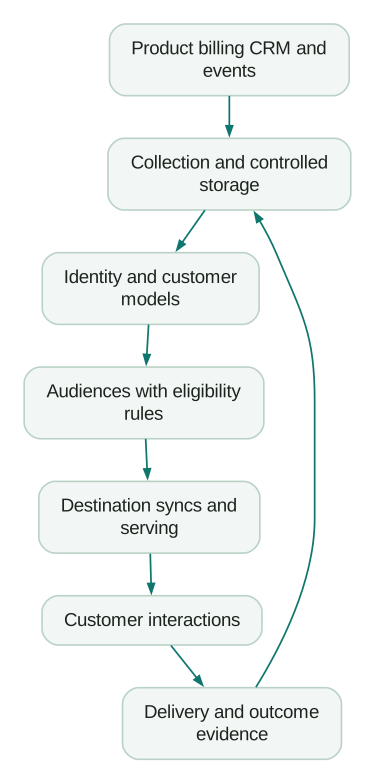
Use this map during evaluation. Ask the supplier or implementation team to name the component and owner for every box and connection. An unassigned connection becomes your problem after launch.
Compare composable, packaged and hybrid options by responsibility
An own-store packaged CDP maintains its customer store and supplies a set of integrated functions around it. That can reduce the number of interfaces your team operates. You still need to provide meaningful events, inspect identity rules and connect the required destinations.
A composable approach can reuse customer models already used by analytics and finance. It can also expose more of the implementation to your team, including query performance, model deployment and the ordering of dependent jobs. The flexibility has value when you can use and maintain it.
A hybrid implementation combines these approaches. For example, warehouse-derived account attributes might enrich profiles in another platform while event streams support faster interactions.
Twilio's Segment Reverse ETL documentation describes sending warehouse data to destinations and enriching Segment profiles. That illustrates why “packaged CDP versus warehouse” is often an incomplete comparison. A product can participate in both paths.
Ask the same questions of each option:
- Where do identity rules and audience definitions live, and can you inspect their history?
- Which customer entities and relationships can the system represent?
- Can the people running campaigns create, preview and safely change audiences?
- What happens when records are corrected, removed or become ineligible?
- How do you prove that the destination received the intended state?
- Which capabilities require another product, contract or technical owner?
A long destination list is only an initial filter. Verify the exact destination object, operation, field type and removal behaviour your workflow requires.
When a small team is ready for a composable CDP
The strongest starting point is a warehouse that already contains trustworthy customer identity and useful product or commercial models. Someone owns that data, tests changes and responds when a feed fails. The business has multiple actions that need the same definitions.
For example, a paid-account model might support acquisition suppression, customer-success prioritisation and lifecycle messaging. Reusing a reviewed model can prevent each tool from independently guessing what “paid” means.
Composable architecture becomes harder to justify when the main task is one application sending one field to another. If a supported direct integration can deliver the right identity, timing and failure handling, use it as a serious alternative.
It is also a poor first purchase when nobody can explain how product users map to billing customers, or when every proposed audience needs a new data-cleaning project. Address the single customer view and the first business workflow before buying a broad platform around unresolved definitions.
Do not use company headcount as the only readiness test. A small team with strong data ownership can operate a focused stack. A larger team with fragmented responsibility can struggle with the same design.
Work through one customer journey end to end
Take the trial-to-paid example. Define the desired behaviour: once an account is confirmed as paid, eligible members stop receiving trial-conversion prompts and receive onboarding appropriate to their plan and role.
Map the path before selecting the audience builder:
- Billing records the successful transition under a stable customer ID.
- A maintained mapping connects that billing customer to the commercial account.
- The account model records paid status, its effective time and source freshness.
- Membership data identifies which people belong to the account and their roles.
- Eligibility rules determine which communications each person may receive.
- The destination receives the updated state and removes inappropriate journey membership where supported and required.
- Delivery and product outcomes are collected for review.
A company-level upgrade should not silently overwrite a person's independent relationship with another account. Nor should syncing an account attribute automatically subscribe every member to marketing.
Test the uncomfortable cases: a failed payment, an upgrade followed by a refund, two workspaces under one payer, a person in two accounts, a stale billing feed and a customer already waiting in the next journey step.
Write down the fallback for each. For example, if paid status cannot be verified because the feed is stale, pause the affected promotional action instead of defaulting every missing record to trial.
Evaluate latency across the complete path
A sync that runs every fifteen minutes does not make the whole workflow fifteen minutes old. Data can wait before ingestion, before transformation, before delivery and inside the destination.
Consider an illustrative sequence with these assumed maximum delays during healthy operation:
- Wait for the next source ingestion: 30 minutes.
- Ingest the data: 5 minutes.
- Wait for the model job: 15 minutes.
- Build and check the model: 5 minutes.
- Wait for the destination sync: 15 minutes.
- Deliver the update: 5 minutes.
- Destination processing: 15 minutes.
The sequential budget totals 90 minutes before retries or outages. This is an illustrative upper-bound calculation under the stated assumptions, not a measured service guarantee or a sum of latency percentiles.
If the customer journey requires the change within an hour, that design misses the requirement. Consider triggering dependent jobs after successful upstream completion, increasing the necessary refresh frequency or using an event path for the urgent state change. Measure the complete path after changing it.
Keep the warehouse useful for historical context even when an urgent action needs another route. A payment confirmation or an interaction during a live session should not inherit an overnight reporting schedule simply because the reporting model already exists.
Treat warehouse-native storage claims precisely
Keeping core customer models in your warehouse can reduce duplicated modelling and give you direct control over those records. It does not mean that no data ever leaves the warehouse.
Destinations must receive data to act. A service may also use caches, logs or change-tracking state. Hightouch's security documentation distinguishes its avoidance of a separate long-lived copy of primary customer tables from configurable storage for logs, change tracking and certain workloads. Review the actual configuration and product features involved.
For each component, document what it reads, writes and retains. Check whether temporary storage is in your account or the vendor's, which region processes it and how access is scoped.
Make deletion and suppression part of the operational design. Removing a warehouse row does not prove that the corresponding destination record, cached feature or previous export disappeared. Trace the required change through the systems that received the data and record the outcome.
Retain the minimum evidence needed to operate and investigate the workflow under your organisation's policy. Do not turn debugging into a reason to copy every customer field into unrestricted logs.
Compare total cost for the same accepted workflows
A licence comparison is useful only when both proposals deliver the same functions, history, destinations and service requirements.
Include implementation, incremental warehouse usage, platform charges, destination charges, maintenance and migration. Separate costs you already incur from costs the proposed change adds. An existing warehouse is not free, but charging its entire unrelated analytics bill to the CDP comparison also distorts the decision.
Here is a fictional first-year budget to show the method. These figures are assumptions, not vendor prices or market benchmarks. Both options are assumed to satisfy the same two approved workflows and destination requirements.
For a composable option:
- Platform and component licences: $18,000 per year.
- Incremental warehouse, storage and related infrastructure: $6,000 per year.
- Implementation: 120 hours at $80 per hour, or $9,600.
- Maintenance: 12 hours per month at $80 per hour, or $11,520 per year.
The first-year total is $45,120.
For a packaged option:
- Platform licence: $30,000 per year.
- Incremental integration infrastructure: $2,400 per year.
- Implementation: 80 hours at $80 per hour, or $6,400.
- Maintenance: 6 hours per month at $80 per hour, or $5,760 per year.
The first-year total is $44,560. The $560 difference is too small to justify a confident choice from the headline licence alone. A few extra maintenance hours or an omitted destination feature could reverse it.
Replace the assumptions with your quotes and measured pilot effort. Ask how the bill changes with more active records, event volume, destinations, audience refreshes and backfills. Also ask what remains available if a contract ends.
Fivetran's Activations FAQ now describes Census reverse ETL capabilities inside Fivetran and usage tracked through Monthly Active Rows. This is one reason to verify current commercial terms instead of relying on an old comparison of standalone products.
Prove replacement and recovery before expanding
Composable architecture is supposed to preserve choices. Test whether it actually does.
Export an audience definition, its model dependencies, identity mappings and destination field mappings. Have someone other than the original builder explain how to reproduce the output. Identify vendor-specific features that would need reimplementation.
Then run a recovery exercise. Introduce a controlled bad record in a test environment, confirm that validation catches it and restore the previous approved model. Check what happened at the destination. Rolling back a query does not unsend a message or automatically restore an overwritten field.
For a migration, begin with a limited audience and compare the old and new outputs without letting both trigger the same action. Explain every membership difference before switching ownership. Keep a plan for pending journey participants and previous suppression records.
Evaluate business value separately from infrastructure correctness. A functioning audience sync proves delivery. To claim that a new journey increases activation or retention, use an appropriate comparison and measure the intended customer outcome. The customer journey guide helps choose that outcome.
Use a concrete decision checklist
- The first workflows have a customer outcome, an owner and a timing requirement.
- Identity mappings work for the real person, account and workspace relationships.
- Every required component and connection has a maintenance owner.
- Business users can preview and operate the audiences they need.
- Updates, removals, nulls and corrections have defined destination behaviour.
- End-to-end freshness has been measured, including destination processing.
- Data access, temporary storage and retention are understood.
- The cost comparison includes labour and the same accepted scope.
- A failed job and a model rollback have been rehearsed.
- Definitions and mappings can be exported for recovery or migration.
Choose a composable CDP when these checks show that reusing your customer models and controlling the architecture will improve named workflows. If the missing piece is the warehouse-to-application connection, the reverse ETL guide goes deeper into that contract. For help choosing and implementing a manageable architecture, our data warehouse and CDP service starts from the workflows and ownership your team can sustain.
Questions people ask
Is a composable CDP just a warehouse and reverse ETL?
Those can be important components, but they do not automatically provide customer identity, reliable profiles, audience management or governance. A useful implementation assigns all those responsibilities and verifies the downstream action. Reverse ETL moves modelled data; it cannot decide whether the model represents the right customer.
Is a composable CDP cheaper than a packaged CDP?
It depends on the existing infrastructure, required features, usage and maintenance effort. Reusing good models can reduce work, while building missing capabilities can add substantial labour. Compare total cost for the same workflows and test the assumptions during a pilot. Lower licence cost alone is insufficient evidence.
Can a small team run a composable CDP?
Yes, if the scope is focused and someone owns identity, models, delivery and incidents. Team size matters less than operational readiness. A team with one simple integration need may get better value from that integration before introducing a broader customer-data platform.
Does composable mean all data stays in our warehouse?
No. The warehouse can remain the primary customer-data store while destinations, caches, logs and sync state still contain data. Inspect the actual architecture, configured storage, access and retention for each feature. A warehouse-native label does not establish every processing boundary.
Which vendors should we evaluate?
Start with the capabilities missing from your workflow. Hightouch and Fivetran Activations are relevant to warehouse activation; RudderStack documents warehouse identity and feature modelling; Segment supports event collection and warehouse-driven activation paths. These are examples, not a ranking. Test exact destination operations, identity behaviour, latency and costs against your requirements.
Sources
Written by
Jafrin Akter AloData Engineer and Co-founder, martechdevs
Jafrin Akter Alo is a data engineer and co-founder of martechdevs, where the team has delivered 74+ martech, data and growth stack implementations.