
Fivetran Pricing: Estimate Your Bill and Cut the Right Costs
Data Engineer and Co-founder, martechdevs
Published 12 min read
Your Fivetran bill depends on which records change, how many connections move them, whether you retain history and which contract applies. Employee count tells you very little. A small company with constantly changing CRM properties can move more billable data than a larger company with a quiet database.
Last updated: 4 September 2026.
The useful starting point is a connection-level forecast. Separate ingestion, transformations, activations and warehouse costs. Then investigate the largest contributors before changing the pipeline. Cutting the wrong history table can save money while removing the evidence behind your funnel report.
This guide uses current primary documentation and public calculator outputs. The workloads are illustrative, not customer invoices or promises about what your account will cost.
What you are paying for
Fivetran's Free plan currently allows up to 500,000 connection MAR, 3,500 activation MAR and 5,000 model runs per month. Standard, Enterprise and Business Critical are paid plans with different features and rates. Some sources and deployment options require the higher editions. Plans and billing
The Free allowance is not a deduction from a paid plan's usage. After moving to a paid plan, you pay for its actual billable consumption. Annual contracts have a $12,000 minimum commitment; that is not the minimum annual cost of monthly PAYG. Fivetran billing FAQ
Price four separate lines:
- Connections bringing source data into your destination.
- Fivetran-hosted transformations, if you use them.
- Activations sending warehouse data into business tools, if you use them.
- Destination compute, storage and the people operating the system.
A free ingestion allowance does not pay your warehouse invoice. Likewise, moving dbt scheduling elsewhere changes the orchestration bill and its ownership; it does not make SQL execution consume no resources. Use the BigQuery pricing guide or Snowflake pricing guide for that part of the estimate.
Understand MAR before multiplying anything
Monthly active rows, or MAR, are measured using distinct record keys within the relevant connection, table and destination scope. For ordinary current-state data, repeated changes to the same record during a calendar month generally count once. Separate copies and history versions need separate treatment. Fivetran's MAR definition
Consider an original, simplified example. You have 10,000 existing deals. During October, 1,000 distinct deals change; each changes five times. Ignoring history and other tables, that is 1,000 active deal keys, not 5,000 and not the full 10,000-row inventory.
Now suppose those changes also produce five retained versions for each affected deal. You have introduced 5,000 history rows into the example. The current-state table and the history output are different things to account for. Do not price a real connector from this sketch until you inspect its actual schema and paid-usage classification.
A second useful distinction is the clock. If a record changes in October and again in November, it can be active in both months. Summing daily distinct-record counts is also unsafe: the same record can appear on many days but count once in that month's ordinary current-state scope.
That is why database row counts, CRM contact counts and monthly API calls are poor substitutes for observed billable usage.
The changes that explain many surprising bills
The March 2025 update moved volume tiering from the whole account to each connection. Under its updated re-sync rules, unchanged records are recognised as free. A historical account-level calculator can therefore give the wrong answer for a current contract. 2025 pricing changes
The January 2026 changes introduced a Standard $5 base charge for connections generating 1 to 1 million paid MAR, excluding Free accounts and zero-paid-MAR connections. They also changed treatment of deletes and repeated history-mode updates for affected contracts. PAYG changed January 1; annual agreements apply changes according to renewal and existing pricing terms. 2026 pricing changes
Do not add another $5 to a current calculator result. Use the complete estimate for the selected edition and connection. Also avoid assuming every existing customer changed on the same day.
When investigating an increase, first compare the agreement, plan and renewal date. A bill can rise without an equivalent increase in source records. Conversely, a renewal may coincide with a real CRM cleanup or new history stream. You need both explanations, not the most convenient one.
Read the public estimates correctly
With one HubSpot connection, Standard and monthly card payment, the public estimator displayed $5.00 at 1 MAR, $54.49 at 100,000, $252.49 at 500,000, $500.00 at 1 million and $1,474.00 at 12 million when checked for this guide. These are the displayed estimates, including their rounding. They are not an inferred linear rate card. Fivetran pricing estimator
The following scenarios use those observations and exclude tax, discounts and services outside ingestion.
A small eligible Free account
A hypothetical account uses 400,000 connection MAR, 2,000 model runs and no activation usage. If its required features and sources fit Free, its Fivetran charge can be $0 within those allowances.
The action here is to monitor headroom. It is not to delete useful data merely to stay under a threshold. Forecast the next source you intend to add and the next bulk update before assuming the present month will repeat.
Six separate CRM connections
Suppose a group operates six HubSpot portals, each generating 100,000 MAR in a paid Standard account. Applying the displayed individual estimate gives:
6 × $54.49 = $326.94 per month
That is 600,000 MAR across six connections. You cannot treat it as one connection's 600,000-MAR price, or subtract 500,000 Free MAR from a paid account.
Connection consolidation is not automatically possible or desirable. Different portals can represent distinct businesses, access boundaries and credentials. Start by removing accidental duplicate replication, not by erasing a necessary boundary.
A history-heavy CRM connection
A connection with 12 million total billable MAR uses the observed $1,474 estimate. That is $17,688 for twelve identical months before discounts and other costs. The estimate assumes the 12 million already includes all relevant billable tables; it is not a shortcut from 12 million customer interactions to 12 million MAR.
For a smaller one-million-MAR connection, the observed $500 monthly estimate annualises to $6,000. An annual contract with a $12,000 minimum is not an automatic saving at that stable workload. Expected growth or other eligible consumption could change the decision, but a discount percentage alone cannot justify unused commitment.
Build a forecast around changes you actually expect
Take the most recent complete month as a baseline. Build a separate forecast for each connection using its own billable usage and rate curve.
Then annotate known changes: a new business unit, another destination, a historical import, a property-history expansion or a planned mass correction. Put dates against them. A source starting halfway through a month does not necessarily generate exactly half a month's normal MAR.
A practical forecast has three scenarios:
- Expected: current useful tables plus changes already planned.
- Busy month: realistic campaign activity, CRM imports or source corrections.
- Architecture change: the connections and history required by an approved new use case.
Price each scenario through the current estimator or your contracted schedule. Do not multiply today's cost by the percentage growth in rows: volume curves, base charges and connection distribution make that shortcut unreliable.
Trial figures need interpretation too. Fivetran's account trial lasts 14 days, starting according to its initial/incremental sync rules. Its usage estimate becomes available after seven continuous days and projects incremental behaviour. Initial historical loading is treated differently from later changes. Account trial and estimates
A quiet seven-day sample cannot reveal a bulk update that your team runs on the last business day. Add that known workload explicitly. Keep trial credits and free historical activity out of your recurring paid forecast.
Diagnose the largest connection at table level
Fivetran provides account and connection usage views, including table-level MAR. Usage follows UTC and dashboard data updates daily. The Platform Connector can export usage for analysis; its own MAR is free, while destination resources can still cost money. Monitoring usage
Start with a record like this original example. The table names are illustrative labels, not a promised vendor export schema:
connection,table_group,paid_mar,required_output,owner,proposed_action
crm_main,current_contacts,150000,audience_eligibility,growth,retain
crm_main,current_deals,50000,qualified_pipeline,revops,retain
crm_main,property_history,800000,stage_duration_and_other_history,analytics,inspect_required_properties
The three groups total one million MAR. Property history contributes 80% of that volume. This identifies where to investigate; it does not prove that removing it will save exactly 80% of the bill. Reprice the resulting connection volume to estimate actual savings.
For the largest group, answer four questions: Which business output consumes it? Which fields and time periods are required? What source operation made it active? What would fail if collection stopped?
Do not rely solely on dashboard queries to identify consumers. Reverse ETL audiences, scheduled exports and occasional finance reconciliations may depend on data that is rarely opened in a BI tool.
Reduce costs without destroying the useful output
1. Stop unused tables before they accumulate more activity
Check connector-supported table blocking and the dependencies of downstream models. A retired experiment's raw event table may have no remaining consumer. A relationship table with few visible columns may be essential to joining contacts and deals.
Obtain the owner's decision, record the last complete timestamp and check dependent outputs after the change. Retaining an old destination table does not mean it remains current.
2. Inspect frequently changing columns
Under current pricing rules, changes only to blocked non-primary-key columns do not contribute MAR. Primary-key columns cannot be blocked. Support and behaviour still depend on the connector and applicable pricing rules. Data-blocking rules
A repeatedly rewritten housekeeping field is worth investigating if nothing uses it. Before blocking a timestamp, establish whether it is also the evidence you rely on for freshness or change detection. Removing the only useful operational signal is an expensive way to save a small amount.
3. Preserve the history your decisions require
Fivetran identifies HubSpot property-history tables as potential major MAR contributors. Its connector-specific guidance recommends reviewing selected tables before the initial sync. HubSpot MAR management
For that connector, current and historical outputs have specific dependencies, and switching sync modes is not supported. Deal-stage history lives in DEAL_STAGE. A blanket instruction to switch every HubSpot table to another mode is wrong. HubSpot connector behaviour
Write the historical question first. “How long do qualified deals take to reach a demo?” needs stage changes. “What is the current account owner?” may only need current values. Keep evidence for the first question while investigating unused history for the second. Where supported controls cannot provide the required granularity, compare another extraction design before cutting the data.
4. Remove redundant copies, with an explicit access design
If production and a sandbox independently replicate the same source, investigate whether the sandbox can use a governed subset of existing warehouse data. Include its refresh requirement and access restrictions. A developer environment should not inherit unrestricted customer data merely because that looks cheaper.
Price the alternative warehouse work and migration effort. Two connections serving separate operational requirements are not necessarily waste.
5. Fix unnecessary model runs
Fivetran-hosted transformation billing counts successful model executions, including intermediate models and successful work inside a partially failed job. The first 5,000 monthly runs are free; the next band costs $0.01 per run. This allowance applies across pricing plans. Transformations pricing
Illustratively, 14 models successfully executed hourly for 30 days produce 10,080 runs. With no other transformation usage or trial allowance, the charge is (10,080 − 5,000) × $0.01 = $50.80.
Executing those models once daily produces 420 runs. If the report genuinely needs only daily data, a schedule change could remove that transformation charge and reduce warehouse work. It does not automatically change ingestion MAR. Check the report's deadline and upstream completeness before reducing frequency.
6. Retire low-value connections deliberately
Pause a connection only after identifying its consumers. Resuming later can collect accumulated source changes and produce a usage increase; pauses are not a reliable way to erase future charges. Ordinary unique-key MAR also does not fall simply because you schedule fewer syncs. Usage optimisation guidance
Use the business freshness requirement to set cadence. Price history separately. If a route has no owner or accepted use, retirement may be appropriate, but leave a record of what stopped and how it could be restored.
Re-syncs, activations and other easy accounting mistakes
Updated pricing recognises specified unchanged re-sync activity as free. Initial historical loading is also distinct from tracked incremental changes outside the trial. Source changes, destination deletion and connector-specific behaviour can affect classification. A “full sync” label alone is not enough to declare a charge. Sync billing rules
Treat recovery work as a data-integrity task first. Estimate its incremental charge and warehouse load, but do not leave a known reporting defect unresolved because an old pricing article says every re-sync is expensive.
Activations, previously Census, joined Fivetran's usage-based platform in February 2026 and use a separate consumption curve per activation. They are not automatically included in a connection estimate. Activations pricing change
A warehouse-to-CRM audience can therefore add a separate bill even when its input arrived through an already-paid ingestion connection. Map both directions before presenting the stack's total cost.
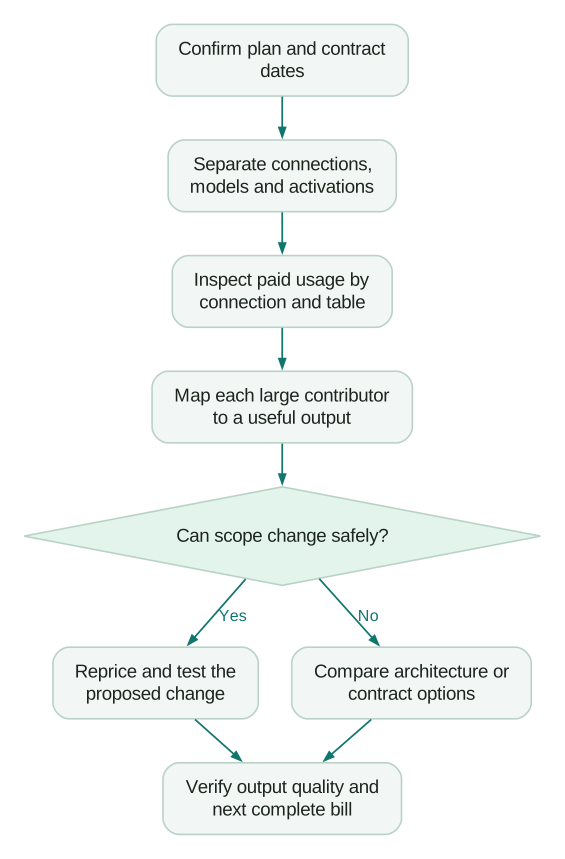
The monthly review worth keeping
- Reconcile usage and invoices against the current contract.
- Explain the largest connection and table changes.
- Separate new records, historical versions and extra copies.
- Reforecast upcoming imports, campaigns and source changes.
- Review transformation cadence against actual reporting deadlines.
- Confirm owners still need each costly output.
- Validate any saving against complete, correct downstream results.
Measure improvement over a complete comparable billing period. A midmonth removal may not undo records already counted, and a quieter campaign month can make an ineffective change look successful.
If the useful workload remains expensive after this review, compare alternatives with the same outputs and maintenance requirements. The Fivetran versus Airbyte comparison explains why a lower per-row price does not settle that decision.
Our data warehouse and CDP service can help trace the largest costs to their business outputs, model the alternatives and validate the reporting impact before you change the pipeline.
Questions people ask
Is Fivetran free for the first 500,000 rows?
That allowance belongs to the Free plan, subject to its other limits and feature eligibility. Paid plans do not deduct 500,000 MAR from their consumption. A source table containing 500,000 rows is also not automatically the same thing as 500,000 monthly active rows.
Does every Fivetran connection cost at least $5?
The current Standard base-charge rule applies to connections with 1 to 1 million paid MAR. Free accounts and connections with no paid MAR are excluded. Check your edition and contract, and do not add the base charge again to an estimate that already includes it.
Will reducing sync frequency lower my bill?
It does not automatically reduce ordinary current-state MAR. The same distinct records may still change during the month. A schedule adjustment can reduce transformation executions and warehouse activity, while history behaviour needs separate analysis. Choose a cadence that preserves the required business freshness.
Why did my bill rise after a CRM cleanup?
A bulk correction can activate many existing records and generate new history versions. Reconcile the affected tables, billing month and contract rules. Total contact count might remain unchanged while billable activity increases substantially.
Is an annual contract always cheaper?
No. A discounted rate can coexist with unused commitment. Compare the annual minimum and terms with a realistic month-by-month forecast, including growth and other eligible products. Monthly PAYG can cost less for a small or uncertain workload despite its higher unit rates.
Sources
- Fivetran plans and billing
- Fivetran billing FAQ
- Fivetran usage-based pricing and MAR
- Fivetran 2025 pricing changes
- Fivetran 2026 pricing changes
- Fivetran public pricing estimator
- Fivetran account trial and estimates
- Fivetran monitoring and optimisation
- Fivetran HubSpot MAR management
- Fivetran HubSpot connector
- Fivetran transformations pricing
Written by
Jafrin Akter AloData Engineer and Co-founder, martechdevs
Jafrin Akter Alo is a data engineer and co-founder of martechdevs, where the team has delivered 74+ martech, data and growth stack implementations.