What is data activation? Routes, owners and proof it worked
Data Engineer and Co-founder at Martechdevs and Growth and Analytics Partners
Last updated 14 min read
Data activation makes a customer fact usable where someone can act on it: an account flag in your CRM, an audience in an ad platform or an event in a messaging tool. The hard part is deciding who should act, how fresh the fact must be, and what happens when that customer no longer qualifies.
Product capabilities and free allowances were checked on this date. The examples and scoring method below are planning examples, not client results.
What does data activation mean in practice?
Data activation connects a trusted fact to an operational decision. A dashboard can show that an account needs help. Activation puts the reason in the support or sales workflow, assigns someone to respond and records what happened afterwards.
The starting point can be a CRM, product database, CDP or warehouse. The thing you activate can be a field, score, audience membership, conversion signal or event. Copying every available customer field into every tool adds exposure and maintenance without making the next action clearer.
Vendor definitions reflect their products. Hightouch describes activation around warehouse data reaching business tools; Salesforce describes publishing segments to operational platforms. Both cover useful routes. Neither requires you to buy that vendor's platform before sending a reliable fact to the person who needs it.
This is also different from SaaS user activation, which asks whether a customer has reached a meaningful product outcome. You might activate product-usage data to help that customer, but those are separate measurements.
Follow one account all the way through
Suppose a fictional SaaS company wants sales to help trial accounts that have imported data and invited colleagues but have not completed their first shared report.
Product events provide the usage evidence. Billing identifies the trial. CRM data supplies the company record and account owner. A customer model produces one row containing the account ID, eligibility flag, reason and computation time. The integration writes those fields to the matching HubSpot company. An agreed workflow creates one task for its owner. The owner records whether the account needed help, declined or completed the report.
Our data warehouse and CDP implementation service covers the models and destination connections behind that workflow. Before choosing a connector, settle the account model: product data in HubSpot explains the CRM side, and a single customer view explains how the source records fit together.
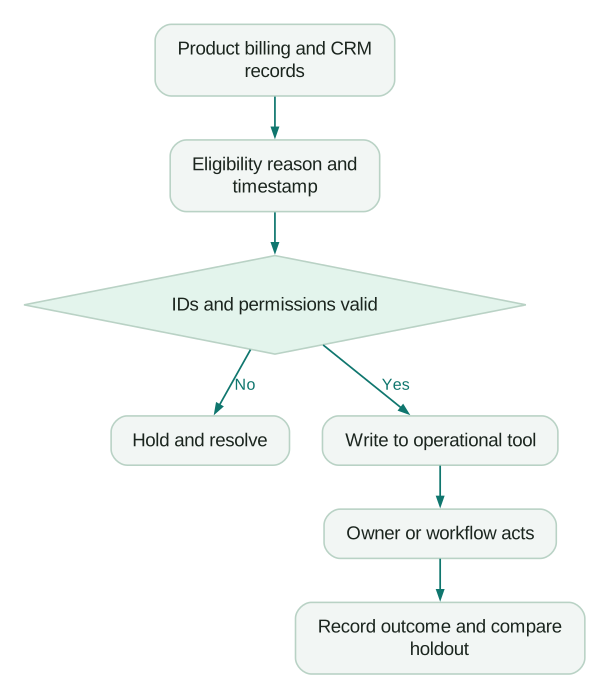
A working sync proves only that data moved. The final two steps make this an operational programme worth measuring.
Which of the six activation routes fits your use case?
Choose the route by the decision at the destination. A list of customers, a purchase event and a CRM property are different contracts even when they originate in the same table.
The timing below describes a business requirement to set, not a universal vendor delivery guarantee. End-to-end freshness includes source collection, loading, transformation, syncing and destination processing.
| Route | What arrives and how it matches | Timing to decide | Common failure |
|---|---|---|---|
| CRM fields and scores | Account or contact property matched by a stable destination ID | Before the owner's next work queue | The wrong company receives a correct score |
| Advertising audiences | Eligible membership using the platform's supported identifiers | Before the next campaign decision, including removals | Former customers remain in an acquisition audience |
| Advertising conversion signals | A defined outcome with event time, deduplication ID and supported matching data | Within the platform's accepted upload window | Retried events inflate counts or map to the wrong conversion action |
| Messaging traits and events | A customer attribute or occurrence tied to the messaging profile | Before the message can still help | A historical event starts a current journey |
| Tools reading the warehouse | A governed dataset or query result | Fresh enough for the consuming workflow | A fresh query reads a stale model |
| Alerts, tasks and AI tools | A reasoned finding, owner, deadline and evidence | While the recipient can take useful action | The alert is delivered but nobody owns it |
CRM fields need a reason and a withdrawal rule
Send needs_onboarding_help, help_reason and computed_at together. A naked score forces the recipient to reverse-engineer why it changed. Write an explicit false or clear state when the account becomes ineligible; do not assume that disappearing from the source query clears a destination field.
Support workflows need the same discipline. Failed-payment context can help an agent choose an appropriate response, but it should include the current payment state and a refresh time. The support customer context guide covers which facts belong in that view.
Audiences and conversion signals solve different problems
An audience controls eligibility for targeting or exclusion. A conversion signal reports an outcome. Sending a paying customer to a suppression audience does not also tell the ad platform which purchase to attribute.
Google's current Customer Match API guide lists contact information, IP address data, mobile IDs and user IDs, with upload diagnostics and audience-clearing operations. Supported identifiers are route-specific; check the intended account's eligibility and consent requirements before choosing one.
For offline outcomes, Google's Data Manager event guide defines supported identifiers including click identifiers, user data and specified IP-address fields. It also requires formatting and hashing for applicable personal identifiers. An internal customer ID by itself is not a substitute for the route's matching requirements. Follow the offline conversion import guide for the complete mapping and deduplication process.
Use warehouse audiences for audience membership mechanics and the Meta Conversions API setup guide for that destination's event contract. Avoid one generic payload intended to serve every ad platform.
Native warehouse connections can remove an extra vendor
Check the destination you already pay for before buying a separate activation layer. As checked on 17 October 2026:
| Destination route | Documented capability | Important boundary |
|---|---|---|
| Braze Cloud Data Ingestion | Attributes, custom and purchase events, deletion requests and catalog data from supported storage | Scheduled warehouse syncs default to a 15-minute minimum in the dashboard; support can enable five minutes. File ingestion follows a different, event-driven route |
| Customer.io reverse ETL | Queries a connected source and sends mapped data on a schedule | Can run every minute, but an overlapping run is skipped; source freshness still limits usefulness |
| HubSpot Data Studio warehouse connectors | Brings warehouse data into datasets for CRM use | Warehouse connectors require Data Hub Enterprise. Preparing data with joins or calculated fields can consume credits even when direct single-source CRM syncing does not |
Braze currently lists Redshift, Databricks, BigQuery, Microsoft Fabric and Snowflake as warehouse sources. Its documentation also distinguishes Connected Sources, which query source data for segments, from ingestion that copies updates. Confirm the feature and commercial entitlement in your workspace rather than treating every warehouse connection as the same product.
For an internal alert or agent, the destination also needs a clear authority boundary; agentic marketing operations explains those controls.
The practical verdict: use a native route when it supports the exact objects, removals, diagnostics and permissions you need. Add a separate platform when multiple destinations or unsupported objects create enough repeated work to justify it.
How do activation, reverse ETL, a CDP and an integration differ?
Activation is the business use; reverse ETL, CDPs and native integrations are ways to implement it. Keeping those categories separate prevents a simple CRM workflow from becoming an unnecessary platform purchase.
| Term | What it owns | When it earns a place |
|---|---|---|
| Data activation | Getting usable facts into an operational decision and measuring the result | You can name the action and its owner |
| Reverse ETL | Moving modelled source data into operational destinations | Several tools need the same warehouse-defined facts |
| CDP | Maintaining customer identity, record structure and access to that context | You need persistent customer context governed across systems |
| Native integration | A supported connection between a particular source and destination | Its objects and lifecycle behaviour cover the job |
| Activation platform | A commercial bundle of modelling, audience, sync or orchestration features | The bundle removes specific work your team otherwise owns |
The CDP Institute's 2026 definition focuses on a persistent unified customer record and responsibility for identity and structure. It allows services to be native or composed from warehouse and other components. It does not support the blanket claim that every CDP must duplicate the entire warehouse.
Compare CDPs and warehouses when deciding where customer context belongs. Use reverse ETL for sync design, composable CDPs for the architecture, and Hightouch versus Census when those products are actual candidates. Their feature lists should follow your action contract, not replace it.
When is it too early to activate customer data?
It is too early when you cannot identify the destination record, defend the eligibility rule or stop the action safely. Faster syncing makes those gaps spread faster.
| Stop sign | What can go wrong | Minimum repair before launch |
|---|---|---|
| Account or person IDs do not map reliably | A message or task reaches the wrong customer | Resolve ambiguous matches and keep unmatched rows visible |
| Teams disagree on paid, active or at risk | The same customer qualifies and disqualifies across tools | Agree the definition, exclusions and owner |
| Nobody owns the downstream action | Correct data accumulates without a response | Name the operator and response deadline |
| Channel permission is missing or stale | A valid customer fact triggers an invalid use | Check purpose and channel eligibility before delivery and action |
| There is no remove or reverse path | Expired eligibility becomes permanent | Test explicit clears, removals and replay behaviour |
Use identity resolution for startups, metric contracts and a customer preference centre to resolve those foundations. Permission is not a universal boolean: the customer may permit service notifications while declining marketing messages.
A warehouse is not the prerequisite for every case. If billing and your CRM already share stable account IDs, a narrow integration may be sufficient. The warehouse decision guide helps decide when cross-source modelling warrants one. The marketing data quality guide covers the monitoring that should stop stale or invalid inputs reaching activation.
How should you choose the first activation use case?
Choose a useful, reversible action whose data is already trustworthy. A modest workflow with observable follow-through teaches more than a sophisticated score nobody can explain.
Use this original planning score: value, data readiness and reversibility each receive one to three points. Three means the action matters, the input is dependable or the change is easy to undo. Score with the people doing the work; the total is a prioritisation aid, not predicted ROI.
Hypothetical scores, assessed on a one-to-three scale per criterion; higher is more favourable.
| Candidate | Value | Readiness | Reversibility | Total |
|---|---|---|---|---|
| Suppress confirmed paying customers from acquisition ads | 3 | 3 | 3 | 9 |
| Show a reasoned onboarding-help flag in CRM | 3 | 2 | 3 | 8 |
| Show current failed-payment context to support | 2 | 3 | 3 | 8 |
| Automatically send personalised retention discounts | 3 | 1 | 1 | 5 |
The highest score still needs a usable measurement plan. If you cannot observe ad suppression accurately enough to evaluate the pilot, the CRM flag may be the better first learning exercise. An irreversible customer message or discount deserves stronger evidence than an internal field that an owner can review before acting.
Write a one-sentence contract: “For eligible trial accounts with no completed shared report, create one onboarding-help task for the CRM owner within two business days; stop further tasks when the account completes the report, exits the trial or declines assistance.”
That sentence supplies the entity, trigger, operator, deadline and exit. Only then choose the route.
How do you build a first activation without losing control of it?
Build one action contract through five checks: model, identity, permission, delivery and readback. Keep the first test small enough to inspect every record.
1. Make the source row explain itself
Include a stable entity ID, destination ID where available, eligibility value, reason, source timestamp and computation timestamp. Document the distinction between “not eligible” and “unknown because source data is late.” Unknown should not silently become a false fact or a fresh-looking old value.
For an account workflow, aggregate to one account row deliberately. A person belonging to two workspaces must not create duplicate company tasks. Document the join and the entity boundary before adding a score.
2. Set the authority for every destination field
Use a CRM property-ownership contract to choose the system that owns the activated property. If a salesperson can legitimately override the result, use a separate override field with an expiry rather than racing two writers. For shared responsibilities, a martech RACI makes the definition owner, integration owner and operator explicit.
Do not overwrite a meaningful destination value with an absent source value unless clearing is the intended operation. Decide how deletions, withdrawn permissions and merged records propagate.
3. Test adds, updates, removals and retries
Create a ten-record test set that includes a new match, existing match, unmatched ID, changed reason, withdrawn permission, expired eligibility, deleted record, null input, stale timestamp and duplicate delivery. Use controlled test records or an agreed internal cohort.
Read the values back from the destination. A successful API response may mean accepted for processing, not applied to the intended object. Check task creation separately from the property update, including what happens when the same row is sent twice.
4. Set freshness from the action deadline
A queue reviewed each morning may not need minute-level polling. A time-sensitive notification may require an event path rather than a daily model. Use the freshness SLA guide to define the maximum usable age and escalation owner.
Pause on stale input rather than repeatedly publishing it with a new sync timestamp. Report source age and delivery age separately. Lower sync latency cannot repair a source that has not loaded.
5. Reserve the comparison group before delivery
For a discretionary assistance pilot, randomly assign eligible accounts to treatment and holdout before syncing. Keep every user in an account in the same group. Record assignment once so reruns do not shuffle accounts between groups.
Do not withhold required service or consent controls to manufacture an experiment. Where randomisation is unsuitable, report operational reliability and use an appropriate evaluation design; do not turn a before-and-after chart into a causal claim.
How do you prove an activation worked?
Measure delivery, action and customer outcomes separately. Each answers a different question, and each needs its own denominator.
Consider this fictional onboarding-assistance pilot. There are 330 eligible accounts: 300 are randomly assigned to the workflow and 30 to a holdout. Counts describe accounts, not users or API requests.
| Stage in treatment group | Accounts | Share of previous stage | What the gap means |
|---|---|---|---|
| Assigned to treatment | 300 | Not applicable | Starting population for outcome comparison |
| Matched to destination records | 270 | 90.0% | Thirty accounts need identity or CRM repair |
| Destination writes accepted | 265 | 98.1% | Five matched accounts have delivery failures |
| Readback confirms correct current values | 262 | 98.9% | Three accepted writes did not produce the expected state |
| Owner acts within two business days | 180 | 68.7% | Eighty-two verified records received no timely action |
The technical work is not finished at 265 accepted writes. The operational bottleneck is also visible: only 180 of the 262 verified accounts received timely action. Buying a faster connector would not solve that response gap.
Now suppose 75 of all 300 treatment-assigned accounts complete the product milestone, versus six of 30 holdout accounts, over the same predefined window. That is 25% versus 20%, an observed five-percentage-point difference.
Compare all assigned accounts, including delivery failures and non-responses. Comparing only the 180 acted-on accounts selects a different population and can overstate the intervention's effect. Keep the original assignments even when a workflow fails.
This small example does not establish reliable lift. One additional completion changes the holdout rate by 3.3 percentage points, versus 0.33 points in treatment. Choose an adequate sample and duration before launch, consider contamination between accounts, and report uncertainty before making a budget decision.
Advertising may expose audience-match diagnostics rather than row-level readback. State that visibility limit. Event Match Quality, audience size and successful uploads help diagnose delivery; none is a customer outcome on its own.
What should the launch checklist include?
The launch checklist should test the full lifecycle, including losing eligibility and recovering from failure.
Checklist
- The action, operator, deadline and exit condition are written down.
- Each row has an eligibility reason and genuine source and computation times.
- IDs map to the right entity; ambiguous and unmatched records remain visible.
- Permission is checked for the intended purpose and channel.
- Add, update, remove, null and retry behaviour passed a ten-record readback test.
- One owner controls each destination field, with explicit override rules.
- Stale or invalid inputs pause delivery and notify a named owner.
- The operator can see the reason and record the action taken.
- Stage counts and a suitable outcome comparison are defined before launch.
- The rollback stops new actions and deals with already delivered state.
For a first project, bring one destination, one action and a sample source row to a free martech AI audit. If the route is already clear, request a scoped warehouse and activation quote covering modelling, integration, monitoring and the removal path.
Questions people ask
Can a marketing team start activation before hiring a data engineer?
Yes, when the use case fits an existing integration and someone can verify its identity, permission and removal rules. Start with a limited internal workflow, inspect destination records and document ownership. Bring in engineering when joins, custom objects or repeated failures require code. Self-service audience building does not remove responsibility for the model underneath it.
Who owns an activated score after it reaches the CRM?
The business owner owns what the score means and when someone should act. The data owner owns its calculation and freshness. The integration owner owns delivery and clearing. Assign one accountable person for the overall workflow, then document those responsibilities. Otherwise each team can report success while the salesperson sees an outdated or unexplained value.
Does activation need to happen in real time?
Only if the decision loses value before a slower route completes. Start with the response deadline, then budget time across collection, loading, modelling, delivery and processing. A one-minute sync cannot make yesterday's model current. For a morning account-review queue, reliable overnight processing may be more useful than frequent queries that increase cost and alert noise.
Is there a free way to test warehouse activation?
As checked on 17 October 2026, Hightouch's free Basic Reverse ETL includes up to two active syncs. Fivetran's Free plan lists 3,500 activation monthly active rows, and each new activation has a 14-day trial. These are different billing units. Check destination support, warehouse compute and ongoing limits before treating either pilot as permanently free. The Hightouch pricing guide covers its commercial scope.
What happens to activated data when a customer withdraws permission?
Follow the permission change through both the source model and each destination that uses it. Stop new ineligible actions, remove relevant audience membership or clear fields as the destination contract requires, and verify the resulting state. Pausing a sync alone can leave yesterday's audience intact. Record exceptions where the platform's processing delay prevents immediate confirmation.
Sources
- Hightouch: What is data activation?
- Salesforce: What is data activation?
- Google Data Manager: Customer Match overview
- Google Data Manager: Send offline conversion events
- Braze: Cloud Data Ingestion
- Customer.io: About reverse ETL
- HubSpot: Sync third-party applications in Data Studio
- CDP Institute: What is a CDP?
- Hightouch pricing
- Fivetran pricing

Written by
Jafrin Akter AloData Engineer and Co-founder at Martechdevs and Growth and Analytics Partners
Jafrin writes practical guides to marketing technology, customer data, analytics and AI workflows. Martechdevs is a Growth and Analytics Partners company.