Martech stack for startups: what to add from pre-seed to Series B, and what to postpone
Data Engineer and Co-founder at Martechdevs and Growth and Analytics Partners
Last updated 14 min read
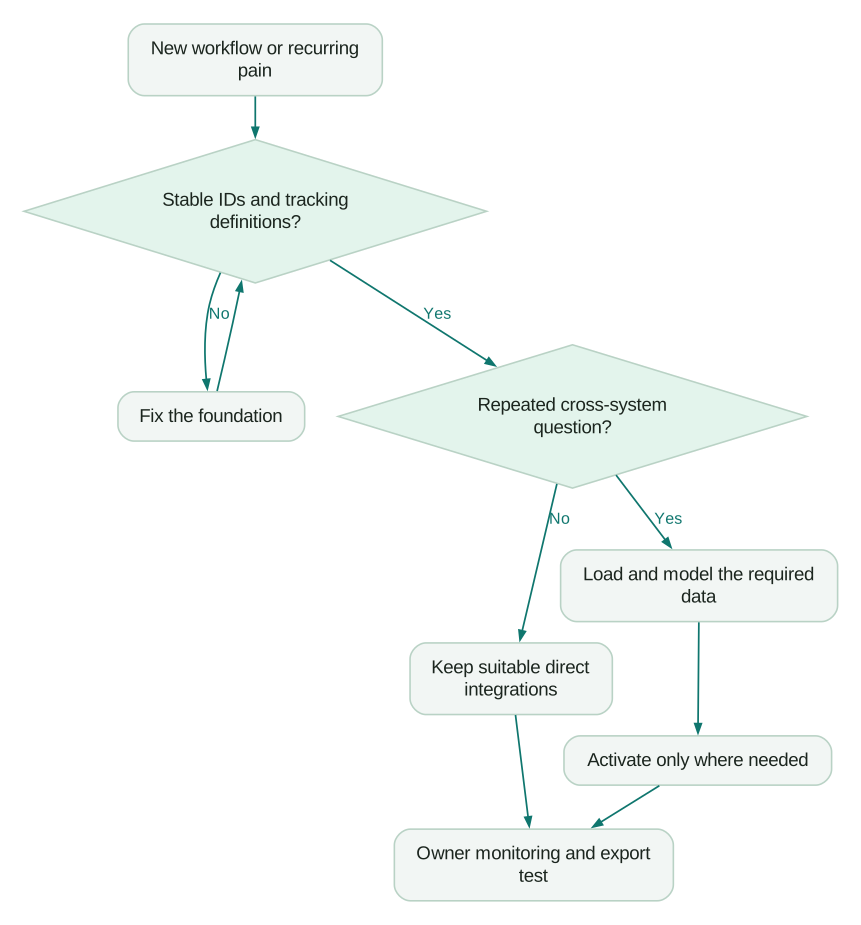
A startup martech stack should grow when a customer workflow or reporting requirement outgrows the current setup. Pre-seed needs a measurable journey and stable IDs; seed usually adds coordinated CRM, messaging and product analytics. Add a warehouse when recurring cross-system questions justify it, then activation and governance as more teams depend on the same data. Funding rounds are shorthand, not purchasing instructions.
What does a startup martech stack need at each stage?
At pre-seed, prove one customer journey; at seed, connect CRM, messaging and analytics. Add shared models and governed activation when recurring work requires them, with an owner for each addition. The layers of a martech stack stay broadly consistent; the workload and operating capacity change.
| Stage shorthand | Trigger to address | Useful addition | Accountable owner |
|---|---|---|---|
| Pre-seed | You cannot trace one visitor through signup to value | Tracking plan, stable IDs and a narrow measurement setup | Founder, with an engineer owning instrumentation |
| Seed | Sales, onboarding and product analysis need the same customer context | CRM, lifecycle messaging and product analytics connected by IDs | First growth/marketing owner plus engineering |
| Series A | A recurring decision needs CRM, billing and product history together | Warehouse, loading and reviewed business models | Named data or RevOps owner |
| Series B and later | Several teams and destinations need shared definitions | Governed activation, monitoring and property ownership | Data team with operational owners |
A five-person consumer app can hit the data-volume trigger before a 50-person services company. A company with one simple sales motion may never need the same architecture as a multi-market marketplace. SaaS often centres billing on an account; ecommerce centres orders and refunds; mobile apps add an acquisition measurement partner when paid installs and available measurement options justify it.
Use our reference stacks for SaaS, Shopify, apps and marketplaces for the business-model variations. This guide focuses on sequence. Website builders, CMS and social scheduling are outside its cost examples because the central problem here is connecting customer records, behaviour and follow-up. Our martech integration work builds those connections and their verification.
What should pre-seed teams establish first?
Prove one journey with a small number of deliberate events, stable identity and a way to follow up. Avoid buying an enterprise architecture before you can explain what a successful customer does.
Start with roughly 10 to 20 events as a planning limit for the first journey, not a vendor requirement. For example: signup, account creation, invitation accepted, first completed workflow and paid subscription. Define which system establishes each fact. A checkout-button click and a paid invoice should not share a name merely because both relate to buying.
Use a stable application database ID as user_id, with email as a trait. For B2B, add account_id and a membership relationship so one person can belong to several accounts without becoming several people. Segment's Identify specification recommends durable database IDs over email addresses or usernames.
What can stay free at pre-seed?
The following public allowances were checked on 17 October 2026. They are alternatives to evaluate, not a recommendation to install every product.
| Job | Candidate free allowance | First boundary to monitor |
|---|---|---|
| CRM | HubSpot: up to 2 users and 1,000 contacts | Users, contacts and paid-feature requirements |
| CRM alternative | Attio: up to 3 seats | Records, credits and collaboration needs |
| Product measurement | PostHog: 1 million analytics events/month | Free-plan overage events are dropped |
| Ecommerce messaging | Klaviyo: 250 active profiles and 500 emails/month | Either cap can restrict sending |
Sources: HubSpot Free CRM, Attio pricing, PostHog pricing and Klaviyo pricing.
PostHog also lists 5,000 monthly recordings and one million feature-flag requests, but those are separate allowances with separate consequences when limits are reached. Do not forecast safe collection from the analytics event cap alone. For website acquisition, standard GA4 and Google Tag Manager are another starting route; server hosting, consent tooling or implementation can still cost money. Google Tag Manager edition comparison.
An illustrated pre-seed software subtotal can therefore be $0 for a two-person team within HubSpot and PostHog's relevant free limits. Billing is separate: Stripe Billing's pay-as-you-go rate is 0.7% of billing volume, so $5,000 of covered monthly billing volume adds $35. Payment processing, tax tools, hosting and implementation are outside that figure. Stripe Billing pricing.
Owner: the founder decides what activation and paid status mean; the engineer implementing signup and billing owns the IDs and event emission. Someone must also own the consent configuration and its tests. Use the country-specific cookie-banner guide to frame that decision for the markets you serve.
Postpone: a CDP, broad enrichment, intent data, attribution software, marketing mix modelling and a second CRM unless a concrete requirement already justifies them. Preserve the essential identifiers and export options now so postponing a tool does not postpone the evidence it will need.
What changes when a seed team has several customer-facing workflows?
Add coordination when more than one person manages leads, onboarding needs product behaviour or product decisions outgrow the current reports. The trigger is a repeated job that the existing setup cannot perform reliably.
A practical seed setup connects three questions: who is worth a sales conversation, who needs onboarding help and what behaviour indicates value. Give CRM and lifecycle tools the relevant account ID and current status. A paid account should leave the trial-conversion journey even if the email sequence was scheduled yesterday.
Use the startup product analytics guide to decide whether a dedicated tool is needed, then choose product analytics around the analysis people will actually run. Compare HubSpot and Salesforce for startup sales by sales process and administration capacity; Attio versus HubSpot is useful when evaluating a smaller team's customer record.
When paid acquisition becomes material, send trustworthy qualification or purchase outcomes back to the ad platform before increasing spend. Enhanced conversions and offline conversion imports solve different parts of that job. Server-side tracking should have a specific measurement and operating justification, rather than being a standard purchase at a funding milestone.
A support inbox earns its place when ownership, response time and customer context cannot be managed reliably through the existing process. Evaluate Intercom or Zendesk using real conversations and required channels.
What is a concrete seed-stage budget?
Consider a fictional 15-person B2B SaaS company with four CRM seats, 8,000 lifecycle profiles, two million analytics events per month and $40,000 of monthly Stripe Billing volume. Assume the listed capabilities fit, lifecycle sends stay within the included allowance and there are no paid AI or messaging add-ons. Prices below were checked on 17 October 2026 and are in USD before taxes.
| Component | Billing assumption | Monthly amount or equivalent |
|---|---|---|
| Attio Plus | 4 seats × $35, billed annually | $140 |
| Customer.io Essentials | $100 base + 3,000 additional profiles × $0.009 | $127 |
| Mixpanel Growth | 2 million events; billed yearly | $185 |
| Stripe Billing | $40,000 × 0.7% | $280 |
| Standard GA4 and Google Tag Manager | No paid edition or server hosting assumed | $0 |
| Total of these lines | Mixed monthly and annual payment commitments | $732 |
Sources: Attio's selected USD prices, Customer.io pricing, Mixpanel's published tiers and Stripe Billing pricing.
The recurring software lines excluding Billing total $452; the $280 Billing line grows with revenue. Attio's annual commitment is $1,680 and Mixpanel's displayed yearly equivalent is $2,220. Monthly equivalents help comparison but do not describe when cash leaves the bank. Confirm checkout and contract terms.
Customer.io counts people and object profiles, so the 8,000 assumption must include both. SMS, WhatsApp, additional email usage and implementation are not included. Read the Customer.io pricing guide before equating a user count with its billing population. If you choose HubSpot instead, price its relevant seat, contact and product requirements rather than replacing the CRM line with an unrelated starting price.
Do not add an event pipeline automatically. RudderStack currently lists a 250,000-event monthly Free allowance and Growth from $265 for one million events, but a new routing layer needs its own reliability or maintenance case. RudderStack pricing. Compare Segment and RudderStack when repeated point-to-point event delivery is becoming difficult to operate.
Owner: the first marketer or growth operator owns lifecycle rules and CRM meaning; engineering owns collection and delivery; the founder resolves competing definitions. Postpone: a warehouse until cross-system questions recur, a BI licence without a defined model, and complex attribution before the conversion inputs reconcile.
When does a Series A-style warehouse investment make sense?
A warehouse becomes useful when an important recurring question needs several systems and history, and manually joining them costs more than operating a maintained model. Three systems is a practical diagnostic, not a universal technical threshold.
Examples include recurring revenue by activation cohort, expansion opportunities among paid accounts or acquisition payback after refunds. If CRM, billing and product each define an active customer differently, another dashboard will reproduce the disagreement. Use the warehouse decision guide to distinguish a real modelling need from a desire to own more infrastructure. Write down who owns each system at this stage, including who defines the cross-source result and who operates its delivery.
What does a small warehouse add to the bill?
Extend the seed example with BigQuery in Iowa (us-central1), 50 GiB of active logical storage for a 730-hour month and three TiB of on-demand query processing. Assume the account's free allowances have not already been consumed elsewhere.
Monthly software amounts below are in USD, with prices checked on 17 October 2026. Usage quantities follow the hypothetical workload above.
| Incremental component | Planning calculation | Monthly amount, USD |
|---|---|---|
| Active logical storage | 40 billable GiB × $0.000031507/GiB-hour × 730 hours | About $0.92 |
| On-demand queries | 2 billable TiB × $6.25 | $12.50 |
| Fivetran | Entire account stays within Free plan requirements | $0 |
| dbt Developer | One developer and within included model builds | $0 |
| Incremental listed software | Excludes other cloud services | About $13.42 |
Google's page lists the first 10 GiB of storage and one TiB of on-demand queries free monthly. Fivetran's Free plan includes up to 500,000 connection MAR and 5,000 model runs; dbt Developer lists one developer seat and 3,000 successful model builds monthly. These are distinct meters, not interchangeable allowances. BigQuery pricing, Fivetran pricing and dbt pricing.
If this new reporting path needs eight internal maintenance hours monthly at an assumed $75/hour, time adds $600, making the illustrated increment $613.42. That labour assumption is not a benchmark, but it shows why a $13 cloud estimate is not the full business case. Read warehouse ROI alongside the BigQuery cost guide.
The warehouse and CDP implementation service covers extraction, identity, models and activation scope. A lower cloud invoice cannot compensate for an unowned model that changes the board's revenue figure every week.
What happens when startup pricing ends?
HubSpot advertises a funding-track 90%, 50%, 25% discount sequence, but its general FAQ also says the period is typically two years; use the accepted agreement. Mixpanel's Startup Plan is a one-year offer, while other tools have different graduation terms. Put every step-down and notice date in the plan and use our startup-programme guide for eligibility and renewal modelling. HubSpot programme and Mixpanel Startup Plan.
Owner: a named RevOps, marketing-operations or data person, with a backup and a budget for upkeep. If that role is fractional, define its handover and response responsibilities using the agency versus in-house guide. Postpone: custom predictive scoring, intent data and marketing mix modelling until the use case, inputs and operating capacity justify them.
What does a Series B-style stack need beyond more capacity?
It needs consistent definitions and controlled changes when several teams or destinations depend on the same customer data. A larger plan does not establish who owns an account's lifecycle stage.
Add reverse ETL or a composable CDP when several operating tools genuinely need the same reviewed audience or calculated fields. Start with one audience and a measurable downstream action. Publish its eligibility reason, calculation time and exit rule, then verify the outcome in the destination.
Add metric contracts, CRM property ownership and freshness alerts when changing one field can affect multiple teams. A schema-change review should identify the reports, journeys and syncs that depend on the field before deployment.
There is no honest universal Series B software total. Quote the actual Salesforce seats and usage, Snowflake compute, activation volume, channels and support requirements. The Salesforce, Snowflake and Hightouch pricing guides explain their different meters. The owner is now a data team working with RevOps and lifecycle owners, with one accountable person per shared property and connection.
In what order should you implement the layers?
Implement the dependencies before the tools that consume them. The following order applies whether the company has raised funding or not.
- Write the tracking plan. Define the event's business trigger, properties, source and owner before selecting a dashboard. Use a tracking plan another developer can implement.
- Establish identity. Preserve stable person and account IDs across product, CRM and billing. Use identity resolution for startups for the mapping and correction rules.
- Design consent before collection. Select the appropriate consent setup and retain the required evidence. Google's EU user consent policy covers relevant end users in the EEA, UK and Switzerland and requires consent records and revocation information; it is not a complete statement of every jurisdiction's law. Google's policy.
- Use direct integrations while they are manageable. Add a routing platform when repeated delivery, schema or monitoring needs warrant it, not because every architecture diagram contains one.
- Add warehouse models when joins repeat. Bring in the sources the decision needs and verify the customer/account grain before activation.
- Put AI access on trusted definitions. Start with a known answer and constrained permissions. The AI-ready marketing data guide explains why a fluent answer can still be wrong.
Basic and advanced consent mode change how Google tags behave; neither substitutes for the consent decision itself. Likewise, an MCP connector changes access to data, not the accuracy of that data. Review agents that maintain the stack once the models are trusted before granting recurring jobs wider access.
Which early decisions become expensive to reverse?
Identity, canonical event names, consent design, the CRM object model, raw-history retention, export rights and billing units deserve deliberate decisions early. They are not all literally irreversible, but repair can require coordinated changes and cannot always recreate missing history.
Our scalable martech stack guide explains the vendor-specific constraints and tests. Keep this stage decision simple: record the choice, owner, reason, exit path and condition that would make you revisit it.
For the seed example, software at the illustrated volume is $732 monthly, and the small warehouse's software adds about $13.42. Implementation is a separate investment. Martechdevs projects start at USD 3,000; full warehouse, end-to-end visualization and activation work can reach USD 15,000, depending on scope. Use the implementation cost guide to identify the work behind the quote rather than treating those figures as a fixed package.
How do you know the stack is ready for the next addition?
Trace a real, authorized test customer from the first meaningful event to the paid invoice and the resulting CRM or lifecycle action. Verify the same person/account relationship, the agreed metric and the intended consent state throughout.
Reconcile signup counts between the database and analytics using the same window and exclusions; do not force CRM counts to equal signups when the CRM intentionally receives only qualified accounts. Check one cancellation, refund or account-membership change as well as the successful path. Test an export with identifiers and associations before relying on an exit promise.
Use a stack audit, maturity assessment and current-state map to identify the weak dependency. These are more useful than declaring readiness from headcount or funding alone. The data quality checks to pass before the next stage help turn that diagnosis into recurring evidence.
Common expensive mistakes have simple early countermeasures: keep email out of the primary ID, define “active” once for each intended use, record discount expiry, assign a warehouse owner and require property ownership before an AI assistant can edit shared CRM fields.
Before adding the next layer:
Checklist
- The workflow, decision and success criterion are written down.
- Stable person/account IDs and relevant consent state reach the required destinations.
- CRM objects, property names and update ownership are agreed.
- Prices use actual seats, profiles, events and billing volume.
- Annual cash commitments and startup-discount expiry are recorded.
- Each connection has an owner, a failure alert and a recovery path.
- The postpone list names a trigger that would reopen each decision.
- A customer trace and a usable export have passed.
At Martechdevs, we connect tracking, CRM, lifecycle and warehouse workflows around those definitions and checks. Bring your current map to a free martech AI audit, or request a quote for the next-stage integration.
Questions people ask
What data should we migrate when replacing an early tool?
Move the records and history needed for active workflows and agreed reporting. Preserve stable IDs, associations, consent and suppression evidence, then test a small export in the destination before the full migration. Keep the old tool available until the replacement produces the expected customer trace and reconciled counts, with a clear owner for exceptions.
Should a startup begin with HubSpot or Salesforce?
Choose around the sales process, required integrations and capacity to administer it. HubSpot's free CRM can fit a very small team, but its two-user and 1,000-contact limits matter. Salesforce may fit a more demanding sales model. Compare HubSpot and Salesforce for startups before treating a temporary discount as the deciding feature.
When should a startup buy a CDP?
Consider a CDP when stable identity and audience rules already exist and several destinations need them maintained consistently. Three destinations is a useful discussion trigger, not a universal threshold. First price the direct-integration work and the operating owner. A composable CDP can fit a maintained warehouse; it does not create that foundation automatically.
How much should a startup spend on martech?
Build the amount from the workflow and actual usage. The fictional seed example here totals $732 monthly across specified CRM, messaging, analytics and Billing lines, with exclusions clearly stated. Your seats, profiles, events, channels, contract terms and maintenance time can change that materially. A percentage of a large company's marketing budget is a poor substitute for those inputs.
Who owns martech before the first operations hire?
The founder should own priorities and disputed business definitions; the engineer implementing signup and billing should own IDs and event delivery; the marketing or growth operator should own messaging and CRM usage. A fractional partner can own specified connections, but accountability and handover still need names. Compare the options in our agency versus in-house guide.
Sources
- Twilio Segment: Identify specification
- HubSpot: Free CRM
- Attio: Pricing
- PostHog: Pricing and free-limit behaviour
- Klaviyo: Pricing and free allowances
- Google: Tag Manager edition comparison
- Stripe: Billing pricing
- Customer.io: Pricing
- Mixpanel: Published event tiers
- RudderStack: Pricing
- Google: BigQuery pricing
- Fivetran: Pricing and Free plan
- dbt Labs: Pricing
- HubSpot: Startup programme
- Mixpanel: Startup Plan
- Google: EU user consent policy

Written by
Jafrin Akter AloData Engineer and Co-founder at Martechdevs and Growth and Analytics Partners
Jafrin writes practical guides to marketing technology, customer data, analytics and AI workflows. Martechdevs is a Growth and Analytics Partners company.