Snowflake Implementation: Plan the Phases, Price the Work and Connect Your Sources
Data Engineer and Co-founder at Martechdevs and Growth and Analytics Partners
Last updated 16 min read
A Snowflake implementation should deliver a business output your team can trust and operate: source data arrives, models reconcile, access is controlled and someone owns recovery and cost. Start with one marketing or revenue workflow, then approve the platform, ingestion, modeling and handover phases against explicit evidence. Account creation is an early step in that delivery, rather than its acceptance criterion.
What should a Snowflake implementation include?
A complete Snowflake implementation includes the account and access model, source pipelines, business models, reports or activation, operating controls and handover. Assign an owner and a testable output to each phase before requesting a fixed quote.
| Phase | Accountable owner | Evidence needed to move forward |
|---|---|---|
| Account, security and cost controls | Platform or security owner | The intended production role can perform its job and cannot access unrelated data |
| Ingestion | Data integration owner | Required history, updates and deletions reach the expected source tables |
| Models, reports and activation | Business metric owner with the data lead | A named decision reconciles to the source and reaches the people who use it |
| Validation and handover | Operating owner | Recovery, cost review and routine changes work without the original builder |
For a marketing team, that first output might connect campaign spend to qualified accounts and collected revenue. For finance, it might reconcile billed and paid amounts without losing currency or refund history. Those outcomes require different source records and acceptance rules.
Our Snowflake implementation work for marketing and revenue data starts from that output. The practical scoping question is which decision becomes dependable, which inputs it needs and who will use it after the project ends.
How should you scope the first workflow?
Scope one decision, its population and its authoritative inputs before choosing warehouse settings or connectors. Write down what the output means, how fresh it must be and the exception that would stop someone trusting it.
For an acquisition-to-revenue report, specify whether revenue means a signed contract, an issued invoice, a successful payment or recognized revenue. Name the source for each measure and the identifier that connects it to the account. Keep unmatched records visible; an inner join can make the report look cleaner by hiding the customers you failed to connect.
Use a short delivery brief:
Decision: Which acquisition cohorts produce qualified accounts and collected revenue?
Business owner: Named marketing/revenue owner
Sources: Advertising spend, customer relationship management (CRM) opportunities, billing payments
Output grain: One account and acquisition cohort, with separately reconciled payment facts
History: Explicit start date and treatment of missing history
Freshness: Agreed decision deadline and source-specific limits
Acceptance: Source totals, unmatched-account queue and sample account histories
Operator: Named owner for failures, access changes and monthly cost review
The example is a scoping template, not a universal revenue model. If the team has not agreed on qualification or revenue, give those decisions an owner before promising a delivery date.
Choose edition and region from requirements
Choose the edition for required controls and the region for the complete data flow. Snowflake’s edition matrix places features such as masking, row access policies, extended Time Travel and multi-cluster warehouses above Standard. Business Critical adds protections such as private connectivity and customer-managed-key capabilities. A feature requirement should drive the upgrade.
If protected health information is in scope, Snowflake also requires a signed business associate agreement before that data is stored. Buying an edition alone does not establish that the implementation meets the organization’s obligations.
For a UK workload, supported regions include AWS London, Azure UK South and GCP London. Map source systems, object storage, connector processing, replication and any AI processing alongside the warehouse region. A London account does not, by itself, describe every place the full workflow processes data.
If the platform decision remains open, compare BigQuery before committing. The implementation plan should explain the requirement Snowflake satisfies, rather than treating its selection as proof that every later component is necessary.
Separate a new build from migration
A migration adds translation and continuity work: SQL dialects, permissions, scheduled jobs, historical states, reports and downstream consumers. Inventory what must move, be rebuilt, remain available or be retired. The warehouse alternatives guide explains what can break when these responsibilities move between platforms.
Plan development and production boundaries deliberately. Separate roles, schemas or databases where they provide the required isolation; use separate accounts when the security or operating requirements demand them. Decide naming, ownership and deployment practices before several teams create competing versions of the same revenue table.
What should account and security setup prove?
Account setup should prove that people and services can perform their intended work with controlled access, recoverable authentication and visible costs. Test the production role rather than accepting a successful administrator session as sufficient evidence.
Snowflake’s access-control model assigns privileges through roles. Design the role around its job: loading source data, transforming approved inputs, reading a report or administering security. Keep broad administrative access out of routine connector and reporting credentials.
Use the organization’s approved single sign-on process for people and a supported non-password authentication method for services. Key-pair authentication for service users is one common route; Snowflake’s key-pair guide describes rotation with overlapping public-key slots. Confirm that every selected connector supports the authentication route and that the business controls the private key and recovery process.
Before moving on, run the intended job as the actual service role, attempt an unrelated read that should fail, and rehearse credential rotation. These are acceptance tasks for the implementation team; record the result and the evidence needed to repeat them.
Configure cost controls before enabling workloads
Use different controls for warehouse compute and the wider account. Snowflake resource monitors can notify and suspend assigned warehouses, but do not control serverless or AI spending. They can overshoot a threshold while suspension takes effect, and suspending a warehouse does not stop every possible cloud-services charge.
| Control | What it addresses | Limitation to test |
|---|---|---|
| Warehouse resource monitor | Credit use and notify/suspend actions for assigned warehouses | An alert-only monitor does not suspend; running work and timing affect the final consumption |
| Account or custom budget | Supported warehouse, serverless and AI credit usage | A spending limit is an alerting threshold, not an automatic hard cap |
| Workload configuration | Running time, warehouse generation, size and optional services | Defaults and a newly enabled feature can add a different cost line |
Snowflake’s budget guide supports notifications and separately configured stored-procedure actions. Define the response explicitly, including who can stop a workload and what business process that interrupts. Do not assume a budget number alone enforces a spending ceiling.
Set notification thresholds below the intended suspension point, verify recipients, and check which objects the controls actually cover. A monitor that nobody receives or a serverless service outside the forecast leaves the budget operationally incomplete.
How should you assess source integration difficulty?
Assess each source against the history, changes, identifiers and recovery the business output needs. The number of connectors is a poor substitute for this work: one source without deletion history can require more design than several well-supported feeds.
Use this original scoring framework to expose uncertainties before quoting. The score is a planning aid, not a delivery-duration formula.
| Dimension | Lower-complexity evidence | Higher-complexity evidence | Decision before build |
|---|---|---|---|
| History | Required historical records are exportable | Only current state exists or archives are incomplete | Narrow the historical promise or find another source |
| Changes and deletions | Stable incremental cursor and documented delete handling | Edits arrive late, deletes are invisible or the cursor resets | Define replay, reconciliation and deletion treatment |
| Identity and schema | Stable business identifiers and consistent field types | Duplicate identities, custom objects or frequent schema changes | Agree mappings and quarantine rules |
| Access and volume | Supported service authentication and sufficient throughput | Expiring access, restricted exports or shared application programming interface (API) limits | Prove the access route and backfill capacity |
Score low, medium or high by dimension, and attach the evidence. A high score should identify a question to resolve, not justify an unexplained premium. For example, “the source cannot export deleted subscriptions” is actionable; “Stripe is complex” is not.
Choose the loading route per source
Use the route that preserves the necessary data with an operating model your team can maintain. Compare Fivetran or Airbyte for the same sources, including history, custom fields, deletes, permissions and the recurring bill.
| Route | Suitable job | Scope to verify |
|---|---|---|
| Managed connector | Supported SaaS or database ingestion | Objects, historical coverage, delete behavior and billing unit |
Warehouse COPY INTO | Controlled file batches | File format, warehouse runtime, replay and load reconciliation |
| Snowpipe | Automatically loading arriving files | Billed bytes, event notification path and freshness |
| Openflow | A supported managed data-flow pattern | Deployment type, runtime capacity, source access and operating responsibility |
| Data share | Provider-managed access to a source dataset | Availability, permissions, update schedule and model compatibility |
Snowflake’s Snowpipe billing guide charges by loaded data size: text files use uncompressed bytes; binary formats such as Parquet use their observed storage size. File count does not add a separate charge under that model, although file sizing still affects delivery behavior.
For Openflow bring-your-own-cloud deployment, the Service Consumption Table lists 0.0225 Platform Credits per vCPU-hour. That is one cost component, not an all-in price for the external cloud runtime or a promise that every connector fits the same capacity.
Stripe Data Pipeline can provide a warehouse share, with a full refresh every three hours after the initial load. Availability and individual dataset schedules need checking; the published cadence is not evidence that every financial table is current at the same instant. Reconcile the tables actually used by the report.
Google Analytics 4 (GA4)’s native event export writes to BigQuery. A Snowflake design can retain that export and add a replication path, or evaluate another supported connector. Price the extra movement, processing and delay. Do not draw a direct native GA4-to-Snowflake arrow without identifying what performs that transfer.
How should you build models, reports and activation?
Build models around stable business entities and explicit definitions, then publish the smallest report or action that answers the chosen question. Use warehouse layers and naming to distinguish retained source data, normalized staging models and business-facing outputs.
For acquisition-to-revenue reporting, preserve person, account, opportunity, invoice and payment identities separately. Define the grain before joining them. An account with three opportunities and four payments must not turn into twelve copies of revenue because both detail tables were joined directly.
Put business rules in dbt or another maintained transformation process, with tests for the intended uniqueness, required fields and relationships. Reconcile money before adding channel breakdowns. The Stripe revenue reconciliation guide separates commitments, invoices and payments so a technically valid join does not become a misleading revenue measure.
Publish a report that a named user can use to make the agreed decision. For activation, define destination identity, field ownership, eligibility, suppression and removals as a separate write contract. A correct warehouse result does not prove that the destination applied it correctly.
Include business intelligence (BI) licences and activation charges as separate budget lines. A report-build fee does not include every future viewer, scheduled query or destination update unless the agreement says so.
What should a local reconciliation test demonstrate?
A reconciliation test should retain missing and unexpected records, detect duplicate grain and compare amounts only under matching currencies. Start with a small known fixture before adapting the test to real source and warehouse tables.
This original read-only SQL example declares its own sample schema. Amounts are integer minor units: an amount_minor value of 3,900 with currency USD represents USD 39.00. The expected set represents three approved invoices rather than an accounting-revenue definition.
WITH expected(invoice_id, currency, amount_minor) AS (
    SELECT 'inv_alpha', 'USD', 3900
    UNION ALL SELECT 'inv_beta', 'USD', 11900
    UNION ALL SELECT 'inv_gamma', 'EUR', 4000
), loaded(invoice_id, currency, amount_minor) AS (
    SELECT 'inv_alpha', 'USD', 3900
    UNION ALL SELECT 'inv_beta', 'USD', 11900
    UNION ALL SELECT 'inv_beta', 'USD', 11900
    UNION ALL SELECT 'inv_extra', 'USD', 2500
), observed AS (
    SELECT invoice_id, COUNT(*) AS row_count,
           MIN(currency) AS currency,
           MIN(amount_minor) AS amount_minor
    FROM loaded
    GROUP BY invoice_id
)
SELECT e.invoice_id AS invoice_id,
       CASE
           WHEN o.row_count IS NULL THEN 'missing'
           WHEN o.row_count <> 1 THEN 'wrong_grain'
           WHEN o.currency IS NULL OR o.amount_minor IS NULL THEN 'incomplete'
           WHEN o.currency <> e.currency THEN 'currency_mismatch'
           WHEN o.amount_minor <> e.amount_minor THEN 'amount_mismatch'
           ELSE 'matched'
       END AS result
FROM expected e
LEFT JOIN observed o ON e.invoice_id = o.invoice_id
UNION ALL
SELECT o.invoice_id, 'unexpected_invoice' AS result
FROM observed o
LEFT JOIN expected e ON o.invoice_id = e.invoice_id
WHERE e.invoice_id IS NULL
ORDER BY invoice_id;
The expected output is inv_alpha=matched, inv_beta=wrong_grain, inv_extra=unexpected_invoice and inv_gamma=missing. MIN only selects a representative amount after the row count is known; it does not turn duplicate invoice rows into a valid match.
Before adapting the query, inspect the real table schemas and types, require non-empty invoice keys on both sides, validate that expected keys are unique and expected currencies and integer amounts are present, and apply the agreed status/date filters. Do not substitute a guessed column into a production query. Add cases for wrong currency, wrong amount, null values and a late correction. A zero-exception result is meaningful only when the expected population and source snapshot are also correct.
How much does the Snowflake platform cost for a first workload?
Platform cost depends on warehouse generation and size, running time, region, edition, storage and enabled services. Keep that operating bill separate from implementation services and the other tools in the stack.
The current consumption table gives the following AWS on-demand references. Credit prices are USD per Platform Credit; storage is USD per average billed TB-month. These are published rates, not a negotiated capacity quote.
| AWS region and edition | USD per Platform Credit | Standard storage, USD/TB-month |
|---|---|---|
| Northern Virginia, Standard | 2.00 | 23.00 |
| London, Standard | 2.70 | 24.00 |
| London, Enterprise | 4.00 | 24.00 |
The Snowflake pricing guide explains the wider rate card. Choose the cloud and edition explicitly; London on a different cloud does not make every other rate identical.
Reproduce a scoped Gen1 reference
This hypothetical 30-day month reuses the running-time pattern from the pricing guide: an XS transformation warehouse runs two hours daily, and a Small BI warehouse runs three hours on 22 working days. At Gen1 rates of one and two credits per hour, they consume 60 + 132 = 192 credits.
Assume one cluster each, 0.5 TB of average billed standard storage and 300 GB of uncompressed text files loaded through Snowpipe. Snowpipe uses 300 × 0.0037 = 1.11 credits. The following totals exclude query acceleration, net billable cloud services, AI, transfers, connectors, BI subscriptions, activation and implementation. USD amounts are rounded only for display.
| Monthly component | US East Standard, USD | London Standard, USD | London Enterprise, USD |
|---|---|---|---|
| Gen1 warehouse compute, 192 credits | 384.00 | 518.40 | 768.00 |
| Average standard storage, 0.5 TB | 11.50 | 12.00 | 12.00 |
| Snowpipe text loads, 1.11 credits | 2.22 | 3.00 | 4.44 |
| Modeled subtotal | 397.72 | 533.40 | 784.44 |
Account for Gen2 and query acceleration
New Standard warehouses default to Gen2 where it is available. Query Acceleration Service (QAS) requires Enterprise Edition or higher. For eligible deployments, Snowflake’s Gen2 guide says new Gen2 warehouses enable QAS by default; changing an existing warehouse to Gen2 does not automatically change its existing QAS state.
For the AWS workload above, Gen2 XS and Small rates are 1.35 and 2.7 credits per hour. At the same assumed running hours, compute becomes 259.2 credits. The otherwise-identical subtotals become USD 532.12, USD 714.84 and USD 1,053.24 respectively, still excluding QAS and the other listed items.
This is a configuration sensitivity, not a performance benchmark. Gen2 can finish work faster; measure the actual workload and concurrency before deciding its total cost. Record generation, size, clusters and QAS settings in the plan rather than budgeting from the word “XS” alone.
Snowflake’s compute-cost guide describes the standard warehouse’s 60-second minimum at start or resume, followed by per-second billing. Running time includes idle time. Many brief resumptions can therefore cost differently from one continuous run of the same total query duration.
Cloud services also need their own calculation: the daily adjustment is based on 10% of eligible daily warehouse consumption, rather than a flat monthly surcharge. Serverless and AI meters remain separate. Use the applicable Platform or AI Credit rules instead of multiplying every quantity called a credit by the warehouse price.
What should the full implementation budget contain?
Budget the one-off delivery, recurring platform, connected tools and internal effort as separate lines. The platform subtotal above cannot price the people and integration work needed to produce a dependable business output.
At Martechdevs, implementation projects start at USD 3,000. Full warehousing, end-to-end visualization and data activation can reach USD 15,000, with scope determining the quote. This guidance is not an unlimited enterprise migration package; a multi-system enterprise program can require a different scope and budget. See how implementation quotes are built.
Require the proposal to identify sources, history, models, reports, activation destinations, cleanup, tests and handover. Mark unquoted software or cloud items as unresolved inputs rather than assigning them zero. Price parallel systems during migration and the operator’s recurring work after handover.
A first usable output can be smaller than the eventual platform. Reduce scope by postponing an unneeded destination or report, while preserving the identity, security and reconciliation that the first output requires.
How long does a Snowflake implementation take?
The timeline follows dependency resolution and acceptance, not a universal number of weeks. Access, procurement, security review, source history and metric decisions often determine when the next phase can start.
| Dependency | Owner to name | What can proceed while it is unresolved |
|---|---|---|
| Account and commercial approval | Procurement/platform owner | Business definitions and source inventory |
| Source credentials and export access | Source-system owner | Sample mapping from approved fixtures |
| Revenue and identity definitions | Business metric owner | Platform setup and clearly independent feeds |
| Historical load and reconciliation | Integration/data owner | Report design against a controlled sample |
| Close-period validation and handover | Finance/operating owner | Documentation and failure rehearsals |
For a financial workflow, include a representative close period in parallel validation; month-end is a useful gate when the report supports monthly reporting. Do not claim complete acceptance from a same-day sample that has never seen refunds, late changes or closing adjustments.
Separate working effort from elapsed time. More engineers cannot resolve an unsigned access approval or an unavailable historical extract. A credible plan names the dependency, owner, required evidence and decision date.
Which implementation risks should the plan address?
Check credentials, idle compute, spending coverage, recoverable source history and the role used for acceptance before handover. Assign the repair and its evidence to the relevant phase owner.
| Risk | Control to agree | Evidence to retain |
|---|---|---|
| Password-based service login | Use supported service authentication | Integration and credential rotation pass |
| An idle warehouse stays running | Configure and test appropriate suspension | Idle periods fit the running-time forecast |
| Serverless or AI spend escapes warehouse controls | Add the relevant budget and response | Each enabled meter has an owner |
| Transient staging holds the only source history | Retain a reconstructible source copy | Required history survives a staging rebuild |
| Tests pass only as administrator | Run them with the production service role | Intended work succeeds and unrelated access fails |
Snowflake's transient-table guidance documents no Fail-safe period and zero or one day of Time Travel retention. Use transient staging for data you can reconstruct. Keep the source history and recovery procedure needed to rebuild it, and test that recovery before relying on the staging layer.
How do you verify the implementation is ready for handover?
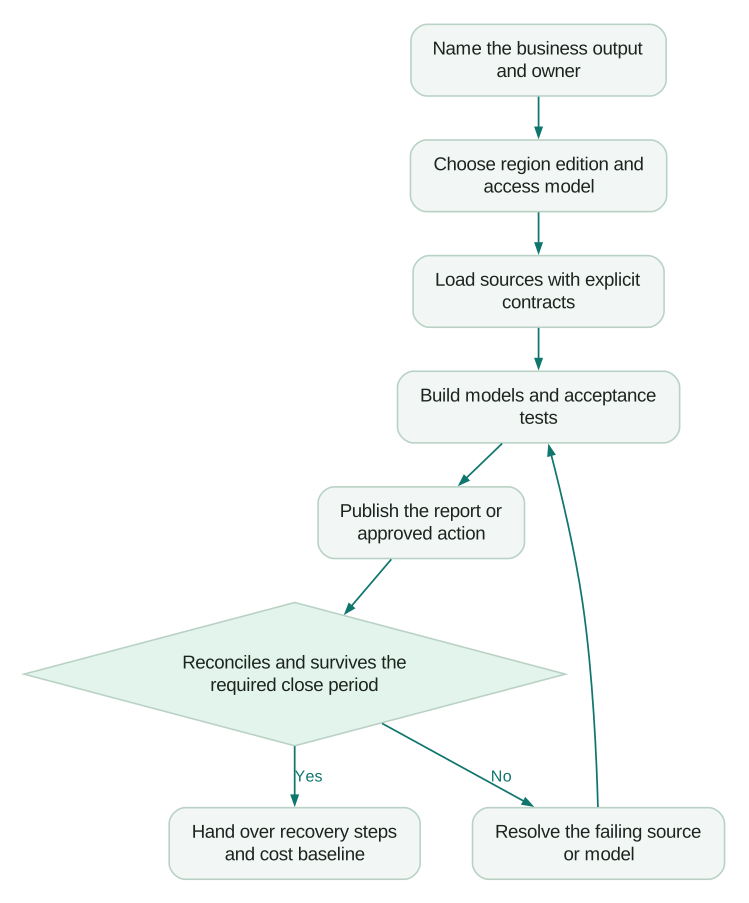
Accept the implementation when the business output reconciles, the intended role can operate it, failures are recoverable and the cost is explainable. Retain evidence from normal and failure cases.
Checklist
- A named owner approves the output’s grain, definitions and exclusions.
- Edition, region, generation and optional services are explicit.
- Production jobs run through the intended roles and authentication.
- Warehouse monitors and wider credit budgets have tested recipients and responses.
- Each source has agreed history, update, delete and replay behavior.
- Source counts and amounts reconcile, with unmatched records retained.
- A failed run can be retried without duplicating the business outcome.
- Credential rotation and the recovery procedure have been rehearsed.
- Stale inputs are visible to the report or activation owner.
- Required close-period cases pass before full handover.
- Actual usage is compared with the estimate after usage records become available.
- The business owns the configurations, access records, tests and runbook.
Allow for usage-view latency when checking cost. Snowflake’s Snowpipe cost guide says the Account Usage PIPE_USAGE_HISTORY view can lag by up to three hours. A newly run load missing from that view is not proof that it was free.
If an existing setup already fails these checks, use the common Snowflake implementation mistakes guide to diagnose it. For a new build, bring the first workflow, source inventory and acceptance criteria to a scoped warehouse implementation quote, or book a free martech AI audit to settle the priorities. The marketing warehouse guide connects this delivery plan to the wider architecture.
Questions people ask
How should test-mode and live Stripe data be separated?
Keep test-mode data out of production financial models and make the mode explicit in the ingestion contract. Stripe Data Pipeline separates live and sandbox data into different schemas and provides merchant_id for account filtering. Include a test record that would inflate revenue if the wrong mode or account entered the model. Acceptance should prove that it is excluded while legitimate source totals still reconcile.
How should a security review that finishes late affect the delivery plan?
Keep work that depends on the unresolved security decision behind its approval gate. Continue only the independent activities, such as documented definitions or approved synthetic fixtures. Record which access, hosting or data-handling choice remains open and how it affects the schedule. A successful prototype does not authorize moving sensitive production data into an arrangement the organization has not approved.
What if finance and marketing use different fiscal calendars?
Preserve the underlying transaction dates and model each approved calendar explicitly. Name the calendar used by every period-based output, including its timezone and year boundary, instead of relabelling one team’s month as the other’s. Include a transaction near the fiscal boundary in acceptance. Both reports can be internally correct while showing different period totals, provided the business can trace each assignment.
What should a first report do when a required source is stale?
Expose the stale input and its effect on the decision instead of silently presenting the report as current. Keep the last successful load, the relevant business timestamp and the agreed freshness expectation visible to the owner. Depending on the consequence, retain a clearly labelled prior view or stop the downstream action. The choice belongs in acceptance criteria before the first incident occurs.
What should happen if the chosen region is unavailable during launch?
Follow an agreed contingency rather than improvising a new production location. The plan should identify who can postpone cutover or authorize an approved recovery environment, and what evidence must pass before traffic moves. Recheck access, source connectivity, reporting and data-handling requirements in that environment. A reachable account in another region is not enough to establish a safe or accepted replacement for the planned deployment.
Sources
- Snowflake: Editions and feature requirements.
- Snowflake: Supported regions.
- Snowflake: Access-control model.
- Snowflake: Key-pair authentication and rotation.
- Snowflake: Resource monitors.
- Snowflake: Credit budgets.
- Snowflake: Snowpipe costs and usage.
- Snowflake: Service Consumption Table.
- Stripe: How Data Pipeline works.
- Google Analytics: BigQuery export.
- Snowflake: Generation 2 standard warehouses.
- Snowflake: Compute cost.
- Snowflake: Query Acceleration Service eligibility and defaults.
- Snowflake: Temporary and transient table recovery.

Written by
Jafrin Akter AloData Engineer and Co-founder at Martechdevs and Growth and Analytics Partners
Jafrin writes practical guides to marketing technology, customer data, analytics and AI workflows. Martechdevs is a Growth and Analytics Partners company.