Scalable martech stack: seven decisions that are cheap now and expensive to undo
Data Engineer and Co-founder at Martechdevs and Growth and Analytics Partners
Last updated 14 min read

A scalable martech stack can accommodate more customers, data and teams without repeatedly rebuilding identity, losing useful history or changing what its metrics mean. The decisions worth slowing down for are stable IDs, event definitions, consent, CRM structure, history, exports and billing units. They are not all irreversible, but a late correction can involve several systems and cannot always recover missing evidence.
What makes a martech stack scalable?
Scalability is the ability to increase useful work while preserving correctness and manageable operating effort. A tool that accepts more events solves a capacity problem; it does not ensure that the same customer is recognized in analytics, billing and CRM.
Amazon's 2015 shareholder letter distinguishes consequential, difficult-to-reverse decisions from reversible ones that smaller groups can make quickly. That is a useful decision principle here, not proof that every data-model choice is literally permanent. Amazon's original letter.
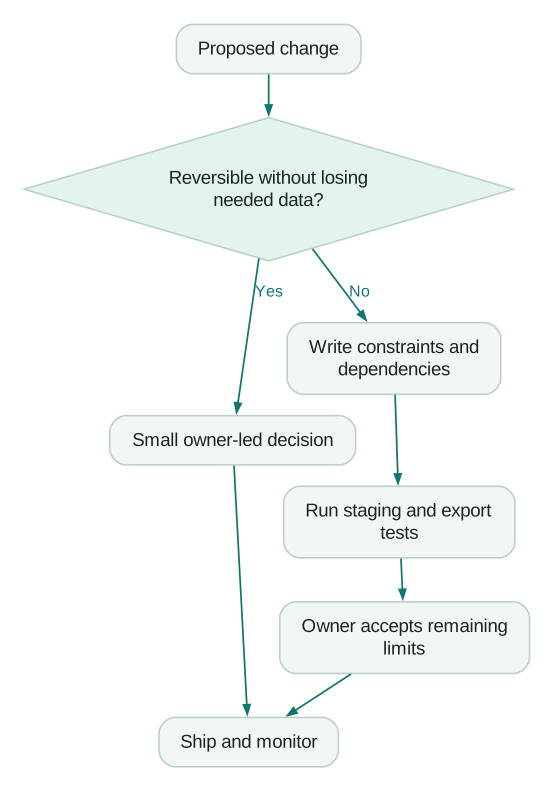
A draft dashboard, an email template or a display label is often easier to change than a customer identifier embedded in SDKs, journeys and exports. The actual cost depends on its dependencies. Classify the proposed change by what it affects, rather than calling an entire vendor a one-way decision.
Use the startup stack stage guide for when each tool earns its place and the martech layers guide for how data moves between them. Also account for who can run the stack: an architecture that needs expertise nobody owns is not operationally scalable.
Which IDs represent people and accounts?
Use stable application identifiers for people and accounts, with a separate membership relationship. Keep email as an attribute rather than a key that changes when someone changes their address.
The vendor constraints make this more than a naming preference. The sources below were checked on 17 October 2026.
| System or identity model | Documented constraint | Design implication |
|---|---|---|
| Segment Identify | Recommends database IDs rather than email or username | Choose a durable key controlled by your application |
| Mixpanel Simplified ID Merge | Cannot merge two established $user_id values or change one | Do not assume an email change can be repaired by another identify call |
| Amplitude login identity flow | Changing a non-null user_id creates another user | Preserve the anonymous-device relationship when assigning the stable user ID |
| PostHog identity | Cannot re-identify an already identified user as a different distinct ID; dangerous merges have no safe undo | Test login, logout and alias behaviour before production rollout |
Sources: Segment Identify, Mixpanel Simplified ID Merge, Amplitude's engineering guidance and PostHog identification.
A database ID is useful only if your own application preserves it. Namespace IDs by environment and source account where necessary; 42 in staging is not automatically production user 42. Keep an account ID distinct from its billing customer ID and CRM company ID, with explicit mappings between them.
For B2B products, one person can belong to several accounts. Their person ID stays stable while the active account changes. Account membership should not be represented by manufacturing a different person for every workspace or by merging unrelated colleagues because they share a company domain.
How should you test identity before release?
Run an agreed sequence in staging and inspect the raw events, not only the final user count:
| Test | Expected result | Evidence to inspect |
|---|---|---|
| Anonymous visit, then signup | Permitted anonymous activity links to the correct new person | Raw events immediately before and after identification, with device and person IDs |
| Login on a second device | The same person ID appears without creating another known customer | Both devices' authenticated events and their shared canonical person ID |
| Logout, then another person logs in on the shared device | The two known people remain separate | Logout/reset boundary and the next person's first identified event |
| One person switches workspaces | Person ID stays stable; account context changes correctly | Before/after account IDs attached to the same person ID |
| Empty or placeholder ID reaches the emitter | Invalid identification is rejected before sending | Local validation result and absence of an unintended identify request |
Use the SDK's documented reset/logout sequence. PostHog rejects specified placeholder values and describes $merge_dangerously as irreversible; its Split IDs feature does not guarantee how all past events will be treated. Amplitude's Data Assistant cannot reconstruct a linking relationship that was never sent. Do not plan a production rollout around the assumption that a later merge button will fix everything.
Our identity-resolution guide covers cross-system mappings, while the identity merge guide covers vendor-specific repair boundaries. For implementation, tracking and identity work should include those staging traces and the destination checks.
What does each event name mean?
Choose a canonical event name and a precise business trigger before saved reports and destinations depend on it. A new display label is different from emitting a new event identifier.
GA4 event names are case-sensitive and must start with a letter. Its documented collection limits include 40-character event names and 25 parameters per event; the 500-distinct-event limit applies per app user in app streams, not as a universal web-event cap. Google's naming rules and collection limits.
Define, for example, whether subscription_started means a trial began, a checkout completed or a first successful payment occurred. Those are different business facts. Include the source, expected properties, retry/deduplication rule and owner in the tracking plan.
When a definition changes, decide whether it needs a new event, a versioned property or a compatible update. Record the effective date and update dependent funnels, audiences and exports. Do not rename a production event and then interpret the split history as a sudden fall in usage. Use an event naming convention that separates stable identifiers from human-facing labels.
How does consent control collection and activation?
Consent architecture decides which data can be collected, how the user's choice is stored and how destinations respect a later change. It should be part of the data flow rather than a banner added after the tags ship.
Google's EU user consent policy covers relevant end users in the EEA, UK and Switzerland. It requires appropriate consent, records of that consent and clear revocation information. That policy is a product requirement, not a complete legal assessment of every market or processing purpose. Google's policy.
Google distinguishes basic consent mode, which blocks tags until the applicable consent interaction, from advanced mode, which loads with defaults and can send cookieless pings when consent is denied. The exact implementation and permitted behaviour need to match your requirements. Consent mode does not obtain consent by itself or make every downstream tag compliant. Google's consent-mode documentation.
Decide where the consent record lives, which purposes and channels it covers, how version and time are recorded, and how withdrawal reaches messaging and advertising destinations. Test a first visit, rejection, acceptance, changed choice and logout. Missing historical evidence cannot be recreated merely by changing a setting later.
Use basic versus advanced consent mode and choose a consent platform the team can operate. Keep retention and deletion duties attached to any raw copies you create.
What is the CRM object model?
Choose objects, relationships and stable internal property names before importing data or wiring automation to them. A contact, company, subscription and product workspace represent different entities even when a small business initially has one of each.
HubSpot does not let you edit a property's object type or internal name after creation. Field-type changes can affect stored values, so export and inspect the data before converting a property. Its custom objects require an eligible Enterprise subscription, have fixed internal names and cannot be restored after deletion. HubSpot property rules and custom-object rules.
Another constraint is easy to miss: HubSpot's normal company-domain deduplication does not apply to companies created through APIs, including third-party sync apps. The integration needs a stable key, lookup/upsert strategy and duplicate policy; a domain field alone does not establish idempotency. HubSpot deduplication documentation.
Before the first import, write down the grain of each object, its external ID, allowed associations and which system wins when values conflict. Test one person linked to two accounts, one account with two subscriptions and one merged CRM record. Those cases reveal problems that an import of three ordinary companies can conceal.
Use HubSpot custom objects, CRM property ownership and the CRM selection guide to decide whether a configuration is sufficient before committing to a more expensive object model.
Which history must remain available?
Retain the history needed to answer agreed business questions, under a documented access and retention policy. Do not assume that a tool's current dashboard or a later export will recreate everything that happened before the connection existed.
GA4 standard-property retention settings normally offer two or 14 months for the relevant user/event-level data. The setting affects explorations and funnel reports rather than standard aggregated reports; large-property rules and specific data categories have additional limits. GA4 retention.
Google says Analytics data already exported to BigQuery cannot be re-exported. Standard daily export has a one-million-event limit, and linking begins the export flow rather than establishing a promise to reconstruct all earlier history. The setup guide says data should start flowing within 24 hours. Keep a reliable export early when the business needs it, and do not confuse limited backfill features with a complete historical replay. Export behaviour and setup.
PostHog lists one-year event retention on Free and seven years on paid plans; session recordings have different retention. Amplitude Free lists one year of data access. Check the particular data type and plan rather than using “retention” as a single number for every product. PostHog pricing and Amplitude pricing.
Owning a raw copy does not require a large reporting project immediately. It does require intentional collection, access control, cost monitoring and a deletion process. The GA4 export guide and raw, staging and business layers explain that distinction. If a warehouse has no decision or owner yet, preserve only the justified data through a maintainable route; do not build an unowned repository of customer information.
Can you leave with usable data?
Test an export before signing, not only after deciding to migrate. A CSV containing display names and totals is not equivalent to raw records with stable IDs and relationships.
Use a small exit acceptance test:
- Export raw events with timestamps, person/account IDs and required properties.
- Export CRM records with their source IDs, associations and relevant history.
- Export consent and suppression information with the context needed to apply it correctly.
- Save the journey, audience and metric definitions needed to reproduce current behaviour.
- Check format, API access, rate limits, retention, export fees and termination notice in the actual agreement.
Load the sample into an independent store and reproduce one useful report or relationship. If the export cannot distinguish two accounts with the same display name, it has not passed. Document what is unavailable and whether you can accept losing it.
Our stack rationalization guide covers the dependencies behind a replacement. An exported copy is also subject to your own permission and deletion responsibilities; portability is not a reason to retain everything indefinitely.
How does the billing meter grow?
Choose the product based on the workload and its paid operating cost, then use discounts to improve the timing. Event, profile, seat, credit, active-row and billing-volume meters grow for different reasons.
| Meter | Example | What to forecast or test |
|---|---|---|
| Events | Mixpanel or PostHog analytics | Retries, duplicate emission, autocapture and traffic growth |
| People and object profiles | Customer.io | Anonymous profiles, object counts and duplicate identities |
| Seats plus credits | Attio | Active operators and automated work separately |
| Distinct active rows | Fivetran | History tables, new sources and change volume |
| Billing volume | Stripe Billing | Revenue growth and which invoices enter the billed base |
Checked on 17 October 2026, Customer.io Essentials lists USD 0.009 per additional profile in its monthly billing cycle, and Stripe Billing's pay-as-you-go rate is 0.7% of billing volume. Those figures are useful examples of different growth curves, not the whole cost of either product. Customer.io pricing and Stripe Billing pricing.
Attio combines seats with credit allowances, while Fivetran prices distinct active rows rather than every repeated transfer of the same row. Check those vendor definitions before turning a source-record count into a bill. Attio pricing and Fivetran pricing.
Price a quiet month, an expected month and a plausible high-volume month. Ask what happens at the limit: extra charges, reduced access, paused processing or dropped data. A cost cap that drops incoming events trades spending control for missing evidence.
Startup discounts can make an unsuitable package appear affordable temporarily. HubSpot's published funding track shows 90%, 50% and 25% discounts, while its FAQ has conflicting duration language. Use the accepted terms, not the headline, in a renewal plan. HubSpot for Startups. Our startup-programme guide separates eligibility, exclusions and post-program costs.
Does a suite or a composable stack scale better?
Either can scale if its identities, definitions, exports, operating model and cost curve fit the business. A suite reduces some integration work; a composable design gives more choice but leaves your team responsible for the interfaces.
A single team running one sales motion may benefit from a suite with native workflows. Several products, regions or data-heavy activation needs can justify a maintained warehouse and specialist destinations. Neither choice removes the need to define account membership or decide who may overwrite a CRM field.
Evaluate both candidates with the same customer trace and export test. Include administration and failure recovery in the cost comparison. A composable CDP is a useful option when the warehouse and shared audience rules already earn their upkeep; it is not a prerequisite for a scalable early-stage company.
What can a late user-ID change cost?
A late identity change can require instrumentation, mappings, downstream updates and report rebuilding without fully repairing the vendor's historical identity graph. The following is a fictional planning exercise, not an observed project or guaranteed estimate.
Assume a SaaS company used email as its user ID across web, iOS and backend, with 30 tracked events, three destinations and 12 saved reports. It now needs stable database IDs after customers began changing email addresses.
The table estimates one-time person-hours under the assumptions above.
| Illustrative work | Assumed effort | Hours |
|---|---|---|
| Change identification across three platforms | 3 × 4 hours | 12 |
| Review 30 event payloads | 30 × 0.25 hour | 7.5 |
| Update three destination mappings | 3 × 2 hours | 6 |
| Rebuild or validate 12 reports | 12 × 0.5 hour | 6 |
| Build a justified old-to-new ID map | One assumed work package | 8 |
| Shared-device, login and regression checks | One assumed work package | 6 |
| Total | Excludes unresolvable historical cases | 45.5 |
At an assumed $75/hour, that is $3,412.50 of work. A hypothetical two-hour early design review would cost $150 at the same rate. The difference illustrates why reviewing the ID contract can be valuable; it is not a promise that every repair takes 45.5 hours or every early review prevents it.
If 4,000 unnecessary profiles are billable above Customer.io's allowance, their ordinary $0.009 rate adds $36 monthly or $432 annually. Confirm that the profiles are true duplicates before removing anything, preserve legitimate consent and activity relationships, and measure the bill afterwards. The Customer.io pricing guide explains why profile counts need their own reconciliation.
A warehouse mapping can support corrected analysis, but it does not override Mixpanel's restriction on merging established user IDs or restore an anonymous link that was never collected. Define the historical boundary of the repair explicitly.
What belongs in a one-hour scalability review?
Use the hour to identify consequential decisions and assign the required tests, not to certify an entire stack. Allow ten minutes for the workflow and scope, five minutes for each of the seven decisions, ten minutes for staging/export tests and five minutes for owners and follow-up: 60 minutes in total.
For each consequential choice, keep a short decision record:
Decision:
Business workflow and owner:
Identifier, definition or contract being fixed:
Alternatives considered:
Vendor constraint and source checked:
Staging or export test and expected result:
What can be reversed, and what history cannot be recreated:
Trigger for revisiting the decision:
If the choice is easily reversible and has limited downstream effects, move quickly and record it. If it changes identity, collection, a shared schema or a long commitment, complete the relevant test before rollout.
Before proceeding:
Checklist
- Person and account IDs are stable, distinct and namespaced where needed.
- Shared-device logout and invalid-ID tests pass.
- Events have canonical names, triggers and a change policy.
- Consent state, records and withdrawal reach the intended systems.
- CRM objects, internal names and update ownership are agreed.
- Required history has a justified, maintained retention path.
- A useful export has been tested outside the vendor.
- Billing units, volume assumptions and discount expiry are recorded.
- Every unresolved dependency has an owner and a next action.
Use the startup stage map to decide which implementation comes next. If the consequential decisions are still unclear, bring the record above to a free martech AI audit or request tracking implementation help.
Questions people ask
Which martech decisions are hardest to reverse?
Identity, event definitions, consent architecture, CRM structure, historical-data handling, export rights and billing commitments often have the widest dependencies. Some are technically reversible, while others can leave unrecoverable gaps. Assess the actual vendor behaviour and downstream uses rather than treating every software purchase as permanent. Test the high-consequence choices before relying on them.
How can a startup reduce vendor lock-in?
Use stable IDs, maintain the definitions behind reports and test exports with records, timestamps and relationships before signing. Preserve justified raw history under your own retention policy where needed. Read termination, export-access and notice terms. A data download is useful only if another system can interpret it and reproduce the required work.
Does a scalable stack require a CDP?
No. Stable identity, a maintained tracking plan and dependable integrations matter first. A CDP becomes useful when shared audience rules, destination count or governance work justify it. A composable CDP also needs a maintained warehouse model and operating owner; purchasing an activation layer does not supply those prerequisites automatically.
What should we check before an annual martech contract?
Check the actual billing unit and expected volume, required feature tier, startup-discount steps, renewal price and notice period. Test export access and the most consequential workflow before signing. Include implementation and maintenance effort in the decision. An affordable first-year subscription can still create an expensive second year or a difficult exit.
When should we revisit these architecture decisions?
Review them before an annual commitment and when a new product, region, sales motion or identity model changes the assumptions. Revisit sooner after a failed reconciliation or a vendor capability change. Keep the existing contract stable between deliberate changes so teams do not silently redefine events, IDs or ownership while building unrelated features.
Sources
- Amazon: 2015 shareholder letter
- Twilio Segment: Identify specification
- Mixpanel: Simplified ID Merge
- Amplitude: Login identity engineering
- PostHog: Identifying and merging users
- Google: Event naming rules
- Google: Event collection limits
- Google: EU user consent policy
- Google: Consent mode
- HubSpot: Property rules
- HubSpot: Custom objects
- HubSpot: Record deduplication
- Google: Data retention
- Google: BigQuery Export behaviour
- Google: BigQuery Export setup
- PostHog: Pricing and retention
- Amplitude: Pricing and data access
- Customer.io: Profile pricing
- Stripe: Billing pricing
- HubSpot: Startup programme
- Attio: Seat and credit pricing
- Fivetran: MAR pricing

Written by
Jafrin Akter AloData Engineer and Co-founder at Martechdevs and Growth and Analytics Partners
Jafrin writes practical guides to marketing technology, customer data, analytics and AI workflows. Martechdevs is a Growth and Analytics Partners company.