
Martech Agency vs In-House vs Freelancer: Choose Who Builds and Runs Your Stack
Choose a martech agency for a defined build needing several skills, an employee for sustained work needing daily business context, or a freelancer for a bounded specialist task. Managed support fits recurring administration below a full-time load. Fractional RevOps supplies operating leadership where agreed. In every arrangement, someone inside the business owns priorities, definitions and acceptance.
On this page

The wrong comparison is an agency quote against a salary or hourly rate. The useful comparison is the total cost and reliability of getting a particular set of workflows built, adopted and maintained.
A founder may need a warehouse delivered now and only occasional changes afterward. A product-led SaaS company may need daily decisions across billing, product events and customer lifecycle. Those are different staffing problems, even if both use HubSpot and BigQuery.
This guide helps you separate them, compare economics and set an agreement that leaves you with a working system. The numerical examples are hypothetical, not market salary benchmarks or supplier quotes.
How do you inventory the work before choosing a delivery model?
Divide the backlog into building, operating and deciding. Use the eight jobs a martech stack performs to check which systems and connections that work covers.
Building includes integrations, migrations, tracking, models, dashboards and automation. Some tasks need specialist depth for a short period. Others are tightly coupled to product engineering and require repeated collaboration.
Operating includes failures, access changes, monitoring, vendor updates, data corrections and routine improvements. This work continues after the initial project. Its timing can be less predictable than a planned build.
Deciding includes metric definitions, account ownership, lifecycle rules, acceptable risk and which business problem matters next. A supplier can advise on these decisions, but cannot replace the business's authority to make them.
List the expected work over the next quarter and the recurring work afterward. Identify required skills, urgency, dependencies and the person who can accept each output. An honest backlog is more useful than hiring for a vague ambition to “own martech.” Use a martech RACI with one accountable owner per decision when employees, a freelancer and an agency share that backlog. For the build backlog, list each integration flow and the method it needs before assigning a supplier or employee.
A martech stack audit turns suspected gaps into a prioritized fix list. The martech stack map helps reveal the systems and data flows. Use the map to find the work and dependencies; the number of logos alone does not tell you how many people to hire. Where the same job is duplicated, retire overlapping tools before staffing around them, after proving which capabilities and dependencies must remain.
The stage guide describes who usually owns each layer at each stage; use those roles as a starting point for the actual backlog, not a staffing formula.
When is a martech agency a good fit?
An agency can suit a bounded implementation spanning several capabilities: tracking, data engineering, CRM configuration, activation, testing and handover. The commercial unit is a defined outcome or scope, even if the agency internally plans work in hours.
This can be useful when the business needs a concentrated build but does not have enough ongoing demand for every specialty. It also lets an existing internal owner draw on skills that would be difficult to combine in one hire.
Check the actual delivery team. A brand can sell broad capability while assigning one person to all the work. Ask who will design, implement, review and support the system, how much continuity they can commit and what happens if the main specialist is unavailable.
An agency is a poor fit when the scope remains entirely undefined and nobody in the business can make decisions. More supplier meetings will not settle conflicting revenue definitions if finance, sales and product have not assigned an owner.
It may also be unnecessary for a narrow task that a strong specialist can complete with little coordination. Pay for the delivery capability you need, not the organizational label.
When does hiring in-house make sense?
Hire when the work is persistent, priorities change frequently and the person needs deep context about the product, customers and commercial model. The value of an employee can include faster judgment, institutional knowledge and the ability to improve the system between formal projects.
Write the role around the actual backlog. A CRM administrator, analytics engineer, data engineer and RevOps leader have overlapping but different strengths. Do not assume one job title supplies expert coverage across all of them.
For the hiring budget, compare the full cost of hiring a GTM engineer with the specific responsibilities in your vacancy. See the role-specific salary evidence and employer-cost model before setting the offer.
The US Bureau of Labor Statistics describes software development work as including requirements, system design, maintenance, testing and documentation. That is a useful reminder of the work beyond writing code; its occupational category is broader than a martech role and does not establish your local hiring rate. BLS role descriptions
An employee also needs management, access to decision makers and time to maintain what they build. Hiring someone and then routing every unrelated operations request to them can recreate the original bottleneck under a new title.
Do not equate employment with complete coverage. A single employee can leave, take leave or lack a required specialty. Plan review, documentation and backup responsibility just as you would with an external supplier.
What should you settle before advertising the role?
Write down the systems and backlog the hire inherits, their reporting line, the decisions they may make independently and the documentation they must keep current. Give examples of the work expected in the first quarter. A request to own everything from attribution to sales operations makes it difficult to evaluate candidates fairly.
Use reference stacks for teams of 1 to 50 to identify likely responsibilities, then remove systems your business does not use. Decide who supplies specialist help when the role reaches its limits. Name the person who resolves conflicting requests from marketing, sales and product before those requests arrive.
When is a freelancer the better choice?
A freelancer can be effective for a specific task with clear inputs and acceptance: a GA4 investigation, a bounded CRM migration, a set of warehouse models or an integration with a documented contract.
You may get direct access to the person doing the work, with less coordination overhead than a larger delivery team. That benefit depends on the freelancer's availability and the way you manage the engagement; it is not guaranteed by the billing format.
The buyer normally needs enough technical or operational ownership to define priorities, review the output and connect the work to the rest of the system. If that owner is missing, a cheap hourly rate can leave the founder doing architecture, project management and quality control at night.
Ask how they handle testing, documentation, handover and work outside their expertise. A candid specialist who identifies a limit can be more valuable than a generalist who claims every platform is easy.
For critical ongoing workflows, agree on availability and backup. A freelancer hired for planned delivery should not be assumed to provide immediate incident response whenever a production sync fails.
What capacity does fractional RevOps provide?
A fractional RevOps leader can help coordinate lifecycle definitions, pipeline process, reporting priorities, systems ownership and the operating cadence across sales, marketing and customer success.
That may be exactly what the business lacks. If teams disagree about who owns a lead or what counts as qualified pipeline, additional engineering alone will not resolve the problem.
However, fractional leadership and hands-on implementation are separate capabilities. Inspect the proposal: does the person write models, configure workflows and test integrations, or do they direct internal staff and suppliers? Either can work when the responsibility is explicit.
A common useful arrangement is a named internal sponsor, a fractional operations owner and a specialist builder. It becomes expensive when each participant assumes another is handling acceptance, monitoring or documentation.
Keep one person accountable for the overall workflow. “The agency owns the integration, the consultant owns the process and the team owns the data” is incomplete until someone can decide what happens when those responsibilities conflict.
When should you buy managed support for an existing platform?
Choose managed martech support when recurring administration needs several skills or remains below a full-time workload. Hire an internal owner when the work requires daily product and customer context. A managed service covers agreed tickets, changes, monitoring and release reviews on a platform already running; a project build delivers a defined new system or migration.
Compare monthly hours banks, ticket plans and fixed run scopes using the actual work included. Ask whether unused hours expire, whether investigation consumes the bank and how incidents compete with planned improvements. A retainer price without those rules does not establish the capacity you can use.
Use the same operating questions for all three support options:
| Decision | Vendor product support | Partner managed service | Internal administrator |
|---|---|---|---|
| Broken product or outage | Investigates within the vendor support terms | Collects evidence and escalates, if scoped | Owns business impact and coordinates escalation |
| Routine configuration change | Confirm the plan's assistance scope | Builds and tests agreed changes | Prioritizes and implements within their skills |
| Response expectations | Severity and support-plan terms | Written hours, severity and escalation terms | Working hours, backup and on-call agreement |
| Administration and definitions | Product assistance does not assign business ownership | Receives approved access; proposes changes | Company retains access authority and definition approval |
A managed service can perform the work while someone inside the business remains accountable for definitions and acceptance. Use Marketo managed services versus hiring an admin for the platform-specific workload decision.
What should a managed-support scope include?
Get the ticket types, hours or ticket allowance, severity response targets, assigned people and backup in writing. Include change approval, release-note review, sync monitoring, access administration, runbooks and documentation. Your business retains the priorities, acceptance decisions and authority to send communications to customers.
Salesforce Premier lists 30% of net license fees, coaching, health checks and a one-hour response for business-stopping issues. That is a response commitment, not a guaranteed resolution time. Premier Success Plan. Signature adds a designated success manager and specialized architect reviews. Signature Success Plan. Those descriptions support guidance and technical assistance; they do not establish an outsourced administrator for every configuration request. Obtain a separate statement of who performs routine changes.
How does run work differ across Marketo, HubSpot and Salesforce?
For Marketo, put deliverability settings, CRM sync failures and smart-campaign governance on the maintenance backlog. Ask who can diagnose both ends of a sync and who approves a campaign-rule change before it affects a live audience.
For HubSpot, include property changes, workflow enrollment, permissions and seat or marketing-contact capacity. Review changes against the implementation's documented lifecycle definitions so routine administration does not gradually change the meaning of a customer or qualified lead.
For Salesforce, include permissions, flows and release testing. Use Salesforce release and permission testing to define the evidence required before a production change. The recurring workload follows the business process and integrations, so a platform name alone cannot determine the staffing model.
What does a martech consultant do?
A martech consultant diagnoses operational problems, designs the architecture and helps choose vendors; implementation depends on the agreed scope. Read the proposal for four named responsibilities: who decides the design, who configures the tools, who tests the workflow and who hands it over to the operator.
Advisory work is useful when a consequential decision remains unresolved, such as which system owns customer status or whether to retire overlapping tools. Define the decision and the evidence that will settle it. Once that decision is made, a new discovery phase needs a new reason. A business with an accepted design and a delivery backlog usually needs a builder and an accountable reviewer next.
How do you compare full costs over the same period?
For an employee, include salary, employer costs, benefits, recruitment, equipment, onboarding and relevant management time. Use the applicable local costs and the actual role. Do not turn a national average into a universal salary multiplier.
BLS reports $46.89 per hour worked for private-industry employee compensation in June 2026, with wages and salaries accounting for 70.0% and benefits 30.0%. This is a US population average, not a martech salary or a multiplier for your country. BLS employer compensation release. Use the compensation components to identify the categories your local estimate needs.
For a freelancer, include paid delivery, discovery, revisions, coordination, review and any separate support arrangement. For an agency, include the agreed project, required extras, internal participation and the ongoing work after handover.
Some costs are common across all options, such as the same warehouse subscription. Keep them visible in total ownership cost, but do not make one staffing option look cheaper by omitting a cost that the others include. Record the running cost of every tool and integration alongside the staffing comparison.
Separate cash spending from internal capacity value. Four hours of the founder's time is not necessarily a new cash invoice, but it is not unlimited or free of consequences.
How do you calculate a workload cost crossover?
Calculate the workload crossover by dividing the fixed cost difference by the variable delivery-hour rate. Assume a business is comparing ongoing specialist capacity after its initial build. For illustration:
- An employee costs $9,000 per month, including the assumed salary, employer costs, equipment and allocated recruiting/onboarding expense.
- That employee has 120 usable delivery hours per month for the relevant work, after other obligations.
- Internal management requires 2 hours per month, valued at $60 per hour.
- A freelancer charges $100 per delivery hour and requires 4 hours of internal coordination, valued at the same $60 rate.
These are planning assumptions, not reported market rates. They also assume comparable skill and output per delivery hour, which the actual selection must test.
At 24 delivery hours per month, the freelancer's invoice is $2,400 and coordination adds $240 of internal capacity, for a $2,640 resource cost. The employee option is $9,120, including its $120 management allocation.
At 100 delivery hours, the freelancer option becomes $10,240, while the employee option remains $9,120 within its assumed capacity. Under this deliberately simplified linear model, the cost crossover is 88.8 hours per month: ($9,120 − $240) divided by $100.
That crossover is not a hiring recommendation. Contractor rates may change with volume, coordination may increase, specialist coverage may differ and the workload may not persist. The employee may also create value in other important work outside this narrow backlog.
Treat 120 hours as usable capacity, not a promise that every employee delivers that amount. If the workload exceeds the assumption, account for additional capacity rather than pretending salary creates unlimited throughput.
Do not compare a one-time agency implementation price directly with one month of either option. Define the same outputs, operating period and support requirements first. The implementation-cost guide separates project pricing from the first-year operating budget. For a HubSpot project, compare partner and onboarding costs separately from the internal work and continuing administration.
How should you compare delivery speed?
An available specialist can start quickly but still wait on account access, product instrumentation or a business decision. A new employee may require recruiting and onboarding before delivering, but then work with less repeated explanation.
An agency may parallelize several specialties, provided the work can actually be separated and the assigned people are available. More names in a proposal do not make a sequential dependency disappear.
Ask every option to identify the first useful deliverable, the information needed to produce it and the dependencies that could block it. Compare schedules from the same starting point, including your team's commitments.
Also ask how quickly a correction reaches production after review. Delivery speed includes acceptance, deployment and adoption. A dashboard sitting in the supplier's workspace is not yet a report the business can depend on.
How do you test a provider before a larger commitment?
Choose a paid, limited assignment when uncertainty about delivery is material. It should be small enough to stop after, but representative enough to reveal how the person or team works.
For a CRM project, use a scoped HubSpot implementation plan to choose one representative workflow. For example, ask for one revenue model reconciled to a defined billing sample, with an explanation of refunds, ambiguous identities and known limits. Or ask for one lifecycle rule with a clear entry condition, removal condition and recovery behavior.
Agree on outputs, access, price and acceptance before work starts. Do not disguise a full implementation as an unpaid interview exercise. Evaluate the reasoning, questions, tests and documentation as well as the final screen.
A useful trial reveals how the supplier handles contradictory data and missing requirements. A polished demo using only clean, invented inputs says little about how they will handle your actual workflow.
What delivery evidence should the agreement require?
Commercial terms should make the work reviewable. Specify the included workflow, deliverables, customer responsibilities, dependencies, change process, acceptance method and handover.
For recurring work, name the delivery people and their backup, response targets by severity, and the route for urgent escalation. Request a sample deliverable from a comparable scope. Record how access is approved, granted and revoked, including what happens when the assigned person changes.
Tie milestones to useful outputs. “Complete four sprints” says that time passed. “A reconciled report is running in the client's environment, with documented exceptions and an operating owner” describes a deliverable.
UK government agile-contracting guidance similarly recommends clear quality standards and payment milestones linked to deliverables rather than merely completing the process. It is public procurement guidance, not a standard contract for every private business; the delivery principle is still useful when comparing proposals. Agile contracting guidance
Define what happens when acceptance fails, requirements change or a dependency remains unavailable. Clarify the distinction between defects in agreed work and additional scope. Include the practical exit and transition obligations, and have the actual agreement reviewed for your business and jurisdiction.
A long strategy phase can be justified when it resolves genuine uncertainty. Require the phase to name that uncertainty and produce a decision. Avoid repeated discovery whose only output is another proposal for more discovery.
How do you retain control of the environment and exit?
Prefer work in accounts and repositories your business controls where the platform supports that arrangement. Name the owner of billing, domains, deployments, automations and operational alerts from the beginning.
Access should fit the work. A supplier's need to inspect a report does not automatically justify broad production administration. Google's service-account guidance recommends safer authentication alternatives to user-managed keys where possible and warns against passing those keys between users or putting them in repositories. Google Cloud credential guidance
Agree on code and configuration rights, including any supplier-owned components or ongoing licenses the system depends on. A repository export is less useful if the production workflow still relies on an undocumented private service you cannot operate.
If a repository must be transferred, review the surrounding access as well. GitHub documents that collaborators, webhooks, secrets and deploy keys can remain associated through a transfer. Changing the repository owner is not a complete supplier offboarding process. GitHub transfer behavior
Use an agreed transition plan to review permissions, replace credentials where appropriate and verify that deployments still work. Do not revoke a production dependency blindly before its replacement is ready.
Who owns what when martech work is shared?
Give each task one accountable individual who can accept the result or settle a conflict. Atlassian distinguishes the person doing the work from the accountable decision maker and calls for exactly one accountable individual per task. RACI guidance.
Use this starting allocation, then replace each role with a name:
- Business definitions: internal owner accountable; agency consulted.
- Build: internal owner accountable; agency responsible for delivery.
- Acceptance: internal owner accountable; internal users responsible for testing their work.
- Production operations after handover: internal operator accountable; agency consulted during transition.
- Tool accounts, billing and access: company administrator accountable.
The full martech RACI separates those decisions across teams. Accountable means the person has authority and enough time to review the work. Giving the founder every row without reserving that time creates an approval queue.
When does a hybrid delivery model work?
A small team may benefit from an agency or freelancer delivering the initial system while an internal owner learns and accepts it. As demand becomes persistent, that owner can justify a hire using an observed backlog and operating workload.
The handover should start during implementation. Have the future operator review definitions, observe troubleshooting and perform a bounded change using the documentation. Waiting until the final call to explain the whole system creates avoidable dependency. The martech handover checklist turns that transition into an asset register, runtime-identity review and receiver-operated acceptance tests.
The reverse arrangement can also work: an internal engineer owns the system and uses outside specialists for a migration, an unfamiliar platform or a temporary backlog. This preserves business context while adding focused capacity.
Reassess the arrangement when the workload changes. A project supplier need not become a permanent retainer, and a freelancer who was ideal for a small backlog may not provide the coverage a growing operation requires.
Keep one internal decision owner whichever delivery route you choose. Fractional leadership can help resolve priorities, but the build/run arrangement still needs a representative acceptance test, operating coverage and a usable handover.
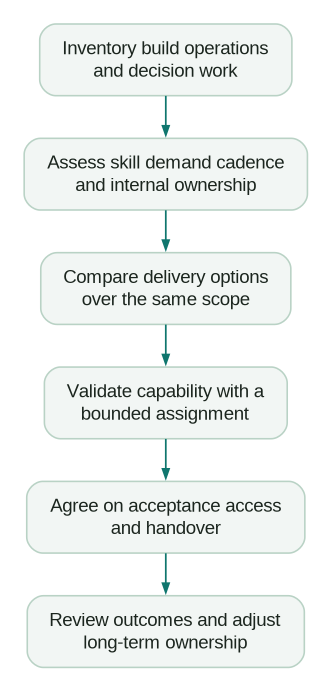
Read diagram as text
- Inventory build operations and decision work with an owner to Persistent work needs daily business context?.
- Persistent work needs daily business context? to Evaluate an in-house owner with specialist backup: Yes.
- Persistent work needs daily business context? to What delivery work remains?: No.
- What delivery work remains? to Evaluate an agency team: Multi-skill defined build.
- What delivery work remains? to Evaluate a freelancer: Bounded specialist task.
- What delivery work remains? to Evaluate managed support and coverage: Recurring administration.
- Evaluate an in-house owner with specialist backup to Representative assignment and handover pass?.
- Evaluate an agency team to Representative assignment and handover pass?.
- Evaluate a freelancer to Representative assignment and handover pass?.
- Evaluate managed support and coverage to Representative assignment and handover pass?.
- Representative assignment and handover pass? to Correct scope coverage or the provider choice: No.
- Correct scope coverage or the provider choice to Persistent work needs daily business context?.
- Representative assignment and handover pass? to Agree ownership access exit and workload reviews: Yes
Which signs justify changing the delivery model?
Change the arrangement when observed workload, response delays or business-context needs exceed the capacity you bought. Use a ticket log, time records and incident timestamps to identify the cause before adding another supplier or hire.
| Signal | Evidence to collect | Decision to examine |
|---|---|---|
| Recurring work crosses the cost crossover | Comparable delivery hours for three consecutive months | Recalculate a hire versus support using your own costs |
| Incidents wait in a supplier queue | Impact, escalation time and first useful response | Change coverage or bring critical operations closer to the team |
| Provider makes daily product-context decisions | Decisions repeatedly returned for clarification | Give an internal operator more responsibility |
| Employee mostly handles unrelated work | Time by task and rejected priorities | Redefine the role or buy focused specialist capacity |
| A sole administrator is leaving | Access inventory and another operator's rehearsal | Fund a transition before replacing the person |
| Overlapping tools recreate the same issue | Repeat incidents and duplicated capability | Simplify the stack before staffing around it |
The 88.8-hour crossover above belongs to that hypothetical cost model. Three consecutive months is a suggested review trigger, not a universal hiring threshold. Use a maturity assessment of the workflows you depend on to identify the operating gap, and retire overlapping tools before staffing around them when complexity is creating avoidable work.
Which arrangement should you choose for the next phase?
Use an agency when a defined implementation needs coordinated skills and the team can make the required decisions. Use a freelancer when a bounded specialist can work with a capable internal owner. Hire when the workload and context justify sustained capacity. Add fractional leadership when prioritization and cross-team operating decisions are the missing capability.
None of these options removes your need to decide what good looks like. If that is unresolved, start with the martech business-case guide and define the outcome, alternatives and acceptance before buying capacity. For measurement work, agree marketing ROI definitions finance can check before choosing who will maintain the inputs. Use a maturity assessment of the workflows you depend on to name the operating gap the chosen delivery model must close.
Martechdevs fits a defined build when you need a martech development partner with a fixed scope and handover, including HubSpot or Salesforce implementation with a documented handover. If the need is a permanent daily owner embedded in your company, build that role deliberately rather than using an implementation project to conceal a staffing gap.
Start with the $99 martech audit to identify the work, or request a detailed implementation scope when the backlog and acceptance criteria are ready.
| Situation | Best starting fit | Runner-up | Deciding evidence |
|---|---|---|---|
| Bounded build across several systems | Agency with the required specialists | Freelancer team with one delivery owner | Accepted scope and coordination capacity |
| Narrow specialist repair | Freelancer | Agency specialist | Representative test and availability |
| Steady administration below a full-time load | Managed support | Part-time internal operator | Ticket volume, coverage and escalation needs |
| Daily decisions tied to product and customers | In-house owner | Internal owner supported by specialists | Persistent backlog and decision frequency |
| Conflicting priorities across revenue teams | Fractional RevOps plus a builder | Internal operations leader | Authority to settle definitions and accept work |
What should you confirm before committing to a delivery model?
Confirm the backlog, acceptance owner and operating responsibilities before signing.
Checklist
- The backlog separates building, operating and business decisions.
- Skills and recurring workload are based on actual requirements.
- Cost comparisons use the same scope, horizon and support obligations.
- Internal coordination and review capacity are available.
- The assigned delivery people and backup arrangements are known.
- Acceptance covers working outputs, exceptions and documentation.
- Accounts, code rights, dependencies and exit requirements are explicit.
- Access is scoped, and supplier offboarding can occur without breaking production.
- The future operator participates before the final handover.
- The arrangement will be reviewed when workload or business needs change.
Keep reading
Browse all Martech Strategy guides
 Martech Strategy
Marketo Managed Services: What's Included, What It Costs and When to Hire In-House
Marketo managed services cover campaigns, admin and Salesforce sync. Compare scoped cost examples, included work and when hiring in-house costs less.
Jafrin Akter AloLast updated 28 min read
 Martech Strategy
How to Build a Martech Business Case Your CFO Can Evaluate
Build a defensible martech business case with an eight-part proposal, three-year cash examples, alternatives, downside scenarios and clear pilot acceptance.
Jafrin Akter AloLast updated 13 min read
 Martech Strategy
Martech data integration: choose the method for each flow and prove it works
Connect martech tools flow by flow: write a sync contract, pick the simplest method, then test and monitor it. Includes a worked example and a checklist.
Jafrin Akter AloLast updated 18 min read
Martech integration
See the implementation scope, deliverables and acceptance checks.
Questions people ask
Can an agency and an internal admin safely change the same platform?
Yes, if one person owns the production change queue and release acceptance. Give both parties a shared change log, a sandbox or staging rule, and an agreed freeze window for sensitive launches. Require each change to identify its test evidence and rollback. A shared login or an informal message that something changed is insufficient coordination.
How should we compare a retainer with a supplier's hourly quote?
Normalize both proposals to the same work and coverage. List the expected tickets, planned changes, review meetings and incident response, then ask which consume the allowance. Include rollover, minimum charges and exclusions. Use a normal month and a busy month. A cheaper hourly price can still produce a larger bill if investigation and coordination are omitted from the comparison.
Should a paid selection exercise use production customer data?
Start with the least sensitive representative sample that can expose the problem. Define the permitted fields, access duration and disposal requirement before sharing it. If a real production investigation is necessary, give scoped access and a named reviewer. The exercise should reveal reasoning and exception handling without granting unrestricted administration merely to assess a potential supplier.
What should we do when a provider substitutes its lead engineer?
Use the agreed substitution process to review the replacement's relevant experience and availability. Ask for a handover of open decisions, recent changes and known faults, then have the new engineer perform a bounded task with the existing runbook. Confirm whether the change affects deadlines or support coverage. Keep acceptance tied to the deliverable and its evidence.
How can finance distinguish staff capacity released from actual savings?
Record the cost that will disappear from a budget separately from hours people can use elsewhere. Ending an external retainer creates a different cash effect from freeing a salaried employee for other work. Give reassigned hours an explicit planned use, and avoid counting their value again as reduced payroll unless the staffing budget will actually change.
Sources
- BLS software development and testing role descriptions
- BLS employer compensation components
- UK government agile-contracting guidance
- Google Cloud service-account key guidance
- GitHub repository transfer behavior
- BLS: June 2026 employer compensation release
- Salesforce: Premier Success Plan
- Salesforce: Signature Success Plan
- Atlassian: RACI chart

Written by
Jafrin Akter AloData Engineer and Co-founder at Martechdevs and Growth and Analytics Partners
Jafrin writes practical guides to marketing technology, customer data, analytics and AI workflows. Martechdevs is a Growth and Analytics Partners company.