Reverse ETL Tools Compared: Hightouch, Fivetran Activations, Segment, RudderStack and Others
Data Engineer and Co-founder at Martechdevs and Growth and Analytics Partners
Last updated 19 min read
Choose a reverse ETL tool by the destination operations your team needs, the people who will maintain them and the unit that drives the bill. Hightouch, Fivetran Activations, Segment, RudderStack, Airbyte and Polytomic can serve different versions of that job. Shortlist two against the same warehouse model, then test rejected rows, removals, recovery and ongoing cost before signing.
What does a reverse ETL tool do?
A reverse ETL tool sends selected warehouse data into operational applications. ETL means extract, transform and load; reverse ETL applies that movement to destinations such as a CRM, messaging platform or advertising audience. The useful output is a correct operational record or action, with evidence that it arrived.
For example, a warehouse account model might supply renewal context to Salesforce, product engagement to HubSpot and suppression membership to Google Ads. Those are different operations even when they originate from the same customer data.
The tool typically manages change detection, mappings, delivery and execution history. It cannot supply a missing business definition or decide whether a stale eligibility signal should trigger a campaign. Start with how reverse ETL works and how to design a safe sync for that contract.
Our data warehouse and activation implementation work connects the model, destination matching and acceptance tests. This comparison focuses on selecting the delivery tool once those requirements are clear.
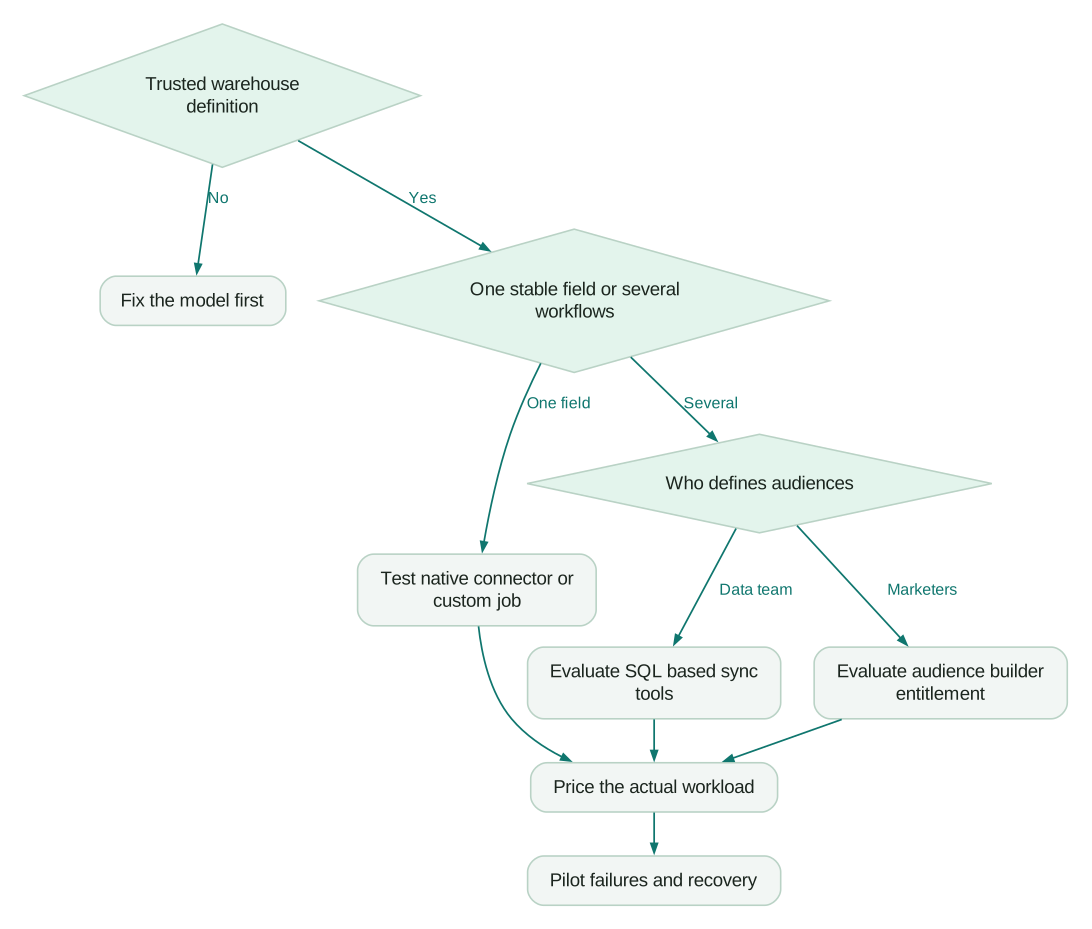
Which reverse ETL tools should you shortlist?
Start with the product you already operate if it supports the exact destination behaviour. Add a dedicated candidate when its audience interface, recovery controls or commercial model solves a demonstrated gap. The following recommendations come from documentation and published plans, rather than a hands-on performance benchmark.
| Operating situation | First candidate | Runner-up | What should decide the pilot |
|---|---|---|---|
| Marketers need to build audiences from approved warehouse data | Hightouch with Customer Studio | Fivetran Activations | Marketer independence and the quoted audience-builder scope |
| Fivetran already owns ingestion and transformation scheduling | Fivetran Activations | Hightouch | Dependency controls and the activation-specific quote |
| Segment already collects product events | Segment Reverse ETL | RudderStack | Required object actions, shared usage and failure handling |
| Engineering wants collection and activation in one event budget | RudderStack | Segment Reverse ETL | Per-destination usage and the actual plan limits |
| An existing Airbyte team can own the connector lifecycle | Airbyte data activation | Polytomic | Edition, destination maturity and rejected-record visibility |
| Operations needs varied application and database syncs | Polytomic | A dedicated reverse ETL product | Matching, null handling and support for the difficult object |
| One stable field goes to one application | Native connector or a small maintained job | The existing licensed platform | Maintenance responsibility and recovery cost |
A weaker fit is a product that needs extra systems or custom code to complete the one workflow you bought it for. Count those dependencies in the decision, even if its base subscription is smaller.
How should you compare the tools one by one?
Compare each candidate's operating fit and exact paid configuration. Free allowances and product limits below were checked on 18 October 2026. Startup discounts are excluded unless an applicable written offer is confirmed; a free plan is not evidence of a separate startup programme.
Hightouch
- Best for: teams that want marketers to build audiences over data the warehouse team has prepared.
- Pros: Customer Studio supports audience building without SQL after schema setup. Its documentation currently places it on Business-tier plans. Customer Studio overview.
- Cons: the public Composable CDP package and documentation's Business-tier labels need to be reconciled in the quote. Do not infer premium controls from the free sync allowance.
- Free tier and startup offer: Basic Reverse ETL includes up to two active syncs, unlimited destinations and unlimited seats. Paid usage has no public dollar rate on the pricing page. Hightouch pricing.
- Choose it if: the audience builder and a configured failure gate pass the pilot on the quoted package. Check Hightouch pricing in detail, including what counts as an active sync.
- Skip it if: the budget assumes the free tier includes the audience interface or orchestration features your workflow requires.
Fivetran Activations, formerly Census
- Best for: teams evaluating warehouse activation alongside an existing Fivetran operating process.
- Pros: dependencies can link activation syncs with Fivetran connections and transformations. A Sequence starts a dependent sync after its specified parent succeeds. Triggering and scheduling.
- Cons: ingestion and activation have distinct consumption curves. An existing ingestion agreement does not establish the marginal activation price.
- Free tier and startup offer: current documentation lists 3,500 monthly active rows (MAR) across Activations on Free and a 14-day trial for each new activation. Paid usage needs the activation rate schedule. Activations usage rules.
- Choose it if: the parent-failure test prevents dependent writes and the actual changed-row population fits the agreement. Use the head-to-head with Census, now Fivetran Activations for a closer two-tool comparison.
- Skip it if: the evaluation assumes every completed parent job proves its model is correct. Required data tests must affect that parent's success status.
Segment Reverse ETL
- Best for: a team already using Segment that can reuse its destination operations and access model.
- Pros: SQL models and destination-specific actions can carry warehouse state into business tools. The dbt extension can schedule delivery after a successful dbt Cloud job. Reverse ETL setup, dbt extension.
- Cons: collection billing and reverse ETL records are separate limits. The current Connections page also conflicts on additional monthly tracked user rates: its detailed bands and FAQ differ. Confirm the complete subscription in writing.
- Free tier and startup offer: the pricing page lists 500,000 monthly Reverse ETL records on Free and 1,000,000 on Team. Other limits, including collected visitors and source count, still apply. Connections pricing.
- Choose it if: the required update, removal and failed-job cases work using the existing platform. Compare teams replacing Segment's collection as well only if collection is also part of the decision.
- Skip it if: the purchase depends on treating every event-stream destination as a direct object-sync destination. Verify the action and mapping you actually need.
RudderStack Reverse ETL
- Best for: engineering-led teams combining event collection with warehouse activation.
- Pros: supported Upsert and Mirror modes send incremental changes after the initial full load. Full sync mode resends everything; changing a mapping can also trigger a full run. Sync modes.
- Cons: every record sent counts as an event for each connection. Sending one record to three destinations consumes three events. Collection traffic also needs room in the budget. Reverse ETL billing.
- Free tier and startup offer: Free includes 250,000 events monthly and ten Reverse ETL connections; Growth has 25 connections and Enterprise lists unlimited connections. RudderStack pricing.
- Choose it if: the destination-specific mode works and the RudderStack event pricing forecast includes retries, full loads and every receiving connection.
- Skip it if: you need a destination operation that its connector cannot perform. Salesforce Bulk Upload, for example, is upsert-only; failed-record retries default on. Salesforce Bulk Upload setup.
Airbyte data activation
- Best for: teams that already operate Airbyte and can evaluate the specific outbound connector on their edition.
- Pros: the data-activation documentation marks Core, Standard, Plus, Pro and Enterprise Flex available, with HubSpot, Customer.io, Marketo and Zendesk among its examples. Data activation.
- Cons: capability and observability have different boundaries. The separate rejected-records documentation is marked for Pro and Enterprise Flex; verify the equivalent diagnosis and recovery path on your proposed edition. Rejected records.
- Free tier and startup offer: self-managed Core and managed Cloud have different operating costs. Standard/Plus use credits, while Pro/Enterprise Flex use capacity. A Cloud trial is temporary; infrastructure and maintenance remain part of a self-managed budget. Billing and credits.
- Choose it if: the destination's update, rejection and recovery cases pass, and the deployment model fits the people maintaining it. Use Airbyte credit pricing for the managed-service forecast.
- Skip it if: the business case assumes an ingestion connector's maturity automatically proves its outbound counterpart's behaviour.
Polytomic
- Best for: teams that want a sync product spanning databases, warehouses and operational applications.
- Pros: Salesforce controls include skipping or copying nulls and an option to write only values that differ from Salesforce. Those are concrete behaviours to test against CRM automation. Salesforce connector.
- Cons: rejection of one record need not stop the whole run. Invalid Salesforce relationship values fail the affected record by default while other records continue.
- Free tier and startup offer: the public page starts at USD 500 per month and requires a discussion for package scope. It does not establish a generally available free production plan. Polytomic pricing.
- Choose it if: the difficult relationship and null cases pass with an acceptable complete quote. Include a null identity in the trial: a creation-capable Salesforce mode can create a new record despite that missing identity.
- Skip it if: the proposal relies on a whole-run data-quality stop that has not been demonstrated. Record-level rejection is a different control.
A small custom job
- Best for: one or two stable syncs with a named engineer and a narrow destination contract.
- Pros: you control the selected fields, schedule and business checks without another platform subscription.
- Cons: the team must implement change detection, checkpoints, retries, throttling, row-level results, removals and credential maintenance.
- Free tier and startup offer: software you write has no third-party platform allowance, but engineering time, infrastructure and support are real costs.
- Choose it if: a tested quality gate controls the trigger, an outbox records intended writes, and another engineer can recover a partial failure. An outbox is a durable list of operations waiting to be delivered.
- Skip it if: the plan ends at a scheduled script and a success email. Price the operator and failure handling before calling the build cheaper.
Which requirements should disqualify a candidate?
Disqualify a tool when it cannot perform the required operation safely on the proposed plan. Resolve these constraints before scoring convenience or interface preference.
Destination operations and matching
Name the object and operation: update an existing company, upsert a contact, remove audience membership or clear a property. Upsert means create a missing record or update an existing one. Support for a CRM logo does not prove support for each operation.
Hightouch's Salesforce upsert path requires a matching field explicitly marked External ID and Unique. Updating by Salesforce's own record ID uses Update mode. Preserve that distinction when designing the pilot. Hightouch Salesforce matching.
Ask the vendor to demonstrate a missing key, two records sharing a key, a merged customer and a protected field. Match companies and people separately. A person's email address is not a reliable substitute for an account identifier.
Sync state, warehouse cost and exit effort
Ask where the previous-run state, credentials, errors and mappings live, who can access them and what happens when they are reset. Segment, for example, maintains state tables inside the warehouse and requires appropriate write permissions. Segment's sync system.
A warehouse query can scan a large table to find a handful of changes. Record query cost and runtime as well as destination writes. Ask whether a mapping edit, key change or expired checkpoint causes a full replay.
For either migration direction, inventory models, mappings, destination IDs, schedules, exclusions and operational owners. Warehouse SQL may carry over; vendor-specific state rarely becomes portable just because it sits in your warehouse. Run the replacement against a test destination, reconcile it, then assign one production writer before retiring the old path.
Controls that stop writes
Most failure alerts report a problem after some work has happened. Hightouch must enable advanced alerting before its warning, critical and STOP controls are available. Its pre-send STOP for unexpected volume applies specifically to journey trigger syncs; rejected-row alerts are evaluated after a run. Its paid dbt Cloud extension skips delivery when the job fails, and Business-tier Sequences can stop subsequent syncs on selected errors. Fivetran Sequences wait for parent success, while its Failed Records alert defaults to 75%. Configure the gate and deliberately break its prerequisite. Hightouch alerts, dbt scheduling, Sequences, Fivetran alerts.
Use the reverse ETL design guide for the complete bad-data method. A test that raises a notification after writing the wrong values has proved notification delivery, not prevention.
The people operating the audience
Have the intended marketer edit an audience and explain its exclusions. Have the data owner diagnose a failed row. If either task requires assistance, include that work in the operating model. An AI-generated audience needs the same definition and preview checks as one built manually.
How do the billing units compare on one workload?
The same workload produces sync counts, sent events, successful records or distinct active rows depending on the vendor. Comparing those meters requires a delivery forecast with repeated changes separated from unique identities.
This hypothetical 30-day month starts with a full load, followed by 30 daily incremental runs. Each destination receives its own model. No new identities, removals, retries, backfills or mapping changes occur after the initial load; every planned delivery succeeds. A changed row is sent once per daily run.
| Destination workload | Initial records | Changed records/day | Incremental sends over 30 days | First-month sends |
|---|---|---|---|---|
| HubSpot companies | 5,000 | 600 | 18,000 | 23,000 |
| Customer.io people | 20,000 | 2,000 | 60,000 | 80,000 |
| Google Ads suppression members | 15,000 | 300 | 9,000 | 24,000 |
| Total across destination paths | 40,000 | 2,900 | 87,000 | 127,000 |
The first-month arithmetic is 40,000 + (600 + 2,000 + 300) × 30 = 127,000. These are operational deliveries, not matched ad users or unique people across the company.
Translate the workload into each meter
Plan limits checked 18 October 2026. Counts below are monthly unless stated otherwise. Dollar amounts require the selected contract; the table does not claim equivalent paid packages.
| Product | Meter applied to this example | What the example establishes | What remains to price |
|---|---|---|---|
| Hightouch | Three active syncs | Exceeds Basic's two-sync allowance | Paid scope, audience builder and required orchestration |
| RudderStack | 127,000 first-month events across three connections | Within the published 250,000-event allowance if other usage is zero | Collection traffic, replays, retry treatment and plan features |
| Segment | 127,000 successful destination-record deliveries | Below the published 500,000 Reverse ETL allowance | Other plan limits, routing path and contractual excess treatment |
| Fivetran Activations | Distinct keys per activation sync, aggregated per activation | Daily change counts alone do not determine MAR | Unique-key distribution, trial treatment and activation consumption curve |
| Airbyte | Deployment and source-dependent usage | Row sends alone cannot establish Cloud credits or self-hosted cost | Source bytes/records, connector edition, runtime and infrastructure |
| Polytomic | Quoted package | The USD 500/month floor is not this workload's quote | Included systems, operations, capacity and support |
RudderStack explicitly charges each receiving connection. Its Upsert/Mirror mode documentation supports incremental operation after the first full load. Full syncs or mapping changes would invalidate the simple forecast above. RudderStack meter, Full-sync behaviour.
Segment's system documentation counts successful records per destination and excludes failed deliveries from the usage limit. Its processing limit is not a monthly spending stop. Reconcile the actual usage view rather than pricing the model's total rows on every run. Segment usage definition.
Segment extraction itself does not add monthly tracked users (MTUs), but routing through its Segment Connections destination can. That route treats the data as ordinary incoming events. A reverse ETL record allowance therefore cannot establish the whole bill. Reverse ETL and MTUs.
Why monthly active rows need an identity count
Fivetran counts a qualifying active key once per calendar month within each activation sync, even when it changes repeatedly. Keys in different activation syncs are counted separately, and usage aggregates per activation. Initial-sync and trial rules also affect charges. Fivetran usage definition.
For a later steady-state month with the same fixed populations, changing the same 600 companies, 2,000 people and 300 audience members every day produces 2,900 distinct active keys across the three paths. Spreading changes across different identities can produce up to 5,000 + 20,000 + 9,000 = 34,000 keys. Both patterns produce 87,000 sends.
That range explains why a monthly active row is different from a monthly sent record. It does not establish a Fivetran invoice: apply the activation-specific curve, plan, trial and contractual rules to the actual unique keys.
Include year two and operating work
Keep temporary trials out of the normal monthly baseline. If a quote is USD 500 monthly for the required Polytomic scope, twelve unchanged payments would be USD 6,000 in either year before implementation or other costs. The published starting price alone cannot confirm that quote.
For an internal comparison, four maintenance hours a month valued at an assumed USD 90/hour represent USD 4,320 of annual capacity. Add infrastructure and incident work separately. Removing that maintenance creates cash savings only when spending actually falls; otherwise it releases staff time. Apply the same accounting to a custom job and a managed platform.
What happened to Census, Castled and Grouparoo?
Census now sits within Fivetran Activations; older open-source names require individual maintenance checks. A familiar listing in an old comparison is insufficient evidence that the software remains available or maintained.
Fivetran announced its agreement to acquire Census on 1 May 2025, and its migration FAQ dates the unified Activations experience to 15 October 2026. Existing contracts and migration terms need the Hightouch versus Fivetran Activations guide, rather than assumptions from a pre-acquisition price list. Acquisition announcement, Census migration FAQ.
Maintenance checks on 18 October 2026 found:
- Castled: the former
castledio/castledrepository returns 404. The public organisation shows SDK and documentation repositories, with the latest recorded push in October 2024. The old domain redirects through a landing page and did not provide current product documentation in this check. Treat a maintained supported product as unverified. Castled's public repositories. - Grouparoo: the repository is archived and read-only, with the archive dated 12 April 2022. Existing code can remain inspectable without an active maintenance commitment. Grouparoo repository.
- Multiwoven: the public repository is unarchived, lists AGPL-3.0 and had a default-branch commit on 15 October 2026. Its README describes ongoing development. Review the licence, connector implementation and recovery tests before adopting it; activity alone is not production validation. Multiwoven repository.
For an existing unmaintained deployment, freeze unreviewed changes, export mappings and credentials inventory, and test a replacement against a sandbox. Preserve the old system's behaviour as a reference while removing its production write authority at the agreed cutover.
When can a native connection avoid another platform?
A native route can be enough when one destination, its supported fields and its schedule complete the job. Test it against the same requirements before adding a general-purpose sync product.
Google Ads Data Manager supports BigQuery and Snowflake sources. Its documented maximum scheduled import frequency is daily. Use native audience connectors for Google Ads when that timing and the supported audience operations fit. Connection scheduling.
HubSpot's Snowflake Direct Sync is currently a beta documented for Data Hub Enterprise. It provides one-way scheduled syncs with creation/update choices; this is not an entitlement shared by every HubSpot subscription. HubSpot requirements.
Salesforce Data 360's zero-copy route can access external warehouse data through federation. Establish whether the business needs that access or a materialized CRM-field update. Querying an external attribute and overwriting an Account field are different acceptance criteria. Salesforce zero-copy choices.
For a Snowflake-focused shortlist, Omnata is another architecture to inspect: its sync engine runs within Snowflake, with pricing by active endpoint and sync direction. Include Snowflake resource consumption and the required plugin rather than assuming a free engine makes the workflow free. Omnata architecture, Pricing model.
What do user reviews contribute to the decision?
User reviews supply test questions about support, diagnosis and setup effort. They do not establish your connector's current capabilities or justify ranking products with different scopes by one score.
G2 snapshots checked 18 October 2026. Ratings are out of five; counts are displayed platform totals, not the number of comments evaluated here. Several visible entries are invited or incentivized, and the samples lean positive.
| Product profile | Rating / 5 | Displayed reviews | Question prompted by the visible comments |
|---|---|---|---|
| Hightouch | 4.6 | 421 | How much schema preparation is needed before marketers can work alone? |
| Twilio Segment | 4.5 | 567 | Can the operator diagnose delivery and forecast the broader subscription? |
| RudderStack | 4.7 | 52 | Can the team trace failed events and control usage without extensive support? |
| Airbyte | 4.4 | 79 | Does this particular connector handle realistic failures and volume? |
| Polytomic | 4.8 | 49 | Does the purchased support and error visibility meet the operating need? |
Hightouch reviews, Segment reviews, RudderStack reviews, Airbyte reviews, Polytomic reviews.
Airbyte and Segment reviews cover broader products than reverse ETL. A current Activations-specific review snapshot was not verified, so legacy Census scores are not presented as a rating of the new unified experience. Ask for references using the same destination, operation and current product edition, then verify their relevant constraints in your own pilot.
What should a pilot prove before production?
A pilot should prove correct destination state, controlled failure and recovery. Run both candidates against separate test destinations with the same model and expected outcomes; do not let both write to production merely to compare counts.
Use these proposed acceptance cases. They are a test design, not results from a vendor benchmark.
| Test case | Required result | Evidence to retain |
|---|---|---|
| Existing record changes | Only intended writable fields change | Source version and destination readback |
| Row exits an audience | The agreed removal occurs without deleting an unrelated CRM record | Membership state and operation log |
| Null, empty string and zero | Each follows its defined meaning | Before/after values for every case |
| Duplicate or missing match key | The configured exception path runs | Rejected key and diagnostic reason |
| Destination rejects a field | Affected rows remain visible for repair | Row result and accountable owner |
| Destination throttles or times out | Bounded recovery without repeating an unsafe action | Attempts, responses and final state |
| Upstream validation fails | Dependent production writes do not start | Failed test, skipped run and unchanged destination |
| Mapping edit or history reset | Replay scope and usage are understood | Planned rows, actual sends and usage view |
Measure model rows, valid rows, changed rows, attempted writes, accepted writes and verified state separately. In a hypothetical run, 1,000 model rows minus 20 invalid rows leave 980 valid rows. If only 300 changed, and the destination accepts 294 and rejects six, delivery is 294 accepted writes. Reporting 980 synced records would confuse valid input with delivery.
Read back the critical fields and inspect any automation they trigger. If transport succeeded but another integration overwrote the value, the workflow still failed its intended contract. Use the Hightouch pilot failure cases as one implementation-specific extension.
Checklist
- Every sync has a destination object, operation and business owner.
- Model keys and destination matching rules are unique and appropriate to the chosen operation.
- Required field types, nulls, protected fields and removals passed the test cases.
- Sync-state storage, log retention and access are documented.
- First loads, incremental changes, retries and backfills are included in the forecast.
- A failed upstream validation demonstrably stops dependent writes.
- Alert thresholds and escalation match the consequence of failure.
- Rejected rows enter a reviewable repair process.
- The quote covers the tested edition and the period after trial benefits.
- Mappings, models and destination IDs are available for an eventual exit.
At Martechdevs, we scope the first syncs around destination matching, upstream checks and evidence of delivery. Start with a free martech audit when the failure is still unclear, or get a scoped quote for your first syncs with the warehouse, destination objects and expected operations.
Questions people ask
Who should approve changes to a warehouse audience model?
Use joint approval from the business owner of eligibility and the data owner of its implementation. A technically valid query can still change which customers receive a campaign. Record the intended population change, inspect added and removed members, and agree when the new definition takes effect. The sync operator should receive that version and its expected consequences before enabling delivery.
Can pausing reverse ETL stop a message already queued elsewhere?
Pausing future sync runs does not necessarily stop an active run or cancel work the destination already scheduled. Check the sync engine's in-progress run controls and the lifecycle platform's queued messages separately. If the audience was wrong, stop or suppress the affected destination workflow, repair the data and verify recovery before resuming. Restoring a warehouse model cannot unsend a message.
Should every destination receive the full customer profile?
Send the fields needed for the specific action and its verification. More columns increase mapping, access and maintenance obligations without necessarily improving the workflow. Document why each destination needs an identifier, eligibility field or supporting reason. Keep sensitive attributes out of broadly visible logs and alerts, and verify the destination's permissions and data-use requirements before expanding the payload.
What happens when two integrations write the same CRM property?
The result depends on write order, destination rules and the integrations' retry behaviour. Assign one authoritative writer per property where possible and give other systems separate fields for their inputs. Test an older update arriving after a newer one and inspect any resulting automation. A successful response from both integrations does not prove that the final CRM value is correct.
What should a reverse ETL support escalation contain?
Include the affected sync, time window, source version, intended operation and sanitized examples of failed records. Separate the model's row count from attempted and accepted writes, and describe what changed before the failure. Provide the destination's error message through an appropriate restricted channel. This lets the vendor investigate a specific boundary without circulating a complete customer dataset or guessing from a dashboard screenshot.
Sources
- Hightouch: Customer Studio overview. Accessed 18 October 2026.
- Hightouch: Pricing. Accessed 18 October 2026.
- Fivetran: Activations triggering and scheduling. Accessed 18 October 2026.
- Fivetran: Usage-based pricing. Accessed 18 October 2026.
- Twilio Segment: Set up Reverse ETL. Accessed 18 October 2026.
- Twilio Segment: dbt extension. Accessed 18 October 2026.
- Twilio: Connections pricing. Accessed 18 October 2026.
- RudderStack: Reverse ETL sync modes. Accessed 18 October 2026.
- RudderStack: Reverse ETL overview. Accessed 18 October 2026.
- RudderStack: Pricing. Accessed 18 October 2026.
- RudderStack: Salesforce Bulk Upload setup. Accessed 18 October 2026.
- Airbyte: Data activation. Accessed 18 October 2026.
- Airbyte: Rejected records. Accessed 18 October 2026.
- Airbyte: Billing and credits. Accessed 18 October 2026.
- Polytomic: Salesforce connector. Accessed 18 October 2026.
- Polytomic: Pricing. Accessed 18 October 2026.
- Hightouch: Salesforce destination. Accessed 18 October 2026.
- Twilio Segment: Reverse ETL system. Accessed 18 October 2026.
- Hightouch: Configure sync alerts. Accessed 18 October 2026.
- Hightouch: dbt Cloud extension. Accessed 18 October 2026.
- Hightouch: Run syncs in a sequence. Accessed 18 October 2026.
- Fivetran: Activations alerts. Accessed 18 October 2026.
- Twilio Segment: MTUs, throughput and billing. Accessed 18 October 2026.
- Fivetran: Agreement to acquire Census. Accessed 18 October 2026.
- Fivetran: Census migration FAQ. Accessed 18 October 2026.
- GitHub / Castled: Public repositories. Accessed 18 October 2026.
- GitHub / Grouparoo: Grouparoo repository. Accessed 18 October 2026.
- GitHub / Multiwoven: Multiwoven repository. Accessed 18 October 2026.
- Google: BigQuery data source. Accessed 18 October 2026.
- Google: Snowflake data source. Accessed 18 October 2026.
- Google: Connection scheduling. Accessed 18 October 2026.
- HubSpot: Sync Snowflake data to HubSpot. Accessed 18 October 2026.
- Salesforce: Data 360 zero-copy choices. Accessed 18 October 2026.
- Omnata: How Sync works. Accessed 18 October 2026.
- Omnata: Sync pricing. Accessed 18 October 2026.
- G2: Hightouch reviews. Accessed 18 October 2026.
- G2: Twilio Segment reviews. Accessed 18 October 2026.
- G2: RudderStack reviews. Accessed 18 October 2026.
- G2: Airbyte reviews. Accessed 18 October 2026.
- G2: Polytomic reviews. Accessed 18 October 2026.

Written by
Jafrin Akter AloData Engineer and Co-founder at Martechdevs and Growth and Analytics Partners
Jafrin writes practical guides to marketing technology, customer data, analytics and AI workflows. Martechdevs is a Growth and Analytics Partners company.