
What Is a Martech Stack? Layers, Data Flows and Ownership for Small Teams
A martech stack is the set of tools and connections a company uses to attract customers, understand their behaviour and improve the customer relationship. It includes analytics, CRM, messaging and the data flows between them. For a small product company, a useful stack lets a customer action become a reliable report or a relevant follow-up, with someone responsible for each step.
On this page
Stripe can record a payment while HubSpot still treats the buyer as a prospect. Both tools can work exactly as configured. The missing connection decides whether sales sends the wrong message and whether the revenue report explains what happened.
That is the practical starting point for martech stack architecture: follow a customer through the systems you already use, then identify where useful information stops moving.
What does a martech stack include?
Most marketing technology stacks perform eight jobs: collect, store, model, measure, activate, engage, support and give approved AI tools access to context. One product can cover several jobs, and a small company rarely needs a separate purchase for every layer.
Start with a business question: “Which trial accounts reached value and should receive help from sales?” The answer needs product events, account identity, a definition of value and a destination for the result. A list of software logos cannot explain that path.
| Layer | What it produces | First ownership question |
|---|---|---|
| Collect | An event or source record | Who confirms that the action happened? |
| Store | Retained data and history | Who controls access and recovery? |
| Model | A defined customer or business fact | Who approves the meaning? |
| Measure | A report used for a decision | Who acts on the result? |
| Activate | An operational field, audience or event | Who permits the destination write? |
| Engage | A message or customer interaction | Who owns eligibility and suppression? |
| Support | A problem, resolution and customer context | Who keeps the status accurate? |
| AI and MCP | Approved access to context and actions | Who limits authority and checks results? |
Martechdevs' integration work connects those paths across the tools a team uses. The reference stack examples show how the same jobs look in SaaS, ecommerce, mobile apps and marketplaces.
Collect: capture the action where it happens
Collection brings website, product, billing and sales activity into the stack. Google Tag Manager manages website tags. Product SDKs, which are libraries installed in an application, capture product interactions. Backend events record business changes such as an accepted invitation or a successful payment.
Choose the source that can establish the fact. A click on “Pay” establishes intent. A confirmed payment from the billing system establishes a payment outcome. Name the events accordingly so a later analyst does not have to guess which meaning you intended.
Store: preserve records at the right level
Your application database owns product records. Stripe owns its billing objects. HubSpot or Salesforce owns its sales records. A warehouse such as BigQuery or Snowflake can hold copies for analysis across systems.
A warehouse becomes useful when questions require those systems together and manual joins keep recurring. A founder who can answer the important questions from two dependable exports may have a more urgent investment elsewhere. Use the warehouse decision guide to assess that threshold.
Model: turn records into agreed definitions
Modelling transforms source records into business concepts such as active account, recurring revenue or first meaningful product use. SQL is the query language commonly used for this work; dbt is one option for organising and testing the transformations.
Write down the definition before building the dashboard. For “active account,” specify the qualifying actions, time window, exclusions and account identifier. Logging in and completing a core workflow answer different questions about value.
Measure: answer a decision
GA4 measures acquisition and website behaviour. Mixpanel or Amplitude can analyse product journeys and retention. BI tools present models across product, CRM and billing data. Their overlap does not make their answers interchangeable.
Decide who uses each report and what changes because of it. A weekly acquisition report may guide budget allocation; an account activation report may guide onboarding work. When two tools show different totals, compare their definitions and populations before replacing either tool. Use those agreed definitions to calculate marketing ROI from reconciled inputs.
Activate: send a useful result back to an operating tool
Data activation turns a calculated result into something another system can use. A warehouse model might identify trial accounts that have completed onboarding, then update a HubSpot property. Reverse ETL is the process of sending warehouse data into these operating tools.
Direct integrations and small scheduled jobs can also do this. Choose a dedicated activation platform when the number of destinations, identity rules, monitoring needs or maintenance burden justifies it.
Engage: respond at the right moment
Customer.io, Braze, HubSpot and Klaviyo can run different kinds of customer communication. Pick based on your business model, channels, event needs and operating team. A SaaS onboarding journey and a Shopify replenishment journey need different inputs.
Every journey needs an entry rule, an exit rule and a check immediately before sending. A person who paid during the delay between two emails should leave the trial-conversion sequence. The lifecycle journey library gives concrete examples.
Support: keep customer problems in context
A support system records conversations, ticket status and ownership. Useful integration can show support a customer's plan and recent account activity, while allowing lifecycle teams to pause unsuitable messages during an unresolved incident.
Send the fields the receiving team needs. Copying full support transcripts into every marketing system increases access and retention work without necessarily improving a decision. A current escalation flag and account ID may be sufficient.
AI and MCP: expose trusted context and permitted actions
An AI assistant can use approved tools to inspect CRM records, query models or draft an action. Model Context Protocol, or MCP, is a standard way for an AI application to connect to tools and data. The MCP introduction describes that connection between AI applications and external systems. Your implementation still needs its own access controls and definitions.
An assistant cannot infer a dependable customer relationship from five unrelated IDs. Give it a documented account model and restricted tools. Begin with a question whose answer can be independently checked, such as explaining last week's qualified trials by source.
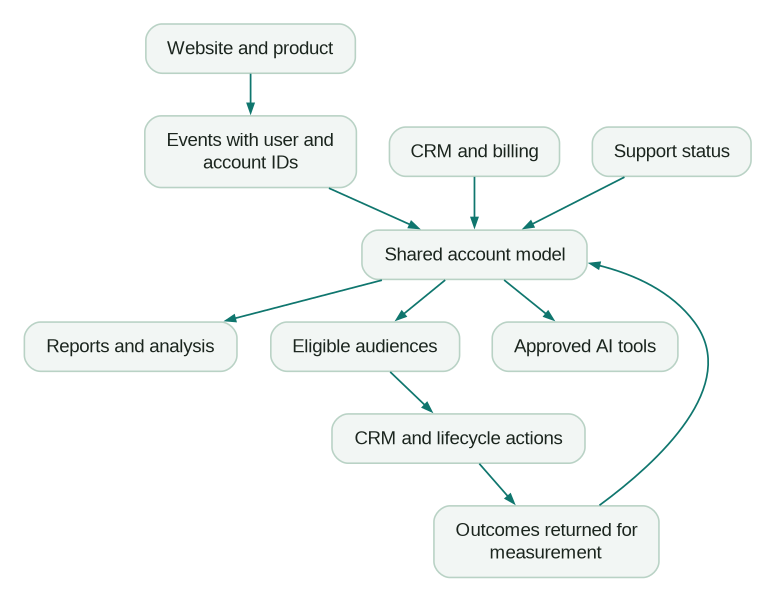
Read diagram as text
- Website and product to Events with user and account IDs.
- CRM and billing to Shared account model.
- Events with user and account IDs to Shared account model.
- Shared account model to Reports and analysis.
- Shared account model to Eligible audiences.
- Eligible audiences to CRM and lifecycle actions.
- Support status to Shared account model.
- Shared account model to Approved AI tools.
- CRM and lifecycle actions to Outcomes returned for measurement.
- Outcomes returned for measurement to Shared account model
What should a B2B martech stack include?
A B2B martech stack needs account identity, acquisition measurement, CRM stages, product or service usage, billing outcomes and a way to coordinate follow-up. Start with the handoff you need to improve, such as qualified trial to sales conversation. Add a tool only when an existing system cannot perform its assigned job reliably.
An illustrative SaaS stack could use GA4 for acquisition, HubSpot or Salesforce for the sales process, product events for activation, Stripe for billing and Customer.io or Braze for lifecycle messages. A warehouse becomes useful when the required account view repeatedly joins those systems. The B2B SaaS stack guide develops the architecture.
| B2B question | Record needed | Operating destination |
|---|---|---|
| Which trial account reached value? | Account membership and the agreed activation event | CRM account or company record |
| Who should sales contact? | Role, eligibility, activity and existing owner | Assigned sales task with context |
| Has the prospect already paid? | Confirmed subscription or payment state | Sales and lifecycle stop conditions |
| Which acquisition produces retained revenue? | Acquisition, account mapping, billing and retention | Reconciled reporting model |
Use a person identifier and an account identifier separately. One consultant can administer several customers; several colleagues can contribute to one buying decision. Segment's Group specification illustrates that relationship. A company name copied onto a contact cannot express every membership or its removal.
What is an integrated martech stack?
An integrated martech stack moves agreed customer facts between systems with stable identifiers, clear field ownership and a known delivery delay. Integration includes what happens when a record changes, disappears or arrives twice. A collection of connected apps becomes dependable only when the receiving workflow acts on the intended current state.
For example, an accepted payment should update billing state, stop the relevant trial reminder and reach the revenue model. Give that payment one occurrence ID and preserve the subscription or account it belongs to. Stripe explicitly documents duplicate delivery and event-ordering considerations for webhooks; the receiving design must handle them.
Test the business result at each boundary: payment accepted, state available, journey evaluated and reminder suppressed. A successful connector run establishes transport; it does not prove the customer decision. The martech data integration guide covers ownership, failure handling and reconciliation in more detail.
What makes the connections reliable?
Reliable connections preserve identity, meaning, freshness and ownership. Test those properties explicitly; a green connector status only tells you that a particular transfer succeeded. Use those properties to plan and test each martech data integration, rather than approving a connection from its status alone.
Record decisions that are expensive to undo later, especially identity, event meaning, consent handling and export access, before the first dependent workflow ships.
Identity: Give a person a stable user_id and an organisation a stable account_id. Email addresses can change. Twilio Segment's Identify specification recommends an enduring database identifier rather than treating email as the user key.
Relationships: A person can belong to several accounts. Record membership and role instead of overwriting one company field each time they switch workspaces. Segment's Group specification supports associating people with groups, but destination support and removal behaviour need separate checks.
Meaning: Keep an event name, required properties, triggering condition and version in a tracking plan. A property called revenue needs a currency and a policy on tax, refunds and timing.
Freshness: Distinguish the time an action happened from the time it arrived. A nightly sync may be suitable for board reporting and unsuitable for a message that must stop immediately after purchase.
Ownership: Name the person responsible for the source, transfer and destination behaviour. Give the connection a failure alert and a repair procedure, including how to replay records without duplicating actions.
Stripe documents duplicate webhook delivery and a lack of guaranteed event ordering in its webhook guidance. A connector therefore needs more than a working first request. It must handle repeat deliveries and delayed changes without sending the customer through the same action twice.
For each connection, retain a short contract: source, destination, matching key, allowed fields, expected delay, retry policy and proof of the final result. Test a duplicate delivery, an older update arriving late and a missing destination record before expanding the automation.
What should a startup buy first?
Buy enough to run the next important customer workflow. For a small SaaS team, that usually means dependable billing, a CRM if people manage sales conversations, basic acquisition measurement, product events for activation and a messaging tool suited to onboarding. The free starter-stack guide checks whether that workflow fits the actual seats, allowances and history limits before a paid purchase.
Use what a startup adds at each funding stage to match each new purchase to a current workflow and a named owner.
Put ownership before expansion. If nobody can maintain an event definition, adding a CDP will create another place where the same ambiguity appears. A customer data platform, or CDP, collects and distributes customer data; it still needs a deliberate identity model and destination configuration. Check whether a workflow needs a CDP, a data warehouse or both before buying either.
Use this purchasing sequence:
- Write the recurring decision or action that currently takes too much manual work.
- Identify the source records required to make it reliable.
- Check whether an existing tool can perform the job with a supported integration.
- Estimate the cost of configuration, monitoring and recovery as well as the subscription.
- Pilot one complete workflow before extending it to other teams.
Use the same test cases when deciding how to choose between two martech tools.
Sequence the next period of work around the workflow that passes those tests, with dependencies and operating time visible.
The first warehouse, CDP or AI assistant should have a named job and an owner. Buying a future architecture without a current use case creates maintenance before it creates value.
Check startup programs that cut the first-year bill before the first paid upgrade, then budget the normal price after the offer ends.
Which first decisions are hard to change later?
Set the durable identifiers and meanings before more systems depend on them. These choices usually deserve attention before another subscription:
- Take stable person and account IDs from the application's controlled identity model, with membership represented separately.
- Name events for a confirmed action and keep the trigger in a tracking plan.
- Define consent and suppression handling across collection and destination use.
- Choose CRM entities, relationships and internal property names for the actual business grain.
- Preserve the raw history, export access and deletion policy needed to reproduce an output.
The scalability guide explains the vendor constraints behind these choices and how to test a later change.
How does the stack change as a company grows?
Add a layer when a recurring workflow outgrows its current method. Headcount is context, not a purchasing rule.
At 1 to 10 people, connect activation to payment. At 10 to 25, make account qualification repeatable. At 25 to 50, govern shared definitions and operating handoffs. See the twelve reference stacks by company size.
Pre-seed establishes events and IDs; seed connects CRM, lifecycle and analytics. Series A can justify a warehouse for recurring cross-system questions; Series B may need broader activation and ownership. The startup stage guide explains the triggers.
What does this look like in practice?
A useful stack connects one business outcome through identity, eligibility, delivery and verification. Consider an illustrative 12-person SaaS company using a product database, Stripe, HubSpot and Customer.io. Each Monday, an operator joins exports to identify trials that connected a data source, invited a colleague and have not paid.
Assume that work takes three hours a week at an internal loaded cost of $60 an hour. The manual process costs about $780 a month using 52 weeks divided by 12 months. These are planning assumptions, not a measured client result.
The proposed connection writes stable account IDs to the relevant systems, models the qualifying behaviour and updates an eligibility property. Before a message sends, Customer.io checks the latest payment and suppression state. A daily reconciliation compares eligible accounts with the records successfully delivered.
Suppose added software costs USD 120 a month, maintenance takes one hour at USD 60, and implementation costs USD 3,600. These are hypothetical planning inputs, including the implementation amount; they are not Martechdevs or vendor quotes.
Amounts below are USD. Recurring amounts are monthly equivalents using 52 weeks divided by 12 months; implementation is a one-time cost. The assumptions are stated for this example.
| Input or result | Calculation | Amount | Meaning |
|---|---|---|---|
| Current manual work | 3 hours × USD 60 × 52 ÷ 12 | 780 | Monthly staff-capacity value |
| New recurring cost | USD 120 software + USD 60 maintenance | 180 | Monthly cost under the assumption |
| Full-work-removal benefit | USD 780 − USD 180 | 600 | Monthly net capacity-adjusted benefit |
| Implementation | Assumed one-time project cost | 3,600 | Cash needed before the recurring benefit |
| Half-work-removal benefit | USD 390 − USD 180 | 210 | Monthly benefit when half the work remains |
At USD 600 a month, simple recovery of the assumed implementation cost takes six months. At USD 210, it takes about 17.1 months. The calculation excludes financing, risk and any commercial uplift. Staff time released is capacity value; it becomes cash savings only when an actual expense falls.
That sensitivity may justify a smaller direct integration before a broader warehouse project. Measure how much work disappears after launch instead of treating the original estimate as an achieved saving.
For a different business model, review how the same layers change by industry before reusing this example's identity and revenue assumptions.
What costs continue beyond the licence fee?
Running cost includes subscriptions and commitments, usage meters, integration upkeep and people. A low licence price can still require expensive reconciliation or maintenance. Use what a martech stack costs to run to turn those components into a quarterly register.
The example's USD 780 monthly manual-work value belongs in the operating comparison, alongside software, retries, monitoring, support and time spent on exceptions. Keep shared costs separate from costs that change between options. For one-off work, the implementation cost guide explains how scope changes a quote.
Who should own the martech stack?
Assign an accountable role to each important system, connection and business definition. Then name the person doing the implementation or operating work, with a backup and enough time to perform it.
An agency or freelancer can build and support an agreed scope; an internal role should retain decisions about definitions, acceptance and customer treatment. An employee can own recurring work when there is enough demand and the right skills. The guide to who should run the stack day to day compares those arrangements.
Putting the founder's name against every system without reserving operating time leaves the practical gap unresolved. The martech RACI separates defining, building and operating so the same person need not decide everything.
How do you know the stack is working?
Trace one customer from signup through the authoritative record, the report and the next message. Confirm the right identity, meaning, time and permission at each step, including an exception such as a payment during an email delay.
Apply the five-level martech maturity model to that workflow. These are our assessment levels, not an industry certification:
| Level | Evidence for the same workflow | Next useful improvement |
|---|---|---|
| Ad hoc | The result depends on one person's memory | Write the outcome and assign an owner |
| Repeatable | Another operator can follow the documented steps | Verify the cross-system handoffs |
| Connected and controlled | Matching, delivery and exceptions work together | Monitor the real operating result |
| Measured in operation | Failures and delays are tracked against an agreement | Test changes and recovery |
| Adaptable | The team can change the workflow and contain a failed release | Maintain that evidence as the business changes |
A single successful test proves one path. Ongoing checks establish whether the path remains dependable. Record both and use them to choose the next improvement.
How do you avoid a stack that nobody can maintain?
Keep a short operating record beside the architecture. For each system, record its business purpose, owner, billing unit, renewal date, access method and data exports. For each connection, record the identifiers, schedule, failure alert and recovery method.
Add a tool only when its benefit survives that maintenance cost. A free product that creates two hours of weekly reconciliation has a cost. A paid connector that removes a fragile custom job may reduce the total burden.
Review workflows when the business changes: a second product, a new sales motion, multiple regions or a new billing model can invalidate old assumptions. The stack audit guide provides a way to turn that review into an ordered fix list.
What signals unnecessary tool overlap?
Too many overlapping tools show up as two products maintaining the same audience, competing definitions of the same metric, paid seats with no active job and connectors nobody owns. Confirm the capability that must survive before cancelling anything. The stack rationalisation guide helps decide which overlapping tools to keep or retire.
How do martech stack audit and optimisation services differ?
A martech stack audit identifies the current problems, their business impact and the order to address them. Optimisation implements selected improvements, such as fixing identity, retiring a duplicate tool or changing an unreliable workflow. Agree the deliverable before buying: a diagnosis and a running production change require different access, ownership and acceptance evidence.
| Service | Useful deliverable | What proves completion? |
|---|---|---|
| Stack audit | Current-state map, evidence, risks and prioritised recommendations | Each recommendation names the affected decision and next action |
| Optimisation | A scoped change to data, tools or workflows | Before-and-after acceptance checks pass and an owner takes over |
| Ongoing support | Monitoring, incident response and maintained changes | Agreed response and maintenance work is recorded |
Martechdevs' $99 audit includes a written assessment and a one-hour specialist call. Implementation is scoped separately. Bring a tool list, one disputed report, one failed handoff and the relevant contracts; that gives the review a useful starting point. The stack audit checklist helps collect the evidence.
How do you build the business case for stack rationalisation?
Build the business case from avoidable spend and work that can actually stop after the change. Subtract migration, overlap and ongoing operating cost, then show the payback under a slower delivery scenario. Keep revenue improvements outside the committed saving until an experiment or accepted business record supports them.
Consider a hypothetical consolidation in USD. Two overlapping tools cost $1,200 a month. A replacement plus ongoing maintenance costs $700 a month. Migration costs $3,000, and one additional month of the old tools costs $1,200. The net monthly saving is $500; the transition cost is $4,200.
| Measure | Calculation | Result |
|---|---|---|
| Monthly operating saving | 1,200 − 700 | $500 |
| Change and overlap cost | 3,000 + 1,200 | $4,200 |
| Simple payback after cutover | 4,200 ÷ 500 | 8.4 months |
| First-year benefit if savings start immediately | 12 × 500 − 4,200 | $1,800 |
| First-year benefit with three fewer saving months | 9 × 500 − 4,200 | $300 |
These are planning assumptions, not vendor quotes or a forecast of your return. Count a cancelled licence only after its notice period permits the saving. Time released by automation becomes cash saving only when expenditure actually falls; otherwise describe it as available capacity for named work. Use the stack rationalisation guide to decide which capabilities must survive before cancelling a contract.
What should your first stack map prove?
The map should let another operator trace a customer action to the resulting record, report or message. Start by drawing a stack map the team will keep current, then check the operating details below.
Checklist
- Name the customer journey and business decision the stack must support.
- Identify the system that owns each important fact.
- Define stable person, account, subscription and transaction IDs.
- Write the qualifying event and metric definitions.
- Map every transfer with its direction and update frequency.
- Check consent, suppression and deletion behaviour at destinations.
- Assign an owner, alert and replay procedure to each critical connection.
- Record subscription, usage and maintenance costs together.
- Prove one complete workflow with realistic exceptions.
- Review the map when a tool, product or business model changes.
At Martechdevs, we build and document the connections between customer data, reporting and the next operational action. Request a detailed integration scope when the required outcome and dependencies are clear. For readiness, use the free AI readiness checklist, or explore an AI assistant built around your approved workflows.
Want a second pair of eyes on your stack? Book a free call with one workflow you want to make dependable.
Keep reading
Browse all Martech Strategy guides
 Martech Strategy
CMS vs CRM: Website Content, Customer Records and Integration
Compare CMS and CRM responsibilities, publishing access, customer identity and integration. Includes a worked submission example and an end-to-end handoff checklist.
Jafrin Akter AloLast updated 11 min read
 Martech Strategy
Seat vs Usage-Based Pricing: Models, Cost Crossovers and Buyer Checks
Compare seat, usage and hybrid SaaS pricing with worked crossovers, allowance and tier examples, commitment costs, invoice checks and a founder margin model.
Jafrin Akter AloLast updated 11 min read
 Martech Strategy
Martech stack examples: 12 practical setups for teams of 1 to 50
12 martech stack examples for SaaS, Shopify, apps and marketplaces, with illustrative monthly budgets. SaaS teams of up to 10: $250 to $800.
Jafrin Akter AloLast updated 21 min read
Martech integration
See the implementation scope, deliverables and acceptance checks.
Questions people ask
What is the difference between martech and adtech?
Martech covers technology used for acquisition, measurement and customer relationships. Adtech focuses on buying, serving, targeting and measuring advertising. They overlap when ad platforms exchange conversion or audience data with a CRM, analytics system or warehouse. Map the data and permitted uses across that boundary rather than assuming the category label determines who owns the record.
How many tools should a startup have?
There is no target count for a small team. Zylo's 2026 vendor dataset reports an average of 305 SaaS applications and a median of 240 across organisations and departments; those figures are not startup martech recommendations. Buy around the trigger that justifies each tool, including who will maintain it and what existing work it replaces.
How many martech products are available?
Chiefmartec's 5 May 2026 landscape lists 15,505 products, up 0.79% from its 2025 count. That is a dated market inventory, not a shopping list or a requirement to cover every category. Narrow the options by your business model, required data, operating capacity and the next customer workflow that needs improvement.
Can a spreadsheet be part of a martech stack?
Yes. A controlled spreadsheet can hold definitions, a small operating queue or a reviewed transfer between tools. Give it an owner, access rules, stable identifiers and a recovery process. Replace the manual step when its volume, delay or error cost justifies automation. The acceptance test remains whether the right customer record reaches the intended action reliably.
What is the difference between a martech stack and a tech stack?
A martech stack is the part of a company's software and data flows used for acquisition, measurement and customer work. The broader tech stack also includes product infrastructure, application development and internal operations. They can share databases, identity services and engineering owners. The boundary is a responsibility and use-case decision, rather than a list of tools that must be bought separately.
Sources

Written by
Jafrin Akter AloData Engineer and Co-founder at Martechdevs and Growth and Analytics Partners
Jafrin writes practical guides to marketing technology, customer data, analytics and AI workflows. Martechdevs is a Growth and Analytics Partners company.