How to choose martech tools: a head-to-head method for teams of 1 to 50
Data Engineer and Co-founder at Martechdevs and Growth and Analytics Partners
Last updated 19 min read
Choose martech tools by making two candidates prove the same useful job, then pricing the working setup beyond any promotion. Define the user, action, data and failure conditions first. Translate each vendor's billing units into your workload, test the difficult case, and price the exit. Buy when the evidence supports a choice and someone can operate it after handover.
Do you need a new tool or a better implementation?
A new tool is justified when an important job remains unsupported, a commercial change makes the current arrangement unsuitable, or the existing product fails a written acceptance test. Missing events, unclear ownership and contradictory field updates usually need investigation before a replacement decision.
Audit the current stack to identify the constraint. If two products overlap, the stack rationalisation guide addresses which capability to keep. This guide begins once you have a specific job and a short list of candidates.
How do you write a tool requirement that can be tested?
Write who needs to do what, with which data and how often. Replace category labels with an observable result.
Use this sentence: “The [operator] must [make a decision or complete an action] using [required data] within [time or frequency], and we will accept it when [known result].”
| Job | Testable requirement | Evidence of completion |
|---|---|---|
| Product analytics | A product manager compares seven-day activation for eligible workspaces each week | A known multi-user fixture produces the expected account count |
| Lifecycle messaging | A marketer reminds the relevant trial owner unless that workspace converts | A conversion during the delay prevents the stale reminder |
| CRM | A seller sees the current commercial account and permitted next action | A late source update cannot revert a paid account to trial |
| Data activation | An operator updates an audience after source eligibility changes | The destination receives the correct membership change within the agreed delay |
When the job crosses systems, martech integration work includes the matching key, update order, permissions and recovery path. Buying the endpoint tools does not define that contract.
Do not select from category names alone. Segment's current Free Connections plan includes Reverse ETL records as well as event collection, so a “CDP versus reverse ETL” label can conceal overlapping capabilities. Inspect the exact operation and plan. Segment's current packaging, checked on 17 October 2026.
Choose the hardest valuable workflow for the pilot. A standard welcome message or a count of all pageviews can pass while the real account relationship, exception or handoff fails.
Which requirements should disqualify a tool before scoring it?
Treat mandatory requirements as pass/fail gates before comparing preferences. A weighted score should not let attractive dashboards compensate for a missing access control, unusable export or incorrect customer action.
| Requirement class | Example | Decision rule |
|---|---|---|
| Mandatory behaviour | Suppress a reminder after a qualifying purchase | Must pass the defined fixture |
| Mandatory access | Restrict customer data to the intended operator | Must demonstrate the actual role and data boundary |
| Commercial constraint | Affordable complete cost after an introductory period | Must fit the agreed budget and commitment |
| Preference | Fewer clicks to build a weekly report | Compare after mandatory gates pass |
| Future possibility | A channel the business might launch next year | Record the trigger; do not purchase it without a reason |
Keep the shortlist to two or three products with credible routes through those gates. Ask the operators to build the same task, and record what requires help from engineering, an agency or the vendor. A workaround is not automatically unacceptable, but its owner and cost belong in the comparison.
If both pass, prefer the one your team can maintain with a manageable exit. If neither passes, revise the shortlist or the requirement explicitly. Do not quietly weaken the test to justify a favourite demo.
How do you compare prices when the billing units differ?
Convert each vendor's meter into the same business workload before comparing monthly totals. Events, tracked users, profiles, active rows, sync definitions and AI outcomes are different quantities.
The examples below were checked on 17 October 2026. Free allowances are monthly unless stated otherwise; USD amounts describe the named subscription or usage unit and exclude taxes and other products.
| Product or category | Published meter or allowance | Input your forecast needs |
|---|---|---|
| Mixpanel and Amplitude | Free analytics: 1M and 2M events respectively | Client events, backend events, identity treatment and backfills |
| Segment Connections | Free: 1,000 visitors and 500,000 Reverse ETL records; Team includes 10,000 visitors | Tracked people and reverse-ETL activity separately |
| Customer.io Essentials | From USD 100/month with 5,000 profiles | People plus objects, send volume and required package |
| Fivetran connections | Free up to 500,000 monthly active rows | Qualifying changed rows under the connector's billing rules |
| Hightouch Basic Reverse ETL | Up to two active syncs | Working sync definitions, required schedule and destinations |
| Clay Free | 500 Actions and 100 Data Credits | Successful operations, data providers, validation and reruns |
Sources: Mixpanel, Amplitude, Segment, Customer.io, Fivetran, Hightouch and Clay.
For example, 8,000 people plus 1,000 account objects are 9,000 profiles under Customer.io's people-and-objects model. They are not 8,000 profiles just because the CRM contains 8,000 contacts. Customer.io billing.
Build normal, growth and migration cases. The hypothetical analytics workload below uses client and server events together; it is a volume model, not a vendor quote.
| Scenario | Calculation | Monthly events | What to price separately |
|---|---|---|---|
| Current operation | 6,000 users × 300 events | 1,800,000 | Replay, flags and required add-ons |
| Growth | 12,000 users × 500 events | 6,000,000 | Changed identity mix and feature requirements |
| Growth plus historical import | 6M current events + 9M imported events | 15,000,000 | Each vendor's historical-ingestion treatment |
A row-based connector may count one repeatedly updated record differently from an event tool receiving every update. An active sync is not a count of its executions. Keep the definitions beside the quantities so another person can reproduce the estimate.
How should AI support usage be compared?
Price each vendor's defined outcome, not a shared label such as “AI conversation.” For chat and email in Intercom, Fin documents USD 0.99 for several outcome types and USD 9.99 for a sales qualification, with at most one charged outcome per conversation. Fin outcome definitions.
Zendesk lists automated resolutions at USD 1.50 committed or USD 2 pay-as-you-go after the applicable included allowance. Freshdesk includes 500 Freddy AI Agent sessions once per account, then lists USD 49 per 100 additional sessions. These figures were checked on 17 October 2026 and do not make a resolution, qualification and session equivalent. Zendesk pricing, Freshdesk pricing.
Run representative support cases and classify what each vendor would bill. Keep the price per billed unit separate from the cost per correctly completed customer job. Use the support AI pricing guide for the detailed definitions and assumptions.
What does “free” mean after the evaluation ends?
Separate an ongoing free allowance, a trial, a temporary credit balance and a declining startup discount. They produce different renewal decisions and different failure modes at the limit.
An ongoing free plan can still have feature or usage constraints. Microsoft describes Clarity as free without traffic limits; Zoho CRM Free covers three users; Google's Data Studio has no charge for creators and report viewers. Those facts do not make their underlying integrations, source queries or operating time free. Terms checked on 17 October 2026.
For email, Klaviyo and Mailchimp both currently show 250-profile/contact and 500-monthly-send free allowances, with Mailchimp also limiting daily sends. Their billing definitions differ. Compare the usable workflow and the Klaviyo/Mailchimp contact model, rather than choosing from the similar headline allowance.
The programme examples below were checked on 17 October 2026. Currency is USD where credits are shown; periods and discount scope are part of the offer, subject to acceptance.
| Programme | Initial benefit | Later decision | Qualification to retain |
|---|---|---|---|
| Freshdesk Free programme | Six months, two agents | Paid plan after month six | Freshdesk programme, not Freshdesk Omni |
| Customer.io Startup | Up to twelve months and 30,000 profiles | Price the post-programme package and usage | Acceptance and allowed audience sources |
| Mixpanel Startup Plan | Twelve months; 1B annual events | Select the appropriate continuing plan | Programme eligibility and annual allowance |
| Amplitude Startup | A free Growth year | Published 40% discount applies to annual Plus in year two | Required Growth/add-on capabilities may change the renewal |
| PostHog for Startups | USD 50,000 credit for twelve months | Fund usage after expiry | Several AI products and a BAA are excluded |
| Attio Startup | 80% off annual Pro in year one; 30% in year two | Fund the remaining subscription and later renewal | Up to ten seats; obtain confirmation for the eligibility route |
| HubSpot for Startups | Conditional 90%, 50%, 25% track; another 30%, 15% track | Price the eligible products beyond the discount | Net-new Professional/Enterprise scope and annual commitment |
Read the programme owner's terms: Freshdesk, Customer.io, Mixpanel, Amplitude, PostHog, Attio and HubSpot.
Attio's page describes a partner route in one passage and VC-backed eligibility in its FAQ. HubSpot's specific three-year schedule also sits beside a generic FAQ referring to a typical two-year discount period. Confirm the applicable offer rather than combining whichever clauses look most generous. The startup programmes guide keeps the detailed eligibility checks together.
Set a renewal decision before the benefit ends. A cheaper second-year tier may remove a feature the team adopted during the free year, and credit expiry can expose usage that was always chargeable but previously subsidised.
How do you calculate a budget beyond the introductory period?
Model the accepted offer year by year, then add the work and products needed to operate it. Use published cash prices where the supplier provides them; do not reconstruct an invoice from a rounded discount headline.
Intercom's current Early Stage help article covers customers joining before 29 June 2026 or from 8 October 2026. It lists a USD 903 monthly package comprising six Advanced seats, six Copilot seats, Proactive Support Plus and the included Pro add-on.
Prices below were checked on 17 October 2026. Monthly USD prices exclude additional usage and tax; annual figures multiply the published monthly package price by twelve and assume unchanged scope and terms.
| Programme year | Published discount | USD/month | USD/year |
|---|---|---|---|
| Year one | 93% headline | 65.00 | 780 |
| Year two | 50% | 451.50 | 5,418 |
| Year three | 25% | 677.25 | 8,127 |
The published USD 65 price is used directly because the percentage headline is rounded. The three-year package total is USD 14,325, compared with USD 32,508 at an unchanged USD 903 list price. Fin above the included allowance, SMS, outbound WhatsApp, phone and Operator-credit overages remain separate. Verify the account's joining cohort and accepted terms before applying this example.
Now add the actual implementation proposal, connectors, warehouse compute, administration and migration overlap. For a hypothetical alternative, suppose a different qualified tool costs USD 250 a month throughout three years, requires USD 3,000 of setup and takes four internal hours a month at USD 75/hour. Its economic cost is:
Subscription: 250 × 36 = USD 9,000
Implementation: USD 3,000
Operating capacity: 4 × 75 × 36 = USD 10,800
Three-year total: USD 22,800
The USD 22,800 is an invented planning scenario, not a vendor rate. It cannot be compared with Intercom's USD 14,325 subscription alone: add the equivalent operating lines and required usage on the Intercom side first. Keep cash payments and internal capacity costs separately visible.
Use Intercom's full billing model for its usage definitions and the martech business-case guide for an approval case. The purpose here is to compare two complete ways of doing one job, rather than build a second company-wide cost register.
What should you ask about access, integration and exit terms?
Ask each vendor to demonstrate the exact operation on the edition you would buy and document the commercial terms that could interrupt it. “Has an API” is an incomplete answer.
| Question | Evidence to request | Why it changes the decision |
|---|---|---|
| Can we export the needed history? | A representative raw export with IDs, dates and relationships | A chart CSV may omit the data required to switch |
| What does this integration sync? | Object, field, direction, delete and failure behaviour | A connector logo does not prove the intended data contract |
| Can operators investigate without excessive access? | Role-scoped demonstration and audit evidence | Broad permissions can create an avoidable operating dependency |
| What does AI or MCP actually access? | Available tools, scopes, product and usage meter | Documentation search and account actions are different capabilities |
| What happens at renewal or cancellation? | Notice, price-change, retention and export terms | A cheaper monthly equivalent can create a larger commitment |
For a concrete boundary, Mailchimp's Marketing documentation MCP searches published documentation. It is not evidence that an assistant can manage Marketing account records. The MCP versus API guide helps separate investigation from a repeatable production integration.
An exit rule can matter before you buy. Freshdesk's Free programme documentation says accounts suspended for exceeding its agent limit are deleted after 90 days. That is a specific programme condition, not a rule for all Freshdesk accounts. Put the relevant retention and recovery deadlines into the decision record before experimenting with a higher tier.
What should the same acceptance test contain?
Give both candidates the same input, expected result and operator, including one deliberate failure. Measure time to a correct answer and the effort required for someone else to reproduce it.
A useful hypothetical trial for a SaaS onboarding system contains these records:
| Test case | Expected result | Evidence to save |
|---|---|---|
| One person in a paid workspace and a separate trial workspace | Reminder concerns only the trial workspace | Recipient, workspace key and rendered context |
| Trial converts during a delay | No stale conversion reminder | Source update, evaluation time and suppression reason |
| The same business event arrives twice | One intended business action | Stable event key and destination record |
| An update arrives after a newer state | Newer state remains authoritative | Source versions and resulting state |
| Operator loses permission | Restricted work is unavailable | Actual role and failed permitted-scope test |
Adapt the same pattern to another tool: a late event for analytics, a refunded order for email, a revoked credential for a sync, or an incomplete record for a CRM workflow. Use synthetic records for failure tests wherever possible.
A practical evaluation can be organised around these outputs, with dates set by your team's capacity:
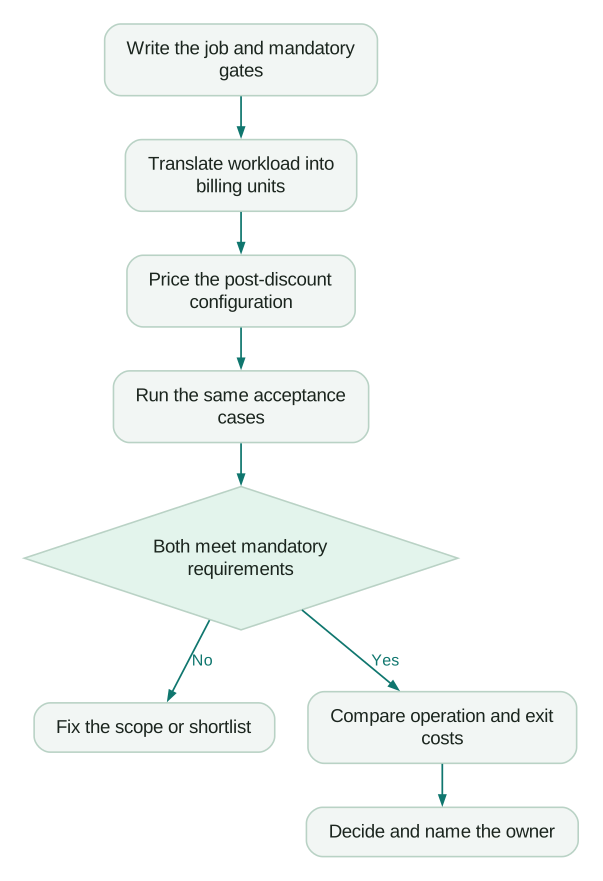
- Agree the job, mandatory gates and commercial workload.
- Configure the smallest comparable pilot in both products.
- Run the normal and failure cases, recording evidence and help required.
- Have the future operator repeat the task without the builder.
- Price the accepted configuration and both migration directions.
- Record the decision, unresolved inputs and next review trigger.
The result can be “neither qualifies” or “repair the existing setup.” Those are useful conclusions when the test explains why.
How do you price a switch in both directions?
Inventory what can be transferred, what must be rebuilt and what must operate in parallel. Data export and a complete working replacement are different deliverables.
| Workstream | What to measure | Cost or risk to include |
|---|---|---|
| History and identity | Records, mappings, timestamps and relationship rules | Export/import work and reconciliation |
| Customer permissions | Consent, preferences and suppression semantics | Incorrect targeting during or after cutover |
| Operational configuration | Reports, journeys, flags, routing and roles | Rebuild and acceptance testing |
| Parallel operation | Necessary overlap and which system owns each action | Two usage meters and duplicate-action prevention |
| Retirement | Export completion, access removal and cancellation deadline | Continuing charges or inaccessible history |
Keep the old system responsible for an action until the replacement has passed its acceptance checks, then switch ownership deliberately. Sending from both systems is usually a defect; measuring in both may be a deliberate, temporary comparison.
Price an exit from the proposed destination too. A small initial saving can be poor value if essential definitions and history become expensive to recover. The scalable-stack guide explains which ownership and export decisions become harder to reverse.
At Martechdevs, a fixed-price implementation or migration quote should name the flows, records, failure tests and handover. Use that scope to compare suppliers and internal work on the same basis.
Who should own the decision and the tool afterwards?
Name a business decision owner, a daily operator and owners for data definitions and the bill before signing. One person can hold several responsibilities in a small team, but each responsibility still needs an explicit answer. The agency, freelancer or in-house comparison helps decide who supplies the capacity. Keep account and documentation ownership with the business. Use a RACI that names the owner of each tool to keep the decision, implementation and ongoing operation distinct.
Which comparison fits the layer you are choosing?
Use the guide for your specific pair after agreeing the job and workload. The short verdicts below are starting points drawn from the linked guides; each guide retains its own dated source evidence and implementation tests.
Product analytics
- Mixpanel versus Amplitude: Mixpanel is a focused product-analysis pilot, with the benefit of a clear immediate job and the cost of confirming account and operating requirements. Amplitude offers broader workflows to test, with additional packaging and governance decisions.
- PostHog versus Mixpanel: PostHog is a first test for engineers joining behaviour and release investigation; its breadth needs ownership. Mixpanel is a first test for repeated product analysis; validate the complete workflow and bill rather than assuming it lacks replay or flags.
- Amplitude versus PostHog: Amplitude is a first test for analyst-led reporting, subject to its confirmed entitlements. PostHog suits an engineering-led investigation pilot, with per-product costs and limits to manage.
- Mixpanel versus GA4: Evaluate Mixpanel for product-behaviour questions and GA4 for acquisition work in Google's ecosystem. Each can serve a useful job; running both adds reconciliation and instrumentation responsibilities.
- Product analytics pricing: Compare the same event, identity and feature workload when the deciding question is the full analytics bill.
Lifecycle messaging
- Braze versus Customer.io: Customer.io is a useful small-SaaS pilot with an explainable account model and public entry price, but still needs sound events. Braze is a candidate for more coordinated mobile programmes, with greater commercial and operating scope to justify.
- Customer.io versus Klaviyo: Customer.io fits a product-event journey test, with relationship modelling to maintain. Klaviyo fits a store-data journey test, with active-profile and channel costs to reconcile.
- Customer.io versus Iterable: Customer.io offers an accessible first scoping exercise for SaaS messaging, while limits may change the package. Iterable warrants evaluation for established cross-channel operations, with a contract and implementation process to manage.
- Klaviyo versus Mailchimp: Klaviyo is a first pilot for a store's detailed retention work, with an operator and recurring bill to fund. Mailchimp is a first pilot for campaign-led work and supported commerce flows, with contact rules and post-promotion pricing to check.
CRM and support
- Attio versus HubSpot: Attio is a candidate for a flexible relationship model, but replacement marketing work can add costs. HubSpot is a candidate for connected marketing, sales and service operations, with the correct edition and contact model to price.
- HubSpot versus Salesforce for startups: HubSpot is a useful first test for shared workflows with a small administration team; limits can force a larger package. Salesforce deserves evaluation for more elaborate processes and relationships, with greater administration work to budget.
- Intercom versus Zendesk: Intercom is a first test when support grows from in-product conversations, with AI and channel usage to price. Zendesk is a first test for queue-led service operations, with routing, knowledge and administration requirements to validate.
Collection, pipelines and activation
- Segment versus RudderStack: Segment is a candidate for packaged collection and destinations, with separate product entitlements to inspect. RudderStack is a candidate for warehouse-centred models, with technical configuration and ownership to maintain.
- Hightouch versus Census/Fivetran Activations: Hightouch is a candidate for the required warehouse activation workflow; its scope needs a matched quote. Existing Census customers should inspect the Fivetran transition first, gaining continuity where it fits but facing changed billing and contract conditions.
- Fivetran versus Airbyte: Fivetran is a first test when managed connectors remove worthwhile operating work, with changed-row economics to verify. Airbyte is a candidate where tested stream coverage and deployment choice fit, with the corresponding maintenance responsibility.
- CDP versus warehouse: Compare the needed collection, identity, storage and activation capabilities; the categories can overlap or work together.
Warehouses
- Snowflake versus BigQuery: BigQuery is a first test for a Google-heavy analytics stack, with query and modelling costs to manage. Snowflake is a candidate when sharing, existing expertise or platform needs matter, with the complete compute and integration bill to evaluate.
- Snowflake versus Databricks: Start with the platform the team can operate. Snowflake can serve a warehouse reporting proposal; Databricks can fit an existing engineering environment. Either becomes a weaker choice when a small workload inherits unnecessary operating complexity.
Tracking, consent and attribution
- Stape versus Elevar: Stape-hosted server-side GTM offers configuration control with container QA to own. Elevar offers a Shopify-focused managed path whose supported events and destinations must cover the actual store.
- Consent management platforms: Choose by the journeys and regions to control, then test browser behaviour and the billable unit.
- AppsFlyer versus Adjust: Run the same acquisition, deep-link and reporting test with each proposed package. Both can serve a mobile-measurement shortlist; network fit, export access and the continuing contract settle the choice rather than a universal accuracy claim.
- Attribution, MMM or incrementality: Pick the method that can answer the next spending decision with the available outcomes and an explicit alternative.
Enrichment and outbound
- Clay versus Apollo: Clay is a candidate for combining sources and conditional research, with workflow maintenance to own. Apollo is a candidate for a more contained prospecting and sales workflow, with target-market data yield to test. Their features overlap.
- Apollo versus ZoomInfo: Apollo is a first test for accessible prospecting and sales execution; its coverage must fit the audience. ZoomInfo warrants a sample when account intelligence could change the sales motion, with a fuller quote and implementation scope to justify.
- Instantly versus Smartlead: Test replies, stop rules, account ownership and CRM updates in both. Either becomes costly when a cheap sending allowance leaves daily manual repairs; choose from the verified operating path.
Martech AI and build-versus-buy decisions
- Mixpanel AI versus Amplitude AI: Test the native assistant where trusted data already lives first; compare correct, inspectable answers and workflow effort before considering a platform move.
- AI decisioning options: Identify where context is prepared, actions are selected and messages are executed before comparing vendor roles.
- AI analysts for your warehouse: Start from the maintained model and access rules your business already trusts.
- Build or buy a martech AI agent: Choose how much software and operating responsibility the team should own for the specific task.
- MCP versus APIs and fixed workflows: Use assistant tools for changing investigative questions and defined integrations for repeatable production actions.
What should your final decision record contain?
Keep the chosen configuration, evidence, costs, unresolved conditions and owner in one record. A decision is reviewable when another person can see why the rejected option lost and which change would make the choice worth revisiting.
Checklist
- The job identifies user, action, data and frequency.
- Mandatory behaviour, access and commercial gates are separate from preferences.
- Normal, growth and backfill usage use each vendor's actual billing definition.
- Free limits and failure behaviour are recorded with a check date.
- Programme acceptance and the post-discount package are confirmed.
- Export, integration and AI access were demonstrated on the intended plan.
- The same normal and failure cases were tested in both tools.
- The future operator reproduced the task without the original builder.
- Migration, overlap and an eventual exit are costed.
- Account, definition and billing owners are named.
- Renewal or workload changes trigger a scheduled internal review.
Bring a specific shortlist and its hardest workflow to a free martech audit. A useful next step resolves the decision or implementation gap; it does not add another demo to the calendar.
Questions people ask
How much weight should review-site ratings carry in a tool decision?
Use ratings and individual reviews to discover cases your pilot should test. Read the reviewer's role, company type, date and any incentive or seller-invitation label. A highly rated product can still fail your required workflow, while a complaint about a different plan or old release may not describe the version you would buy.
What should we do when a vendor will not provide an exact quote?
Separate the known price from the unresolved scope and request a written estimate for the same workload and requirements given to the other candidate. Do not fill the missing amount with a competitor's unit rate or an online anecdote. If the commitment cannot be bounded within your budget, keep the purchase decision open.
Should the most technical person choose the martech tool alone?
The technical owner should assess data, access and operating feasibility, while the business owner remains responsible for the job and its value. Include the person who will operate the tool daily and the person approving its bill. A technically sound implementation still fails adoption if nobody can use it for the intended decision.
Can we keep the existing tool while evaluating a replacement?
Yes, when the overlap is bounded and each customer action has one owner. Duplicate measurement can help reconciliation, while duplicate messages, CRM writes or sequence enrolments can create failures. Record both usage meters and the cancellation deadline, then stop the overlap once the agreed evidence is complete rather than letting the pilot become permanent.
When is it worth reopening a decision that already worked?
Reopen it when a required workflow changes, the current setup fails a meaningful test, the vendor changes terms or the workload moves beyond the priced assumptions. First measure the new constraint and the cost of repairing the existing implementation. A new feature announcement alone is a weak reason to rebuild a working operating process.
Sources
- Twilio Segment: Connections pricing.
- Mixpanel: Pricing.
- Amplitude: Pricing.
- Customer.io: Pricing.
- Customer.io: Billing mechanics.
- Fivetran: Pricing and MAR allowances.
- Hightouch: Basic Reverse ETL pricing.
- Clay: Pricing and free allowances.
- Intercom: Fin outcome definitions.
- Zendesk: Pricing and automated resolutions.
- Freshworks: Freshdesk pricing and AI sessions.
- Microsoft: Clarity FAQ.
- Zoho: CRM plans.
- Google Cloud: Data Studio pricing.
- Freshdesk: Free programme.
- Customer.io: Startup programme.
- Mixpanel: Startup Plan.
- Amplitude: Startup Plan.
- PostHog: Startup programme.
- Attio: Startup programme.
- HubSpot: Startup programme.
- Intercom: Early Stage programme for the stated joining cohorts.
- Mailchimp: Marketing documentation MCP.
- Klaviyo: Free plan.
- Mailchimp: Free plan.

Written by
Jafrin Akter AloData Engineer and Co-founder at Martechdevs and Growth and Analytics Partners
Jafrin writes practical guides to marketing technology, customer data, analytics and AI workflows. Martechdevs is a Growth and Analytics Partners company.