
Seat vs Usage-Based Pricing: Models, Cost Crossovers and Buyer Checks
Seat pricing works best when paid access tracks the people receiving value and their workload is reasonably consistent. Usage-based pricing fits measurable work that can grow independently of headcount. Compare both against the same customer activity, including minimum commitments and overages. A hybrid model can cover ongoing service costs while charging separately for heavier consumption, provided customers can predict and verify the bill.
On this page
SaaS pricing models compared
The examples below use hypothetical USD rates; vendor examples are identified separately.
| Model | Charge basis | Practical fit | Main exposure |
|---|---|---|---|
| Per seat | Paid users × price | Collaboration and repeatable employee workflows | Unused access and expensive light users |
| Usage-based | Measured units × applicable rate | Workload growth independent of headcount | Variable bills and measurement disputes |
| Fixed fee plus usage | Base subscription and metered work | Ongoing account service plus variable processing | Paying for both components without understanding inclusions |
| Allowance plus overage | Base fee covering units, then excess usage | A predictable baseline with growth headroom | Allowance expiry and overage surprises |
| Committed consumption | Minimum purchase against eligible usage | Stable, measurable demand | Paying for a forecast the customer does not reach |
Stripe's recurring pricing model guide distinguishes seat, tiered and usage models, including fixed fees, overages and credit burndown. The commercial choice is broader than a billing setting: it changes the customer's buying decision, the product's incentives and the evidence needed to defend an invoice.
At Martechdevs, we connect customer data and revenue workflows to an agreed commercial definition. The product event, billable event and successful customer outcome can be different things. Write those definitions before comparing a price per user with a price per action.
The unit that belongs on the invoice
A useful billing unit is understandable to the buyer, measurable by the provider and connected to the work being purchased. It also needs a clear boundary. A seat might mean an invited user, an active user or an assigned paid licence. A usage unit might mean a request, processed record, message, completed task or unit of compute.
Stripe's per-seat model represents users as the purchased quantity. That simple formula still leaves a commercial decision: which roles need paid access and when quantity can fall. A viewer, temporary contractor and daily operator may need different rights even inside one account.
For usage, define the counted event in ordinary language. A request-based charge can apply even if the requested business outcome fails, depending on the agreement. A success-based charge needs an accepted definition of success, a correction process and a way to handle later reversals. Neither label resolves those details by itself.
The MTU versus event-pricing guide shows why the same activity can produce different quantities under different definitions. Monthly users, all events and billable events should not share one forecast column.
A worked cost crossover
Assume two hypothetical offers with equivalent required capabilities and no additional charges:
- Seat offer: $50 per paid user per month.
- Usage offer: $200 monthly base plus $0.008 per completed task.
Let the paid seat count be S and the monthly task count be Q. The seat bill is 50 × S. The usage bill is 200 + 0.008 × Q. Their costs match at Q = (50 × S - 200) / 0.008.
For twenty seats, the fixed bill is $1,000. The crossover is 100,000 monthly tasks. Below that quantity the stated usage offer costs less; above it the stated seat offer costs less, while its capability and usage conditions still need to hold.
| Company pattern | Paid seats | Monthly tasks | Seat bill / usage bill |
|---|---|---|---|
| Five-person startup | 5 | 5,000 | $250 / $240 |
| Twenty-person team | 20 | 50,000 | $1,000 / $600 |
| Same team at crossover | 20 | 100,000 | $1,000 / $1,000 |
| Small team with heavy automation | 5 | 200,000 | $250 / $1,800 |
| Many occasional users | 100 | 20,000 | $5,000 / $360 |
The five-person crossover is only 6,250 tasks. A recommendation based on the twenty-seat example would mislead that team. With four seats, the seat charge equals the usage offer's $200 base before any task consumption; any positive usage raises the latter above it. A negative calculated crossover for fewer seats means there is no nonnegative usage quantity at which the stated usage offer becomes cheaper.
Run the comparison for the actual paid population, not total employees. Then repeat it for the expected busiest month and the next contract year. A company can add automation while keeping headcount flat, so seat growth and usage growth deserve separate assumptions.
Included allowances and tier boundaries
An included allowance changes the crossover. Suppose the $200 base includes 25,000 tasks, with $0.008 charged only above that amount. The formula becomes 200 + 0.008 × max(Q - 25,000, 0).
For twenty $50 seats, the matching quantity is now 125,000 tasks. At 50,000 tasks, the usage offer costs $400 instead of $600 under the earlier model. The word “included” must therefore be translated into the actual formula before selecting a plan.
Tier labels also need care. Volume pricing applies the reached tier's rate to the whole quantity. Graduated pricing charges each band at its own rate. Stripe documents both and notes that a volume-priced total can decrease at a boundary. Volume and graduated tiers.
Consider an illustrative first band of up to 10,000 units at $0.01, followed by a $0.008 rate:
| Quantity | Volume calculation | Graduated calculation |
|---|---|---|
| 10,000 | 10,000 × $0.01 = $100.00 | 10,000 × $0.01 = $100.00 |
| 10,001 | 10,001 × $0.008 = $80.01 | $100 + 1 × $0.008 = $100.01 |
| 20,000 | 20,000 × $0.008 = $160.00 | $100 + 10,000 × $0.008 = $180.00 |
Amounts are rounded to cents for presentation. The exact 10,001-unit totals are $80.008 and $100.008. The contract and billing configuration must specify rounding, included amounts and any flat tier fees; the phrase “volume discount” alone is insufficient.
Real vendor examples and their boundaries
Salesforce Pro lists $100 per user per month with annual billing. Its Sales pricing page illustrates a seat-based subscription, while other products and consumption can add costs. Our Salesforce pricing guide separates the selected CRM package from the wider implementation.
BigQuery provides a different example. Its US on-demand query model includes the first 1 TiB monthly and charges $6.25 per additional TiB, with storage and other services separate. More people can create more scans, but the query meter follows processed data rather than a reader-seat count. BigQuery pricing.
Those products perform different jobs and their prices should not be compared as substitutes. They show the distinction between a commercial access unit and a consumption unit. Even within one vendor, seats, storage, credits and capacity can coexist.
A pricing page's free allowance is also different from a startup promotion. Record which entitlement continues, which expires and which requires an application. Compare the normal second-year bill before treating temporary credits as a lasting cost advantage.
Buyer scenarios and contract fit
| Buyer situation | First model to examine | Runner-up | Evidence for selection |
|---|---|---|---|
| Many occasional collaborators | Usage with low access cost | Role-specific seats | Real activity and required access |
| Few operators with heavy automation | Seat or capacity offer | Committed usage | Included workload and fair-use conditions |
| Predictable recurring workload | Commitment with tested headroom | Monthly usage | Consumption floor and unused-credit treatment |
| Seasonal business | Usage with flexible capacity | Seasonal seat arrangement | Peak rates and off-season minimums |
| Early product with uncertain adoption | Small base with clear allowance | Monthly seats | Affordable low-use bill and expansion rules |
These are starting points for evaluation. A cheap meter cannot compensate for missing capabilities, data access or recovery behavior. Test the business workflow first, then compare the complete cost of the configurations that pass.
For a growing buyer, ask for examples at the current quantity, twice that quantity and the highest credible spike. Include test environments, reprocessing, retries and retained data if the agreement bills them. The martech stack cost guide helps keep adjacent systems and implementation in the same decision.
Committed spend and the effective unit price
A commitment buys an obligation as well as a rate. In a hypothetical annual contract, a customer prepays $12,000 for 1.2 million units. The nominal rate is $0.01. If the customer uses only 600,000 eligible units before expiry, the effective paid rate is $0.02 per used unit.
If the allowance is divided into twelve monthly buckets of 100,000 with no rollover, uneven usage can be more expensive still. An idle month can lose its allowance while a busy month incurs overage. A pooled annual allowance and twelve monthly allowances produce different outcomes even when their headline totals match.
Request the commercial treatment of unused units, credits, cancellations, refunds, expansions and renewals. A commitment discount is useful only if the expected utilization and flexibility justify the obligation. Keep the downside case beside the expected case.
A forecast should distinguish the rate from utilization. A 20% lower contractual rate with half the purchased quantity unused can cost more per useful unit than an undiscounted flexible plan. Calculate total paid divided by accepted billable work over the actual expiry window.
Founder economics and customer incentives
Choose the pricing unit from customer value and delivery cost together. A seat model can be easy to explain but undercharge a small team running expensive automation. A raw-resource meter can track provider cost while remaining difficult for a business buyer to predict. A hybrid can help if each component has a clear purpose.
For an illustrative processing service, assume $0.008 revenue and $0.003 variable delivery cost per task. Before fixed account work, the contribution margin is ($0.008 - $0.003) / $0.008 = 62.5%. At 50,000 tasks, revenue is $400 and variable cost is $150.
Add an assumed $100 of monthly account-support cost and contribution falls to $150, or 37.5% of revenue. That calculation excludes other company expenses. It explains why a low-volume customer can need a base fee even when the marginal task has a healthy spread.
Test the incentive the unit creates. Charging for invited collaborators can discourage adoption across a team. Charging for every failed attempt can make customers pay for the provider's retries. Charging only for an outcome can create disputes if customers and the provider disagree about when it was achieved.
Metronome's billing-architecture guide treats the value exchange, usage and operating design as connected choices. Give product, engineering, finance and support one shared unit definition before announcing the model.
Metering and invoice integrity
A usage bill needs a reproducible trail from customer activity to invoice quantity. Give each billable event a stable identity, customer mapping, occurrence time, quantity and relevant pricing version. Retain enough evidence to investigate a disputed line without reconstructing the entire product session.
Stripe's account of its usage-billing architecture describes aligning usage with the pricing configuration in effect. Its AI billing guidance emphasizes deduplication and rule versioning. Use those principles to prevent a retry or a later price change from silently changing the customer's bill.
A small acceptance set should contain a normal event, the same event delivered twice, a late event, a correction, a price change and activity at the billing boundary. Specify the expected charge before running the cases. For the duplicate, distinguish a redelivery of the same work from a genuinely new billable operation.
Reconcile quantities at three points: the source ledger, the billing meter and the draft invoice. A green delivery response shows that something arrived; it does not prove that the customer, amount and period were correct. Our Stripe and CRM revenue reconciliation guide provides the broader data-control pattern.
Choose the current billing architecture deliberately. Stripe now directs most new usage-billing implementations toward Metronome, while its basic Billing Meters recording guide addresses existing users of that approach. Follow the path appropriate to the account rather than copying an older integration tutorial unchanged. Current usage recording guidance.
Spend controls and subscription changes
An alert informs someone; a hard limit must prevent additional work through a defined enforcement path. Decide whether reaching the limit blocks new work, queues it, reduces service or asks an authorized person to expand the budget. Make the customer-facing behavior consistent with the contract.
Stripe's usage-alert guide describes notifications and workflows that can remove access. Test the complete enforcement behavior, including in-flight requests and reporting delay, before describing an alert threshold as a maximum invoice amount.
For seats, specify when additions and reductions take effect. A proration can create a credit without automatically refunding it. Stripe documents that negative prorations are not automatically refunded and positive prorations are not immediately billed unless configured or acted on accordingly. Proration behavior. Subscription entitlement, invoice adjustment and cash movement need separate checks.
Pricing-model acceptance
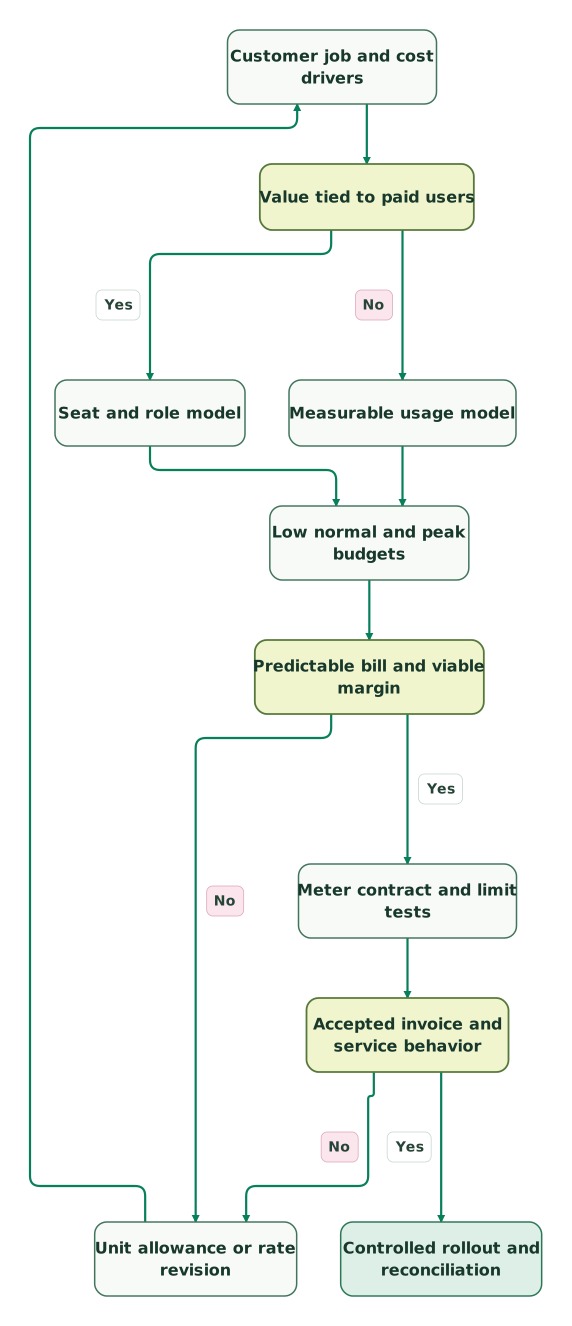
Read diagram as text
- Customer job and cost drivers to Value tied to paid users.
- Value tied to paid users to Seat and role model: Yes.
- Value tied to paid users to Measurable usage model: No.
- Seat and role model to Low normal and peak budgets.
- Measurable usage model to Low normal and peak budgets.
- Low normal and peak budgets to Predictable bill and viable margin.
- Predictable bill and viable margin to Unit allowance or rate revision: No.
- Unit allowance or rate revision to Customer job and cost drivers.
- Predictable bill and viable margin to Meter contract and limit tests: Yes.
- Meter contract and limit tests to Accepted invoice and service behavior.
- Accepted invoice and service behavior to Unit allowance or rate revision: No.
- Accepted invoice and service behavior to Controlled rollout and reconciliation: Yes
Checklist
- The chargeable unit matches a clear customer activity or access right.
- Required capabilities match across the compared offers.
- Low, normal and peak budgets use separate seat and usage assumptions.
- Included units, tiers, minimums and rounding reproduce the quoted amount.
- Unused commitments and temporary offers have explicit expiry treatment.
- Retries, late events and corrections produce the expected invoice quantity.
- Alerts and actual enforcement limits are tested separately.
- Renewal, proration and cancellation behavior are part of the decision.
Use the marketing data audit skill to organize source-to-billing evidence. Request a CRM and revenue-data implementation scope when the product, billing and customer record need to agree on usage, entitlements and revenue.
Keep reading
Browse all Martech Strategy guides
 Product Analytics
MTU vs Event Pricing: How Product Analytics Tools Bill Users, Events and Sessions
Event pricing tends to cost less when users do little; MTU pricing when each user fires many events. Compare six analytics tools on the same workload.
Jafrin Akter AloLast updated 16 min read
 Martech Strategy
Martech Stack Cost: Calculate Total Cost of Ownership and Explain It to the Board
Work out what your martech stack costs to run: licenses, usage meters, integrations and people, why integration costs compound and how to show the board.
Jafrin Akter AloLast updated 14 min read
 CRM & Lifecycle
Support AI Pricing: Compare the Unit You Pay For
Compare Fin, Zendesk, Freddy, HubSpot and Agentforce billing units, allowances and worked costs, including the human work left after AI support.
Jafrin Akter AloLast updated 15 min read
CRM & marketing automation
See the implementation scope, deliverables and acceptance checks.
Questions people ask
Can usage-based pricing produce a bill even with no usage?
Yes. A usage-based offer can include a base subscription, minimum commitment or flat tier fee. Calculate the zero-use case from the full contract rather than assuming the bill falls to zero. Then check whether allowances expire during that period and whether the customer can pause the service or reduce its commitment before the next billing cycle.
Does a usage discount apply to every unit or only the excess tier?
That depends on whether the price uses volume or graduated tiers. Volume pricing applies the reached band's rate to the whole quantity. Graduated pricing charges each portion at its band's rate. Request calculations immediately below and above a tier boundary, including flat fees, to establish which model the quote actually uses. Tier mechanics.
Can a spending alert guarantee that the next invoice stays below its threshold?
An alert alone cannot guarantee the invoice amount. The product needs a tested enforcement path, and already accepted work or delayed usage reporting may continue to create charges. Agree what happens at the limit, who can approve more consumption and how the remaining work is handled. Test those conditions with the billing and application teams before promising a hard ceiling.
Should a founder price an AI product only by provider token cost?
Provider token cost is one input, alongside infrastructure, retries, support and the value delivered. A raw-token meter may also be hard for the buyer to forecast. Model the complete delivery cost and test a unit customers can understand, then check margins across light and heavy accounts. Keep any base fee, allowance and consumption charge explicit.
Can a seat reduction lower access without returning cash immediately?
Yes. Access, the purchased subscription quantity, invoice credits and refunds can follow different rules. Confirm the effective date and commercial terms before expecting a cash reduction. In Stripe, a negative proration does not automatically become a refund, so the customer experience must explain whether the adjustment changes a future invoice or produces a separate payment. Proration rules.
Sources
- Stripe recurring pricing models
- Stripe per-seat model
- Stripe volume and graduated pricing
- Salesforce Sales pricing
- BigQuery pricing
- Metronome billing architecture
- Stripe usage-billing architecture
- Stripe AI usage billing
- Stripe current usage recording guidance
- Stripe usage alerts
- Stripe subscription prorations

Written by
Jafrin Akter AloData Engineer and Co-founder at Martechdevs and Growth and Analytics Partners
Jafrin writes practical guides to marketing technology, customer data, analytics and AI workflows. Martechdevs is a Growth and Analytics Partners company.