Martech RACI: Who Owns Tracking, the CRM, the Warehouse and Reporting
Data Engineer and Co-founder at Martechdevs and Growth and Analytics Partners
Last updated 14 min read

A martech RACI assigns one accountable owner to each recurring decision, names who does the work and identifies who must be consulted or informed. Split tracking, CRM, warehouse and lifecycle work into defining, building and operating. Then connect those responsibilities to real permissions, acceptance evidence and a backup who can act when the owner is unavailable.
What does a martech RACI actually decide?
A martech RACI decides who has the authority to settle a question and who must deliver the result. It gives a founder or head of growth somewhere to turn when a dashboard, CRM workflow and agency deliverable disagree.
The letters describe participation in a specific task:
- Responsible: does the work and supplies the evidence that it is complete.
- Accountable: owns the outcome and makes the final acceptance decision.
- Consulted: provides information before the decision or change.
- Informed: receives the decision, progress or result.
Use one accountable individual per row, mapped through a role. A row can have several responsible contributors, but name the person coordinating their work. This follows Atlassian's RACI guidance.
“Owns HubSpot” is too broad to settle whether a salesperson may change a renewal date or whether an integration may overwrite it. Divide ownership into three kinds of work:
| Work | Decision it covers | Evidence of completion |
|---|---|---|
| Define | What a field, event, audience or metric means | Approved definition and permitted uses |
| Build | How the approved rule is implemented | Configuration, code and test results |
| Operate | Who keeps the result reliable after launch | Monitors, response procedure and recovery evidence |
The business owner approves meaning. A data steward maintains values and exceptions. An administrator manages configuration and access. One person can perform all three jobs, but the chart should show which job they are doing.
The RACI points to definitions; it does not replace them. Put event triggers in the tracking plan, field precedence in the property register and reporting rules in metric contracts. Our martech integration work can build those rules while your internal owner retains acceptance and business decisions.
Which roles should a small team put in the chart?
Use the roles your company actually has, then maintain a short directory naming their current holders and backups. A title without a reachable person is not an escalation path.
Most small stacks need a business decision owner, an engineering owner, a CRM or operations owner and a data owner. Finance, sales, customer success and privacy advisers join the rows where their decisions or obligations are affected. You do not need a new hire for every role.
For example, a founder can hold both budget ownership and head-of-growth responsibilities. The same engineer can build an ingestion job and operate it. Record that overlap so the team can see when leave, turnover or a large release leaves nobody available to review a change.
Where does an agency or freelancer fit?
An outside builder can be responsible for configuration, code, tests and contracted operating support. Our recommended default keeps definitions, acceptance, access ownership and permission to resume customer-facing automation with an internal role.
Write the end of the responsibility into the contract: the handover date, support period, credentials, documentation and person receiving the operating role. An agency's build responsibility does not silently become permanent on-call coverage. The guide to choosing an agency, employee or freelancer covers that commercial decision.
What should a copyable martech RACI contain?
Start with the decisions below and replace the role labels with your company's roles. These are recommended operating defaults, not vendor requirements. Each table uses A for accountable, R for responsible, C for consulted and I for informed.
“Data lead” means the internal person accountable for data outputs. If you have no data team, explicitly assign that role to an engineering lead or founder. Keep the current holder and backup in the role directory rather than repeating personal names throughout the matrix.
Tracking and event definitions
| Decision or recurring task | A | R | C | I |
|---|---|---|---|---|
| Define product events and their success triggers | Product lead | Product manager | Data, engineering | Growth, lifecycle |
| Define marketing-site lead and campaign events | Growth lead | Marketing ops | Product, data, engineering | Sales |
| Implement application events and stable identity | Engineering lead | Developer | Event owner, data | Marketing ops |
| Investigate collection regressions after a release | Engineering lead | Assigned responder | Marketing ops, product | Affected report owners |
Attach event-level owners in the tracking plan to these rows. A product event and a marketing-site event can have different business owners even when both reach GA4.
Consent decisions and tag publishing
| Decision or recurring task | A | R | C | I |
|---|---|---|---|---|
| Approve the collection and consent policy | Internal privacy decision owner | Policy coordinator | Legal adviser, growth, engineering | Tool owners |
| Implement and test consent configuration | Engineering lead | Developer or marketing ops | Privacy owner | Growth |
| Authorise a tag release against the approved scope | Tracking owner | Release coordinator | Event owner; privacy owner for changed collection | Report owners |
| Publish the approved container version | Tracking operations owner | Named GTM publisher | Release coordinator | Change subscribers |
The person accepting a release need not personally press Publish. The authorised publisher needs the tool permission, and the approval record must identify the exact version. Keep those two facts separate when reviewing GTM implementation mistakes.
CRM structure and daily records
| Decision or recurring task | A | R | C | I |
|---|---|---|---|---|
| Approve the shared CRM data model and lifecycle rules | Revenue process owner | CRM admin | Sales, growth, CS; finance for monetary fields | CRM users |
| Keep sales-owned fields accurate | Sales lead | Sales team | CRM steward | Revenue process owner |
| Keep customer-success assessments accurate | CS lead | CS team | CRM steward | Sales, lifecycle |
| Maintain routing configuration | Revenue process owner | CRM admin | Sales and growth | Routed-work recipients |
RevOps often holds the revenue-process role. Marketing ops can hold it where that team has the remit and authority. Job titles alone do not settle the decision. Document routing rules and exceptions at the same level as the automation.
Integrations and field writers
| Decision or recurring task | A | R | C | I |
|---|---|---|---|---|
| Approve field precedence, blanks and overrides | Destination process owner | Integration designer | Source field owners, CRM admin | Field users |
| Build and test mappings and retry behaviour | Engineering lead | Integration builder | Source and destination owners | Operations owner |
| Respond to failed or conflicting syncs | Integration operations owner | Assigned responder | Source owner, destination admin | Affected business owner |
A record owner's name inside the CRM is not a substitute for these assignments. Use property-level write ownership to decide which integration may change each field. The RACI then names who can approve that contract and who repairs a violation.
Warehouse pipelines, models and access
| Decision or recurring task | A | R | C | I |
|---|---|---|---|---|
| Operate ingestion and source coverage | Data lead | Data engineer or contracted operator | Source owners | Report and audience owners |
| Implement models and their tests | Data lead | Analytics engineer | Metric owners | Consumers |
| Approve warehouse access and cost controls | Data lead | Warehouse admin | Security, finance | Budget holder |
| Accept a report-ready delivery deadline | Report owner | Data lead | Source owners | Report users |
Put the actual cutoff and recovery promise in a freshness agreement for the output. The report owner approves whether the delivery meets the decision's needs; the data lead owns the technical work required to deliver it.
Metrics and dashboards
| Decision or recurring task | A | R | C | I |
|---|---|---|---|---|
| Define a growth metric such as qualified leads | Growth lead | Analyst drafts the contract | Sales, RevOps, data | Report users |
| Define the revenue measure used in financial reporting | Finance owner | Analyst drafts the contract | Revenue, billing, data | Leadership |
| Accept a dashboard for a business decision | Named report owner | Analyst | Metric owners | Intended users |
Each metric contract should name its grain, period, exclusions and authoritative inputs. An analyst can expose a mismatch and recommend a definition; the business owner must decide which question the report should answer.
Lifecycle campaigns and activation
| Decision or recurring task | A | R | C | I |
|---|---|---|---|---|
| Approve journey eligibility, content and suppression | Lifecycle lead | Lifecycle marketer | Product, data, privacy | CS |
| Deliver the agreed audience and freshness checks | Data lead | Analytics or data engineer | Lifecycle owner | Campaign operator |
| Pause or resume an unsafe journey | Lifecycle lead | Authorised campaign operator | Incident responder, privacy when relevant | CS and growth |
The lifecycle owner approves frequency and suppression rules. The data team proves that the delivered audience follows those rules. A successful sync by itself is not campaign acceptance.
Purchases, renewals and access removal
| Decision or recurring task | A | R | C | I |
|---|---|---|---|---|
| Approve a purchase, renewal or cancellation | Budget holder | Tool owner | Finance, users, security | Operations |
| Grant or remove tool access | System owner | Tool admin | Manager, security | Affected user or manager |
| Transfer operating responsibility after handover | Internal system owner | Outgoing and incoming operators | Builder, affected teams | Budget holder |
An access-removal request should include service identities, scheduled jobs and alert subscriptions. Removing a departing person's interactive login does not establish that their automations have been transferred.
Who accepts a launch and who acts during an incident?
The business owner accepts the intended outcome; the technical owner confirms implementation evidence; the operating owner responds after launch. Record who can pause or roll back the affected workflow before anything runs unattended.
For a renewal campaign, acceptance might require the right eligible subscriptions, current consent and suppression states, duplicate prevention and a sampled destination readback. The builder supplies the test record. The lifecycle owner accepts the customer treatment. The data lead accepts the audience's technical readiness.
Prefer a reviewer other than the builder for consequential changes. In a very small team, document the overlap and use an external reviewer or a restricted pilot where practical. A chart cannot manufacture independent review when only one person exists.
Define emergency authority in advance. An operator may have permission to pause a journey immediately when a known safety condition fails, while the lifecycle owner retains authority to resume it after reconciliation. Set an escalation deadline and backup; a Slack mention to someone asleep is not an operating plan.
The marketing data quality monitoring plan covers detection, severity and recovery. Keep the RACI focused on who can decide and who must respond.
How should responsibilities change at 5, 20 and 50 people?
Move responsibility when the workload and consequence justify it. Headcount is a planning example, not proof that a company needs a particular department.
The following staffing patterns are hypothetical. Each cell names a possible holder of the same accountable role.
| Accountable role | 5-person company | 20-person company | 50-person company |
|---|---|---|---|
| Growth metric definition | Founder | Head of growth | Growth function lead |
| CRM process and changes | Founder | RevOps or marketing ops lead | RevOps lead |
| Application tracking implementation | Engineering lead | Engineering lead | Product engineering lead |
| Warehouse operation | Engineering lead | Internal data owner with builder support | Data lead with named response coverage |
| Lifecycle customer treatment | Founder or growth lead | Lifecycle lead | Lifecycle lead with delegated operators |
At five people, protect continuity by documenting the backup and keeping accounts under company control. At twenty, transfer operating authority explicitly instead of leaving the founder as the default approver for every small change. At fifty, clarify cross-team boundaries and response coverage so an issue cannot bounce between RevOps and data indefinitely.
The startup stack guide explains which systems to add. Revisit ownership whenever a new system introduces another writer, approval step or business dependency.
How would the chart resolve an MQL reporting dispute?
Assign the definition decision before changing filters, models or workflows. A RACI resolves authority; the underlying record evidence resolves the numerical disagreement.
Consider a hypothetical 20-person SaaS company using HubSpot, GA4, GTM, BigQuery, dbt and Customer.io. HubSpot shows 500 contacts that first became marketing-qualified during September. A dashboard shows 410 contacts whose current stage is MQL. The dashboard is 90 contacts, or 18% of 500, lower.
The review finds that 90 of the September-qualified contacts have since progressed to later stages. Both queries ran successfully. They answered different questions.
| Decision or task | A | R | Evidence needed |
|---|---|---|---|
| Choose the monthly MQL definition | Growth lead | Analyst | Whether qualification is an entry event or current state |
| Confirm CRM stage-transition behaviour | RevOps lead | CRM admin | Sample histories including later-stage contacts |
| Implement the approved cohort | Data lead | Agency analytics engineer | Model change using first qualification time |
| Accept the report | Growth lead | Analyst presents results | Same 500 contacts under the agreed rule |
| Release the change | Data lead | Named deployer | Reviewed change and rollback reference |
| Maintain the output afterwards | Internal data lead | Assigned operator | Scheduled checks and an accessible runbook |
The growth lead approves “distinct contacts first qualifying during the month, even if they later advance.” The analyst records the timezone, test-contact exclusions and treatment of requalification. The one reporting change replaces the current-stage filter with the agreed first-qualification cohort.
Verify the 90-contact difference by stable contact ID, sample stage histories and compare the final 500-contact set. Do not reset lifecycle stages to make the old filter match. If reliable historical qualification timestamps are absent, disclose the history gap and agree a valid starting period; the RACI does not recover missing facts.
The decision record should include the question, chosen definition, approving role, evidence, affected outputs, implementation reference and effective date. This gives the next analyst a reason for the rule instead of another unexplained filter.
How do you check the RACI against tool permissions?
Check that each responsible operator can perform the assigned action and each accountable owner can inspect sufficient evidence to approve it. Business accountability does not automatically require administrator access.
The tool facts below were checked on 17 October 2026. Access should remain limited to the work a role performs.
| Tool control | Documented behaviour | What to verify against the chart |
|---|---|---|
| GTM Edit | Can edit and create workspaces; cannot create versions or publish | Builders can prepare changes without receiving release authority |
| GTM Approve | Can create versions; cannot publish | The release process still names an authorised publisher |
| GTM Publish | Can edit, create versions and publish | Publishers follow the recorded approval and version scope |
| GA4 roles and restrictions | Administrator manages users; Editor manages property settings; Marketer can manage audiences, events and key events | The assigned task fits the role, and cost/revenue restrictions do not hide acceptance evidence |
| HubSpot audit logs | Super Admin is required to view/export; coverage varies by subscription and records HubSpot-user actions | The investigator can obtain evidence and understands that the log does not show every possible data change |
Google's GTM permissions guide, GA4 access management and HubSpot audit-log documentation provide the current details.
Google recommends at least two active GTM account administrators and management inside your organisation. This protects account continuity; it does not require every administrator to publish routine changes. Also inspect inherited permissions, because a narrow direct assignment may not describe a user's effective access.
GA4's Analyst and Viewer roles support analysis and reading with different sharing rights. Its No Cost Metrics and No Revenue Metrics restrictions can hide the very figures an approver needs. Resolve that evidence-access problem deliberately instead of granting every reviewer full administration.
For HubSpot, retain source-system and integration logs alongside the audit log. HubSpot specifically excludes property updates made without a HubSpot user, such as form submissions, from that central user-action log. Absence there does not prove that a field never changed.
How can you introduce the chart without creating an approval queue?
Start with decisions that cause conflicting writes, unsafe releases or unresolved incidents. Define which routine changes an operator may make within an already approved policy, then reserve escalation for exceptions.
- Map the systems and connections using the stack inventory. Mark the outputs that affect money or customer treatment.
- Draft define, build and operate rows for those outputs. Use one accountable role per row.
- Review each assignment with its holder. Confirm authority, capacity, backup and the conditions requiring consultation.
- Check tool permissions and the evidence each approver can access. Record access changes for the authorised administrator to make.
- Publish the matrix beside the tracking plan, field register and recovery procedures. Test it with one proposed release and one simulated incident.
Replace “consult everyone” with a trigger: consult privacy when collection changes, finance when monetary definitions change and sales when routing changes. Routine corrections inside a documented rule can then proceed through the delegated operating process.
Review the chart after a role change, new tool, transferred contract or incident with unclear ownership. Keep a dated change record. If two people both claim final authority, split the row by decision or name the person who breaks the tie.
At Martechdevs, we can help turn the agreed ownership into implementation scope, acceptance checks and handover documentation. Request a scoped integration quote.
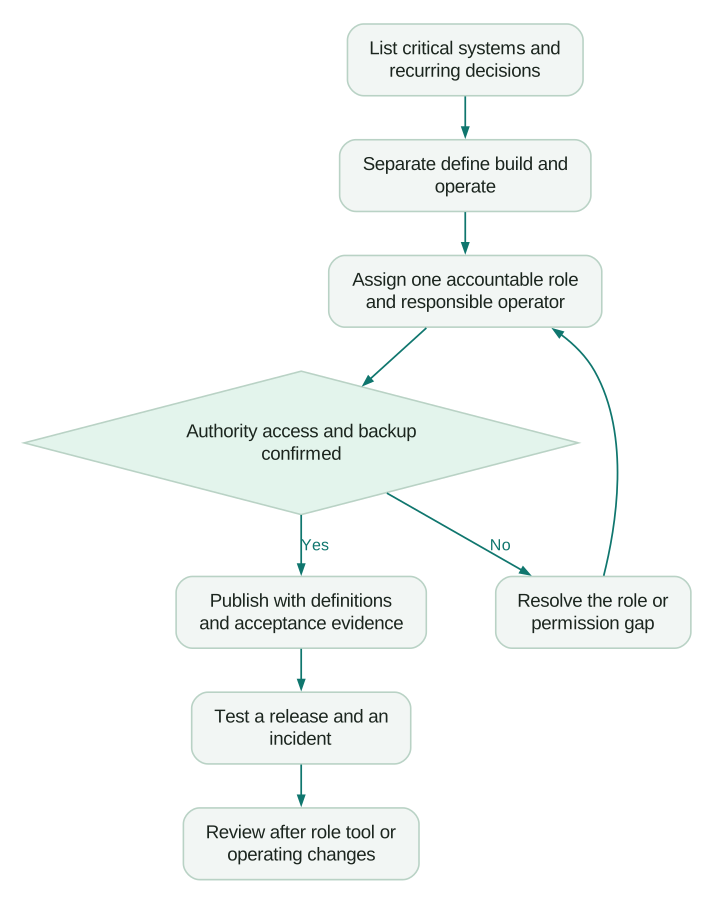
What should pass before the RACI becomes the operating policy?
The chart is ready when the assigned people can use it to approve a change and respond to a failure without negotiating responsibility from scratch.
Checklist
- Each critical system has separate define, build and operate responsibilities.
- Every row has one accountable role with a current holder and backup.
- Responsible operators have the needed permissions, and approvers can inspect acceptance evidence.
- Outside build and support responsibilities have explicit start, end and handover conditions.
- Emergency pause, rollback and resume authority are documented separately.
- A sample release identifies its definition, reviewer, publisher and acceptance record.
- A simulated failure reaches the named operator and backup within the agreed response window.
- Role changes, tool changes and ownership failures trigger a review and dated change record.
Want a second pair of eyes on your stack? Book a free audit with the current system map and one workflow whose ownership is unclear.
Questions people ask
Can the same person be responsible and accountable for a martech task?
Yes, particularly in a small company. Record both responsibilities and identify where independent review matters, such as a new data recipient or a campaign affecting many customers. A backup provides continuity but does not automatically become a second accountable owner. When the primary owner is absent, record the delegation and its scope.
Does a RACI replace the CRM property ownership register?
A RACI identifies who approves and maintains the field policy; the property register contains that policy. Keep authoritative writer, blank handling, override rights, freshness and conflict rules in the field-level document. Link the two so an integration engineer can find both the rule to implement and the person authorised to change it.
What should happen when the accountable owner misses an approval deadline?
Use the escalation and delegation rule agreed before the release. A deadline passing should not silently turn a builder's request into permission. The backup can accept within a recorded remit, or the change waits. Time-sensitive workflows should also define a safe fallback, such as retaining the last approved report or keeping a journey paused.
How should an internal owner challenge an agency's completed work?
Compare the result with the agreed acceptance cases and record the failing output, expected behaviour and evidence. The agency owns repairs within its scope; the internal owner decides whether the business result is acceptable. If the requirement changed, document a scope decision rather than treating a new request as an unexplained defect in the original delivery.
When would a decision framework such as DACI help alongside RACI?
Use DACI when one consequential choice needs a driver, approver and contributors, such as replacing a CRM. Keep the standing RACI for ongoing work after that choice. The driver gathers the evidence and moves the decision forward; the approver makes the choice. Afterwards, assign the implementation and operating responsibilities in the RACI.
Sources
- Atlassian: RACI charts and responsibility assignment. Accessed 17 October 2026.
- Google Tag Manager: Managing users and permissions. Accessed 17 October 2026.
- Google Analytics: Access and data-restriction management. Accessed 17 October 2026.
- HubSpot: View and export account activity history. Accessed 17 October 2026.
- Atlassian: DACI decision-making framework. Accessed 17 October 2026.

Written by
Jafrin Akter AloData Engineer and Co-founder at Martechdevs and Growth and Analytics Partners
Jafrin writes practical guides to marketing technology, customer data, analytics and AI workflows. Martechdevs is a Growth and Analytics Partners company.