
How Much Does a Martech Implementation Cost?
At martechdevs, implementation comes in fixed price packages, each 25% off its list price. Starter is $4,800 USD (list $6,400) and goes live in 4 weeks. Growth is $12,150 USD (list $16,200), goes live in 12 weeks and covers data warehousing, dashboards, lifecycle messaging and data activation. Super fast delivery halves the time for 1.4 times the price, and larger builds get a custom plan.
On this page

A price is useful only when you can see what it buys. “HubSpot implementation,” “warehouse setup” and “tracking integration” can each describe anything from a narrow configuration task to a migration involving years of history and several teams.
Use a written scope to connect each charge to an outcome, acceptance test and future owner. That makes competing quotes comparable and exposes the recurring work before you approve the build.
What do the $4,800 and $12,150 packages cover?
The $4,800 Starter package covers one tracking plan named the same in every tool, web analytics and tags in GA4 and Google Tag Manager, conversion tracking for Google Ads, Meta, LinkedIn and TikTok, product analytics in Mixpanel, Amplitude or PostHog, leads and signups in your CRM, a data pipeline into Snowflake or BigQuery, first dashboards, your martech AI agent, and docs with a handover call. It goes live in 4 weeks and includes 30 days of support, up to 10 hours.
The $12,150 Growth package adds the fuller work discussed here: server-side tracking, CRM and marketing automation, lifecycle messaging in tools like Braze, Customer.io or Klaviyo, support automation, warehouse models and a CDP, dashboards and attribution, audiences synced back to your ads and CRM, mobile attribution, outbound and enrichment, and AI on your data over MCP. It goes live in 12 weeks and includes 90 days of support, up to 30 hours.
Work beyond those plans, such as a large CRM migration or several business units, gets a custom plan after a free call. Compare the fixed price packages, and see the martech integration service for how planning, build, testing and handover fit together.
When the scope is unclear, the USD 99 martech audit includes a written assessment, priorities for what to fix and a one-hour call with a martech specialist. The report comes within a day; the USD 149 option brings the report within six hours. Both include the specialist call. Compare the audit options.
Keep the implementation fee distinct from the operating budget. The quote should explicitly identify software subscriptions, cloud usage, third-party services, taxes where applicable and post-launch support. Model recurring expenses separately, including the internal work that continues after handover.
This is martechdevs pricing, not a claim about the market's average rate. A meaningful comparison requires quotes for equivalent outcomes and responsibilities.
Why does the work between tools change the quote?
Implementation effort follows the identity, field-ownership and recovery rules between systems. Counting application logos leaves most of that work unexplained.
Two systems with clear identifiers, documented APIs and agreed field ownership can be straightforward to connect. The same two systems become a different project when customers have duplicate records, historical state matters and both sides overwrite each other's fields.
A useful scope identifies the source, the destination and the rules between them. It specifies which records qualify, which fields can change, how conflicts are resolved and what happens when one system is unavailable. See how the parts of a martech stack connect before estimating the work from a list of products. Then choose the integration method for each data flow, including its failure and acceptance requirements.
Ask for the behavior in a concrete case: “When a paid account cancels, what changes in CRM, analytics and the renewal audience, and how do we prove it?” That question reveals more implementation work than “Do you integrate Stripe and HubSpot?”
The CRM implementation checklist is useful when the uncertain work sits in objects, ownership, routing and adoption. A warehouse project needs a similar level of specificity around source data and metric definitions.
How does CRM scope change implementation effort?
A CRM implementation costs more when it must preserve existing relationships, automate different business processes or reconcile conflicting records. Configuration, migration and ongoing integration are separate deliverables, even when they involve the same two applications.
Name the objects, properties, pipelines, associations, routing rules and reports in scope. Then identify which historical activities must survive and which old automations must remain inactive during the transfer. A clean import with stable customer identifiers has a different workload from several exports containing duplicate contacts and conflicting lifecycle stages.
Vendor onboarding has its own scope. HubSpot’s Sales onboarding page describes technical advice and consulting, and directs customers needing execution help toward Solutions Partners. Confirm who performs each build and migration task in the purchased service. Treat the software subscription, vendor service and implementer’s deliverables as separate quote lines.
What changes the price of a warehouse and visualization project?
Warehouse and visualization costs depend on source difficulty, historical reconstruction, metric definitions and the controls needed to keep reports usable after launch.
Source count matters, but source difficulty matters more. A maintained connector to a familiar system may need less work than one custom source with undocumented changes, missing history or a restricted API.
Modeling determines whether the dashboards mean anything. Agree on the grain of each output: one row per order, account, subscription or account-month, for example. Define refunds, failed payments, expansion, churn, currency and time zones before the charts become the acceptance target.
Visualization scope should name the decisions and users. “Three dashboards” is not enough if one is a simple daily sales view and another requires account permissions, cohort retention, drilldowns and reconciliation across several billing systems. Price BI licences separately from the work needed to build and verify those reports.
Specify backfill separately from ongoing refresh. Loading the last three months of current records differs from reconstructing several years of historical customer states. If the source never stored a required historical value, a new warehouse cannot simply recover it.
The marketing data warehouse guide explains the architecture and model decisions. The quote should translate those decisions into included sources, models, reports, operating controls and handover artifacts.
Why does data activation add implementation work?
Data activation adds the work of safely changing records and audience membership in business tools. Define what a data activation project involves before treating a successful query as the completed deliverable.
Define who qualifies, which identity is used, what permissions apply, which destination fields are owned by the sync and when membership must end. Include removals and corrections, not just the first successful upload.
A customer who stops meeting an audience rule should not remain there indefinitely because the integration only adds records. A delayed update should not overwrite a newer state. An unclear identity match should not trigger outreach to the wrong account.
Rate limits and failures affect the implementation. HubSpot’s application programming interface (API) limits depend on the app and subscription context, with 429 responses when limits are exceeded. Throughput and recovery belong in the design and testing scope. HubSpot API usage guidance
If the project includes event-driven work, ask how duplicate or out-of-order deliveries are handled. Stripe, for example, explicitly documents both possible duplicates and a lack of guaranteed event delivery order. A workflow that succeeds once on a clean demonstration is not sufficient evidence of dependable behavior. Stripe webhook guidance
Those requirements explain why a working activation flow can cost more than drawing a line between two tools. The warehouse audience guide shows the membership and destination questions to include.
What changes the price of server-side tracking?
Server-side tracking costs depend on the collection paths, destinations, consent behaviour and business events the implementation must support. The outcome is correct collection and delivery of the agreed events under those rules.
Scope the platforms and environments: website, application, checkout, mobile app, staging and production. Name the destinations and events, then define their identifiers, timestamps, values and allowed data.
A purchase path may need browser and server deduplication, refunds, failed-payment exclusions, cross-domain behavior and diagnostics. A lead path may need later qualification or sales outcomes from CRM rather than treating every form submission as equally valuable.
Include the consent behavior and the evidence needed to verify it. Server-side delivery does not remove the need to respect the user's applicable choices. The technical team should implement the agreed requirements and surface any policy decisions that need the business's qualified reviewer.
Ask whether ongoing hosting, monitoring and incident response are included or separately priced. At martechdevs, server-side tracking and the Meta Conversions API are part of the USD 12,150 Growth package.
What testing and handover should the quote include?
The quote should include business reconciliation, meaningful failure tests and a handover that the future owner can use. Define completion through observable behavior. Use the twelve cross-system launch tests to make that acceptance scope concrete before the work starts.
| Deliverable | Acceptance evidence | Work that must be assigned |
|---|---|---|
| Reporting model | Totals reconcile to the agreed source, with explained exceptions | Business owner approves the metric definition |
| Migration | Counts, associations and meaningful historical records reconcile | Someone resolves ambiguous source records |
| Activation | Enrollment, removal and correction work under the same identity rules | Destination owner approves field and audience ownership |
| Recovery | A duplicate, delay or failed request produces the intended outcome | Operator can retry or stop safely |
| Handover | Future owner completes a bounded change or recovery exercise | Accounts, code, instructions and access are transferred |
The scope should specify the test records and expected results before the final demonstration. A live record count alone can conceal broken associations or duplicate actions.
Automated checks can cover known assertions. dbt's data tests, for example, include uniqueness, non-null, accepted-value and relationship checks, plus custom assertions. Those checks help verify models; they do not replace agreement on what a metric should mean. dbt testing documentation
Handover should identify the accounts, repositories, configurations, credentials process, diagrams, field mappings, tests and operating instructions your team receives. Have the future owner use the documentation to inspect a failure or make a bounded change before declaring the handover finished.
Clarify the difference between correcting a defect in the agreed work and adding a new requirement. Both may need attention, but their commercial treatment should not be improvised after launch.
Where should you look for implementation costs by tool?
Martechdevs’ USD 4,800 Starter and USD 12,150 Growth packages cover our implementation work. Vendor licences, onboarding requirements and other partners’ fees have their own units and inclusions:
- HubSpot implementation cost: vendor onboarding, partner delivery, migration and internal effort.
- Snowflake implementation plan: delivery phases, source complexity and regional platform costs.
- BI licence costs by team size: paid creators, viewers and capacity outside the report-build fee.
- Support AI billing units: how consumption changes the operating bill.
How do you budget for the first and second years?
Use four separate lines: implementation, ongoing tools and infrastructure, internal effort and transition overlap. Add other applicable expenses explicitly rather than hiding them inside a vague contingency percentage.
Compare software costs by company stage from vendor list prices with the implementation allowance, using your own volume and keeping subscriptions separate from delivery work. Check startup discounts that change year-one software cost, but keep the programme’s expiry and later rates in the same cost model.
This hypothetical budget uses USD, a 12-month operating period and unchanged existing payroll. The USD 12,000 implementation allowance is an example, not a fixed Martechdevs package. Year two assumes the same monthly operation and internal maintenance capacity, with no second implementation or legacy-tool overlap.
| Budget line | Calculation | Year one, USD | Year two, USD |
|---|---|---|---|
| Implementation | One-off assumed quote | 12,000 | 0 |
| Tools, hosting and maintenance | 600 × 12 months | 7,200 | 7,200 |
| Old-tool overlap | 250 × 2 months in year one | 500 | 0 |
| Incremental cash | Sum of the cash lines | 19,700 | 7,200 |
| Internal capacity allocation | Assumed 40 hours × 75 per year | 3,000 | 3,000 |
| Total resource estimate | Cash plus internal allocation | 22,700 | 10,200 |
The extra USD 3,000 capacity allocation is not an additional cash payment when payroll is unchanged. Replace the annual 40-hour assumption with the actual build-review and maintenance workload; the identical figure here makes the cash-versus-capacity distinction easy to see.
If monthly running costs rise from USD 600 to USD 750 in month 7, year one adds USD 900. Cash becomes USD 20,600 and the resource estimate USD 23,600. If that rate continues for all of year two, year-two cash becomes USD 9,000 and the resource estimate USD 12,000. This is a sensitivity case, not a forecast of a 25% vendor increase.
Decide who runs the system after handover while setting this budget. A fixed implementation fee does not supply an indefinite owner for schema changes, failed syncs and business-rule updates. Keep the recurring cost after the build visible even when year one receives a software discount.
Keep a contingency reserve separate from the base estimate and from actual spending. Name the risks it covers and who can authorize its use. A reserve is not permission for unexplained charges.
Then check the proposed benefit against the same horizon and cost definition. The martech business-case guide shows how to compare the project with a smaller repair and the cost of continuing as-is. For replacement products, price the switch before you buy, including the work each candidate would retain or remove.
How do vendor usage meters affect the operating budget?
Vendor usage meters turn the planned workload into a recurring bill. Estimate source changes, refresh frequency, query scans, destination updates, event volume and user seats where applicable. Use the running cost of the warehouse stack to separate recurring software, upkeep and unquoted items from the build fee.
Fivetran's pricing distinguishes connections and activations measured in monthly active rows from transformations measured in monthly model runs. One generic “data volume” estimate is not a substitute for understanding those different meters. Fivetran pricing
For BigQuery on-demand workloads, Google’s guidance describes query-cost estimates and controls such as maximum bytes billed. Ask how dashboard queries, refreshes and backfills are designed and bounded; the stored database size alone does not describe all query spending. BigQuery cost-control guidance. Support AI needs the same discipline: sessions, resolutions, configured handoffs and actions can produce different bills for the same customer requests.
The implementation should leave the owner able to explain the major bill drivers and identify unexpected changes. A project that works only while nobody opens the dashboards has not solved the operating problem.
Should you choose a fixed price or hourly work?
Choose a fixed price for agreed deliverables and bounded hourly work for uncertainty that still needs investigation. A fixed price works well when deliverables, assumptions and acceptance are clear. The buyer gets a known price for that scope; the supplier is responsible for estimating and delivering it. Scope changes still need an explicit process.
Hourly work can fit uncertain investigation or a changing backlog, provided there is a spending cap, visible output and a regular decision about the next work. An hourly rate alone does not reveal total cost or competence.
For unresolved source-system problems, a bounded discovery phase can establish whether the desired result is feasible. It should produce useful findings, a proposed scope and a decision. Avoid paying repeatedly for discovery that never resolves a named uncertainty.
martechdevs publishes a fixed price for each package. Compare a package with alternatives using the same responsibilities: cleanup, migration, software, testing, documentation, training and support. A cheaper headline with several mandatory extras may buy less at a similar total cost.
How long does implementation take?
Implementation timing depends on delivery work and on dependencies outside the builder’s control. The quote should provide the schedule for the agreed scope. At martechdevs, Starter goes live in 4 weeks and Growth in 12, or in half the time with super fast delivery.
Common dependencies include account access, a source export, metric decisions, engineering changes, security review, business-owner testing and a migration window. Assign an owner and due date to each. An unresolved revenue definition can delay the project even when every API is available.
Separate first usable output from full rollout. A first reconciled model may help the team before every dashboard and activation is complete, but it should not be called full delivery. Define the scope and acceptance at each milestone.
Also separate working effort from elapsed time. Adding engineers does not make an unavailable customer export arrive sooner. A credible schedule shows what can run concurrently and what must wait for evidence or a business decision.
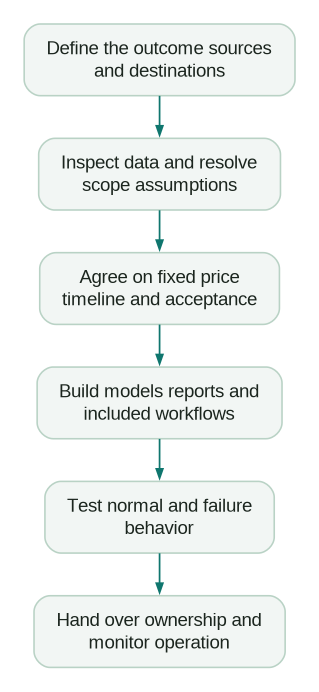
Read diagram as text
- Define the outcome sources and destinations to Inspect data and resolve scope assumptions.
- Inspect data and resolve scope assumptions to Agree on fixed price timeline and acceptance.
- Agree on fixed price timeline and acceptance to Build models reports and included workflows.
- Build models reports and included workflows to Test normal and failure behavior.
- Test normal and failure behavior to Acceptance criteria met.
- Acceptance criteria met to Build models reports and included workflows: No.
- Acceptance criteria met to Hand over ownership and monitor operation: Yes
What should you send to get comparable implementation quotes?
Send the business outcome, current systems, required outputs, dependencies and acceptance owner. Explain the current failure, then list the source systems, destination systems, access status, approximate record volumes and required history.
Include the outputs that matter: reports, customer segments, CRM updates or lifecycle triggers. Define what would prove success and identify the person who can make decisions about fields, metrics and exceptions.
Add the deadline and its reason, existing vendor contracts and renewal dates, and who will maintain the system. If part of the work belongs to your engineers, say which part. This helps avoid duplicate work and makes dependencies visible early.
You do not need to solve the architecture before contacting an implementer. You do need enough context to distinguish an important business requirement from a tool preference.
What should you verify before approving the quote?
Approve the quote when its scope, exclusions, acceptance and operating ownership are clear enough to test. Check these items against the written proposal:
Checklist
- The price names the currency and the scope it covers.
- Sources, objects, history, reports and destinations are listed.
- Cleanup, migration and unresolved data decisions have owners.
- Software, cloud usage, taxes and support are explicitly addressed.
- Identity, permissions, retries, corrections and removals are scoped where relevant.
- Acceptance includes business reconciliation and failure cases.
- The schedule lists dependencies and customer responsibilities.
- Accounts, code, documentation and training are part of the handover agreement.
- Changes, defect correction and post-launch support have clear terms.
- The first-year operating budget is assessed alongside the build price.
If this is the work you need, compare fixed price packages or request a detailed scope. Bring your current tools, the workflow that needs to work and the outcome your team needs, and we confirm which plan fits.
If the first decision is which part of the system needs fixing, book a free call to establish the priorities before pricing a wider build.
Keep reading
Browse all Martech Strategy guides
 Martech Strategy
Marketo Managed Services: What's Included, What It Costs and When to Hire In-House
Marketo managed services cover campaigns, admin and Salesforce sync. Compare scoped cost examples, included work and when hiring in-house costs less.
Jafrin Akter AloLast updated 28 min read
 Martech Strategy
How to Build a Martech Business Case Your CFO Can Evaluate
Build a defensible martech business case with an eight-part proposal, three-year cash examples, alternatives, downside scenarios and clear pilot acceptance.
Jafrin Akter AloLast updated 13 min read
 Martech Strategy
Martech data integration: choose the method for each flow and prove it works
Connect martech tools flow by flow: write a sync contract, pick the simplest method, then test and monitor it. Includes a worked example and a checklist.
Jafrin Akter AloLast updated 18 min read
Martech integration
See the implementation scope, deliverables and acceptance checks.
Questions people ask
How much does a HubSpot implementation cost?
Martechdevs packages start at USD 4,800 for Starter. Growth, at USD 12,150, adds CRM and marketing automation, and a large HubSpot migration gets a custom plan. The HubSpot cost breakdown linked above separates that delivery work from HubSpot’s subscription and onboarding charges.
What if a source system cannot provide the history included in the quote?
Pause the affected deliverable and resolve the evidence gap before rebuilding around an assumption. Ask the source owner for the available export, retention limits and alternative records, then document whether the original requirement remains achievable. Agree on any changed scope, price and acceptance before proceeding. Current-state records should not be presented as a reconstruction of historical states that were never retained.
Can two suppliers share an implementation without duplicating charges?
Yes, when the contract divides ownership at observable boundaries. Assign who produces the source extract, approves the mapping, builds the destination change and runs the end-to-end acceptance test. Name one owner for failures that cross that boundary. Compare both proposals together, including coordination and rework responsibilities, so the same migration or validation task is not silently billed twice.
What happens if our implementation owner leaves before handover?
Assign a replacement decision-maker and confirm their access before continuing through acceptance. The new owner should review unresolved definitions, scope changes and operating responsibilities, then complete the planned handover exercise. Keep those decisions in the project record rather than an individual inbox. If the replacement needs additional training or review time, agree on its treatment explicitly instead of assuming the original schedule still applies.
Should a promised future connector reduce the implementation budget?
Budget against the route you can actually use for the required launch. A future connector may reduce later maintenance, but its release, object coverage and failure behaviour still need confirmation. If you choose to wait, make the dependency and fallback decision explicit. If you build an interim route, include its eventual retirement and data reconciliation so the temporary solution does not become an unpriced second migration.
Sources

Written by
Jafrin Akter AloData Engineer and Co-founder at Martechdevs and Growth and Analytics Partners
Jafrin writes practical guides to marketing technology, customer data, analytics and AI workflows. Martechdevs is a Growth and Analytics Partners company.