
Martech stack examples: 12 practical setups for teams of 1 to 50
Data Engineer and Co-founder, martechdevs
Last updated 13 min read
A useful martech stack connects customer activity to a decision and a follow-up. The right setup depends on how your business acquires customers, delivers value and earns revenue. These twelve examples show SaaS, Shopify, mobile app and marketplace stacks at three team sizes, including data flows, illustrative software budgets and the specific problem that should justify the next purchase.
Last updated: 25 September 2026. Budgets are original planning scenarios in USD, not vendor quotes or observed client spending.
Headcount gives these examples a familiar frame, but usage drives much of the bill. A five-person consumer app with millions of active users can need more data capacity than a fifty-person company selling to a hundred accounts.
How should you read the budgets?
Each budget allocates money to functions: CRM, messaging, analytics, integration and reporting. Substitute your actual quotes before purchasing. These are monthly operating allowances for the described modest-volume scenario; they exclude implementation, staff time, advertising, payment processing, taxes and core application hosting unless explicitly stated.
Named products are candidates for the architecture, not a promise that a particular combination of features fits the allowance. Contact counts, event volume, sending volume, seats, annual commitments and regional pricing can change the result. A CRM upgrade alone can exceed an entire early-stage budget.
Use the current Customer.io pricing page, Firebase pricing schedule and Shopify plan comparison to price the relevant workload and country. Firebase, for example, combines no-cost products or quotas with usage-priced services; enabling a Google product does not make the whole data path free.
Martechdevs' integration service builds the connections behind these setups. For the underlying concepts, start with what a martech stack includes.
What does a small SaaS company need?
SaaS stacks must connect people to accounts and distinguish product activity from billing state. A founder should be able to identify which accounts reached value, which paid and which need a human conversation.
SaaS with 1 to 10 people: connect activation to payment
Use HubSpot or Attio for the conversations people actively manage, Stripe for billing, GA4 for acquisition and Mixpanel or Amplitude for a short list of product questions. Start lifecycle messaging with a tool that can receive the required product and billing events. Keep the application database as the source of account membership.
The essential flow is signup to account creation, then first meaningful product use, then paid status. Attach account_id to product events and map it to the Stripe customer and CRM company. A founder should see the account's current activation and payment state without opening four exports.
Illustrative monthly allowance: $250 to $800. Allocate $0 to $150 to CRM, $100 to $300 to messaging, $0 to $150 to analytics and $150 to $200 to small integrations and monitoring. The upper allowance assumes modest volumes and limited paid seats; premium automation can require more.
Add next: a warehouse when cross-system reporting becomes a recurring manual task. Defer a broad enrichment stack until someone has a clear prospecting process and the capacity to use its output.
SaaS with 10 to 25 people: make account qualification repeatable
Keep the existing CRM and billing system. Add BigQuery or Snowflake for shared models if the use case justifies it, and an integration method that brings account, product and billing changes into those models. Choose Customer.io or Braze based on the required channels, event handling and commercial fit.
The new flow calculates an account's qualification from product behaviour, fit and billing state. It sends an explainable property to the CRM, including the reason and calculation time. Sales feedback returns to the model so “qualified” can be compared with accepted opportunities.
Illustrative monthly allowance: $900 to $2,600. Budget $300 to $1,000 for CRM, $250 to $700 for lifecycle, $100 to $350 for analytics and $250 to $550 for the warehouse, transfers and reporting. These allocations require quote checks where a feature forces an enterprise tier.
Add next: automated reconciliation between CRM and billing, then warehouse audiences if direct integrations are becoming hard to maintain. The product data in HubSpot guide explains the account model and useful activation fields.
SaaS with 25 to 50 people: govern the shared account model
Use a maintained warehouse model, version-controlled transformations and clear ownership for sales, product and revenue definitions. Choose HubSpot or Salesforce for the actual sales process, retaining the lifecycle and product analytics tools that the team uses well.
The flow now includes multiple subscriptions, account roles, expansion opportunities, support escalations and lifecycle suppression. Separate a person's activity from the health of the account they belong to. Give any AI assistant access to approved models and scoped CRM tools.
Illustrative monthly allowance: $2,500 to $7,000. Reserve $900 to $2,800 for CRM, $500 to $1,500 for messaging, $300 to $900 for analytics and $800 to $1,800 for data movement, warehouse and reporting. Large contact databases or negotiated lifecycle contracts can exceed this envelope.
Add next: stronger testing, permission management and failure recovery. Another dashboard is rarely the answer when the existing reports disagree about what counts as an active customer.
For the smaller CRM option in these examples, Attio pricing separates seats, shared automation credits and startup-discount expiry.
What does a Shopify business need?
Shopify stacks centre on orders, customers, products and margins. The operating model must account for cancellations, discounts and refunds before turning reported revenue into acquisition or retention decisions.
Shopify with 1 to 10 people: establish dependable orders and consent
Start with Shopify, its supported sales-channel integrations, GA4 and Klaviyo or another messaging tool suited to ecommerce. Use an appropriate consent setup and establish which integration owns each purchase event. Multiple apps sending the same purchase can produce convincing but inflated totals.
The core flow is product view to checkout to confirmed order, followed by fulfilment and repeat purchase. Keep the Shopify order identifier across reporting and advertising integrations. Define whether the weekly revenue report shows gross sales, net sales or cash received.
Illustrative monthly allowance: $150 to $650. Allocate $40 to $120 for the store plan, $50 to $250 for messaging, $0 to $80 for tracking or consent tools and $60 to $200 for support and operational apps. This is a budget envelope, not a statement of Shopify's regional plan prices.
Add next: a reliable refund and margin view. Add specialist attribution only after proving that orders, consent and campaign parameters are captured consistently.
Shopify with 10 to 25 people: connect retention with unit economics
Retain the commerce and lifecycle core. Add support integration and warehouse reporting when ad spend, refunds, shipping and product costs cannot be reconciled efficiently in existing reports. BigQuery with a supported Shopify data connector is one possible path.
The useful flow joins an order to its customer, acquisition context, refund status and cost inputs. It then creates segments such as a second-purchase candidate or a customer waiting on a support resolution. Lifecycle tools receive eligibility and suppression fields rather than an uncontrolled copy of every warehouse column.
Illustrative monthly allowance: $750 to $2,400. Allow $100 to $350 for commerce and core apps, $250 to $800 for lifecycle, $150 to $500 for support and $250 to $750 for tracking, data movement and reporting.
Add next: contribution-margin reporting by acquisition cohort and controlled lifecycle experiments. Revenue attributed by a messaging vendor and incremental revenue caused by a message are separate measurements.
Shopify with 25 to 50 people: manage several markets or channels
Build around the commerce plan required by checkout, market, staff and operational needs. Headcount alone does not justify Shopify Plus. Bring ecommerce, retail or marketplace sales into a consistent order model when the business actually operates those channels.
The flow preserves order source, currency, customer identity and return status, then publishes agreed net-sales and margin measures. Use region and permission rules for audience activation. A customer eligible for email in one context is not automatically eligible for every channel or brand.
Illustrative monthly allowance: $2,000 to $6,500 without a large enterprise commerce commitment. Allocate $300 to $900 for commerce and apps, $700 to $2,000 for lifecycle, $400 to $1,400 for support and $600 to $2,200 for the data and measurement layer. Price enterprise commerce separately if required.
Add next: market-specific measurement and operational alerting. A daily monitor for missing orders or stale stock inputs can be more valuable than another attribution model.
What does a mobile app need?
Mobile stacks must connect acquisition, app behaviour, subscription state and messaging permissions. Install attribution is one input; useful product analysis also needs activation, retention and purchase outcomes.
Mobile app with 1 to 10 people: capture the first useful action
Use Firebase for the relevant analytics and app operations, plus Mixpanel or Amplitude if the team needs their product analysis workflow. Choose one deliberate event schema across platforms. Keep app-store purchase and entitlement state connected to your backend or subscription infrastructure.
The flow starts with installation and registration, then the first action that delivers value. Track subscription changes from the authoritative purchase source and reconcile them with entitlements. A screen view cannot establish that a subscription remains valid.
Illustrative monthly allowance: $100 to $600. Set aside $0 to $150 for analytics, $0 to $100 for messaging, $50 to $200 for subscription integration and $50 to $150 for reporting and monitoring. App infrastructure and store commissions are excluded.
Add next: a mobile measurement partner when material paid acquisition and the available attribution options justify its cost. Avoid buying it simply because other apps use one.
Mobile app with 10 to 25 people: connect retention to subscriber value
Add a warehouse export where practical, a mobile measurement partner if justified and Customer.io or Braze if the lifecycle requirements need it. Compare cohorts by acquisition source, activation and renewal, with explicit handling for unavailable attribution.
The flow joins app events, subscription lifecycle and messaging exposure. Store push permission separately from email subscription and use the current device or user context. A notification token is a delivery address with a lifecycle, not a permanent identity.
Illustrative monthly allowance: $700 to $2,800. Allocate $100 to $450 to analytics, $200 to $800 to lifecycle, $200 to $900 to attribution or subscription tooling and $200 to $650 to warehouse, transfers and monitoring.
Add next: experiments with explicit eligibility and holdout groups. First verify that treatment assignment reaches reporting, so a test can be analysed without guessing who received the experience.
Mobile app with 25 to 50 people: control volume and experimentation
Use a shared event catalogue, access controls and cost monitoring across analytics, lifecycle and attribution platforms. Keep anonymous and identified usage distinct until the identity rules justify joining them. Measure renewal and retained value alongside initial subscription conversion.
The flow must handle reinstallations, multiple devices, delayed store notifications and account deletion. Analyse each source's coverage instead of forcing every install into a known campaign. Document the population an attribution report actually represents.
Illustrative monthly allowance: $2,200 to $8,000. Reserve $400 to $1,500 for analytics, $600 to $2,500 for lifecycle, $600 to $2,500 for attribution and subscription tooling, and $600 to $1,500 for the data layer. High-volume consumer apps can spend substantially more.
Add next: event-volume controls and independent experiment analysis where needed. An uncontrolled stream of repeated low-value events can raise several vendor bills at once.
What does a two-sided marketplace need?
Marketplace stacks need separate models for buyers, suppliers and transactions. A single contact stage cannot adequately describe someone who buys in one context and supplies in another.
Marketplace with 1 to 10 people: make both sides observable
Use the product database for membership and marketplace state, Stripe or the relevant payment platform for transactions, a CRM for supplier onboarding and basic product analytics for the matching funnel. Use a lifecycle tool for each side's essential onboarding and transaction messages.
The flow records supplier availability, buyer demand, match creation and completed transaction. Give the transaction an enduring ID. Measure failed matches as well as completed orders, since acquisition spend can grow while buyers still fail to find suitable supply.
Illustrative monthly allowance: $200 to $700. Budget $0 to $150 for CRM, $100 to $250 for messaging, $0 to $100 for analytics and $100 to $200 for integrations and reporting. Payment fees and marketplace infrastructure remain separate.
Add next: a liquidity report by the geography, category or time window that determines whether customers can transact. A global conversion average can hide a local supply shortage.
Marketplace with 10 to 25 people: join operations with lifecycle
Add a warehouse when supplier quality, transaction outcomes, support and acquisition need a shared view. Keep a person's buyer and supplier roles explicit. A support escalation on one transaction should not silently change every role or organisation associated with that person.
The flow connects demand to matching, fulfilment, cancellation and repeat transaction. Send lifecycle tools a reasoned next action, such as completing supplier availability or returning after a successful first purchase. Separate transactional service notices from marketing eligibility.
Illustrative monthly allowance: $900 to $2,800. Allocate $200 to $600 to CRM, $250 to $750 to lifecycle, $150 to $500 to analytics and support, and $300 to $950 to integration and reporting.
Add next: cohort and contribution-margin models that distinguish transaction value from the marketplace's own revenue. The gross value moving through the platform is not automatically the amount the business earns.
Marketplace with 25 to 50 people: model exceptions and operating quality
Use governed transaction and party models, versioned metric definitions and an operational view of disputes, refunds and fulfilment. Add regional or category owners where the business needs them. Give support and growth teams the relevant context without broad access to payment or sensitive operational records.
The flow now tests whether a transaction completed, generated the expected fee and produced a good outcome on both sides. Reconcile payment records with marketplace transaction records and publish an exception queue for mismatches.
Illustrative monthly allowance: $2,500 to $7,500. Allow $600 to $1,800 for CRM, $500 to $1,500 for lifecycle, $500 to $1,500 for analytics and support, and $900 to $2,700 for the data and integration layer.
Add next: forecasting and controlled automation once the operating definitions hold up. An AI assistant can summarise a category's declining match rate when the underlying model distinguishes demand, available supply and successful outcomes.
What stays the same across all twelve stacks?
Every stack needs a source of truth, stable identifiers, a useful model and an outcome returned for measurement. Twilio Segment's Identify specification is a useful reference for stable user identity, regardless of whether you buy Segment.
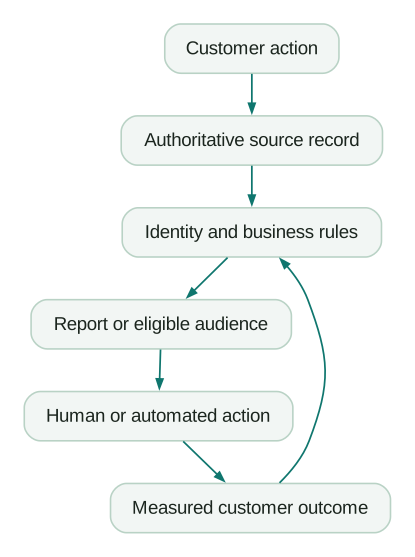
The budget should also include maintenance. An illustrative $1,200 software stack with six hours of monthly maintenance at $70 an hour costs $1,620 to operate before implementation. If a $180 connector removes four of those hours, the recurring total falls by $100, assuming it delivers the expected saving.
Use that calculation to compare an integration with the work it replaces. The stack audit guide helps identify the current cost and the workflows worth changing first.
A checklist before copying a reference stack
- Choose the example closest to your revenue model and operating complexity.
- Replace headcount assumptions with actual seats, profiles, events and sends.
- Define the first customer workflow the stack must support.
- Verify the plan includes the required API, connector and automation features.
- Map person, account, order and subscription identifiers.
- Include support, suppression, refund and cancellation states.
- Add maintenance and implementation to the software budget.
- Pilot the flow and reconcile its output with the source.
- Name the specific condition that would justify the next purchase.
At Martechdevs, we build and document the connections between customer data, reporting and the next operational action. Start with the free martech AI audit, or explore an AI assistant built around your approved workflows.
Questions people ask
Can we use these budgets as vendor quotes?
No. They are planning allowances for the described architecture and assume modest usage. Get quotes using actual volumes, required features and billing terms, then replace each allowance in your own budget.
Does every example need a warehouse?
Early setups can often work with supported direct integrations and a small reporting process. A warehouse becomes more useful when important questions repeatedly join several sources or require history that operating tools do not preserve well. Assign an owner before adding it.
Which stack is best for a product-led SaaS startup?
Prioritise account identity, activation events, billing state and lifecycle eligibility. Choose the CRM based on the human sales process and the messaging tool based on the product journey. A long list of sales tools will not substitute for knowing which accounts reached value.
Should we replace tools when we move into the next size bracket?
Keep tools that still meet the job at an acceptable total cost. Add capacity or controls when a real limit appears, such as missing permissions, unreliable joins or excessive manual work. The brackets describe increasing complexity rather than mandatory migrations.
Where does AI fit in these examples?
AI can help explain reports, inspect records or prepare actions once the relevant data and permissions are dependable. Start with an auditable question over a small approved dataset. Expand access after checking the answers and recording the actions it can take.
Sources
- Customer.io, Pricing and plans, checked September 2026.
- Google Firebase, Pricing, checked September 2026.
- Shopify, Pricing and plan comparison, regional pricing checked September 2026.
- Twilio Segment, Identify specification, checked September 2026.
Written by
Jafrin Akter AloData Engineer and Co-founder, martechdevs
Jafrin Akter Alo is a data engineer and co-founder of martechdevs, where the team has delivered 74+ martech, data and growth stack implementations.