
Free Martech Stack: What USD 0 Covers and Where It Stops
A startup can use free plans for tagging, analytics, a small CRM, reporting and limited data movement. The useful question is which required workflow fits those plans, what happens at each limit and whether the history you need survives. Choose one tool per job, check seats before volume, and separate genuinely free access from trials, promotional credits and billable usage allowances.
On this page
What can a startup operate without a software subscription bill?
A bounded startup workflow can have no recurring software subscription charge, but that does not make its implementation, hosting, messages or paid usage free. Define the people, data, channels and retention the workflow needs before selecting plans.
| Offer type | What it means | What to establish |
|---|---|---|
| Ongoing free plan | No fixed trial end, within stated entitlements | Seats, usage, features, retention and cap behavior |
| Free trial | Temporary access to a product or tier | Expiry, payment details and what remains afterward |
| Startup programme | Conditional award, discount or credit | Written acceptance, covered usage and eventual paid arrangement |
| Free usage allowance on a paid account | A portion of usage costs nothing | What becomes billable and how spending is controlled |
| Open-source software | No licence charge for the chosen edition | Hosting, maintenance, security and backup costs |
Use what a martech stack includes to define the jobs. Our martech integration work connects those jobs with stable identifiers, permission controls and repeatable tests. A zero-dollar tool choice is useful when the resulting workflow remains maintainable.
Do not buy every free product in this guide. The inventory below describes options and boundaries; the actual stack should contain only the components the team needs.
Which free tools fit the first collection and analysis jobs?
Start with acquisition measurement and, where product decisions require it, one product analytics tool. Record the different billing units rather than adding events, sessions, users and replay recordings together.
Tagging and GA4
Standard Google Tag Manager allows three simultaneous workspaces: the default plus two custom workspaces. This is an editing-concurrency limit, not a cap of three websites or three tracked events. GTM workspace limits
For standard GA4, user/event retention can be set to two or fourteen months. That setting affects relevant detailed analysis, not the standard aggregated reports in the same way; demographic data has a separate two-month limit. Extending retention cannot restore data already deleted. GA4 retention rules
Set the retention policy deliberately and verify it after setup. The GTM pricing guide covers edition boundaries; the GA4 BigQuery export guide covers retaining a separate export where appropriate.
One product analytics tool
| Free plan | Monthly event allowance | Other selected limits | History boundary |
|---|---|---|---|
| PostHog | 1,000,000 product analytics events | 5,000 recordings; one project | One-year guaranteed event retention; one-month recordings |
| Mixpanel | 1,000,000 events | Five saved reports per seat; 10,000 replays | Confirm the history and export features the workflow needs |
| Amplitude | 2,000,000 events | Ten saved charts per organization | One year of data access |
These are separate product entitlements, not interchangeable bundles. All three list free access without a card. PostHog Free, Mixpanel Free, Amplitude Free
Use the product analytics selection guide to choose the analysis workflow. A larger event allowance does not compensate for a required permission model, report or integration being unavailable. Also distinguish a limit per seat from a limit per organization before planning collaboration.
Which CRM and communication options fit a small team?
Check the required users and permissions before checking contact volume. A plan with enough records can still fail on day one because a teammate cannot have an individual account.
HubSpot Free supports up to two users and 1,000 contacts with no expiry. Attio Free permits three seats and 50,000 workspace records, but its free workspace data is visible and editable by every user. Attio's initial Pro trial is separate; select Free deliberately afterward and verify the features that remain. HubSpot Free CRM, Attio plan features, Attio billing
Three founders who all need CRM access do not fit a two-user plan. Do not solve that with shared credentials. Choose an arrangement with the required seats and access boundaries, or budget the appropriate paid capability.
For email, Klaviyo Free allows 250 active profiles and 500 monthly emails. Its profile and send limits are separate. OneSignal Free lists 10,000 monthly email sends and three active journeys, so meaningful free messaging is not universally limited to startup programmes. Test the required journey, recipient eligibility and delivery setup before selecting either. Klaviyo Free, OneSignal Free
An allowance of 500 emails is not permission to send to 500 new people plus every existing subscriber. Count all intended messages and current eligible profiles. Use the Klaviyo active-profile guide for that unit.
For support, an existing company mailbox with explicit ownership can be enough initially. Intercom's fourteen-day cardless trial is not a permanent free support workspace. Avoid assuming every support product has the same commercial model. Intercom trial and plans
If the necessary lifecycle or support capability does not fit a continuing free plan, check the startup programme guide. Keep programme eligibility, duration and graduation terms there; an application is not a confirmed award.
How can a free warehouse and pipeline fit together?
Separate the warehouse's allowance from the tools that load, transform and query it. A free connector or modeling seat does not pay the destination's bill or preserve its data indefinitely.
BigQuery: sandbox versus billing-enabled Free Tier
| BigQuery route | Payment arrangement | Allowance | Important limitation |
|---|---|---|---|
| Sandbox | No card or project billing account | 1 TiB querying monthly; 10 GiB storage over sandbox lifetime | Tables, views and partitions expire after sixty days; deleted storage does not restore lifetime quota |
| Billing-enabled Free Tier | Paid billing account | 1 TiB querying and 10 GiB storage monthly | Excess usage is charged; allowances do not roll over |
The sandbox also excludes capabilities such as streaming, DML and BigQuery Data Transfer Service. When moving to billing-enabled use, update resource expiration settings as well as billing; the existing expiration policy does not disappear merely because a payment method is added. BigQuery sandbox, Google Cloud Free Tier
A Cloud Billing budget alert notifies; it does not itself stop BigQuery charges. Google's current spend-cap service list covers specified services and does not include BigQuery. Do not assume a newer cap feature applies to the warehouse because it appears elsewhere in Cloud Billing. Budget alerts, spend-cap scope
For durable reporting, use the BigQuery cost guide to set the relevant query controls, monitoring and ownership. A billing-enabled project can remain within its free allowances, but its configuration is not a guarantee of a zero invoice.
Loading and modeling
| Tool | Selected free allowance | Unit that matters | Setup condition |
|---|---|---|---|
| Fivetran Free | 500,000 connection MAR | Monthly active rows in connection usage | Explicitly select Free while eligible |
| Fivetran Free activation | 3,500 activation MAR | A separate activation meter | Do not combine it with connection MAR |
| Fivetran Free transformations | 5,000 successful model runs/month | Repeated qualifying runs consume allowance | Track run frequency and model count |
| dbt Developer | One developer seat, one project, 3,000 successful model builds/month | Builds, not distinct model files | Confirm the account's actual entitlement |
Fivetran's Free Plan and dbt Developer pricing establish these different boundaries. Fivetran's trial is not automatically a lasting Free selection. An existing account can also have legacy dbt terms that differ from the current default.
If ten qualifying models build twelve times per day for thirty days, the model-build total is 10 × 12 × 30 = 3,600. Ten model files are not ten monthly builds. The warehouse compute used by those runs remains a separate resource.
Which reporting and activation tools are genuinely useful on Free?
Use free reporting and activation only where their entitlements cover the actual source, destination and operating cadence. A dashboard editor or enrichment interface is not the entire integration.
Data Studio provides a no-cost self-service reporting product. A connected warehouse or third-party connector may still have costs. Metabase Open Source is free to self-host, while its managed cloud Starter is paid; hosting and maintaining the open-source deployment remain the team's responsibility. Data Studio pricing, Metabase editions
Hightouch's Basic Reverse ETL Free plan permits two active syncs, hourly frequency and one workspace per organization, with a stated monthly operations allowance. A successfully run sync remains counted after deletion or disabling, so do not treat rotating configurations as free extra capacity. Hightouch self-serve limits
Clay Free offers 100 Data Credits and 500 Actions monthly, with a 200-row table limit. These are distinct meters. Its CRM integration and automation gates mean Free should not be presented as a complete unattended CRM enrichment layer. External provider keys can also create a separate provider bill. Clay Free features, Actions and Data Credits
Apollo offers a continuing free entry plan, but do not budget a universal numeric allowance from an old plan screenshot. Confirm the actual account's balance, grant period and required feature rates before relying on a recurring workload. Apollo plan FAQ
Use Hightouch pricing, dbt for marketing and Data Studio's edition comparison for deeper product-specific decisions. Add a sync because a defined action needs it, not because two syncs happen to be included.
What actually happens when a free limit is reached?
Different vendors stop different parts of the workflow. Monitor the consequence as well as the number; losing new events is different from temporarily losing report access.
| Product | Verified cap behavior | Operating consequence |
|---|---|---|
| PostHog Free | Excess events are permanently dropped; raising a cap later does not recover them | Collection can have an irreversible gap |
| Mixpanel Free | Collection continues while report access is blocked at the event allowance until reset or upgrade; no Free overage charge | Data arrival and analysis availability diverge |
| Amplitude non-paying account | Three monthly overages block charts/dashboards; continued excess without upgrading can lead to deletion six months after the initial block | The deletion condition must not be omitted |
| Segment Free | One MTU breach within six months locks access while data flows; a second also stops sending and receiving | The first incident is not the same as the second |
PostHog cap behavior, Mixpanel overage rules, Amplitude limits, Segment billing rules
Segment's Free Connections allowance is 1,000 monthly tracked users and two sources. An MTU is an identified or anonymous user whose data is collected, not a session or pageview. A busy marketing site can consume that allowance before the product has many signed-in users. Segment Connections pricing
| Product or route | Verified cap behavior | Action before dependency breaks |
|---|---|---|
| Klaviyo Free | Profile or send excess can restrict sending | Monitor both; a monthly reset does not remove active profiles |
| Fivetran Free | A first breach has a grace path; a second can freeze the affected account and pipelines under the applicable meter's rule | Track connection MAR, activation MAR and model runs separately |
| dbt Developer | After the model allowance is exceeded, subsequent runs are canceled until reset or upgrade; work remains accessible | Monitor missing scheduled outputs, not only account login |
| GA4 Standard daily export | Persistent excess over one million daily events can pause exports; a substantial breach can suspend them immediately | Missing days are not automatically reprocessed |
Klaviyo sending limits, Fivetran Free enforcement, dbt billing enforcement, GA4 export limits
Some pages establish a plan allowance without specifying the exact overflow sequence. For HubSpot or Attio record caps and a third active Hightouch sync, confirm the account's behavior before a critical import or launch. Do not invent an automatic charge, a safe grace period or a deletion deadline.
History limits are another failure mode. PostHog event and replay retention differ; Amplitude's one year of access is not a statement that all data is physically deleted at that precise boundary; GA4 detailed retention is distinct from aggregate reporting; the BigQuery sandbox has actual resource expiration. A successful login does not prove the older evidence still exists.
Which limit would a hypothetical three-founder startup hit first?
Seat and workflow fit can fail before event volume. Forecast all relevant units from one explicit operating scenario instead of choosing the largest-looking allowance.
Assume three founders each need CRM access, 4,000 distinct tracked website visitors monthly, 1.3 sessions per visitor, 300 new eligible onboarding profiles monthly and 600 CRM contacts growing by 200 per month. The app has 300 active users, twenty sessions per user and twenty-five events per session.
| Requirement | Calculation | Immediate decision |
|---|---|---|
| CRM access | Three individual users | HubSpot's two-user Free plan does not fit; evaluate a suitable three-seat option or paid plan |
| Website sessions | 4,000 × 1.3 = 5,200 | Sessions are not Segment MTUs; the scenario separately assumes 4,000 tracked unique visitors |
| App sessions | 300 × 20 = 6,000 | Recording all app sessions exceeds PostHog's 5,000 allowance |
| Product events | 300 × 20 × 25 = 150,000 | Within the illustrated product-analytics event allowances |
| Eligible new email profiles | 300 | Exceeds Klaviyo's 250-active-profile ceiling if all remain active |
| CRM contact growth | 600 + 200 per month | Reaches 1,000 after two increments; exceeds it after three |
The visitor assumption puts a Segment marketing-site source above 1,000 MTUs immediately. Actual billing still depends on the identities collected under the implementation. Do not infer the count from 5,200 sessions.
A fifty-percent sample of app sessions targets 3,000 recordings, but a random sample is an expected value, not a hard cap. Measure actual usage and use the product's relevant limit controls. The web and app recording streams also share the allowance if they belong to the same applicable organization.
For email, evaluate the required journey on a continuing free plan that fits, or apply to a suitable startup programme. Do not mark an unapproved award as free capacity in the operating plan.
How do you forecast the first month above a usage cap?
Use the current measured billable unit and a stated growth assumption, then distinguish reaching the cap from strictly exceeding it. The forecast is a planning scenario, not a prediction from the vendor.
Let month zero be current usage. With constant fifteen-percent monthly growth, usage after n increments is current × 1.15^n. The continuous crossing estimate is ln(cap/current) ÷ ln(1.15), but the operational check should inspect whole months and the vendor's actual enforcement boundary.
| Current monthly events | Compared cap | Continuous crossing estimate | First whole month strictly above |
|---|---|---|---|
| 150,000 | 1,000,000 | 13.6 increments | Month 14 |
| 150,000 | 2,000,000 | 18.5 increments | Month 19 |
| 450,000 after tripled collection | 1,000,000 | 5.7 increments | Month 6 |
The first scenario grows from about 922,918 events in month thirteen to 1,061,356 in month fourteen. Tripling collected events changes the available time much more than a small dashboard optimization. Check whether the added events have a real consumer before accepting that cost.
This original Python 3 function evaluates the whole-month condition directly:
from decimal import Decimal

def first_month_over(current, cap, growth, horizon=120):
    usage, limit, rate = (Decimal(str(x)) for x in (current, cap, growth))
    if not all(x.is_finite() for x in (usage, limit, rate)):
        raise ValueError("Inputs must be finite")
    if usage < 0 or limit <= 0 or rate < 0:
        raise ValueError("Use nonnegative usage and growth, and a positive cap")
    if type(horizon) is not int or horizon < 0:
        raise ValueError("Horizon must be a nonnegative integer")
    for month in range(horizon + 1):
        if usage > limit:
            return month
        usage *= 1 + rate
    return None

assert first_month_over(150000, 1000000, "0.15") == 14
assert first_month_over(150000, 2000000, "0.15") == 19
assert first_month_over(450000, 1000000, "0.15") == 6
None means no strict excess within the chosen horizon, not unlimited safety. A plan that blocks at equality needs an earlier threshold, and bursty daily exports need a daily forecast. Add a separate warning level and an owner with enough time to reduce collection, upgrade or migrate before the consequence occurs.
How should you wire the stack so a later change preserves history?
Use stable approved identities, a short event contract and an explicit export and retention plan. Do not assume every free product includes an automatic raw backup.
- Create company-controlled accounts with a named operator and recovery owner.
- Write the tracking plan and event naming rules before installing several SDKs.
- Preserve person and account identifiers where known and appropriate; do not invent an identity for anonymous activity or use a shared account ID as every person's GA4 User-ID.
- Confirm the required export feature, source scope, schedule and destination costs.
- Test an export and restoration or downstream read before relying on it.
- Record the plan, cap, reset period, retention and operating response in the stack inventory.
GA4 Standard's daily export limit is one million events per day, separately from BigQuery quotas and charges. Mixpanel Data Pipelines is a paid-plan add-on, not an automatic Free warehouse copy. A missing export period cannot be assumed recoverable simply because the dashboard once showed a total. GA4 export options, Mixpanel plan boundaries
Preserve required CRM records and communication preferences through migration. Export cadence should match the loss the business can tolerate; “monthly” is an example, not a guarantee that losing several weeks is acceptable. Check restore behavior with stable keys and current suppression rules.
When should you upgrade, apply for a programme or reduce collection?
Choose the action from the failing requirement. A useful paid tier can be cheaper than repeatedly maintaining a workaround, while unused collection should be removed rather than funded indefinitely.
| Situation | First action | Evidence for the decision |
|---|---|---|
| A cap threatens required collection or sending | Forecast and plan the transition early | Measured usage, enforcement rule and lead time |
| The needed workflow is outside Free | Compare an eligible programme or paid feature | Actual plan gate and written offer |
| Large volumes have no useful consumer | Reduce collection deliberately | Event inventory, owners and downstream dependency check |
| Permissions or seats force unsafe workarounds | Choose an appropriate plan or product | Required named access and data boundaries |
| Paid meter is a poor fit | Compare migration with continued operation | Complete future cost, export limits and reimplementation work |
For an original planning example, four hours of workaround effort at USD 75/hour consume USD 300 of internal capacity monthly. A hypothetical USD 140 subscription could cost less in that comparison, but only if it removes the work and preserves the required outcome. Those figures are assumptions, not vendor prices or guaranteed savings.
Check startup programme eligibility before changing account status; vendors differ on whether prior payment helps, prevents or is irrelevant to application. The startup stack stage guide handles what to add next once the recurring job is clear.
What must pass before calling the stack free and ready?
Confirm that the actual selected plans support the workflow, all costs outside them are visible and somebody owns the response before a cap or expiry matters. A signup screen showing USD 0 is not an operating acceptance test.
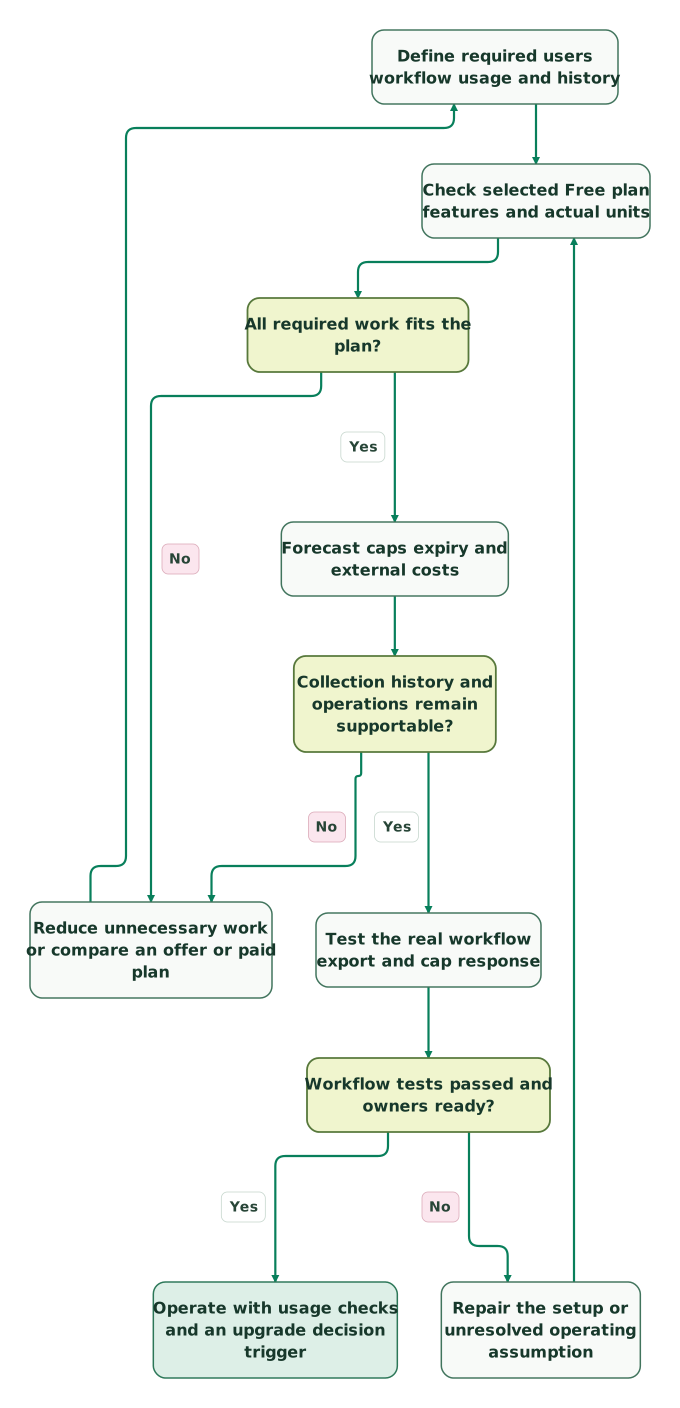
Read diagram as text
- Define required users workflow usage and history to Check selected Free plan features and actual units.
- Check selected Free plan features and actual units to All required work fits the plan?.
- All required work fits the plan? to Reduce unnecessary work or compare an offer or paid plan: No.
- Reduce unnecessary work or compare an offer or paid plan to Define required users workflow usage and history.
- All required work fits the plan? to Forecast caps expiry and external costs: Yes.
- Forecast caps expiry and external costs to Collection history and operations remain supportable?.
- Collection history and operations remain supportable? to Reduce unnecessary work or compare an offer or paid plan: No.
- Collection history and operations remain supportable? to Test the real workflow export and cap response: Yes.
- Test the real workflow export and cap response to Workflow tests passed and owners ready?.
- Workflow tests passed and owners ready? to Repair the setup or unresolved operating assumption: No.
- Repair the setup or unresolved operating assumption to Check selected Free plan features and actual units.
- Workflow tests passed and owners ready? to Operate with usage checks and an upgrade decision trigger: Yes
Checklist
- Every required person has an individual permitted account.
- The selected plan is actually Free, rather than a temporary trial.
- Usage meters and reset periods are recorded separately.
- The effect of each critical cap is known or explicitly unresolved.
- Retention and export capabilities meet the required history.
- Billing-enabled services have realistic cost controls and owners.
- Sampling is monitored rather than treated as a guaranteed ceiling.
- Consent, domains, hosting and implementation costs remain visible.
- A real workflow and export or recovery case have passed.
- The team has a concrete transition trigger before the limit causes harm.
Martechdevs' Starter implementation plan is USD 4,800 with fast delivery after the 25% plan discount. Compare its inclusions with your tools and first customer journey. Get the $99 martech audit when the data and process dependencies are unclear, or discuss a Custom integration scope for work outside the listed plans.
Keep reading
Browse all Martech Strategy guides
 Martech Strategy
Startup discount programs for martech tools in 2026: who qualifies and what you pay later
Dated list of startup programs for HubSpot, Intercom, Mixpanel, Amplitude, PostHog, Customer.io and more: who qualifies, what is excluded, year-two cost.
Jafrin Akter AloLast updated 21 min read
 Martech Strategy
B2B SaaS Martech Stack: Connect Product, Sales and Billing
Design a SaaS stack around accounts, activation and billing. Compare sales-led, product-led and hybrid workflows with qualification and reconciliation checks.
Jafrin Akter AloLast updated 14 min read
 Martech Strategy
Fintech Marketing Stack: Track the Funnel Without Leaking Financial Data
Design a fintech stack around verified application and funding milestones. Control destination data, model pending cases and test internal event boundaries.
Jafrin Akter AloLast updated 14 min read
Martech integration
See the implementation scope, deliverables and acceptance checks.
Questions people ask
Can a tool have a zero subscription price and still produce an invoice?
Yes, when the arrangement includes billable usage, paid channels, add-ons, external providers or infrastructure. Separate the product's fixed subscription from every variable meter and connected service. A no-card free plan and a paid account with a free allowance have different exposure. Read the selected configuration and test usage reporting rather than interpreting a large USD 0 heading as the whole commercial agreement.
Should we remove old CRM records just to stay below the free cap?
Only when removal fits the business's retention and operating rules. A record can still be needed for an existing relationship, a suppression decision or historical reporting. Review dependencies, preserve required evidence and test what deletion does in connected tools. Do not erase useful history or opt-out state simply to avoid an upgrade; compare the actual cost of maintaining the workflow properly.
What does it mean if the forecast never exceeds the cap within its horizon?
It means the chosen assumptions do not produce strict excess during that modeled period. It does not account automatically for bursts, another project sharing the allowance, changed event collection, a new billing unit or a feature gate. Reconcile the forecast to measured usage and update it after material changes. An account can still fail a seat, retention or permission requirement immediately.
Can two free tools safely cover the same collection job during a migration?
They can if the overlap is deliberate, bounded and correctly measured. Name the source and destination of each stream, prevent duplicate downstream actions and record the migration comparison period. Include both products' usage limits and retention. Retire the old path after acceptance rather than leaving an unowned second SDK, exporter or CRM writer running indefinitely because its subscription happens to be free.
Should every early-stage team add a warehouse just because it has a free allowance?
No. Add it when a recurring join, history requirement or reporting decision justifies the setup and maintenance. A small team may first need better source definitions or a reliable CRM process. When a warehouse is useful, budget ingestion, transformations, queries, storage and operating time separately. A free allowance can support a bounded workload, but it does not define the workload or supply its owner.
Sources
- Google Tag Manager workspaces
- GA4 retention
- PostHog pricing and limits
- Mixpanel Free plan
- Amplitude Free plan
- HubSpot Free CRM
- Attio plan features
- Attio billing and trial transition
- Klaviyo Free limits
- OneSignal Free allowances
- Intercom trial
- BigQuery sandbox
- Google Cloud Free Tier
- Cloud Billing budget alerts
- Cloud Billing spend-cap scope
- Fivetran Free Plan
- dbt Developer pricing
- Data Studio pricing
- Metabase editions
- Hightouch self-serve limits
- Clay Free features
- Clay Actions and Data Credits
- Apollo pricing FAQ
- Mixpanel overage and export rules
- Amplitude limits and quotas
- Segment billing and lock rules
- Segment Connections pricing
- dbt billing enforcement
- GA4 daily export enforcement
- GA4 export options

Written by
Jafrin Akter AloData Engineer and Co-founder at Martechdevs and Growth and Analytics Partners
Jafrin writes practical guides to marketing technology, customer data, analytics and AI workflows. Martechdevs is a Growth and Analytics Partners company.