Martech data integration: choose the method for each flow and prove it works
Data Engineer and Co-founder at Martechdevs and Growth and Analytics Partners
Last updated 16 min read

Martech data integration moves events, customer records, revenue and permission state between tools under explicit rules for identity, ownership, format, timing and recovery. Start with the business flow, write its contract, then choose the simplest method that satisfies it. A connection is useful when the receiving system holds the right current state and can act on it correctly, including after failures and removals.
What kinds of data flow does a martech stack need?
Separate collection, reporting loads, activation, operational synchronization and agent access. They solve different jobs and do not need the same transport or schedule.
The customer relationship management (CRM) system is one of the layers of a martech stack. Marketing data integration often refers specifically to loading channel and campaign data for reporting. The wider integration job also changes what operational tools know and do.
| Flow | Example | Result to verify |
|---|---|---|
| Collect | Product events reach analytics and storage | Correct person, account, event and occurrence time |
| Load | Advertising, billing and CRM data reach reporting models | Complete source coverage and reconcilable totals |
| Activate | A modelled account state reaches messaging or sales | Correct members, field values and removals |
| Operate | Billing changes update a CRM account summary | Current authoritative state without conflicting writes |
| Agent access | An assistant queries approved business data | Authorized access and an answer traceable to the source |
A green connector status may confirm a connection or transfer. It does not establish that two records matched correctly, an old audience member was removed or an amount kept its currency. Define the result the business will accept before configuring the connection.
How do you turn customer journeys into a flow inventory?
List the transfers needed for two or three important journeys, then assign an owner and acceptance result to each. Trial to paid, lead to qualified opportunity and first purchase to repeat purchase are useful starting points.
A filled-in inventory row might be: billing subscription changes → CRM company summary; trigger on relevant billing events; map through an approved customer-to-account reference; update only billing-owned fields; meet the agreed freshness target; alert the integration owner when reconciliation fails.
Record source, destination, trigger, entity, fields, timing, current method and owner. Use a tracking plan for event flows so an event name means the same completed action across producers.
At Martechdevs, we start with these flows and the decisions they support. Our hands-on martech integration services turn the agreed rules into maintained connections, tests and operating procedures. Choosing a connector comes after the matching and ownership decisions that determine whether it can do the job.
What should the integration contract specify?
The contract should let two engineers implement the same intended behavior and let the business owner judge the outcome. Keep it short enough to review, but explicit at the boundaries where systems disagree.
Which key identifies the same customer or account?
Use stable source identifiers and a maintained crosswalk to destination records. Email can help matching, but it changes and can belong to different people over time. Keep person, workspace, commercial account and subscription identities distinct. Identity resolution across web, app, CRM and billing supplies the wider model.
Do not silently create a new CRM company every time a lookup fails. Classify unmatched and ambiguous records, keep the original source ID, and give an owner the evidence needed to resolve them. Decide what a source merge changes in the crosswalk before it happens in production.
Who owns each field and what direction may it move?
Assign one authority for each business fact. Billing owns payment state; sales owns the agreed commercial stage; the product owns actual feature access. A bidirectional connector should not give both systems unrestricted authority over every field.
Use property-level ownership rules to specify permitted writers, conflict handling and timestamps. An integration should not overwrite a sales decision with an older copy simply because its scheduled job ran last.
What do the values mean?
Map source field, destination field, type and transformation. Include allowed lifecycle or picklist values, time zone, currency and amount basis. Distinguish an absent field from an explicit blank, a zero and an instruction to remove a value.
For example, paid_amount is incomplete without its currency and whether it includes refunds, tax or fees. A date-only renewal field also cannot carry the same meaning as a precise payment timestamp. Reject or quarantine unsupported values rather than silently mapping them to a convenient default.
How current must the result be?
Set timing from the decision. A weekly performance review and a suppression check before sending a message have different tolerances. Measure source-through time, processing time and destination acceptance separately.
An old event arriving late should not restore an obsolete state. For important state changes, retrieve or reconcile the current authoritative object before writing the destination. Preserve the older event for history without treating arrival order as business order.
What happens to removals, blanks and corrections?
Specify the destination behavior for unsubscribe, audience exit, cancellation, merge and deletion separately. Removing a person from an audience is different from deleting the CRM record; an accounting record may have a different retention policy from marketing eligibility.
Define which downstream copies or actions must change under the approved policy, who verifies them and what to do if a destination cannot express the required removal. An add-only sync cannot satisfy a current-membership contract. A missing row in an incomplete extraction should not become an instruction to delete everyone absent from that batch.
How are failures and repeated deliveries handled?
Separate the receipt of an event from the business action it requests. Use a durable record of accepted inputs, processing attempts and outcomes, then reconcile uncertain writes before replaying them.
Stripe's webhook guide documents duplicate delivery and no guaranteed event ordering. It calls for signature verification and supports asynchronous handling. Live delivery retries can continue for up to three days; sandbox delivery is retried three times over a few hours. An event receipt is not evidence that your downstream action completed.
Protect the action itself with an appropriate idempotency rule: repeating the same intended operation should not produce another business effect. Stripe's application programming interface (API) v1 idempotency behavior retains the first executed response, including server errors, and can prune keys after at least 24 hours. Reuse after pruning can create a new request. API v2 has different retry semantics. A provider key does not replace your longer-lived business-action ledger.
For a timeout after a write, do not automatically assume nothing happened. Inspect the destination using the stable business reference or supported request status before deciding which work remains.
Who controls access and operating credentials?
Keep credentials in business-controlled accounts, grant the permissions required for the specific flow and document rotation and recovery. Test the integration identity separately from an administrator who happens to have broad access.
Carry the relevant consent and communication eligibility with the data and apply it at the action boundary. A successful API call does not establish permission to send a message. Limit logs to the evidence needed for operation and keep sensitive payloads out of general alerts.
Here is a compact, hypothetical business specification for one flow. It is a planning contract, not an importable vendor configuration:
flow_id: billing_summary_to_crm_company_v1
source: authoritative billing subscription state
destination: existing CRM company record
matching: approved billing_customer_id to internal_account_id to crm_company_id
fields:
  active_subscription_count: count_of_current_active_subscription_records
  billing_status_summary: approved_account_level_rule
  billing_checked_at: UTC_timestamp_of_successful_source_reconciliation
  billing_state_revision: integration_owned_snapshot_revision
multiple_subscriptions: aggregate_under_the_approved_account_rule
state_revision: increment_when_reconciled_account_state_changes
blank_policy: quarantine_missing_required_state_do_not_erase_current_value
freshness_target: 15_minutes_after_relevant_change_is_available
removal_policy: update_eligibility_under_approved_policy_keep_required_history
failure_policy: record_attempt_alert_owner_reconcile_uncertain_writes
replay_key: flow_id_plus_integration_snapshot_revision_plus_destination_record
acceptance: read_back_the_expected_company_fields_and_state_version
owner: integration_operations
The 15-minute target is an example requirement. The CRM summary supports sales or support context; it does not itself grant product access. The revision is owned by this integration, not a native Stripe sequence number. Serialize writes for each account and reject obsolete queued revisions; a provider event timestamp does not establish reliable ordering. If one account has several subscriptions, a single last-arriving subscription event must not overwrite the account summary without the chosen aggregation rule.
Which integration method fits each flow?
Choose the least complicated method that passes the contract and has an owner who can operate it. A richer tool does not compensate for an unresolved identity or removal rule.
| Method | Good starting fit | Responsibility that remains | First acceptance check |
|---|---|---|---|
| Native integration | Supported objects, directions and standard mappings | Configuration, permissions and reconciliation | Required field and removal behavior work in both relevant states |
| Automation platform | Bounded rule-based workflows operations can maintain | Task usage, branching, replay and alerts | A partial failure recovers without repeating completed actions |
| Event pipeline | Shared event collection feeding several destinations | Identity, schema and destination-specific mapping | One known event becomes the intended record in each route |
| Warehouse load plus activation | Sources need joining or modelling first | Source completeness, model logic and destination state | Modelled output and actual destination agree, including exits |
| Custom API or webhook service | Required behavior exceeds connector controls | Authentication, pagination, limits, durable recovery and version changes | Duplicates, outages and uncertain writes resolve correctly |
| Model Context Protocol (MCP) access | AI-assisted investigation or reviewed operations | Authorization, context and action approval | The intended identity can perform only the authorized operation |
A native app deserves a trial when it supports the exact objects and fields. Check custom-object support, direction, synchronization timing and error visibility; the word “integration” is not a specification.
Automation platforms are useful when the workflow can be explained and monitored by the operating team. A long chain of compensating branches can become harder to maintain than a small service. Compare the actual task meter and recovery behavior before choosing on initial build effort alone.
Event pipelines and warehouse loads also differ. Segment's Connections overview describes warehouses as destinations loaded in bulk. Reverse ETL (extract, transform and load) sends warehouse data to other tools. Do not promise the same latency or destination behavior for every path. The Google Analytics 4 (GA4) Measurement Protocol supplements automatic collection; it is not a complete replacement for the supported web or application collection setup.
Use how reverse ETL syncs warehouse rows into tools when the value comes from a modelled account state or audience. It is unnecessary to create a warehouse solely to copy one unchanged field if a simpler supported route meets the contract.
Model Context Protocol is a standard for connecting AI applications to external systems. The protocol alone does not supply your recurring scheduler, durable retry ledger or delivery guarantee. A host or service can add those responsibilities, but they still need owners and tests. Start with approved read access when the job is investigation; give consequential actions explicit scope and review.
For a record synchronization flow, use this decision sequence. Event collection and assistant access follow their separate requirements above.
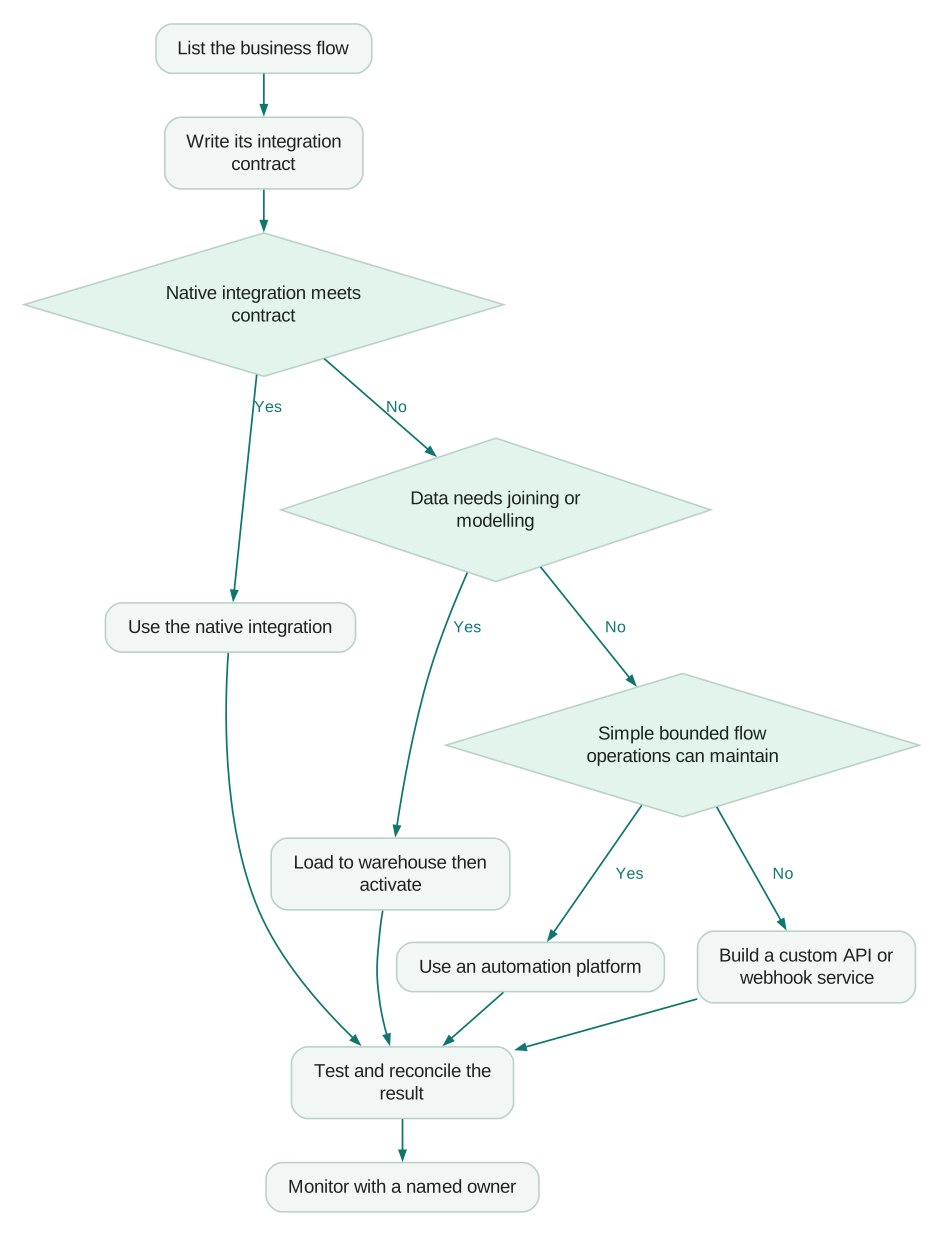
What would six flows look like for a 20-person SaaS company?
Use a different method where the flow's job changes. This hypothetical software-as-a-service (SaaS) company uses HubSpot Professional, Stripe, Segment, Mixpanel, BigQuery, Customer.io and Google Ads. The example shows how six flows can use different methods within one stack.
| Flow | Chosen route | Reason | Acceptance evidence |
|---|---|---|---|
| Product events to Mixpanel and BigQuery | Segment event pipeline | Share collection while preserving destination-specific mappings | Correct actor/account, event count and warehouse arrival |
| Stripe subscription context to HubSpot companies | Governed webhook service, or native app if it meets the contract | Billing owns current state; the CRM needs an account summary | Multiple subscriptions aggregate correctly and old deliveries cannot reverse the summary |
| CRM, billing and ad data to BigQuery | Managed loading connectors | Reporting needs historical source data | Required records, periods and totals reconcile |
| Product-qualified account state to HubSpot and Customer.io | Reverse ETL from an approved model | Both tools need the same maintained rule | Fields and eligible members match, including removals |
| Qualified commercial outcomes to Google Ads | Supported offline-conversion import route | Bidding needs the chosen downstream business outcome | Matching, actual outcome time and acceptance are recorded |
| Pipeline questions from an assistant | Read-only warehouse connection over MCP | Investigation can reuse approved reporting models | Query result matches the reference question and permitted scope |
The CRM route publishes a company-level summary rather than assuming Professional automatically includes the custom objects the design might otherwise require. If independent subscription records must live in the CRM, validate that model and entitlement before selecting the route.
For every flow, separate the business owner from the person maintaining the connector. One person may hold both roles, but “the integration tool owns it” leaves nobody responsible for a wrong customer outcome.
How do you size the backfill and daily changes against API limits?
Calculate requests for the actual endpoint, then leave headroom for the other work sharing its allowance. Record the API version and app-distribution type because a familiar product name does not establish one universal rate limit.
HubSpot's current usage guidelines give privately distributed Professional apps 190 requests per ten seconds per app and 625,000 requests per day shared across the account's apps. Marketplace-distributed OAuth apps instead have a 110-per-ten-second installing-account limit, with endpoint exceptions such as Search. Plan the specific route, not a generic “HubSpot limit.”
The current Contacts API guide uses 2026-09 paths and limits batch operations to 100 records. The API overview explains date-based versions; record the version you actually deploy and review changes deliberately.
For this synthetic sizing example, 40,000 known contacts need the same supported operation and 3,000 are changed on a later day. Assume full batches of 100, resolved destination IDs and one API request per batch. Daily percentages use the 625,000-call private-app account allowance.
| Workload | Records per request | Requests | Share of daily allowance | Time at an assumed smooth 19 requests/second |
|---|---|---|---|---|
| Initial 40,000, one record at a time | 1 | 40,000 | 6.4% | About 2,105 seconds, or 35.1 minutes |
| Initial 40,000, full batches | 100 | 400 | 0.064% | About 21.1 seconds |
| Later 3,000 changed records, full batches | 100 | 30 | 0.0048% | About 1.6 seconds |
The request counts are 40,000 ÷ 100 = 400 and 3,000 ÷ 100 = 30. These are request-budget comparisons. The last column assumes evenly paced calls and is neither a measured runtime nor a completion-time guarantee. A ten-second rate ceiling does not specify network latency, processing time or permitted instantaneous bursts.
Add discovery reads, pagination, association fetches, retries and readback checks to the request count. Reserve capacity for other account applications. If the destination ID is not yet resolved or records need different operations, the simple full-batch assumption no longer holds.
A rate-limit response should trigger controlled backoff and investigation of the applicable allowance. It should not cause a tight retry loop that consumes more capacity while delaying other work. Check response-level and record-level results so one accepted batch does not conceal individual failures.
What tests establish that the integration works?
Turn every contract clause into a specimen with an expected result, then test the final destination as well as the transport. Begin in an appropriate isolated environment and use records that cannot trigger unintended customer activity.
| Test case | Expected evidence | Failure the test should expose |
|---|---|---|
| New and updated record | Correct stable match and owned fields | Duplicate creation or a wrong customer match |
| Merge or missing identifier | Governed crosswalk change or a visible unresolved record | Silent reassignment to an unrelated account |
| Unsupported enum or explicit blank | Contract-defined rejection, clearing or preservation | Convenient default that changes meaning |
| Duplicate or out-of-order delivery | One intended business effect and current state | Repeated message or restoration of obsolete data |
| Audience exit or permission change | Required downstream exclusion verified | Add-only synchronization |
| Rate limit, timeout or unavailable destination | Recorded retry state and named recovery owner | Lost work, tight loops or repeated uncertain writes |
| Partial batch success | Per-record outcomes and targeted recovery | A successful envelope hiding failed records |
Stripe's webhook documentation provides stripe listen for forwarding test events to a local endpoint. Keep the sandbox's shorter retry behavior separate from the live three-day window when planning recovery tests. A local forwarding test and a deployed destination test cover different boundaries.
For warehouse models, dbt's data-test guide provides unique, not_null, accepted_values and relationships tests, alongside custom assertions. Use them for the relevant contract clauses, then reconcile the output population and read back destination values. A passing uniqueness test does not prove that the correct customers were selected.
Write the expected values before running each case. Compare counts by period and status, then inspect identifiers, timestamps, currency and state. Retain unmatched records and explained exclusions; forcing totals to agree by dropping unexplained differences defeats the test.
How do you keep the flow reliable after launch?
Monitor the business result and the recovery path with a named owner. Transport success, complete processing and correct destination state should remain separate observations.
Track source-through time, backlog age, failed and retried records, unresolved identity, removals awaiting confirmation and the last reconciled output. An alert should name the affected flow, business consequence and permitted next action. Keep credentials and sensitive payloads out of a broad notification channel.
The replay procedure should identify the input window, already-completed actions, uncertain writes and the version of mapping being used. Reconcile first, then replay only the required work. Record what changed and verify downstream state afterward.
Revisit the contract when a source schema, API version, commercial plan, identity rule or customer-permission policy changes. Assign an owner to vendor notices and deployment acceptance. A script running on someone's laptop needs a maintained execution environment, business-owned access, logs and recovery before it becomes a dependable operating process.
Which failures should you investigate first?
Start with the wrong customer, an unintended action or an irreversible removal, then follow the failing record across its boundaries. Our first checks at Martechdevs are the stable match, field authority, value mapping and actual receiving-system state.
A two-way loop often indicates unclear field ownership. A lifecycle stage that exists in only one tool indicates a mapping gap. An audience that grows but never shrinks indicates missing removal behavior. A custom object absent from a native integration is a scope mismatch. Those symptoms call for different repairs.
Contain the affected action while preserving useful evidence. A vendor switch should follow a demonstrated capability gap, not replace the investigation. The new tool would otherwise inherit the same undefined contract.
When should you bring in implementation help?
Bring in help when the required identity, mappings, scale or recovery exceeds the team's available operating capacity. Keep an internal owner for business definitions and acceptance in every delivery model.
Budget software and usage, the build, continuing maintenance and internal time separately. What changes an implementation quote explains scope, while agency, freelancer or in-house ownership helps assign the work after launch.
Martechdevs projects start at USD 3,000. Full warehousing, end-to-end visualization and activation can reach USD 15,000; scope sets the quote. Define the flows, test cases, operating handover and exclusions before agreeing the delivery.
Checklist
- Every flow has a source, destination, purpose, freshness target and owner.
- Stable matching and ambiguous-record handling are documented.
- Each field has an authority, transformation and blank-value rule.
- Required removals and permission changes reach the relevant destinations.
- The chosen method passes the contract and has an operating owner.
- Request volumes include backfills, changes, retries and verification.
- Duplicate, late, partial and failed cases have expected results.
- Source populations reconcile and destination records read back correctly.
- Credentials are business-controlled and limited to the flow's needs.
- Alerts, replay and version changes have an accountable owner.
Want a second pair of eyes on your stack? Book a free audit, or request a scoped martech integration quote with the flow inventory and acceptance evidence.
Questions people ask
How do you integrate a system that only exports files?
Use a controlled export-and-load process with a declared schema, source period, stable batch identifier and completeness check. Agree how the receiver knows a file is finished, rather than reading a partially written export. Validate counts, required fields and duplicate batches before publication. Record the available schedule and recovery procedure; a file-based route can be appropriate when it meets the business deadline and contract.
What if a manual correction is made while an integration retry is pending?
Compare the correction with the field's ownership and version rules before allowing the retry to write. Preserve the manual change and its reason so the owner can decide whether it should become authoritative source state or remain an approved exception. An old retry should not silently undo a newer legitimate decision. Reconcile the conflict and record the chosen outcome against the original work item.
How do you verify a partner feed containing only new and changed records?
Agree how deletes, merges and eligibility losses are communicated, and how to reconcile the entire expected population periodically. An incremental file with no row for a customer cannot distinguish unchanged data from a required removal by itself. Request a complete snapshot, explicit removal record or another verified control. Record the fallback and its freshness limit before using the feed for current audiences.
What if both systems assign their own record identifiers?
Keep both identifiers in a crosswalk tied to the stable business entity, and record the destination ID returned by the accepted creation. Prevent another pending creation for that same entity from racing ahead of the first result. If the outcome is uncertain, reconcile it before creating again. Vendor-assigned IDs can coexist; they need an explicit relationship rather than a rule that guesses one from the other.
What should happen when the business cannot agree on a field's meaning?
Keep that field out of consequential automation until its owner resolves the definition and acceptance examples. Preserve the source values and expose the disagreement rather than choosing whichever label is easiest to map. The rest of the flow can progress if its contract remains valid without that field. Record the unresolved decision, affected consumers and a deadline for the accountable business owner.
Sources
- Stripe: Webhook delivery, verification and testing.
- Stripe: Idempotent API requests.
- HubSpot Developers: API usage guidelines.
- HubSpot Developers: Current Contacts API.
- HubSpot Developers: 2026-09 API overview.
- Twilio Segment: Connections overview.
- Google Analytics: GA4 Measurement Protocol.
- dbt Labs: Data tests.
- Model Context Protocol: Introduction.

Written by
Jafrin Akter AloData Engineer and Co-founder at Martechdevs and Growth and Analytics Partners
Jafrin writes practical guides to marketing technology, customer data, analytics and AI workflows. Martechdevs is a Growth and Analytics Partners company.