Startup discount programs for martech tools in 2026: who qualifies and what you pay later
Data Engineer and Co-founder at Martechdevs and Growth and Analytics Partners
Last updated 18 min read
Startup programmes can reduce the early cost of CRM, support, messaging, analytics and data tools, but eligibility and renewal terms differ sharply. Some require a new customer, a funding cap or a partner referral; others exclude specific usage from the award. Choose the workflow first, verify the programme before upgrading and model the paid years before accepting the discount.
Which martech tools currently offer startup programmes?
HubSpot, Intercom, Customer.io, Mixpanel, Amplitude and PostHog offer documented startup programmes, with others grouped by job below. The offers were checked against vendor sources on 17 October 2026. This is a verified selection across the main martech jobs, not a claim to list every available promotion. An advertised maximum is not a guaranteed award, and credits are not cash or necessarily transferable across products.
| Job | Programmes worth checking | Important distinction |
|---|---|---|
| CRM and sales | HubSpot, Attio, Apollo; Clay Wedge | Product/seat discounts differ from accelerator credits |
| Support | Intercom, Zendesk | Included agents and AI usage can change over time |
| Lifecycle messaging | Customer.io, Braze | Free term and graduation price need confirmation |
| Product analytics | Mixpanel, Amplitude, PostHog | Annual events, monthly usage and dollar credits are different allowances |
| Data movement | Fivetran for eligible YC companies | General Free plan is separate from the startup award |
| Warehouse infrastructure | Google for Startups Cloud | Eligible cloud services and credit coverage matter |
Segment, Klaviyo, Hightouch and dbt have relevant free entry options, but the checked pages do not establish a universal startup credit award for each. Snowflake's public trial is also distinct from a negotiated startup offer.
At Martechdevs, our integration work connects the CRM, analytics and messaging workflows a programme helps fund. The objective is a setup that still makes operational and financial sense after the discounted year.
Which CRM and sales programmes fit early-stage teams?
Use the CRM or sales workflow to shortlist a tool, then check the programme's product and seat boundaries. A discounted higher tier can still be unnecessary work for a team that only needs a simple pipeline.
HubSpot for Startups
HubSpot publishes a funding-track offer of 90% off year one, 50% off year two and 25% off year three for eligible pre-seed through Series A companies, with verified venture funding or an approved partner route; its entrepreneurial-partner track shows 30% then 15%. The discount applies to net-new Professional or Enterprise products with an annual commitment, and its generic “typically two years” FAQ conflicts with the three-year funding-track schedule, so obtain the actual duration in writing. Use HubSpot pricing for the underlying package and HubSpot's programme page for the accepted offer.
Attio Startup Program
Attio advertises 80% off annual Pro and credits in year one, followed by 30% off in year two, for workspaces up to ten seats. Its FAQ specifies venture backing, incorporation under ten years ago and signup within the last 90 days; another section also mentions startup partners, so a partner-only applicant should confirm eligibility rather than assuming approval. No fixed continuing discount after year two is established here. Compare the package with Attio's seat and credit pricing. Official programme.
Apollo for Startups
Apollo offers 50% off Basic or Professional for one year, up to five seats. The listed tests include fewer than 20 employees, no existing Apollo subscription, a company domain and affiliation with a startup ecosystem partner. Applicants without a partner can apply for next steps, but the page does not promise acceptance. Price added seats and usage separately using Apollo pricing. Apollo's programme terms.
Clay Wedge and the Free plan
Clay Wedge is a programme for venture-backed startups at Series A or earlier, with live/asynchronous sessions and opportunities to earn credits. The page does not publish a guaranteed individual award. Semester-renewing free credits belong to the separate undergraduate Campus Ambassadors programme, not Wedge. Clay for Startups.
Clay's general Free plan includes 500 Actions and 100 Data Credits monthly, with a 200-row table limit. Use it for a bounded test, then measure Actions and Data Credits rather than budgeting around an unconfirmed accelerator award. Clay pricing.
What support and lifecycle offers are available?
Match the offer to your channels, customer volume and operating owner. Free access to a complex platform does not remove implementation effort or paid delivery usage.
Intercom Early Stage
Intercom advertises 93%, 50% and 25% discounts across three years, starting from $65 monthly in year one. The bundle lists six Advanced seats, six Copilot seats, 20 Lite seats and Proactive Support Plus with 500 messages monthly. Included Fin outcomes fall from 300 to 150 to 75 per month; 15 qualifications remain listed in each year. Intercom Early Stage.
The programme requires a new customer and up to $10 million in funding. Its headline says fewer than 15 employees while other wording treats more than 15 as ineligible; confirm an exactly-15-person application. Extra Fin outcomes cost $0.99 and qualifications $9.99, while phone, SMS and WhatsApp are outside the discount. Switching away from the programme forfeits later-year savings. Use Intercom pricing for the complete operating bill.
Zendesk for Startups
Zendesk's baseline offer is six months, with one- or two-year terms through qualifying institutional partners. It describes Professional Suite and Copilot for up to 50 agents, with the actual award depending on funding profile and partner. No upfront card is required; a paid plan is needed to continue after the term. Zendesk programme.
The FAQ requires a new subscriber, incorporation under ten years ago, no later than Series B and fewer than 250 employees, with a referral for teams of 50 to 249. Its form instead uses inclusive headcount boundaries and requires outside funding, while the FAQ welcomes bootstrapped companies. Confirm those edge cases with Zendesk before relying on the offer. For workflow fit, compare Intercom and Zendesk.
Customer.io Startup Program
Customer.io offers eligible new customers up to 12 months with 30,000 profiles, counting people and objects, and Essentials features. It requires less than $10 million raised, normally collected rather than purchased contact lists, and no current or former customer relationship; trial users can still apply. A credit card is required. Customer.io startup terms.
Profiles above 30,000 cost $0.007 each under the startup offer, different from the ordinary Essentials overage rate. The page describes reminders with 60 days left and an unpublished graduation discount before standard pricing. Confirm your approved term and non-profile usage. The Customer.io pricing guide explains why an object-heavy account can exceed a profile estimate based only on people.
Braze for Startups
Braze publishes four months of free access for eligible venture-backed startups through partner VCs, with onboarding help and discounted continued use at an unpublished rate. Ask whether your investor is a participating partner and request the proposed post-offer package before implementation. Braze's startup offer.
This can fit a team that already needs Braze's channels and operating model. It is a weaker fit when four months would be spent implementing capabilities nobody owns. Use Braze pricing to prepare the quote rather than assuming free access fixes the long-term cost.
Klaviyo's Free plan
The checked Klaviyo page describes a general free tier rather than a standing startup award: up to 250 active profiles, 500 email sends monthly and a small mobile-message allowance subject to region/provider conditions. Full email support is limited to the first 60 days, and exceeding profile or send limits can restrict sending. Klaviyo pricing.
For a small store, that can be sufficient without applying anywhere. Monitor active profiles and sends separately; importing 200 profiles does not mean you can send every one of them ten emails within the free allowance.
How do Mixpanel, Amplitude and PostHog startup offers compare?
Choose the analytics workflow first and compare each programme in its own unit. A billion annual events, 100 million monthly events and $50,000 of credits are not equivalent benefits.
| Programme | Main published allowance | Eligibility to verify |
|---|---|---|
| Mixpanel Startup Plan | 12 months; 1 billion events/year | Under 5 years old, no more than $8 million raised, no prior paid plan or redeemed offer |
| Amplitude Startup Plan | 12 months of Growth; 100 million events/month or 200,000 MTUs | Fewer than 20 employees and less than $10 million raised |
| PostHog for Startups | $50,000 credits over 12 months | Under 2 years old, less than $5 million raised, qualifying signup date and company email |
Mixpanel Startup Plan
Mixpanel's programme also lists one million replay recordings, 1.2 million experiment MEUs per year, 50 flags and 120 million flag API requests per year. The free year starts at approval, and data must arrive within 90 days or the company is removed and cannot rejoin. There is no second free year; the next plan is Free, Growth or Enterprise. The Startup Plan does not support BAAs or MSAs. Mixpanel programme documentation.
That implementation deadline makes early application a tradeoff: secure the offer when the team is ready to use it. Older lists describing a $50,000 Mixpanel credit are not the current Startup Plan. Compare the eventual bill using Mixpanel's event pricing.
Amplitude Startup Plan
Apply inside a free Amplitude workspace with no card. Amplitude describes a usage-based quote about 60 days before the free year ends, then 40% off an annual Plus plan in year two, standing alumni discounts without a universal published percentage, or a Free downgrade. Amplitude startup terms.
Growth in year one and Plus in year two do not have identical capabilities. Confirm the cost of retaining required permissions, experiments or syncs, and whether the discount applies to your full quoted package. The separate Tech for Black Founders route lists US-based companies with fewer than 150 employees and less than $30 million raised; YC has a separate deal. Use Amplitude pricing for MTUs, event allowances and renewal checks.
PostHog for Startups
PostHog asks applicants to join its usage-based paid plan first, then apply from a company-domain account created on or after 1 January 2023. Credits last for 12 months and cover eligible products until consumed; the separate YC deal does not stack with this programme. PostHog's programme.
Since 14 September 2026, credits cannot pay for AI tools such as PostHog AI, Desktop, the Slack app, Replay Vision or Inbox. They also do not purchase the BAA entitlement or paid onboarding services described as exclusions. Startup participants receive normal-priority/community support rather than the premium support associated with an equivalent cash spend. Compare PostHog's product-by-product pricing before treating the credit headline as the whole operating budget.
Which analytics offer should you choose?
- A company older than two but under five years: Mixpanel or Amplitude may remain candidates when PostHog's startup age test does not.
- A team needing the existing Amplitude Growth workflow: evaluate the year-two capability and quote before accepting the first year.
- A young engineering-led team needing analytics, replay and flags: PostHog can fit, but price excluded AI use separately.
- A company without reliable instrumentation: use a small test first; do not start a short application clock merely to collect a discount.
Use product analytics tool selection and the paid-tier cost comparison to make the underlying decision. The vendor selling a programme is not the best source for a competitor's current eligibility terms.
Which data and warehouse offers should you consider?
Distinguish a continuing free plan from temporary credits and a limited trial. Those three arrangements produce different renewal and data-retention risks.
Segment, Fivetran, Hightouch and dbt
| Tool | Verified entry route | Boundary to include in the decision |
|---|---|---|
| Segment Connections | Free: 1,000 monthly tracked users, 2 sources and one warehouse destination | The pricing page's “visitors” label uses the MTU billing definition |
| Fivetran Free | 500,000 connection MAR, 3,500 activation MAR and 5,000 model runs/month | Distinct account-level limits; not a permanent credit balance |
| Fivetran for YC | $50,000 Standard usage over 12 months | Any YC batch, 50 or fewer employees, no current/former customer |
| Hightouch Free | 2 active syncs/month, hourly frequency | 100 million operations/month; no unlimited-speed promise |
| dbt Developer | One developer seat and 3,000 successful model builds/month | Additional platform usage and team needs require separate pricing |
Sources: Segment Connections pricing, Fivetran pricing, Fivetran's startup programme, Hightouch self-service limits and dbt pricing.
Twilio's startup FAQ says it does not currently offer additional startup credits, while Segment's discounts documentation describes nonprofit support and occasional promotions. We did not verify a standing $50,000 Segment startup award. Ask for a current written offer before budgeting one. Twilio startup FAQ and Segment discount documentation.
Use the Segment, Fivetran and Hightouch pricing guides to understand the meters. dbt for marketing explains the modelling work a free developer seat does not perform by itself.
Google for Startups Cloud and BigQuery
Google's Start and Scale tiers have different eligibility. Its programme advertises up to $200,000 in cloud credits, or up to $350,000 for eligible AI-first Scale startups. BigQuery is an eligible Google Cloud service; third-party and Marketplace offerings are excluded. Angel, crowdfunding and friends-and-family funding do not qualify for Scale but can be considered for Start. Website, application-email and billing-account domains need to match. Google Cloud startup FAQ.
The maximum credit amount is not necessarily fully available at signup or a 100% subsidy throughout the programme. Check the tier, periods, coverage percentage and remaining cash contribution in the award. AI-first eligibility means AI is fundamental to the product, not merely that the team uses an assistant.
BigQuery's general free tier covers the first one TiB of on-demand query processing and ten GiB of storage monthly. Its sandbox is different: no card is needed, but tables expire after 60 days and the documented ten-GiB storage quota is lifetime and not refunded on deletion. It is unsuitable as an unattended permanent archive. BigQuery pricing and sandbox limits. See the BigQuery cost guide before relying on credits for a durable pipeline.
Snowflake
Snowflake's public trial ends after 30 days or exhaustion of the free usage balance, whichever happens first. It is not evidence of a particular startup award. Confirm any separate credits, eligible services, expiry and post-trial contract directly, then estimate the Snowflake operating bill. Snowflake trial documentation.
What determines whether your company qualifies?
Most programmes combine funding, company age, headcount, affiliation and prior-customer status. Passing one condition does not establish approval.
Prepare an eligibility record containing incorporation date, total funding and round types, employee count, investors/accelerators, company domain and the account's signup/payment history. Use public funding evidence or the vendor's accepted investor-verification route. Do not substitute an approximate funding total when a programme distinguishes “under” from “up to.”
For example, exactly $8 million meets Mixpanel's published “no more than” funding test, whereas exactly $10 million does not meet Amplitude's or Customer.io's “less than” test. A 20-person team does not meet a “fewer than 20” condition. Boundary cases and contradictory page wording belong in the vendor confirmation, not in a confident eligibility claim.
Programme approval, security/compliance needs and implementation fit are separate decisions. A free analytics plan that cannot support the agreement your business requires is not an adequate substitute merely because the event allowance is large.
In what order should you apply?
Follow each programme's account-state rule before buying or starting its clock. A generic instruction to upgrade first can remove eligibility.
| Programme | Account-state or timing check | Mistake to avoid |
|---|---|---|
| Mixpanel | Do not enter a paid plan first; approval starts the year and 90-day data deadline | Activating the offer before the team can implement |
| Customer.io | Current/former customers excluded; trial users may apply with their trial email | Assuming a former paid customer qualifies after a downgrade |
| HubSpot | Discount is for net-new qualifying products; confirm before purchasing them | Applying the discount to an existing paid product without approval |
| Attio | Apply within 90 days of workspace signup | Letting the workspace-age deadline pass during evaluation |
| Amplitude | Create a free workspace, then apply inside it | Budgeting an unconfirmed award as accepted funding |
| PostHog | Join the usage-based paid plan, then apply, as its instructions require | Assuming an application already provides a usable credit balance |
| Zendesk, Intercom, Apollo, Fivetran | Check the programme's new-customer definition before a paid upgrade | Treating free, trial and prior paid accounts as equivalent everywhere |
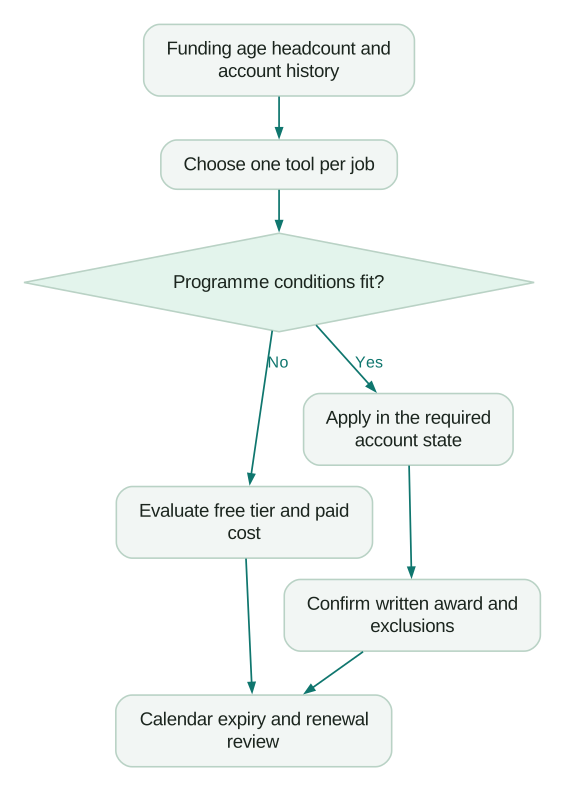
For most candidates, the useful sequence is: choose one tool per job, prepare the tracking or integration requirements, create the permitted account state, apply, obtain written acceptance, then implement the accepted package. Where the vendor requires a paid usage plan first, set appropriate billing limits and confirm when credits apply. An application in progress is not an approved subsidy.
What would a seed-stage startup actually qualify to apply for?
Consider a fictional B2B SaaS company with eight employees, incorporation 14 months ago, $3 million in seed funding from a verifiable VC, no prior paid martech and no YC participation. It has a company-domain email and is ready to implement.
| Candidate | Initial screening result | Confirmation still needed |
|---|---|---|
| HubSpot, Attio | Funding and size can fit | Accepted funding/partner route, product eligibility and account-age rules |
| Intercom, Zendesk, Customer.io | Basic company profile can fit | New-customer status, approved duration and included package |
| Mixpanel, Amplitude, PostHog | Main age, funding and headcount tests can fit | Required account state, implementation deadline and usage exclusions |
| Apollo, Braze | Partner route is not yet established | Referral eligibility before relying on the offer |
| Fivetran startup award | Company fails the YC requirement | Evaluate the general Free plan or paid cost instead |
| Google Cloud | VC-funded profile may fit Scale | Complete tier criteria and accepted funding evidence |
| Clay Wedge | Stage and venture backing make an application relevant | Actual participation terms and any awarded credits |
This is a shortlist, not approval by any vendor. Pick one CRM, one support path, one analytics tool and the lifecycle capability the workflow needs. Running two free analytics programmes in parallel can double instrumentation and reconciliation work without improving a decision. Use the startup stack stage guide to place each purchase in the implementation sequence.
What does the stack cost after the discounts step down?
Model recurring software at the required paid capability, then add usage, seats and implementation separately. A discounted year-one Growth plan should not be compared with year-two Plus unless Plus still supports the work.
A conditional three-year model
This fictional recurring-software model assumes written approval of HubSpot's 90/50/25 funding-track schedule and a full 12-month Customer.io term. It uses four eligible Sales Hub Professional seats at the ordinary catalogue rate of $100/seat/month, Amplitude Plus's checked five-million-event annual equivalent of $225/month and Customer.io Essentials at $100/month within 5,000 profiles and included sends.
For Amplitude year two, it assumes the entire illustrated base subscription qualifies for the published 40% annual Plus discount, with no add-ons. Later years use unchanged list-price references before any unquoted alumni or graduation discount. These assumptions need confirmation; they are not guaranteed renewals. HubSpot catalogue, Amplitude pricing and Customer.io pricing.
The table shows recurring software in USD per year using prices checked on 17 October 2026, under the approval assumptions and exclusions above.
| Recurring software line | Year one, USD | Year two, USD | Year three, USD |
|---|---|---|---|
| HubSpot: $4,800 annual reference × amount paid | $480 | $2,400 | $3,600 |
| Amplitude: free Growth year, then illustrated Plus | $0 | $1,620 | $2,700 |
| Customer.io: approved free term, then standard reference | $0 | $1,200 | $1,200 |
| Total before excluded costs | $480 | $5,220 | $7,500 |
The three-year reference total is $13,200. At unchanged undiscounted references, year four is $4,800 + $2,700 + $1,200 = $8,700. This table excludes implementation, mandatory onboarding where applicable, taxes, extra seats/profiles/events, paid channels and price increases. HubSpot's other regional or flexible pricing models can differ; confirm the actual agreement and do not stack an unrelated introductory price on the startup discount.
Usage growth can dominate the discount. Amplitude's checked annual equivalent at 15 million monthly events is $936, or $11,232 a year, versus $2,700 at five million. The $8,532 difference exceeds this example's entire third-year CRM and lifecycle reference cost. Forecast workload, not only discount percentage.
Which costs can survive a “free” year?
Intercom charges extra outcomes/qualifications and specified channels outside the discount. PostHog excludes the named AI tools. Customer.io charges profiles above 30,000 during its programme. Added seats beyond an award's cap and extra product capabilities may also change the bill.
The general calculation is:
Annual cash requirement = eligible list price × share payable
                        + usage outside the award
                        + extra seats and add-ons
                        + onboarding and implementation
                        + applicable taxes
Do not assume a $50,000 credit pays a professional-services invoice or transfers between accounts. Keep the accepted award and the supplier invoice categories together so finance can see which charges remain payable.
How should you manage the end of a programme?
Start the review 90 days before the earliest discount step-down, credit expiry or cancellation notice date. Remove genuinely unused capacity without deleting data needed for operating or retention requirements.
At 60 days, request the next-year offer with the same feature and usage scope; Amplitude and Customer.io describe communications around that point, but your own reminder should not depend on receiving an email. At 30 days, decide whether to renew, downgrade or migrate and meet the actual notice deadline. A vendor's cancellation period may require an earlier decision.
Check downgrade consequences before accepting a Free fallback. Amplitude says data and dashboards can remain when moving to Free, but Free's access and feature limits still apply. Mixpanel offers Free, Growth or Enterprise after its Startup Plan; Zendesk requires a paid choice to continue. Customer.io's graduation discount is unpublished, so request it rather than estimating a percentage.
What can you use when no programme fits?
Use an appropriate free plan at a workload you can monitor. HubSpot Free allows two users and 1,000 contacts; Attio Free allows three seats; Mixpanel Free allows one million monthly events; Amplitude Free allows two million. PostHog Free includes one million analytics events, 5,000 recordings and one project. HubSpot Free CRM, Attio pricing, Mixpanel pricing, Amplitude pricing and PostHog pricing.
A free plan's cap is an operating constraint. PostHog documents dropped excess events on Free; Klaviyo can restrict sending; other products can limit access or processing. Monitor the relevant count before the cap, and check exports and retention before relying on a downgrade. The right free stack is the smallest one that can execute the customer workflow and preserve the evidence you need.
Before applying:
Checklist
- Funding, age, headcount, affiliation and account history are recorded accurately.
- The tool solves a defined workflow, with an implementation owner.
- Current official terms and boundary-case answers are saved.
- The required account state and application clock are understood.
- Plan, seats, usage, exclusions and credit expiry are confirmed in writing.
- Years two and three are affordable at plausible paid usage.
- Renewal notices and 90-day review reminders are assigned.
- Usage alerts, export checks and retention requirements are in place.
Want a second pair of eyes on the choices? Bring the shortlist and renewal assumptions to a free stack audit. For implementation, request a martech integration quote around the actual customer workflow.
Questions people ask
Can a startup join several programmes at the same time?
Different vendors review applications separately, so several programmes may be available. Check restrictions within each vendor: Mixpanel excludes previously redeemed offers, and PostHog's YC deal does not stack with its general startup programme. Choose one tool per job unless a deliberate comparison justifies the duplicate setup, identity and maintenance work.
Can bootstrapped or angel-funded companies qualify?
Some programmes use funding caps without requiring institutional venture backing, while others require a VC or partner route. Google distinguishes Start from Scale funding eligibility. Zendesk's form and FAQ disagree on bootstrapping and some size boundaries. Treat the published conditions as screening criteria and obtain confirmation where your exact company profile is unclear.
Does a free account or trial make us an existing customer?
The rule varies. Customer.io explicitly allows trial users, and Amplitude applications begin in a free workspace. Mixpanel excludes prior paid-plan users, while PostHog asks applicants to join its usage-based paid plan first. Check each programme's wording before changing the account state; a universal “upgrade first” or “never upgrade” rule would be wrong.
Do startup credits cover AI usage, SMS and extra profiles?
Often they do not cover all of them. PostHog excludes specified AI tools, Intercom bills certain extra outcomes and channels at list price, and Customer.io charges $0.007 for profiles above its startup allowance. Confirm the award against each invoice category rather than assuming that a percentage discount or credit balance applies to the whole account.
Can we downgrade to Free when the programme ends?
Sometimes, but the feature and history consequences vary. Amplitude and Mixpanel describe Free options; Zendesk requires a paid plan to continue its account use. Customer.io offers a graduation arrangement before standard pricing. Test the reports, exports, integrations and retention you need on the proposed next plan before the programme or cancellation window ends.
Sources
- HubSpot: Startup programme
- HubSpot: Product and Services Catalog
- Attio: Startup Program
- Attio: Pricing
- Apollo: Startup programme
- Clay: Wedge and Campus Ambassadors
- Clay: Pricing
- Intercom: Early Stage
- Zendesk: Startup programme
- Customer.io: Startup programme
- Customer.io: Pricing
- Braze: Startup programme
- Klaviyo: Free plan
- Mixpanel: Startup Plan
- Mixpanel: Pricing
- Amplitude: Startup programme
- Amplitude: Pricing
- PostHog: Startup programme
- PostHog: Pricing and free-limit behaviour
- Twilio: Startup FAQ
- Twilio Segment: Connections pricing
- Twilio Segment: Discounts
- Fivetran: Free plan and pricing
- Fivetran: YC startup programme
- Hightouch: Self-service limits
- dbt Labs: Pricing
- Google Cloud: Startup programme FAQ
- Google Cloud: BigQuery pricing
- Google Cloud: BigQuery sandbox
- Snowflake: Trial terms
- HubSpot: Free CRM

Written by
Jafrin Akter AloData Engineer and Co-founder at Martechdevs and Growth and Analytics Partners
Jafrin writes practical guides to marketing technology, customer data, analytics and AI workflows. Martechdevs is a Growth and Analytics Partners company.