
B2B SaaS Martech Stack: Connect Product, Sales and Billing
A B2B SaaS martech stack should connect people to the accounts they use, connect those accounts to product value and billing, and give each team a reliable next action. Choose the setup from your sales motion. A sales-led company needs an accountable opportunity workflow; a product-led company needs activation and subscription visibility; a hybrid needs a controlled handoff between them.
On this page
What must a SaaS martech stack make possible?
The SaaS stack must explain who belongs to an account, whether that account received value, what it has purchased and who should act next. Start with those decisions before selecting a CRM, customer data platform or messaging tool.
Four records carry most of the operating meaning:
| Record | Question it answers | Authoritative owner | Common confusion |
|---|---|---|---|
| Person and membership | Who can use which workspace, in what role? | Product identity and membership service | One email domain treated as one customer |
| Product account or workspace | Where does product use and value accumulate? | Product backend | Every active user counted as a separate customer |
| Subscription, invoice and payment | What is contracted, billed and collected? | Billing and financial systems | A created subscription treated as a paid invoice |
| Opportunity | Which commercial process is the sales team managing? | CRM | Pipeline amount treated as realized revenue |
The industry-stack guide compares these requirements with ecommerce, mobile apps and regulated businesses. Within SaaS, the hard part is preserving the relationships as a company adds workspaces, changes plans or introduces sales assistance.
A tool earns its place when it improves a named decision. “We need a CDP” is incomplete. “Three destinations need the same account-qualified event, and their current implementations disagree” describes a job the team can evaluate.
How do sales-led, product-led and hybrid setups differ?
Let the main buying motion determine the operating sequence, while preserving the same underlying account and billing facts. A company can run more than one motion for different segments without duplicating every system.
| Motion | Start with | Decision that matters | Add when justified |
|---|---|---|---|
| Sales-led | CRM, qualified form or sales activity, opportunity and billing handoff | Who owns the next commercial step? | Product usage that changes trial evaluation or customer expansion |
| Product-led | Product identity, activation measurement, billing and lifecycle delivery | Did the account receive value and continue using it? | Sales assistance for a defined population |
| Hybrid | Product-led foundation plus account-level qualification and CRM routing | When should sales help, and why now? | Governed cross-system models when native summaries become inadequate |
Sales-led
For a sales-led SaaS company, define opportunity stages, required evidence and ownership before installing another enrichment or engagement tool. A demo request should reach the correct person with its source, account relationship and current customer status intact.
Use form-to-pipeline tracking for the acquisition handoff. After a deal closes, verify which product account is provisioned, which billing entity pays and which implementation or onboarding owner takes over. Closing a CRM deal is not proof that provisioning or payment succeeded.
Choose this arrangement when consultation, evaluation, procurement or contracting materially determines the sale. Product signals can still support the process, but they should answer the salesperson's actual question rather than fill the CRM with raw clicks.
Product-led
For product-led SaaS, define an activation milestone that represents useful progress for an eligible account. An account created or a teammate invited can precede value without proving it.
Start with the product's identity service, a maintained event contract, one appropriate behavior-analysis tool, billing state and a lifecycle path tied to progress. Send onboarding help when it addresses an incomplete job. Stop instructions that the account has already completed.
Choose this arrangement when users can discover and receive value without a salesperson. Do not insert sales qualification merely because the CRM supports it; first establish whom that intervention would help.
Hybrid
A hybrid needs product evidence in the CRM, an explainable qualification rule and a clear owner. Send a compact account summary containing the relevant milestone, active membership, reason for qualification, freshness and a link to the evidence.
The product-data-in-HubSpot guide covers that implementation, while the lead-scoring guide separates fit, behavior and routing. An account crossing a score threshold should create one useful handoff, not another task every time a sync repeats.
Our product analytics implementation work starts with those event and account definitions so acquisition, product and sales can interpret the same behavior.
Which identity model survives real customer relationships?
Use stable identifiers for people, workspaces, CRM records and billing entities, with explicit relationship tables between them. Preserve the relationship that applied when an event occurred as well as the current relationship needed for today's action.
Segment's Group specification associates an individual user with a company, account or other group using a separate group identifier. One user can belong to multiple groups, although destination support differs. It also notes that group removal needs destination-specific handling. A successful group call therefore does not prove that every connected tool maintains current membership correctly. Segment Group specification
Keep an identity map like this original design example:
| Relationship | Minimum key | Additional context | Acceptance case |
|---|---|---|---|
| Person to workspace | user_id plus workspace_id | Role, joined time, left time | One consultant belongs to two customers without merging them |
| Workspace to CRM company | workspace_id plus CRM company ID | Mapping source and approval state | An ambiguous company match stays unresolved |
| Workspace to payer | Workspace and billing-customer IDs | Effective period and allocation rule | One payer funds two workspaces without duplicating revenue |
| Opportunity to commercial account | Opportunity and CRM company IDs | Buying roles and covered workspaces | A renewal and expansion opportunity remain distinct |
Email is a contact attribute, not a universal account key. Agencies, subsidiaries, contractors and personal addresses all break simple domain grouping. Keep uncertain matches in a review queue instead of selecting the first company with a similar name.
HubSpot's association model connects records and supports relationship labels; labels are directional. The integration must preserve which record is associated with which other object and in what role. HubSpot record associations
For GA4, User-ID represents an individual user, not every person in the same workspace. Google requires unique, consistently assigned identifiers without impermissible personally identifiable information. Do not set the account ID as every teammate's User-ID. GA4 User-ID rules
The identity-resolution guide handles the wider web, app, CRM and billing map. Test membership removal and account switching as carefully as signup.
Which events should you collect before adding more tools?
Collect events that establish a state change or explain a useful decision. Every event needs a business trigger, counting unit, identifier and producing system; a descriptive name alone is insufficient.
| Event or record | Trigger to confirm | Unit and producer | Important exclusion |
|---|---|---|---|
| Account created | Backend commits a new workspace | Workspace; product backend | Reopened signup page |
| User joined account | Membership is accepted and active | Person-workspace relationship | An invitation that was only sent |
| Value milestone reached | The agreed useful result succeeds | Workspace or eligible user; product service | Attempted or failed action |
| Integration connected | Credentials and required access are verified | Workspace-integration pair | An OAuth button click without successful setup |
| Trial started or ended | Trial state changes | Trial instance; product or billing owner | A later retry of the same transition |
| Subscription state changed | Authoritative billing state changes | Subscription; billing integration | An arbitrary browser thank-you view |
| Demo requested or opportunity changed | Confirmed request or CRM transition | Request or opportunity; responsible system | Duplicate form delivery or unchanged sync |
Segment's B2B SaaS specification distinguishes account creation, signup, invitations, account membership and trial events. Use that separation as a reference pattern; your product's value milestone still needs its own definition. B2B SaaS event specification
Record occurrence time and ingestion time separately. Late arrival can change a cohort's interpretation without changing when the user acted. Keep an event ID for delivery handling and a business identifier for the underlying occurrence.
For example, two deliveries of one membership event should not create two members. Two different invitation events sent to the same person should not establish two accepted users. Document both rules in the tracking plan, then follow the product analytics setup for collection and validation.
Which system should own each field and status?
Assign one authoritative writer to each fact, and let other systems hold clearly labeled copies. Ownership can differ by field even when several fields appear on the same CRM company record.
The product backend owns membership and product access decisions. Billing owns subscription, invoice and payment facts. The CRM owns commercial stages and sales activity. A lifecycle platform owns message execution and delivery records, while current channel eligibility must come from the approved preference model.
Stripe illustrates why those distinctions matter. Subscription events are asynchronous, and a newly created subscription can be incomplete. An invoice.paid event is not sufficient on its own to infer every subscription entitlement; Stripe's guidance calls for retrieving and checking the associated subscription. Stripe subscription events
Stripe also does not guarantee webhook delivery order. Log processed event IDs, expect duplicate deliveries and retrieve relevant objects when needed rather than using event timestamps as a universal ordering rule. A retry must not restart onboarding or overwrite a newer account state with an older copy. Stripe webhook delivery
Use a field register with the writer, meaning, update trigger, freshness requirement and behavior on failure. For a copied billing_status, the CRM should distinguish “last confirmed past due” from “current state unknown because the sync stopped.” A silent stale value is more dangerous than a visible unknown.
The Stripe-to-HubSpot guide covers subscription mapping. Keep CRM selection in the sales-motion CRM guide; this architecture should survive a later vendor change.
How do you turn product usage into a useful sales handoff?
Define a product-qualified account rule that combines fit, demonstrated value, current eligibility and enough context for the owner to act. Treat the first rule as a hypothesis to measure, not a universal formula for purchase intent.
Consider a hypothetical twelve-person SaaS company with self-serve subscriptions and a sales-assisted team plan. Its proposed rule is:
rule_version: example_team_handoff_v1
analysis_unit: workspace
required_snapshot: complete_and_current
fit: supported_business_use_case
value: first_successful_shared_report_within_14_days
membership: at_least_10_distinct_current_accepted_members
sales_state: no_active_sales_task_for_this_reason
eligibility: current_contact_and_account_rules_pass
on_missing_or_conflicting_evidence: hold_for_review
action: create_one_explained_sales_review_task
These thresholds are original planning assumptions. Count accepted membership rather than invitations, exclude internal and test accounts, and define the freshness window the team can support. The rule creates a sales review task, not an automatic statement that the account will buy.
Suppose workspace A receives fifteen invitations, eleven people accept, and its first shared report succeeds on day six. It passes the example's behavioral conditions. Workspace B sends twenty invitations but has only three accepted members; it does not. A consultant active in both workspaces belongs to each relationship without making the workspaces one customer.
Before routing A, inspect current customer status, account fit, contact eligibility and an existing task. Store the rule version and evidence cutoff on the handoff. Replaying the same snapshot should update the same review record or do nothing, rather than create another task.
When sales accepts the handoff, record the reason and outcome. A rejected task might reveal an account mismatch, a poor fit rule, stale data or a genuinely early buyer. Those are different feedback signals; do not collapse them into “sales did not follow up.”
How should the team measure whether qualification helps?
Measure the account population, routing coverage and downstream decisions separately. A high count of qualified accounts can reflect a loose rule rather than useful demand.
In an original hypothetical cohort, eighty eligible workspaces start a trial. Thirty-two activate within the defined window. Twelve meet the product and membership rule, two are held because evidence or eligibility is unresolved, and ten receive a new sales review task. Sales accepts six as relevant, and four later become opportunities.
| Measure | Calculation | Example result |
|---|---|---|
| Activation rate | 32 activated / 80 eligible trial workspaces | 40% |
| Behavioral qualification rate | 12 qualifying / 80 eligible workspaces | 15% |
| Routing coverage among qualifying accounts | 10 routed / 12 qualifying | 83.3% |
| Sales acceptance among routed accounts | 6 accepted / 10 routed | 60% |
| Opportunity progression among accepted accounts | 4 opportunities / 6 accepted | 66.7% |
Do not call six out of twelve “routing precision” without explaining the two held cases. Also do not claim the rule caused four opportunities. For causal evaluation, choose a suitable comparison or experiment and account for sample size and sales-cycle maturity.
Inspect the actual held and rejected records. Improving the input or assigning an owner may create more value than adding another enrichment product. Keep the original cohort denominator stable so exclusions cannot make the trend appear better after the fact.
How should acquisition, billing and lifecycle reporting connect?
Connect the records through supported identifiers and preserve each system's meaning. Acquisition attribution, opportunity value, recurring revenue and cash collected are separate measures even when they relate to the same account.
Use GA4 for the SaaS acquisition journey, the CRM for opportunity progression and billing for subscription economics. Preserve captured source evidence and self-reported discovery separately; neither should overwrite the other because it produces a cleaner report.
For eligible advertising flows, offline conversion import can report qualified outcomes, subject to the destination's rules and current permissions. Keep unobservable or ineligible outcomes visible internally rather than inventing click identifiers or uploading every product event.
Stripe's standard MRR definition normalizes recurring value monthly and includes active and past-due subscriptions, with exclusions and configurable discount treatment. Its prebuilt export dates use UTC while dashboard charts use the account timezone. These details can explain a mismatch without either system being broken. Stripe billing analytics
For a hypothetical fixed USD 1,200 annual subscription, monthly normalized recurring value is USD 100 before the chosen adjustments. That is different from an invoice for USD 1,200, the cash actually collected and recognized revenue. If the payer owns two workspaces, copying USD 100 onto both and summing them reports USD 200 incorrectly. Keep revenue at its authoritative grain or use an explicit allocation that sums back to USD 100.
Use billing-to-CRM reconciliation before relying on a blended dashboard. Handle currencies and retrospective corrections explicitly.
Lifecycle messages should then use the relevant state: incomplete activation, approaching a real product limit, a billing issue, renewal or an expansion opportunity. Evaluate Customer.io, Intercom, Braze or another tool against account relationships, channels and operating needs using the lifecycle comparison. Do not select from a channel checklist alone.
The SaaS onboarding sequence should stop completed instructions, avoid duplicate messages to every teammate and distinguish the account's buyer, administrator and daily user.
When should a SaaS team add a warehouse, CDP or reverse ETL?
Add infrastructure when a recurring decision or control is materially difficult to operate with the current setup. Company stage and tool popularity are weaker triggers than repeated reconciliation, unclear ownership or an unmaintainable join.
| Recurring problem | Capability to evaluate | Evidence before buying |
|---|---|---|
| Product, billing and CRM need maintained historical joins | Warehouse and governed models | Named models, freshness expectations and an owner |
| Several destinations need the same event contract | Collection/routing layer or CDP | Demonstrated duplication or inconsistent collection |
| Qualified account fields must move from models into CRM | Reverse ETL or a maintained narrow sync | Stable key, field ownership, deletion behavior and readback tests |
| One simple account summary needs a daily update | Existing integration or small owned job | Clear scope and credible recovery path |
Use the warehouse decision guide and CDP-versus-warehouse comparison to separate these jobs. A warehouse stores and models facts; it does not automatically fix product events or grant permission for activation.
Budget the whole operating arrangement: subscriptions, event or profile consumption, implementation, monitoring and the person maintaining it. The startup stack guide covers stage-specific spending. Avoid duplicating its budget before the required motion and records are clear.
What should pass before the stack is considered ready?
Trace one ordinary account and the important failure cases through the full route. Release only when identity, state, action and reconciliation tests support the same business meaning.
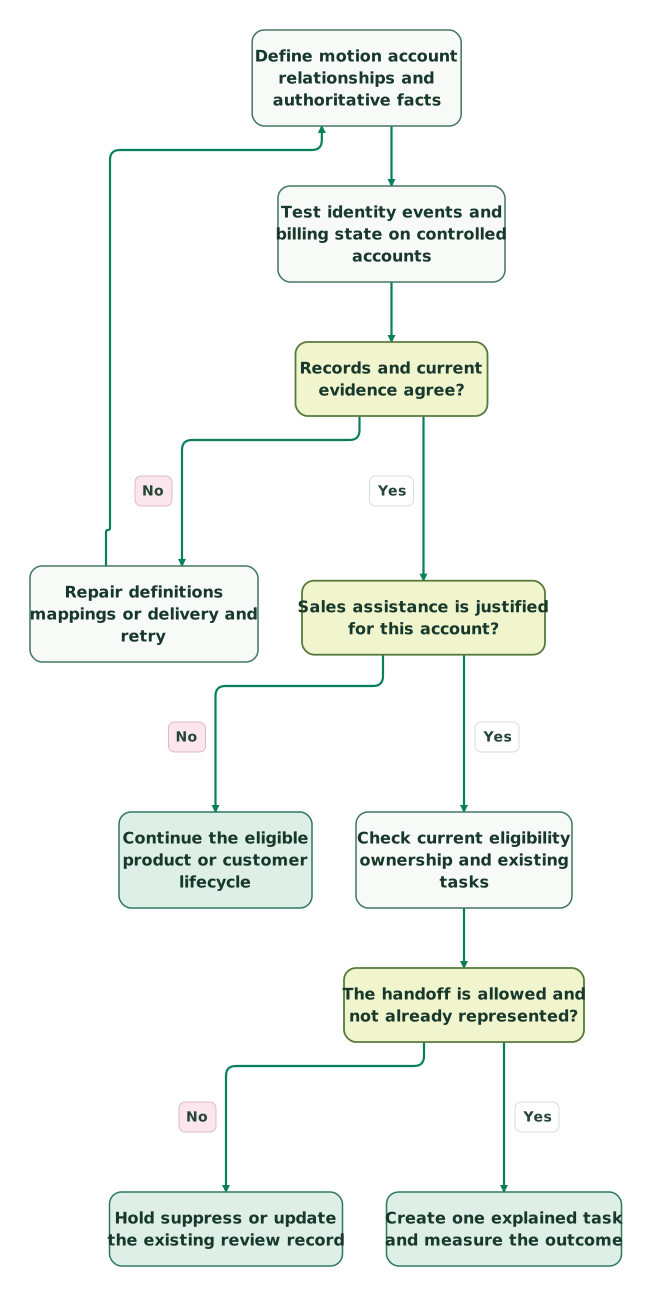
Read diagram as text
- Define motion account relationships and authoritative facts to Test identity events and billing state on controlled accounts.
- Test identity events and billing state on controlled accounts to Records and current evidence agree?.
- Records and current evidence agree? to Repair definitions mappings or delivery and retry: No.
- Repair definitions mappings or delivery and retry to Define motion account relationships and authoritative facts.
- Records and current evidence agree? to Sales assistance is justified for this account?: Yes.
- Sales assistance is justified for this account? to Continue the eligible product or customer lifecycle: No.
- Sales assistance is justified for this account? to Check current eligibility ownership and existing tasks: Yes.
- Check current eligibility ownership and existing tasks to The handoff is allowed and not already represented?.
- The handoff is allowed and not already represented? to Hold suppress or update the existing review record: No.
- The handoff is allowed and not already represented? to Create one explained task and measure the outcome: Yes
Test a person in two workspaces, two workspaces under one payer, a removed member, a failed payment, a duplicate webhook and an account with missing qualification evidence. Include a currently suppressed contact and an already open sales task. Those cases expose problems a clean signup demonstration misses.
Checklist
- The main motion and next-action owner are explicit.
- Person, workspace, payer and opportunity keys remain distinct.
- Accepted membership is separate from invitations.
- Activation describes a confirmed useful result and time window.
- Billing, product and CRM fields each have one authoritative writer.
- Repeated or late events cannot create duplicate commercial actions.
- Qualification preserves evidence, unknown states and current eligibility.
- Revenue copies reconcile without doubling multi-workspace payers.
- Lifecycle delivery stops when the relevant state changes.
- Additional infrastructure has a defined job and operating owner.
Bring those journeys to the $99 martech audit, or request a detailed product analytics implementation scope when the event and account model needs to be built or repaired.
Keep reading
Browse all Martech Strategy guides
 Martech Strategy
Fintech Marketing Stack: Track the Funnel Without Leaking Financial Data
Design a fintech stack around verified application and funding milestones. Control destination data, model pending cases and test internal event boundaries.
Jafrin Akter AloLast updated 14 min read
 Martech Strategy
Mobile App Marketing Stack: Subscription Data, Tools and Release Tests
Build a subscription app stack around store state, identity, revenue and lifecycle messaging. Includes pricing context, reconciliation code and release tests.
Jafrin Akter AloLast updated 17 min read
 Martech Strategy
Ecommerce Martech Stack: Shopify Events, Consent and Margin
Build a Shopify stack with clear purchase ownership, consent controls, lifecycle rules and margin reporting. Trace one order through an upsell and refund.
Jafrin Akter AloLast updated 15 min read
Product analytics
See the implementation scope, deliverables and acceptance checks.
Questions people ask
Can one customer pay for several independently active workspaces?
Yes. Model the payer-to-workspace relationship explicitly and decide whether commercial reporting belongs at payer, subscription or workspace level. Product activation can remain workspace-specific while revenue stays attached to the subscription. If revenue is allocated to workspaces, document the allocation and reconcile it to the original total. Do not multiply revenue simply by copying the same billing field onto every related account.
Should a former employee's historical activity disappear when access is removed?
Usually the access change and the historical event serve different purposes. Remove current access and update membership-dependent actions, while retaining permitted historical evidence under the applicable retention policy. Keep the relationship that existed when the event occurred so past account activity remains interpretable. A current membership list alone cannot reliably reconstruct historical usage or explain who contributed to an earlier activation milestone.
What should happen when the CRM company match is ambiguous?
Hold the association for review and keep the product account's own identifier intact. Record the candidate matches and evidence rather than choosing the first similar domain or company name. Prevent dependent routing or writeback until the mapping is established. The account can continue through appropriate product operations without pretending its commercial identity is already resolved across every connected system.
Should sales acceptance become another input to the product-qualified rule?
It can inform later revisions, but preserve the original rule version and reason for each rejection. Otherwise the evaluation can become circular: accounts are called qualified because sales accepted them, then sales acceptance is presented as proof that qualification works. Review identifiable causes, test a revised rule on a comparable population and keep held or unreviewed accounts separate from genuine negative outcomes.
How should the stack handle a company moving from self-serve to a negotiated contract?
Treat the change as a commercial transition with explicit effective dates and ownership. Map existing workspaces and subscriptions to the negotiated arrangement, prevent overlapping billing or conflicting lifecycle messages, and preserve the earlier history. Confirm which account administrator and billing contact should receive each communication. A won opportunity should trigger a controlled handoff, not silently replace every current product and payment state.
Sources

Written by
Jafrin Akter AloData Engineer and Co-founder at Martechdevs and Growth and Analytics Partners
Jafrin writes practical guides to marketing technology, customer data, analytics and AI workflows. Martechdevs is a Growth and Analytics Partners company.