
How to Build a Martech Business Case Your CFO Can Evaluate
Data Engineer and Co-founder, martechdevs
Last updated 12 min read
A useful martech business case asks for a specific decision: fund a defined change, at a stated cost, to improve an evidenced business problem. It compares realistic alternatives, separates cash savings from other benefits and makes the conditions for success visible. The aim is an investment the business can defend and operate, not a deck engineered to secure a signature.
Last updated: 29 September 2026.
“Connect our data and become AI-ready” does not tell finance what to approve. “Replace a recurring reconciliation process, retire the old contract after acceptance and give a named team ownership of the new workflow” does.
This guide provides a practical proposal structure, a worked three-year model and a pilot decision process. The financial example is hypothetical; the costs and returns are not a martechdevs quote or a client result.
Start with the decision you want made
Put the request on the first page. State the amount authorized now, the total potential commitment, the project owner and the decision the completed system will support.
For example: “Approve a bounded pilot to produce a reconciled account-level revenue report. Further implementation spending depends on agreed data, operating and cost acceptance criteria.”
This is more useful than asking for a warehouse subscription, a CDP or an AI agent in isolation. A tool is part of the delivery choice. The business outcome and operating responsibility are what make the investment assessable.
Name the executive sponsor and the person who can accept the output. They may be different people. The sponsor protects priority and resources; the accepting owner confirms that the workflow works well enough to replace the existing process.
Also identify who can stop the project. A pilot with no authority to decline expansion is an installment plan disguised as an experiment.
Diagnose the objection instead of adding more slides
Gartner's 2024 survey of 378 senior marketing leaders found that respondents most often named the CFO as the executive most skeptical of marketing's value, at 40%. That finding describes the survey population; it does not establish what your CFO thinks. Gartner's original survey release
Find the actual concern. Is it the cash requirement, an unsupported revenue claim, overlapping tools, unreliable delivery or the absence of a maintenance owner?
Each requires different evidence. A stronger ROI percentage will not resolve uncertainty about who owns customer identity. Another architecture diagram will not resolve a cash shortfall before payback. A detailed project plan will not create a benefit that nobody needs.
Discuss the cost definitions and decision criteria with finance before polishing the proposal. You want disagreement about assumptions to surface while changing the scope is still inexpensive.
Build the baseline from work and spending that exist
Document the current workflow with enough detail that another person could verify it. Include the business trigger, source systems, manual steps, users, frequency and known failure consequences.
Then gather the evidence behind each cost: invoices, usage reports, recent incident records and measured staff effort. Distinguish a recurring baseline from a one-time incident. Avoid annualizing a particularly bad week without explaining why it is representative.
A reporting process might have a $900 monthly reconciliation contract and $800 of subscriptions that can genuinely be retired. These are stronger inputs than “analysts waste 40% of their time,” especially when no one has measured the team's work.
For internal effort, list hours, role and activity separately from cash spending. A planned release of capacity matters only if the team can use it. Do not claim a reduction in payroll when the same salaries continue.
Use the cost-of-bad-data worksheet approach to avoid counting the same incident or task twice. Include the owner who will confirm whether the claimed saving actually appears.
Compare three options that solve the same initial problem
The business case should include continuing as-is, a minimum viable repair and the proposed implementation.
Continue as-is: show the recurring expense and operational limitations that remain. Include any already planned improvements; the alternative is rarely a world in which nothing ever changes.
Minimum viable repair: consider fixing a source definition, reducing one manual step, consolidating a tool or improving an existing integration. This option may capture much of the value with less spending and disruption.
Proposed implementation: explain which additional decisions, reliability requirements or operational constraints justify the broader work. Price the capabilities needed now. Keep possible future uses separate unless they have owners and credible delivery plans.
Compare the options against the same initial outcome and horizon. A small reporting repair and a company-wide customer platform are not direct substitutes for every purpose. State where their scopes differ, and do not credit the broader option with speculative benefits simply because it could support them someday.
The martech stack rationalization guide helps identify whether the problem can be solved by improving what is already owned.
Organize the case around benefits, costs, flexibility and risk
Forrester's Total Economic Impact methodology uses these four components. Its commissioned studies can help identify categories to investigate, but their customer interviews and modeled results are not your company's forecast. Forrester also explicitly distinguishes commissioned work from endorsement. Forrester's methodology
Use the categories as prompts, not a license to borrow a vendor's ROI percentage.
Benefits need an amount or observable outcome, an owner, evidence, a start date and a realization condition. A subscription saving starts when the expense can actually stop, not when the replacement technically goes live.
Costs include setup, software, consumption, internal work, migration, overlap, training, maintenance and eventual exit. Show which are cash commitments and which represent allocated staff capacity.
Flexibility describes useful future options, such as adding another destination without rebuilding identity. Keep these qualitative unless you can defend their probability, timing and incremental economics. Do not count the same future use case in both the base benefits and an option-value bonus.
Risk identifies the assumptions most likely to change the decision. It should lead to a test, a smaller commitment, a reserve or a clear acceptance condition. Multiplying every benefit by an arbitrary 80% is not a substitute for understanding the uncertainty.
A three-year cash case you can reproduce
Assume the proposed implementation has these illustrative inputs:
- New implementation cash cost: $12,000, treated as paid at time zero for this model.
- New ongoing software and maintenance cash cost: $500 per month, from month 1.
- Existing cash expenses that can be eliminated: $1,700 per month, beginning at the end of month 3.
- Horizon: 36 months.
- Discount rate: 10% effective annually, chosen only for illustration.
The $1,700 represents the assumed retirement of a $900 contract and $800 of subscriptions. The model assumes the old spending would otherwise continue at the same level. There is no revenue uplift, capacity benefit, tax adjustment, inflation or terminal value in these figures.
Internal staff time must still be assessed for affordability and opportunity cost, but it is outside this deliberately defined cash calculation. Add it to a separate economic view rather than implying it is free.
New project spending is $12,000 plus 36 months at $500, or $30,000. Savings occur for 34 months, totaling $57,800. The undiscounted net cash benefit is $27,800; dividing that by new project spending gives a 92.7% three-year cash ROI.
The cash-flow sequence matters. At time zero it is negative $12,000. Months 1 and 2 each add negative $500. Months 3 through 36 each add positive $1,200: $1,700 saved less $500 of new running cost.
The maximum cumulative cash requirement in this simplified model is $13,000, reached at the end of month 2. Cumulative cash remains negative $1,000 at the end of month 12 and turns positive $200 at the end of month 13. That makes month 13 the undiscounted payback month.
At the stated discount rate, the three-year NPV is approximately $22,064. This is the present value of the incremental cash flows under the assumptions, not another cash benefit to add to the $27,800.
Use the right discount period and payment timing
Convert the effective annual rate to a monthly rate with =(1+10%)^(1/12)-1, approximately 0.7974%. Do not use a 10% rate for every monthly period.
In Excel, place time-zero cash flow in B2 and months 1 through 36 in B3:B38. With the monthly rate in E2, use =B2+NPV(E2,B3:B38). Excel's NPV function treats its listed values as end-of-period cash flows, so the immediate payment sits outside it. Microsoft NPV documentation
Use the real payment schedule before approval. If implementation payments follow milestones, replace the time-zero simplification with those dates. If savings depend on a renewal deadline, place the first saving after the expense can actually end.
Microsoft distinguishes periodic NPV from XNPV for dated, irregular cash flows. Choose the function that matches the model instead of forcing an irregular contract into equal periods. Microsoft cash-flow function guidance
Finance should supply the applicable hurdle rate and accounting treatment. A borrowed 10% discount rate is an example input, not a universal company policy.
Show the downside that could change the answer
Suppose the same project eliminates only $1,000 per month, with savings delayed until month 6. Keep the $12,000 initial cost and $500 monthly operating cost unchanged.
There are now 31 saving months. Total savings are $31,000 against $30,000 of new project spending, leaving only $1,000 of undiscounted net benefit. Payback moves to month 34. NPV at the same rate falls to approximately negative $1,289.
A positive undiscounted total can therefore coexist with a negative NPV. The timing and required return matter. This downside suggests investigating whether the old contract and subscriptions can actually be retired, and what could delay acceptance.
Now consider a separate minimum-repair option: $4,000 upfront, $200 monthly running cost and $900 monthly savings from month 2. Under the same 36-month horizon and discount rate, it produces $20,300 net cash benefit, approximately $16,938 NPV and payback in month 7.
The larger proposal has higher modeled base-case NPV, while the smaller repair requires less upfront cash and pays back sooner. The smaller repair also lacks whatever additional capabilities the wider scope includes. Compare those capabilities explicitly rather than choosing solely by the largest ROI percentage.
These scenarios are planning examples, not probabilities. Do not average them into an “expected return” unless you can justify the weights. First use them to identify the assumptions the pilot must resolve.
Make the cost of doing nothing checkable
In the base example, the existing $1,700 monthly spending equals $20,400 per year if it persists unchanged. That is a defensible baseline when invoices and commitments support it.
It is not all automatically avoidable. The proposed system has its own costs, and the old expenses remain during transition. The savings model already accounts for those changes; do not add $20,400 again as a separate benefit.
Add unpriced consequences in plain terms: reports arrive too late for the budget meeting, audiences cannot be reliably removed or staff cannot explain a material revenue discrepancy. Specify their frequency and owner where evidence exists.
Avoid claiming every delayed decision costs a full day's company revenue. If you cannot establish the financial consequence, show the operational limitation and how the proposed work addresses it. That is more credible than a precise loss invented to make the project urgent.
Design the pilot to answer the expensive uncertainty
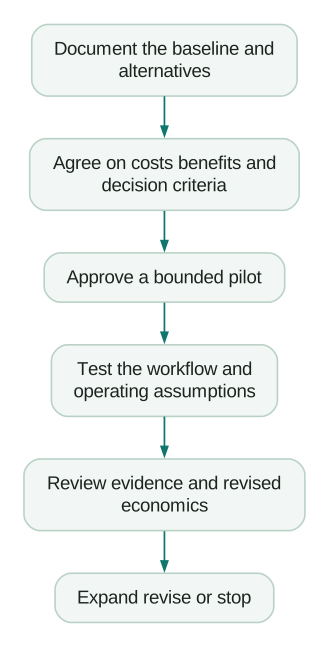
A useful pilot exercises one important workflow from source through the final business action. It should reveal the dependency most capable of invalidating the broader case.
For a revenue report, that might be reconciling refunds and customer identity across billing and CRM. For activation, it might be proving that an ineligible customer is removed correctly and that a retry does not create duplicate actions.
Agree on acceptance before implementation. Define the required reconciliation, freshness, exception handling, operating cost and ownership. Use realistic data with appropriate access controls, including failure cases, rather than a demonstration containing only clean records.
Gartner's February 2025 forecast said organizations would abandon 60% of AI projects unsupported by AI-ready data through 2026. That was a forecast about a specified subset, not a measured failure rate for all AI projects. Use it as context for testing prerequisites, not as a numeric probability in your project model. Gartner's AI-ready data discussion
A pilot should end with one of three decisions: expand because the criteria and economics hold, revise a bounded issue with a defined additional commitment, or stop and retain the useful findings. “Continue exploring” without a new decision date defeats the purpose.
Turn the case into a concise decision deck
An eight-part outline is enough for many small-team proposals. Put detailed calculations and evidence behind it rather than hiding the decision beneath a long discovery narrative.
- Decision requested: amount now, potential later commitment, owner and decision date.
- Current problem: one workflow, its business consequence and evidence of recurring cost.
- Alternatives: continue, repair and proposed implementation, with material scope differences.
- Delivery: included sources, outputs, acceptance criteria, dependencies and handover.
- Economics: cash and capacity views, benefit start dates, NPV, payback and funding requirement.
- Downside: the assumptions that could reverse the recommendation and their tests.
- Pilot gate: evidence required to expand, revise or stop, and who decides.
- Realization: who retires old spending, monitors adoption and checks actual benefit after launch.
Each number should link to an invoice, workload observation, approved quote, contractual term or labeled assumption. An executive should be able to trace an important figure without reconstructing your spreadsheet.
Keep the business case alive after approval
Set a review after the first complete operating cycle, then at an interval suited to the benefit. Compare forecast with realized cost, adoption, retired spending and exceptions.
If benefits are late, identify whether the cause is technical delivery, contract timing, process adoption or a faulty assumption. Those require different interventions. Do not quietly move the start date every month while continuing to report the original payback.
Record scope changes and update the full forecast. Additional integrations create costs and may create benefits, but both need evidence and an owner. Maintain the original approved baseline so the business can see what changed.
The warehouse ROI guide gives more detail on cash versus capacity. The implementation cost guide helps turn scope into a quote. For delivery support, martech integration services should begin with the workflow and acceptance conditions this case defines.
Business-case approval checklist
- The requested decision and current spending authorization are explicit.
- The baseline has evidence and a responsible business owner.
- Continue-as-is and minimum-repair alternatives were evaluated.
- Cash savings, capacity and speculative upside remain separate.
- Costs include transition, operation, adoption and exit requirements.
- Savings start when old spending can actually stop.
- Payback, NPV and maximum cash requirement use a consistent schedule.
- Downside assumptions can change the recommendation.
- The pilot has acceptance criteria and an expansion or stop decision.
- Someone owns benefit realization after the supplier finishes.
Questions people ask
What should a martech business case include?
Include the decision requested, current problem, evidence, alternatives, scope, full costs, expected benefits, timing, risks and ownership. Add a pilot gate when important assumptions are unresolved, and define how the business will verify benefit after implementation.
What does a CFO need to see in a martech proposal?
A checkable connection between spending and an outcome, with a credible alternative and a realistic cash schedule. Show what must happen for savings to appear, what could make the case fail and who can act if the forecast is missed.
Should I use a vendor's ROI study?
Use it to discover possible benefit and cost categories. Inspect its sponsor, interview population, composite assumptions and time horizon. Replace its inputs with your own evidence; the published return is not your forecast or a guarantee.
How do I calculate the payback month?
Build the monthly incremental cash flows, including setup, recurring costs and benefit start dates. Accumulate them from the initial outlay and identify the first month the cumulative balance becomes nonnegative. State whether that calculation uses discounted or undiscounted flows.
What if the benefits are mainly productivity improvements?
Measure the work and the capacity that can realistically be released. Explain how that capacity will be used, and show its value separately from cash savings. A productivity case can be valid without reducing payroll, but the proposal should not describe unchanged spending as money saved.
Sources
Written by
Jafrin Akter AloData Engineer and Co-founder, martechdevs
Jafrin Akter Alo is a data engineer and co-founder of martechdevs, where the team has delivered 74+ martech, data and growth stack implementations.