
GTM Engineer Salary: Read the Pay Evidence and Budget the Hire
A useful GTM engineer salary benchmark matches the work, location and compensation type you are hiring for. Published employer ranges differ substantially because the title covers commercial automation, CRM ownership and production software development. Compare relevant advertised base pay, then add employer costs, tools and operating capacity. A salary headline alone cannot tell you whether hiring is the best way to deliver the work.
On this page

What do employers actually advertise for GTM engineers?
The named postings below advertise US base ranges from USD 130,000 to USD 295,000 across materially different roles and locations. That span describes these examples only. It is not a national market range, a recommended offer or evidence that most GTM engineers receive the midpoint.
| Employer and location | Advertised base pay in USD | Work described in the posting | Qualification to retain |
|---|---|---|---|
| Zone & Co, United States | 130,000–150,000 | Lead GTM systems, integrations, enrichment and team capability | Bonus and equity are additional; actual offer depends on the candidate and business factors |
| ASG, remote US or Walnut Creek | 160,000–185,000 | Hands-on Clay-centered systems across a software-company portfolio | Annual bonus, equity and benefits are part of the wider package |
| Adyen, New York | 169,000–222,000 annually | Custom internal applications, integrations and reliable commercial workflows | Office-based role; at least five years of relevant experience requested |
| Vercel, San Francisco pay band | 180,000–295,000 | Software engineering for AI applications and GTM workflows | Four-plus years of full-stack experience requested; other locations may have different pay |
Vercel explicitly asks for a Next.js application shipped to production. Zone & Co emphasizes leading a function that operates commercial systems. A candidate who fits one may not fit the other, even though both advertisements use the GTM engineer title.
Start with what a GTM engineer actually builds, then select the responsibilities relevant to your company. Our GTM engineering implementation service is useful when a defined workflow must be built and handed over; a permanent daily operating mandate is a separate staffing decision.
Why do salary reports publish different medians?
They measure different samples and often different kinds of pay. A median from disclosed job advertisements is not the same as a median of actual employee earnings. A midpoint calculated from a published range is also not an observed accepted offer.
| Source | Published figure | What the figure represents | How to use it |
|---|---|---|---|
| RevGuild report | USD 150,000 median | Annual base salary from 71 disclosed US vacancies in its sample | A bounded posting-sample comparator; inspect its internal limitations |
| Onfire analysis | USD 160,000 median range midpoint | US postings that disclose pay, within an analysis of 209 roles | Compare midpoint methodology and geography before using it |
| Bloomberry's original analysis | USD 127,500 median in its text | Public salary ranges in a broader analysis of 1,000 GTM jobs | Keep the reported statistic distinct from a payroll survey or universal base-pay benchmark |
Bloomberry's heading calls the figure an average while the explanatory text calls it a median. Use the text's stated measure and do not silently combine it with a differently defined statistic.
RevGuild also contains an unresolved inconsistency: its overall disclosed-pay band ends at USD 210,000, but its leadership chart shows a USD 225,000 median while referring to the same 71-salary basis. That prevents treating the level chart as a reliable progression curve. Its separate state and level cuts also cannot establish a combined “senior in New York” rate. RevGuild's salary sections and methodology
Do not average the three published medians to create a new benchmark. The underlying populations, disclosure patterns and range treatment are not interchangeable. Likewise, the fact that a vacancy disappears does not prove that it was filled in that number of days.
For an actual offer, build a smaller but relevant evidence set: comparable responsibilities, hiring geography, seniority, working arrangement and cash-pay definition. Keep the source with each comparison so another decision maker can challenge the fit.
How should you choose a level and location band?
Define the operating responsibility before choosing the title. Seniority should describe the decisions and risks the person can own, not merely how many tools they recognize or how many years they have used a newly popular job title.
| Scope level | Work to own | Evidence to test | What requires additional support |
|---|---|---|---|
| Developing builder | Implement a defined workflow with review | Correct mappings, tests and clear escalation | Architecture, commercial policy and consequential release approval |
| Independent operator | Build and maintain a complete workflow | Failure recovery, cost control and accepted outputs | Unfamiliar platforms or broad organizational decisions |
| Senior systems owner | Design across tools and manage changes | Data contracts, safe migrations and dependency reasoning | Specialized security, legal or platform expertise when required |
| Function lead | Prioritize the portfolio and develop operators | Work selection, operating coverage and measurable business contribution | Company-level commercial authority remains explicit |
These are suggested scope definitions, not reported salary bands. Use them to select comparable postings and evaluate the actual candidate.
For geography, record where the employer hires and which location the advertised band covers. The Vercel posting explicitly labels its quoted band as San Francisco and says other locations may differ. A remote label does not necessarily mean one worldwide salary. Vercel compensation scope
For a UK, Canadian or other non-US hire, build a local comparison in the relevant currency and employment model. Converting a US dollar salary at today's exchange rate does not account for local labor markets, employer obligations or the candidate's alternatives. Do not turn a pooled “non-US” number into a UK hiring recommendation.
Do coding skills guarantee a salary premium?
No single skill guarantees a fixed premium. Coding can change the scope of work a candidate can own, but compensation also depends on location, seniority, company and the role's responsibilities. Observational differences between postings do not isolate the effect of learning Python.
Onfire reports a higher US salary association for coding-heavy work, but that figure is not a controlled estimate of what one candidate earns after acquiring a language. Use the job requirements and actual offer evidence, not an automatic premium added to a generic median. Onfire's analysis
Compare two concrete mandates. One role maintains established enrichment and routing workflows. Another designs and deploys internal applications, handles production integrations and owns recovery when those applications fail. The second requires more engineering evidence, but the company still needs to value the actual work rather than attach a fixed percentage to the word “AI.”
The GTM engineer skills guide provides a portfolio and interview approach for testing those differences. Pay for demonstrated ownership and judgment, including the ability to stop a flawed automation, rather than a list of certifications.
How does the role compare with RevOps and sales engineering pay?
Compare duties before comparing compensation. RevOps can include commercial process, forecasting, systems governance and reporting. GTM engineering commonly emphasizes implementing and operating revenue workflows. Sales engineering is usually more directly involved in helping customers evaluate and buy technical products.
The US Bureau of Labor Statistics reports a USD 124,900 median annual wage for sales engineers for May 2025. Its wage measure includes relevant commissions and production bonuses, and its occupational category is broader and different from an internal GTM engineering role. It is not an apples-to-apples base-salary benchmark. BLS sales-engineer pay and duties
A company can combine responsibilities, but it should state that combination clearly. If the hire must lead forecasting, administer Salesforce, build production applications and run outbound campaigns, check whether one person can credibly cover the work and whether backup exists.
Do not pay a role solely by whether it sits in Sales, Marketing or Engineering. Evaluate the responsibility, required judgment, operating burden and relevant hiring market. A title change without a scope change does not establish a reason for a large compensation difference.
What belongs in the full employer cost?
Include the cash compensation, employer burden, tools, recruitment and equipment needed to operate the role. Separately record internal management and onboarding capacity so cash spending is not confused with the value of existing employees' time.
| Cost category | Include | Check for double counting |
|---|---|---|
| Cash compensation | Base plus the planned bonus or variable-pay scenario | Do not add on-target earnings (OTE) again on top of its included base |
| Employer burden | Relevant taxes, insurance, benefits and employer contributions | Know whether the percentage applies to salary, cash pay or another base |
| Tools and data | Required subscriptions, usage and infrastructure | Shared tools should not appear twice across delivery options |
| Recruitment and equipment | Actual fees, devices and onboarding purchases | Distinguish one-time costs from recurring costs |
| Internal capacity | Management, review, training and coordination | Paid salary during ramp is already in the annual salary line |
| Equity | Separate grant terms and accounting treatment | Do not treat a headline grant valuation as guaranteed liquid cash |
The denominator matters when reading benefit statistics. In the cited BLS private-industry table, hourly total compensation is USD 46.89, wages are USD 32.82 and benefits are USD 14.07. Benefits are about 30.0% of total compensation but about 42.9% of wages. Applying “30% benefits” to salary would use a different base. These broad private-industry figures are not a GTM-engineer loading rate. BLS employer-cost components
Use your finance team's actual employer assumptions for the jurisdiction and package. Likewise, price the tools required by the workflow: Clay plan and usage costs, ZoomInfo contract costs and the existing CRM can have different commercial units. A person arriving with tool expertise does not make those subscriptions free.
What does a transparent first-year hiring budget look like?
A useful budget labels every assumption and distinguishes the first year from the ongoing run rate. The following is a hypothetical US-dollar planning model for twelve months of employment, not a market salary recommendation or a Martechdevs quote.
| Item | Assumption | First-year cost |
|---|---|---|
| Base salary | USD 150,000 annually | USD 150,000 |
| Target variable pay | USD 15,000 | USD 15,000 |
| Employer burden | 25% of USD 165,000 cash compensation | USD 41,250 |
| Tools and data | USD 1,000/month | USD 12,000 |
| Recruitment | One-time USD 12,000 | USD 12,000 |
| Equipment and setup | One-time USD 3,000 | USD 3,000 |
| Total cash budget | Sum of the above assumptions | USD 233,250 |
Separately, three hours of internal management each month valued at USD 75/hour uses USD 2,700 of existing capacity over the year. The combined resource-cost view is USD 235,950, but that does not mean the company receives an additional USD 2,700 invoice.
A change in the burden assumption is material. At 20% of cash compensation, the cash total would be USD 225,000; at 30%, USD 241,500. The five-percentage-point move changes the budget by USD 8,250 because the defined base is USD 165,000.
If recruitment and equipment do not recur, the same assumptions produce a subsequent annual cash run rate of USD 218,250. Do not present that lower figure as the initial hiring cost. Revisit pay, tool usage and actual operating demand rather than assuming the first year's inputs remain fixed forever.
How should ramp time affect the model?
Ramp changes useful capacity and time to the first accepted result. It should not create a second salary charge for the same paid months.
Suppose the first three months provide 40, 80 and 100 usable delivery hours, followed by nine months at 120 hours. The illustrative first-year capacity is 40 + 80 + 100 + 9 × 120 = 1,300 hours. Dividing the USD 233,250 cash budget by that capacity gives about USD 179.42 per usable hour.
That is a planning ratio, not a billable employee rate or a productivity benchmark. The usable-hour assumptions must reflect meetings, maintenance, leave, learning and the actual role. A hire can also create value through better decisions that does not fit a ticket-hour model.
If hiring takes time before the employee starts, compare all options from the same decision date. Either include a bridge arrangement or acknowledge the period without delivery. A twelve-month employment budget is different from a twelve-month business plan starting today.
How do you compare hiring, contracting and an agency fairly?
Compare the same defined backlog and operating horizon, then make the capacity differences explicit. A one-time project cannot be compared directly with a full year of ongoing ownership.
Suppose the required backlog is estimated at 60 delivery hours each month for twelve months, or 720 hours, with the same tools included in each option. These are planning assumptions to validate against accepted outputs, not a promise that every supplier produces equal work per hour.
| Delivery model | Illustrative cash treatment | Internal capacity to include | Decision still needed |
|---|---|---|---|
| Employee | USD 233,250 from the hiring model above | USD 2,700 management assumption | Can the remaining 580 assumed hours serve a valuable continuing backlog? |
| Contractor | 720 hours × USD 125, plus USD 12,000 tools and USD 2,000 setup = USD 104,000 | Six coordination hours/month × USD 75 = USD 5,400 | Does the contractor provide the required skill, availability and recovery coverage? |
| Agency build and agreed support | Scoped build price plus agreed support over the same horizon and required tools | Acceptance, decisions and handover time | Which ongoing responsibilities are included after the build? |
The contractor's USD 125/hour is hypothetical. Its combined resource-cost illustration is USD 109,400, not a verified market quote. The employee's capacity beyond the assumed backlog is valuable only if the company has useful work for it; unassigned capacity is not automatically waste or automatically a return.
Martechdevs' Starter implementation plan is USD 4,800 with fast delivery after the 25% plan discount, with Custom scope for work outside the listed plans. The Starter plan does not fund a complete annual GTM function or replace an employee's salary. Compare the included build and support with your tools, internal obligations and acceptance criteria.
Use the broader agency, in-house and freelancer comparison for coverage and exit considerations. This salary decision should retain one internal owner for business definitions regardless of who builds the workflow.
When does a full-time GTM engineer justify the commitment?
Hire when the continuing workload needs sustained technical ownership, frequent business context and a clear internal mandate. A bounded integration with occasional maintenance may need a specialist build first; an evolving product-led sales system may justify a permanent operator.
Look for a backlog of specific decisions and workflows, not a wish to “do more AI.” Estimate how often eligibility rules, data models, territories and messaging policies change, how quickly failures need attention and which teams depend on the result.
A useful hiring case connects expected capacity to accepted outputs. For example, the role might reduce the time from an eligible product signal to an owned sales task, lower duplicate-account corrections or make campaign costs traceable to accepted prospects. Establish the baseline and the responsible commercial owner before promising revenue uplift.
Avoid paying variable compensation purely on email volume, enriched contacts or automations shipped. Those measures can improve while customer relevance and data quality deteriorate. If variable pay is appropriate, agree controllable outcomes, quality conditions, attribution and the period needed for results to mature.
What should you put in the job description and interview?
State the systems, decisions and operating responsibilities the person will own, then test them with representative exceptions. A realistic paid or tightly bounded exercise reveals more than a request to build an entire production system for free.
Include the following in the role specification:
- The initial workflows and their expected business outcome.
- The CRM, data sources and deployment environment already in use.
- Which commercial decisions are approved elsewhere and which the role can make.
- The required coding or configuration depth for that actual stack.
- Monitoring, incident response, documentation and backup responsibilities.
- A transparent compensation structure with location and base/variable distinctions.
- The first acceptance milestone and how success will be reviewed.
Use the GTM skills portfolio exercise to test duplicates, missing company data, existing opportunities and suppressed contacts. Ask the candidate to explain why some records should receive no action, how retries avoid duplicates and what evidence another operator needs to maintain the system.
For an offer review, ask about the team and inherited state as carefully as the salary. A well-scoped role with a commercial sponsor and engineering support differs from a role expected to repair every revenue process without authority or backup.
What should be decided before you approve the budget?
Approve a role or supplier scope only after the evidence, cost basis and operating mandate are aligned. If the workload is still unclear, scope a bounded discovery or build rather than inventing a full-time requirement from salary headlines.
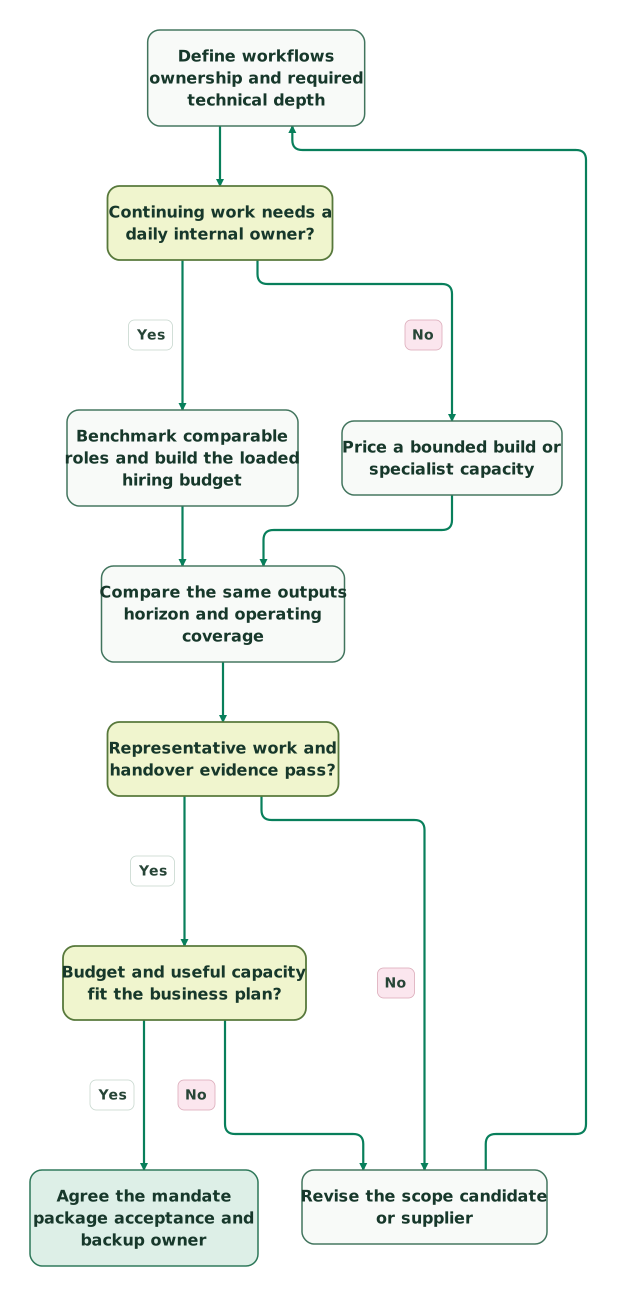
Read diagram as text
- Define workflows ownership and required technical depth to Continuing work needs a daily internal owner?.
- Continuing work needs a daily internal owner? to Benchmark comparable roles and build the loaded hiring budget: Yes.
- Continuing work needs a daily internal owner? to Price a bounded build or specialist capacity: No.
- Benchmark comparable roles and build the loaded hiring budget to Compare the same outputs horizon and operating coverage.
- Price a bounded build or specialist capacity to Compare the same outputs horizon and operating coverage.
- Compare the same outputs horizon and operating coverage to Representative work and handover evidence pass?.
- Representative work and handover evidence pass? to Revise the scope candidate or supplier: No.
- Revise the scope candidate or supplier to Define workflows ownership and required technical depth.
- Representative work and handover evidence pass? to Budget and useful capacity fit the business plan?: Yes.
- Budget and useful capacity fit the business plan? to Revise the scope candidate or supplier: No.
- Budget and useful capacity fit the business plan? to Agree the mandate package acceptance and backup owner: Yes
Checklist
- The job is defined by its responsibilities and required outputs.
- Pay evidence matches location, seniority and base/variable scope.
- A few advertised ranges have not been presented as a market average.
- Employer burden uses a stated denominator and actual local assumptions.
- Tools, recruiting, equipment and internal capacity are visible.
- Ramp reduces capacity without charging salary twice.
- Alternative models cover the same horizon, outputs and operating obligations.
- The person or supplier has passed a representative skills check.
- The company owns the accounts, definitions, code and handover evidence it needs.
- Backup and incident responsibilities remain clear after onboarding.
If the company needs a defined system before a permanent hire, request a detailed GTM engineering scope. If the backlog itself is unclear, start with the $99 martech audit and identify the work before choosing the staffing model.
Keep reading
Browse all GTM Engineering guides
 Tracking & Attribution
Server-side GTM setup: a step-by-step implementation sequence
Set up server-side Google Tag Manager in a testable order: access, hosting, custom domain, clients, tags, consent and deduplication, then launch safely.
Jafrin Akter AloLast updated 16 min read
 Tracking & Attribution
Common Google Tag Manager mistakes and how to fix them
The Google Tag Manager mistakes behind duplicate events, missing sessions and wrong conversions, with the fix for each and a pre-publish checklist.
Jafrin Akter AloLast updated 16 min read
 Tracking & Attribution
Google Tag Manager pricing: is GTM free, what 360 costs and what you actually pay for
Google Tag Manager is free; 360 is quoted. Compare server-side hosting: about $45 per Cloud Run instance, with two recommended, or $20/month on Stape.
Jafrin Akter AloLast updated 14 min read
GTM engineering & outbound
See the implementation scope, deliverables and acceptance checks.
Questions people ask
Should an offer's equity value be added directly to annual cash salary?
No. Keep cash compensation and equity terms separate unless you have a clearly defined valuation and comparison method. Ask about the grant, vesting, exercise terms where applicable and what the quoted value represents. A headline equity number is not guaranteed liquid income. For employer planning, use the company's accounting and compensation approach rather than treating an uncertain future outcome as cash available today.
How should a candidate compare a higher OTE with a higher base salary?
Separate guaranteed base from the variable amount and inspect what makes the variable payable. Ask about targets, measurement, attribution, payment timing and historical attainment where the employer can share it. A larger OTE can carry more uncertainty than a smaller base-heavy package. Compare the role's control over the outcome as well as the advertised maximum, especially when sales results depend on several teams.
Does the highest advertised salary mean the most senior GTM role?
Not necessarily. The band can reflect location, company economics, software-development depth or several possible levels within one advertisement. Read the mandate, reporting line, production responsibility and team leadership expectations. A broad San Francisco software-engineering band cannot be ranked directly against a narrower remote operations role by its maximum alone. Use comparable scope before interpreting pay as a seniority signal.
What if the backlog is valuable but too small for a full-time hire?
Price specialist capacity or a defined build with an internal owner, then observe the ongoing workload. Keep incident coverage and maintenance explicit rather than assuming a project includes indefinite support. If demand becomes persistent, use accepted outputs, operating tickets and decision frequency to justify the role. This gives the hiring case evidence instead of relying on a title's popularity or a projected automation count.
How should a hiring manager handle a candidate who lacks one listed tool?
Determine whether the missing tool is essential on day one or whether the underlying skill transfers. A candidate who can model identities, reason about APIs and recover a failed write may learn a new interface quickly, but that should be tested rather than assumed. Use a bounded representative exercise and an explicit onboarding plan. Do not confuse an unfamiliar logo with an inability to perform the actual work.
Sources

Written by
Jafrin Akter AloData Engineer and Co-founder at Martechdevs and Growth and Analytics Partners
Jafrin writes practical guides to marketing technology, customer data, analytics and AI workflows. Martechdevs is a Growth and Analytics Partners company.