
Martech Handover Checklist: Transfer Control Without Breaking the Work
A martech handover is complete when the receiving team controls the accounts, understands the running integrations and can operate them after the previous owner’s access is removed. Transfer administrative control, runtime authorizations, decision records and operating duties separately. Then verify the customer workflows, scheduled jobs and alerts that depend on them. A folder of documents and a working login are only starting evidence.
On this page
An agency can leave you a healthy dashboard while its employee’s authorization still powers the refresh. A new CRM administrator can own every record while a meeting workflow still points at the person who left. Both failures become visible after the apparent handover has finished.
Use this guide for an agency exit, a change of delivery partner or an administrator’s departure. If you are still deciding who should build and run the stack, start with agency, in-house and freelancer options. If the software itself is changing, use the martech migration checklist for the separate data and reporting workstream.
What must a martech handover transfer?
Transfer four things: control of the assets, authorization for the work that runs, knowledge of the intended behavior, and responsibility for operating it. Give each critical workflow a receiving owner and acceptance evidence.
| Layer | What changes hands | Evidence of completion |
|---|---|---|
| Business control | Accounts, billing, domains, repositories and recovery routes | Authorized internal people can administer and recover the asset |
| Runtime authorization | App credentials, workload identities and connector grants | The required work runs through the intended authorization |
| Operating knowledge | Definitions, decisions, runbooks and known exceptions | The receiver diagnoses and changes a representative workflow |
| Accountability | Monitoring, escalation, renewal and change approval | Named owners receive alerts and can act within agreed coverage |
The same person does not have to perform every role. An internal lifecycle lead might accept the customer behavior while a data engineer owns the pipeline and IT controls privileged access. Record that split in the martech RACI; “the client owns it now” is too vague to operate.
Our integration work with a planned handover treats those outputs as part of delivery. The useful question at acceptance is whether the receiving team can keep the workflow working, including when something fails.
First identify any immediate security concern. A suspected compromised account needs the organization’s incident process, which may require urgent revocation. The staged sequence below describes a normal, authorized transition; it is not a reason to preserve unsafe access.
Which assets belong in the handover register?
Record each system and each connection separately. A company-owned CRM can still depend on an agency-owned extraction job, webhook receiver or deployment pipeline.
Start from your stack map, then follow one real customer journey across it. Trace the website action into tracking, CRM, messaging, warehouse models and the report someone uses. Use the stack audit when the existing inventory cannot explain a step.
A useful register needs account and resource IDs, business owner, billing owner, administrators, execution identity, credential reference, schedule, dependencies, alert destination, runbook and acceptance status. Keep secret values in the approved secret store. The register records where authorized operators obtain them and who can rotate them.
This five-column view shows eight illustrative rows for a small SaaS company. It is a starting schema, not a claim about the authentication configured in your accounts.
| Asset or connection | Business control | Runs as or depends on | Receiving operator | Proof after old access ends |
|---|---|---|---|---|
| GTM account and container | Company administrators | Named publishing permissions | Tracking owner | Accepted version and test event remain correct |
| GA4 property and linked reports | Company account administration | Property roles and report credentials | Analytics owner | Required report and restricted access behave as intended |
| HubSpot booking workflow | Company CRM administration | Scheduling owner and workflow criteria | CRM owner | A fixture booking reaches the correct owner and next step |
| HubSpot association sync | Company-controlled integration | Actual app or Service Key and required scopes | Integration owner | A permitted association operation succeeds through the replacement route |
| CRM extraction into warehouse | Company connector account | Vendor-specific authorization | Data owner | New source changes arrive without the departed identity |
| Warehouse models | Company project or account | Scheduled workload identity and grants | Analytics engineer | Fresh job produces reconciled output and failure evidence |
| Deployment repository | Company repository ownership | Runner, secrets and deployment grants | Engineering owner | Approved build deploys with reviewed permissions |
| Lifecycle platform | Company organization and billing | Workspace credentials, sender settings and audience rules | Lifecycle owner | Test entry, exclusion and alert reach the intended destinations |
Add rows for domain and DNS control, consent configuration, app-store access, advertising accounts, payment profiles and licensed assets where they are part of the scope. Do not create a new analytics property merely to avoid sorting out the ownership of the existing one. Preserve useful history and change the access model deliberately.
How do you find integrations that still depend on a departing person?
Inspect the actual authentication and execution path, not just the visible asset owner. Ask who created the connection, which credential the runtime loads, what permissions it needs and what changes when that person loses access.
Which HubSpot dependencies need special attention?
For legacy private apps, HubSpot states that removing the creator or their Super Admin permission can break association calls with USER_DOES_NOT_HAVE_PERMISSIONS. Token rotation is one documented recovery option. User deactivation also stops workflow triggers for meetings booked with that user. Reassign scheduling assets and criteria; default meeting links cannot simply be transferred. HubSpot user removal
Test the operation your integration performs. A successful contact read does not prove that its company associations or workflow actions still work. Check the connection’s required scopes and the actual downstream result, using a permitted fixture rather than an arbitrary production record.
Do not build the transition around recreating a legacy private app. HubSpot is removing that creation route, while existing legacy apps continue to operate. Select the supported route for the actual account and integration requirements. Private-app creation changes
For simple in-account REST integrations, Service Keys provide account-level authorization that is not tied to the creator remaining employed. HubSpot introduced them as a public beta; confirm the applicable account availability and terms before adopting them. They do not support webhooks. A webhook-dependent integration needs the appropriate app route. Service Key scope and continuity
Current Service Key controls allow immediate old-key expiry or a seven-day rotation window. Super Admins and users with Developer tools access can manage keys. Service Keys are not credentials for UI extensions or other app functionality. Verify the operation before retiring its old credential. Service Key administration
For a third-party connector, separately verify the vendor’s supported reauthorization process. Changing an owner field is not evidence that the token, user grant or external account changed. Record both the accountable person and the runtime authorization in the register.
What should happen to warehouse and pipeline identities?
Use the platform’s supported workload identity for unattended jobs, with only the required privileges. In Snowflake, ordinary non-interactive services use TYPE=SERVICE; those users cannot authenticate with a password or enroll in MFA. A service identity still needs a named human owner and a tested recovery route. Snowflake user types
Review Snowflake key-pair authentication when that is the selected method. Do not automatically replace every connection with a new key: the client, identity, network policy and role grants must support the chosen route.
Google Cloud recommends considering alternatives to service-account keys and keeping any necessary private keys out of source repositories and informal handovers. Passing a key through email or chat creates extra copies to revoke and track. Service-account credential guidance
For every scheduled query, transformation, webhook receiver and automation, identify its runtime host and restart path. Check deployment variables, secret versions, job configuration and external connections. A job that succeeds only because an old process still holds a credential in memory has not demonstrated the replacement setup.
How do you transfer administrative control without granting everyone full access?
Give the company a reliable administration and recovery path, then grant each operator the permissions needed for their work. Separate the ability to manage access from the ability to publish or change customer behavior.
Google Tag Manager distinguishes account administration from container read, edit, approve and publish permissions. Google recommends at least two active account administrators to avoid lockout when the sole administrator leaves. A company can therefore retain recovery control without making every agency user a publisher. GTM access management
In GA4, deleting users requires Administrator at the account level. The last Administrator cannot delete themselves. Check account and property inheritance before treating a property-level permission change as complete removal. Analytics user administration
GA4 also provides No Cost Metrics and No Revenue Metrics restrictions. These affect both the interface and analogous Analytics API access, but access through linked Google products can have different restrictions. Review effective access rather than assuming a checkbox hides the same data through every route. Analytics access restrictions
For other systems, verify the equivalent roles from their current access model. Prefer separate named administrators with company-managed recovery where the platform permits it. Do not solve continuity by giving several people the departing employee’s password and MFA device.
| Control | Verify before cutover | Common incomplete state |
|---|---|---|
| Administrative access | Receiving admin signs in and performs an authorized management task | Invitation sent but never accepted |
| Recovery | Company controls the approved recovery method and emergency process | Recovery email belongs to the agency |
| Publishing or deployment | Receiver can execute a reviewed release with the intended role | Can edit, cannot publish |
| Billing | Company can view the subscription, invoice and required payment settings | New user can log in but only the old owner sees billing |
| Support escalation | Named owner can contact the vendor under the purchased support arrangement | Support entitlement or notices remain with a former mailbox |
Keep the test proportionate. Proving administrative access does not require changing a production billing method or granting a broad role to a test user. Choose a safe operation that establishes the required permission.
What documentation should the receiving team accept?
Accept the explanation of how the system works, why it was built that way and what the operator should do when it stops working. Prioritize the documents needed to make a real decision or recover a real workflow.
The minimum operating pack contains a system map, tracking plan, identity rules, CRM field and workflow register, metric definitions, runbooks, decision log and open-issue register. The marketing operations documentation guide explains how to keep these records useful. A Salesforce operating pack shows how those requirements become platform-specific.
For each unresolved issue, record the effect, evidence, owner, next action and acceptance boundary. “Historical revenue is incomplete before the billing migration” is useful. “There are a few data issues” gives the next operator nothing to work with.
Record walkthroughs of the riskiest tasks where useful, but make the runbook independently usable. A recording can explain a decision; it should not be the only place that names a production secret reference, retry condition or restore procedure.
Check rights and dependencies as well as file possession. Identify reusable supplier components, licences and third-party services that the company may continue to use under the actual agreement. An exported repository does not automatically grant every right or remove an external hosting dependency.
GitHub repository transfers retain webhooks, services, secrets and deploy keys; the original owner becomes a collaborator. Review those items explicitly after transfer. The new repository owner and the set of people or systems still able to use it are different questions. GitHub repository transfers
How do shadowing and reverse shadowing prove operational readiness?
Use shadowing to explain the work and reverse shadowing to prove the receiver can perform it. During reverse shadowing, the receiving operator drives the task with the runbook; the outgoing operator observes and records gaps.
Choose tests by business impact and actual cadence. A daily sync, a weekly finance report and an exception that only happens during renewal require different evidence. Avoid selecting only the easiest five-minute tasks because they fit a closing meeting.
| Acceptance task | Receiver performs | Evidence to retain | Stop condition |
|---|---|---|---|
| Tracking change | Tests an approved change in a non-production environment | Version, fixture event and expected destination | Duplicate event or wrong consent behavior |
| CRM workflow | Runs an authorized booking or association fixture | Required relationship and correct follow-up | Read succeeds but the required operation fails |
| Failed sync recovery | Diagnoses a seeded safe failure and follows the retry rule | Error, recovery step and reconciled output | Replay duplicates or missing records |
| Warehouse report | Refreshes and reconciles a known population | Counts, definitions and explained differences | Material unexplained mismatch |
| Alert route | Triggers an approved test and follows escalation | Alert received by the new owner and acknowledged | Dashboard fails silently or alert reaches the old team |
| Deployment or rollback | Executes a bounded reviewed release and recovery rehearsal | Revision, permission and restore evidence | Requires an undocumented personal credential |
Use the tracking change process and martech QA checklist to select safe environments, evidence and sign-off. Tests that could send customer messages or alter real records need the appropriate scoped authorization and controls.
A successful walkthrough does not prove independence if the outgoing operator supplies every command and fixes every exception. Record where the receiver needed help, improve the operating pack, then repeat the relevant task.
What should the handover acceptance record contain?
Separate permission to retire old access from confirmation that the transition remains healthy afterward. A test performed before revocation cannot prove that the removed identity was unnecessary.
This original YAML template records those two stages for one illustrative connection. Replace references with your own approved evidence locations. It contains no credential values and performs no platform actions.
asset_id: crm_association_sync
scope: account_to_contact_relationships
receiving_owner: integration_owner
runtime_identity_ref: company_managed_authorization
secret_reference: vault_record_reference_only
before_removal:
  replacement_operation: {status: not_run, evidence_ref: null}
  fresh_runtime_session: {status: not_run, evidence_ref: null}
  receiver_recovery_task: {status: not_run, evidence_ref: null}
  alert_route: {status: not_run, evidence_ref: null}
  approved_by: null
old_access:
  removal_status: not_started
  removal_event_ref: null
  affected_credentials: []
after_removal:
  scheduled_run: {status: not_run, evidence_ref: null}
  required_operation: {status: not_run, evidence_ref: null}
  output_reconciliation: {status: not_run, evidence_ref: null}
  alert_route: {status: not_run, evidence_ref: null}
  approved_by: null
exceptions: []
Use explicit statuses such as pass, fail, blocked and not_run. Missing evidence is unresolved. A failed test cannot become a pass because somebody attached a screenshot or assigned an owner.
Before removal, all critical replacement and receiver-readiness tests must pass and the authorized owner must approve the change. After removal, require evidence from runs after the recorded removal event for the affected schedules, operations, outputs and alerts. Keep the asset open until that second gate passes.
For a hypothetical eight-asset scope, seven verified assets and one unresolved connector mean seven of eight accepted. Do not remove the connector from the denominator and report completion. You can accept independent work while retaining an explicit hold on the affected customer workflow.
In what order should old access and credentials be removed?
Replace and verify the necessary authorization, retire the obsolete access, then verify again. Plan the change with the people who control the affected systems; a checklist does not itself authorize production modifications.
- Record the current configuration, credential references and recovery procedure for each affected flow.
- Establish the supported replacement identity or authorization and test the required operations in an appropriate environment.
- Update every known consumer, including job runners, deployment configuration and scheduled automations.
- Have the receiver complete the relevant operating and recovery tasks, then obtain cutover approval.
- Retire the old user, grants, partner access and obsolete credentials through the platform’s supported procedure.
- Start fresh runtime sessions where relevant and verify the next affected runs, outputs and alerts.
- Close the asset only after the new owner accepts the post-removal evidence or records a scoped exception.
Credential overlap must be deliberate and short. Two valid keys can support a controlled transition, but they do not justify running two independent senders or duplicate ingestion jobs. Where a credential cannot overlap, prepare the coordinated cutover and recovery procedure before invalidating it.
Use audit evidence alongside operating evidence. HubSpot’s centralized audit log requires Super Admin access, offers thirty-day views and has plan-dependent categories. It records user actions rather than every system-generated update. An empty audit view therefore does not prove that every pipeline is healthy. HubSpot activity history
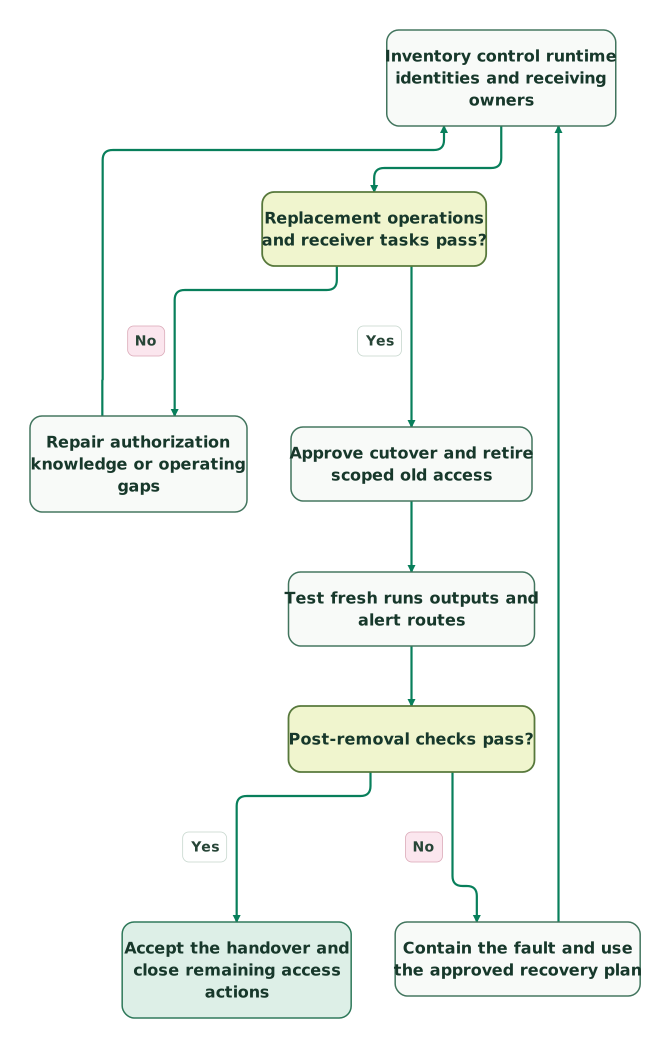
Read diagram as text
- Inventory control runtime identities and receiving owners to Replacement operations and receiver tasks pass?.
- Replacement operations and receiver tasks pass? to Repair authorization knowledge or operating gaps: No.
- Repair authorization knowledge or operating gaps to Inventory control runtime identities and receiving owners.
- Replacement operations and receiver tasks pass? to Approve cutover and retire scoped old access: Yes.
- Approve cutover and retire scoped old access to Test fresh runs outputs and alert routes.
- Test fresh runs outputs and alert routes to Post-removal checks pass?.
- Post-removal checks pass? to Contain the fault and use the approved recovery plan: No.
- Contain the fault and use the approved recovery plan to Inventory control runtime identities and receiving owners.
- Post-removal checks pass? to Accept the handover and close remaining access actions: Yes
Recovery must respect the current access decision. Do not silently restore a departed person’s credentials because a scheduled job failed. Contain the affected workflow, identify the missing dependency and use the authorized recovery path.
How would this work for an agency-to-in-house transition?
Consider a hypothetical 25-person SaaS company with HubSpot, GTM, GA4, a warehouse, an extraction tool, transformation jobs, a deployment repository and lifecycle messaging. A new operations hire accepts the business workflows while an internal engineer owns the integrations.
The register reveals four material gaps: a connector uses an agency employee’s authorization; a legacy private app creates CRM associations; job alerts reach an agency mailbox; and GTM has one administrator despite several publishers.
The receiving team verifies company administrative access first. It then chooses the supported replacement for each connection, tests association operations rather than just reads, changes alert routing and rehearses a failed-job recovery. It keeps the private app’s webhook requirements separate from any data-only Service Key candidate.
During reverse shadowing, the new hire can explain the weekly revenue report but cannot recover the extraction job without help. The reporting task passes; the recovery task remains open. The team updates the runbook and repeats that task before approving the relevant access removal.
After cutover, the next scheduled extraction arrives, the association fixture remains correct and a controlled alert reaches the internal owner. Those results close the affected rows. A weekly report still needs its agreed post-cutover check; a successful daily run cannot stand in for every cadence.
The point of the example is the sequence and the evidence. It does not imply that every connector supports the same authentication method or that an eight-system transition takes a standard number of days.
How should the agreement prevent another difficult handover?
Define company control, named access, operating records and exit deliverables when the engagement starts. Tie acceptance to usable outputs and the receiver’s ability to operate them, with the actual rights and support obligations stated in the agreement.
UK government agile-contracting guidance recommends linking payment milestones to deliverables rather than simply completing a number of sprints. That is public procurement guidance, but the distinction is useful when defining a private implementation’s handover milestones. Agile contracting guidance
If an agency remains on support, name the unresolved duty, response expectation, coverage, access and end condition. A short, scoped escalation arrangement can be useful. An indefinite dependency on knowledge the company never receives is a different commercial choice.
Checklist
- Systems, connections, schedules and runtime identities are inventoried.
- Administrative and recovery access is controlled by the company.
- The actual app, credential and vendor-connection behavior is understood.
- Every credential consumer has an explicit replacement or retirement action.
- Billing, support and alert recipients have been transferred.
- Decisions, definitions, runbooks and known exceptions are usable by the receiver.
- Receiver-operated tests include failures and recovery, not only successful logins.
- An authorized owner approves the scoped removal of old access.
- Fresh post-removal runs, outputs and alert routes have passed.
- Unresolved critical assets remain visible and held.
- The receiving team owns future changes, renewals and escalation.
Start with the $99 martech audit when the running dependencies are unclear. For a defined transition, request a detailed integration and handover scope with the systems, departing identities, critical workflows and access deadline. Those inputs determine the work that must be proved before the previous owner leaves.
Keep reading
Browse all Martech Strategy guides
 Martech Strategy
Marketing Ops Documentation: Seven Records That Survive Turnover
Maintain seven martech operating records with owners, metadata exports and review triggers. Includes a runbook, decision log and practical handover test.
Jafrin Akter AloLast updated 15 min read
 Martech Strategy
Martech QA Checklist: 12 Tests Before a Launch
Test a martech launch across tracking, CRM, warehouse and messaging. Use twelve cases, real-user UAT, record-level reconciliation and versioned sign-off.
Jafrin Akter AloLast updated 14 min read
 Martech Strategy
Tracking Governance: Stop Releases From Silently Breaking Your Data
Set practical tracking governance across website releases, GTM, CRM fields and dbt models. Use risk tiers, native permissions, release evidence and safe rollback.
Jafrin Akter AloLast updated 13 min read
Martech integration
See the implementation scope, deliverables and acceptance checks.
Questions people ask
Should we create new analytics accounts when we change agencies?
Usually preserve the existing business-controlled assets and change the access arrangement. First verify the actual account, property and container IDs, their history and linked dependencies. A new account can introduce a separate migration problem without resolving ownership. Create a replacement only for a clear technical, commercial or governance reason, with a plan for the data and workflows affected.
What if the departing administrator is unavailable?
Start with approved company recovery and administrative routes, then inspect running jobs, connected applications, secret references and recent operational evidence. Prioritize customer-facing dependencies and establish a receiving owner. Record what remains unknown instead of inferring it from a successful login. Use vendor support where appropriate, and contain affected workflows if you cannot verify their authorization or recovery path.
Does transferring a repository remove the agency’s access?
No. A repository transfer and an access review are separate actions. Review collaborators, deploy keys, webhooks, secrets, runners and the destination’s permissions. Then verify deployment and recovery through the intended company-controlled route. Preserve the relevant change evidence. The transfer can succeed while a former collaborator or retained credential still provides access that the organization intended to remove.
How long should the overlap period last?
Size it around the riskiest workflows, operating cadence and receiver readiness. A daily job, a weekly report and a rare recovery operation need different proof. Use safe rehearsals where waiting is impractical, while recording which live cycle remains unobserved. End overlap when the agreed acceptance evidence is complete, rather than choosing a fixed duration that hides unfinished work.
Can we accept the handover with a few unresolved items?
Yes, if acceptance is explicitly scoped and the unresolved items cannot undermine the accepted workflows. Give each exception an impact, owner, next action and boundary on use. A critical connector with unknown authorization should remain held even if seven other assets pass. Track partial acceptance honestly, and close the remaining work only when its own evidence meets the agreed gate.
Sources
- HubSpot: Deactivate and remove users.
- HubSpot: Legacy private-app creation changes.
- HubSpot: Service Keys and creator independence.
- HubSpot: Service Key administration.
- Snowflake: User management and service types.
- Google Cloud: Service-account key practices.
- Google Tag Manager: Users and permissions.
- Google Analytics: User administration.
- Google Analytics: Access and data restrictions.
- GitHub: Repository transfers.
- HubSpot: Account activity history.
- UK Government: Agile contracting guidance.

Written by
Jafrin Akter AloData Engineer and Co-founder at Martechdevs and Growth and Analytics Partners
Jafrin writes practical guides to marketing technology, customer data, analytics and AI workflows. Martechdevs is a Growth and Analytics Partners company.