HubSpot implementation cost: onboarding fees, partner prices and your team's time
Data Engineer and Co-founder at Martechdevs and Growth and Analytics Partners
Last updated 14 min read
HubSpot implementation cost combines software, onboarding, partner delivery, data and integration work, and your team’s time. HubSpot’s published onboarding starts at USD 1,500 for Sales Hub Professional, while Martechdevs implementation starts at USD 3,000 for an agreed scope. Add recurring software and internal effort separately, then compare the records, workflows, testing and handover included in each proposal.
What should a HubSpot implementation budget include?
A HubSpot budget should identify what you are buying, who performs the work and which charges recur. Start with the HubSpot implementation checklist to define the required outcome before assigning a delivery price.
| Cost layer | What belongs here | Evidence needed in the proposal |
|---|---|---|
| Software | Hubs, paid seats, marketing contacts, credits and add-ons | Products, billing model, commitment and included allowances |
| HubSpot onboarding | The vendor’s purchased guidance and consulting service | Exact service, fee and who executes its recommendations |
| Partner delivery | Configuration, automation, reports, testing and training | Named deliverables and acceptance criteria |
| Data and integrations | Cleanup, migration, associations, historical records and ongoing sync | Sources, objects, field rules, exceptions and recovery |
| Internal effort | Decisions, source access, review, testing and operational ownership | Named people and an agreed capacity allocation |
Keep implementation separate from the HubSpot subscription cost. Buying software access does not assign someone to resolve duplicate companies, define lifecycle stages or prove that a sales report matches the intended revenue measure.
For a five-to-100-person business, the first expensive mistake is usually an unclear boundary. “Set up Sales Hub” might mean creating a pipeline, migrating years of activity, changing routing across regions or rebuilding a connection to billing. Ask for the actual records and workflows involved.
Our CRM and lifecycle implementation service covers the system and process work behind those outcomes. The right scope should leave your team able to use and maintain the result, with acceptance evidence attached to each critical workflow.
What does HubSpot charge for onboarding?
HubSpot publishes different onboarding fees for different Hubs and editions. Its service pages describe technical advice, recommendations and migration consulting; execution responsibilities need to be explicit in the purchased scope.
The following are HubSpot’s published one-time USD fees. They exclude recurring software, partner build work and any separately scoped services. Sales fees are also explicitly listed on the Sales Hub pricing page; Marketing and Customer Platform amounts come from their linked onboarding pages.
| HubSpot onboarding service | Professional, USD | Enterprise, USD | Scope distinction |
|---|---|---|---|
| Sales Hub | 1,500 | 3,500 | Advice on the sales process, configuration and reporting; confirm migration responsibilities |
| Marketing Hub | 3,000 | 7,000 | Guidance on data, lead capture, nurturing and campaign reporting |
| Customer Platform | 10,000 | 17,000 | Broader guidance across the purchased platform; Premier onboarding is USD 24,000 |
Customer Platform Premier is an onboarding option for the broader Enterprise purchase, not another software subscription tier. Do not add every row together without checking which service your order form actually requires.
HubSpot’s Sales onboarding description distinguishes guidance from the hands-on execution a Solutions Partner can provide. During scoping, turn “migration support” into a concrete assignment: who exports the source, cleans the records, builds mappings, imports associations and resolves failures?
That distinction also works in the other direction. A partner may execute configuration while the business still owns data decisions and acceptance. Neither the vendor service nor an agency fee removes the need for someone who understands the sales process to approve the result.
Can a partner replace HubSpot’s onboarding fee?
A partner arrangement can change the onboarding line only when HubSpot confirms that treatment for your purchase. The Sales and Marketing pricing pages list their Professional and Enterprise onboarding fees as required. Keep those charges in the budget until the actual order form says otherwise. Sales terms, Marketing terms.
INSIDEA’s published implementation page says an accredited partner can often replace the HubSpot onboarding charge. That is the provider’s advertised position, not a universal waiver you should apply to every quote.
Ask for written answers to three questions: which HubSpot fee is removed, which partner service replaces it, and what happens if the software purchase or delivery arrangement changes. A verbal “onboarding included” can describe inclusion in the partner fee while leaving the vendor’s own charge unresolved.
Keep the software and services documents together when approving the budget. The saving exists only when the final commercial terms remove a charge you would otherwise pay.
What do partners and agencies publish as starting prices?
Published partner fees provide useful scope questions, but they are not a market average or a ranking of delivery quality. Compare what each starting amount includes before treating the lower figure as the cheaper implementation.
The cited partner pages display dollar signs without an explicit ISO currency code in their price passages. The table reproduces their advertised starting amounts; confirm billing currency, taxes and the final scope in the written quote.
| Provider | Advertised starting amounts | Scope to normalize before comparing |
|---|---|---|
| Lean Labs | Onboarding $2,000; implementation $5,000; migration $7,000; integrations $15,000 | These are separate starting categories, not four charges to add automatically |
| INSIDEA | Professional from $2,000 per Hub; Content Hub from $1,500; Enterprise from $4,000 per Hub | Migration, custom integrations and cleanup beyond a standard import are separately scoped |
Martechdevs implementation starts at USD 3,000. Full data warehousing, end-to-end visualization and data activation can reach USD 15,000, depending on the agreed scope. Our published project pricing is broader implementation guidance; it does not establish a fixed HubSpot package or an unlimited project cap.
Compare proposals with an inclusion matrix. If one supplier includes historical activities, association repair and a migration rehearsal while another includes only standard-object import, request a common scope or price the missing work separately. Do the same for documentation, training, defect correction and post-launch ownership.
Compare the charging model as well as the scope. A fixed price needs explicit inclusions, assumptions and a change process. Hourly work needs a capped discovery or delivery budget, visible outputs and approval before the allowance expands. A retainer needs a defined monthly capacity, priorities, unused-time treatment and exit terms. Keep recurring administration outside the one-off implementation total unless the proposal explicitly includes both.
Avoid treating a discount on delivery as a reason to buy a more expensive edition. First establish whether the required process needs that edition. A custom-object design, for example, needs a confirmed entitlement and a sound reason to exist; use the HubSpot custom-objects guide before making it a dependency.
Which data and integration decisions change the quote most?
The largest scope differences usually come from identity, history, business rules and the route used to move data. Counting contacts or connected applications alone leaves those costs unexplained.
Migration coverage and record quality
List the source objects, required properties, associations, historical activities, owners and consent-related fields. Mark each as migrated, archived elsewhere or deliberately excluded. Use the Salesforce-to-HubSpot migration plan when leaving Salesforce, and resolve CRM data hygiene before treating every source row as a valid new record.
HubSpot’s Smart Transfer guide describes a one-way, one-time migration route. Access requires Super Admin permissions, and custom field mappings require a Data Hub subscription. It warns that running Smart Transfer alongside the Salesforce integration can create duplicates because the two routes use different matching identifiers. Choose the migration route before pricing both tools into the same plan.
Use an exception ledger to keep migration acceptance honest. In this fictional example, 1,000 source rows contain 20 approved exclusions and 30 duplicate copies, leaving 950 intended unique contacts. If 940 arrive correctly and ten remain in an exception queue, the transfer is accounted for, but acceptance is still incomplete until those ten are resolved or explicitly accepted as exclusions.
measure,count
source_rows,1000
approved_exclusions,20
duplicate_copies_removed,30
intended_unique_contacts,950
accepted_contacts,940
unresolved_contacts,10
Also reconcile relationships. Ten contacts linked to the wrong company can pass a contact-count check. Require examples that prove the intended company, deal and owner associations, including records with ambiguous source identifiers.
Ongoing sync and automation
An ongoing sync needs rules for field ownership, conflicting edits, deletions, delays and retries. HubSpot’s Salesforce installation guide warns that syncing a single contact can consume up to four API calls per sync cycle, with variation. An application programming interface (API) budget must therefore include the other Salesforce workloads sharing that capacity.
The suspension guide explains that exhausting Salesforce’s organization limit can stop updates even while the integration appears connected. Include headroom, monitoring and recovery in the quote. A successful connection screen is not the acceptance test.
For workflow rebuilds, identify which events can enroll imported records and when automation becomes active. Price a rehearsal that proves expected enrollment and exclusions before switching the whole dataset. Copying every old Salesforce customization one-for-one can preserve obsolete work and force unnecessary HubSpot complexity.
Contact tiers, AI usage and internal time
Changing an existing marketing contact to non-marketing status does not take effect immediately; use the account’s next update date. Removing those contacts also does not automatically lower the purchased tier, which waits until renewal. Decide which imported contacts should be marketing contacts before loading them into paid targeting workflows.
Included HubSpot Credits do not add together across Hubs, and usage rates vary by feature. Check the credit rules, then use the HubSpot AI guide to scope the workflow.
Internal effort includes decisions and review as well as training. Someone must approve lifecycle stages, identify the authoritative owner, resolve exceptions and judge whether the report answers the business question. A supplier cannot safely infer those decisions from conflicting exports.
What would a first-year and second-year budget look like?
A useful budget separates recurring subscription costs from one-time delivery and internal capacity. The following fictional ten-person configuration extends the example in our HubSpot pricing guide, using the Hub-based pricing model rather than the separate flexible seats-and-credits model.
Amounts are USD per month with the applicable annual Professional commitment and monthly payment. The example has four Sales seats, three included Core seats, three View-Only users, capacity for 7,000 marketing contacts and 200 Customer Agent text resolutions each month. It excludes taxes, other Hubs, external tools and negotiated discounts.
| Recurring component | Quantity and rate | Monthly USD |
|---|---|---|
| Marketing Hub Professional | Base with three Core seats and 2,000 contacts | 890 |
| Sales Hub Professional | Four Sales seats × 100 | 400 |
| Additional marketing contacts | One 5,000-contact increment | 250 |
| Additional credits | 7,000 credits × 0.01 | 70 |
| Monthly total | Sum of the four components | 1,610 |
The Hub-based product catalog publishes the Marketing base and contact increments. Under the credit rate sheet, 200 text resolutions at 50 credits use 10,000 credits; one included 3,000-credit allowance leaves 7,000 to purchase. Annual prepayment offers and flexible seats-and-credits accounts have different pricing, so substitute a complete quote rather than mixing components from different models.
For the delivery model below, assume 80 external hours at USD 100 per hour, or USD 8,000. This is an illustrative labour estimate, not a Martechdevs hourly rate or a promise that the scope takes 80 hours. Internal year-one capacity is 40 hours at USD 75; year two assumes 16 hours at the same capacity value. Existing payroll remains unchanged.
| Budget component | Calculation | Year one, USD | Year two, USD |
|---|---|---|---|
| Software and credits | 1,610 × 12 months | 19,320 | 19,320 |
| HubSpot onboarding | Marketing 3,000 + Sales 1,500 | 4,500 | 0 |
| External implementation | Assumed 80 hours × 100 | 8,000 | 0 |
| Incremental cash | Sum of the cash lines | 31,820 | 19,320 |
| Internal capacity allocation | 40 hours, then 16 hours, at 75 | 3,000 | 1,200 |
| Total resource estimate | Cash plus internal capacity | 34,820 | 20,520 |
Software plus vendor onboarding alone is USD 23,820 in year one. Calling that the complete implementation budget would omit the assumed build work and your team’s participation. Conversely, the internal USD 3,000 allocation is not another supplier invoice when payroll stays the same.
Year two assumes unchanged subscription usage and no new external project. It is a continuation case, not a guaranteed renewal quote. Add ongoing administration, external maintenance, parallel licences and new requirements where your actual operating model needs them.
A simple sensitivity makes the risk visible. If the same USD 250 contact increment is needed for six additional months, year-one cash increases by USD 1,500 to USD 33,320. If it remains for all of year two, that year adds USD 3,000. Recheck the actual contact band before extending this assumption to larger volumes.
Two larger scope changes need their own quoted inputs:
- Adding a Salesforce migration: let
Mbe the additional migration fee after removing work already included in the USD 8,000 allowance. Year-one cash becomes31,820 + M. Add legacy-licence overlap separately; do not assume a partner’s published migration starting price buys your required history and associations. - Requiring Enterprise: first confirm that the required feature cannot be delivered appropriately within the existing design. Then replace the affected software and credit lines. If
Eis the net annual recurring-cost change,Othe additional onboarding andDthe delivery change, year-one cash becomes31,820 + E + O + D. Obtain each input from the revised scope and order form.
Should you implement in-house, use a partner or bring in a specialist?
Choose the delivery model according to available capacity and the hardest part of the scope. Keep a business owner inside the company in every case.
| Situation | Stronger starting fit | Alternative | Decision test |
|---|---|---|---|
| Clean start, one process, capable internal owner | Internal build with suitable guidance | Bounded partner configuration | Can the owner configure, test and maintain the required workflow? |
| Several teams moving together with a fixed launch dependency | Partner-led delivery | Internal lead plus specialist workstreams | Who owns end-to-end acceptance and the cutover decision? |
| CRM works, but billing or product-data sync is unreliable | Specialist integration project | Wider reimplementation if evidence justifies it | Can the failed boundary be repaired without replacing sound processes? |
| Unclear source history or conflicting revenue definitions | Bounded discovery before fixed delivery scope | Phase the viable part first | Does discovery resolve a named uncertainty and produce a usable decision? |
An internal build still consumes time and may need help with migration or integration. A partner-led build still needs internal decisions. Use agency versus in-house ownership to plan who maintains the system after the project team leaves.
Start with a smaller reliable workflow when the wider process is unsettled. For example, prove that one qualified lead reaches the right owner with the right company association and reporting status. Expand once the team agrees on that behaviour. A large configuration completed against unresolved definitions creates a larger rework bill.
What must the statement of work and handover prove?
The statement of work should define completion through business behaviour, data reconciliation and ownership. “Portal configured” does not establish that salespeople can trust routing or management can use the reports.
- List included objects and history. State exclusions, volume assumptions and who resolves bad source records.
- Define the operating rules. Record lifecycle stages, routing, field ownership, enrollment and suppression conditions.
- Name the acceptance cases. Include normal records, duplicates, missing associations, integration failures and imported records that must not trigger automation.
- Plan the rehearsal and cutover. Assign source access, change control, the final reconciliation and the person who can delay launch.
- Transfer ownership. Include configuration records, access, recovery instructions, training and the treatment of defects versus new requests.
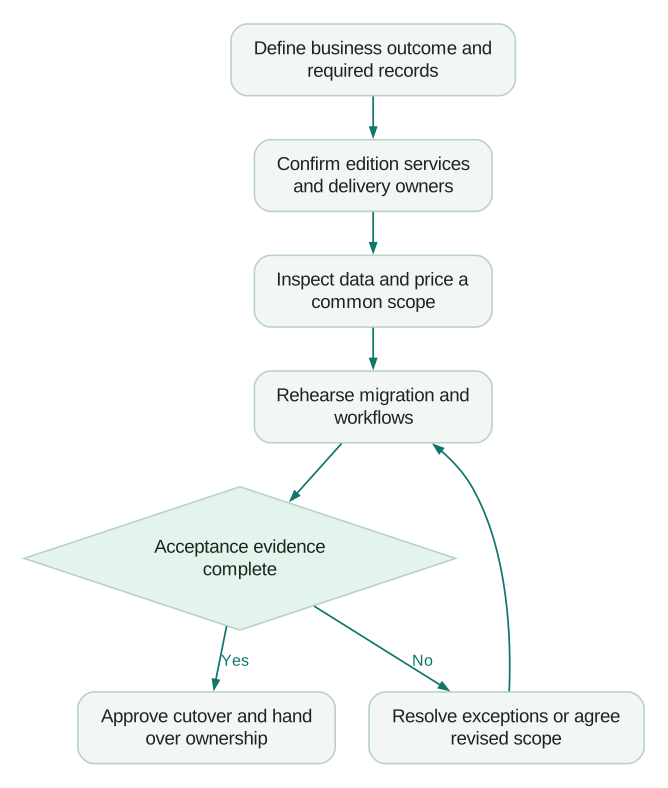
The schedule should follow these dependencies. Access delays, an unavailable export or an unresolved definition can determine elapsed time even when the build itself is small. Ask for a schedule tied to your actual scope; a generic number of weeks cannot establish when your migration is safe to launch.
How should you review the final HubSpot quote?
Approve the quote after you can trace each fee to an included deliverable, owner and acceptance result. Use these checks before signing:
Checklist
- The account’s pricing model, products, seats and commitment are explicit.
- Vendor onboarding fees and any agreed replacement are recorded in writing.
- Migration objects, history, associations and cleanup responsibilities are listed.
- Marketing-contact handling and AI-credit assumptions have been modeled.
- Integration capacity, monitoring and recovery are part of the scope.
- The rehearsal tests imported records and automation side effects.
- Internal review and training capacity is available.
- Handover, defect correction and later changes have clear terms.
- Year-two operation is budgeted separately from the one-off build.
Compare the total cost of delivering and operating the agreed system. Bring the current tools, required workflows and source-data constraints to a scoped CRM implementation quote. If the uncertain part is what needs fixing, book a free audit before committing to a wider rebuild.
Questions people ask
Should the implementation contract include every purchased Hub?
Include each Hub whose configuration or data behaviour is part of the required outcome, and explicitly exclude the others. A purchased Hub may need little delivery work, while one shared workflow can cross several products. Ask the supplier to show those dependencies rather than multiplying a generic per-Hub fee. Confirm which team owns any omitted configuration so launch does not depend on an unassigned task.
How should we price records that fail the migration rehearsal?
Agree on the exception-handling unit before the rehearsal begins. Separate a mapping defect within the supplier’s scope from source records that need a business decision or new cleanup work. Keep counts and representative cases for each category, then price any additional work against that evidence. A single undifferentiated failed-record total makes it difficult to judge effort, responsibility or whether the same issue affects many records.
Can training be accepted before the final workflows are available?
Use early training for shared concepts, then require operational training against the configuration the team will actually use. Have participants complete relevant tasks such as assigning a qualified lead, correcting a record and reading the agreed report. If training occurs before those workflows settle, include the later update in the scope. Attendance alone does not demonstrate that the team can operate the delivered process.
What should a fixed-price proposal say about adding a second business unit?
Specify whether the second unit shares the same process or introduces new permissions, pipelines, reporting and data boundaries. Reusing a template can reduce build work, but a different approval or ownership model changes the scope. Ask for an explicit change mechanism and acceptance cases rather than assuming another unit is covered by an unlimited configuration allowance. Confirm the required HubSpot features before agreeing to the design.
How do we avoid paying twice when replacing an unfinished implementation partner?
Inventory the usable configuration and evidence before commissioning replacement work. Obtain the mappings, workflow definitions, migration results, access records and unresolved-issue list, then ask the new supplier to distinguish reusable assets from work requiring repair. Tie the replacement quote to that assessment. A fresh supplier should not automatically rebuild sound work, and an existing configuration should not be accepted merely because someone already invoiced for it.
Sources
- HubSpot: Sales Hub onboarding.
- HubSpot: Marketing Hub onboarding.
- HubSpot: Customer Platform onboarding.
- HubSpot: Sales Hub pricing.
- HubSpot: Marketing Hub pricing.
- Lean Labs: Published HubSpot partner starting prices.
- INSIDEA: Published implementation fees and scope.
- HubSpot: Smart Transfer.
- HubSpot: Salesforce integration installation.
- HubSpot: Salesforce integration suspension errors.
- HubSpot: Product and services catalog.
- HubSpot: Set contacts as non-marketing.
- HubSpot: Hub-based product pricing and contact increments.

Written by
Jafrin Akter AloData Engineer and Co-founder at Martechdevs and Growth and Analytics Partners
Jafrin writes practical guides to marketing technology, customer data, analytics and AI workflows. Martechdevs is a Growth and Analytics Partners company.