BI Tools Price Comparison: What Tableau, Power BI, Data Studio, Metabase and Looker Cost
Data Engineer and Co-founder at Martechdevs and Growth and Analytics Partners
Last updated 14 min read
Compare business intelligence (BI) tools using the people who build, edit and read reports, then add the cost of delivering trustworthy data. For the same 25-person team, published annual licence costs can range from no software fee to a sales quote. Reader licensing, required permissions and an existing Microsoft subscription often change the shortlist more than the advertised entry price.
Which billing units should you compare first?
Count the actual jobs each person needs to perform. A builder creates data sources and models, an editor changes reports, and a reader consumes them. Those are planning roles for this comparison; each vendor's entitlements still need checking against the person's work.
Our warehouse and reporting implementation scopes those roles alongside the source models, access rules and reports. A licence that cannot serve the required user is not a saving.
USD list rates. Monthly equivalents marked annual require the stated annual purchase; tax, negotiated discounts, capacity contracts and external data costs are excluded.
| Product and plan | Published billing unit | Base or role price | Commitment basis |
|---|---|---|---|
| Tableau Cloud Standard | Creator / Explorer / Viewer | USD 75 / 42 / 15 per user/month | Annual contract, billed annually |
| Tableau Cloud Enterprise | Creator / Explorer / Viewer | USD 115 / 70 / 35 per user/month | Annual contract, billed annually |
| Power BI Pro | Licensed user | USD 14 per user/month | Paid yearly |
| Power BI Premium Per User | Licensed user | USD 24 per user/month | Paid yearly |
| Data Studio self-service | No software licence charge | USD 0 | Data and connector costs remain separate |
| Data Studio Pro self-service | Pro user per project | USD 9 per user/project/month | Monthly subscription billing |
| Metabase Starter | Base plus accounts over five | USD 100/month; USD 6 per extra account/month | Monthly, or published annual rates below |
| Metabase Pro | Base plus accounts over ten | USD 575/month; USD 12 per extra account/month | Monthly, or published annual rates below |
| Looker Google Cloud core | Platform plus user types | Quote | Annual subscriptions in one-, two- or three-year terms |
Sources: Tableau Cloud, Power BI US pricing, Data Studio, Metabase and Looker.
Tableau requires at least one Creator per deployment. Server has its own operating responsibilities even where its published role prices match Cloud; use Tableau license costs by role and edition for that distinction. Tableau Server pricing.
Use Metabase's published annual amounts when pricing a prepaid year. Starter is USD 1,080/year plus USD 65 per extra account/year; Pro is USD 6,210/year plus USD 130 per extra account/year. Enterprise starts at USD 20,000/year.
Who pays for people who only read dashboards?
The reader's licence depends on the product, hosting model and content location. Do not give every tool the same reader count and silently assume readers are free.
Reader rules. This table concerns ordinary internal access; customer embedding is a separate design.
| Tool | Internal reader rule | What changes the estimate |
|---|---|---|
| Tableau | Named Viewers are paid in role-based deployments | Capacity-based Viewer Blocks replace per-Viewer licensing; Creators and Explorers remain per user |
| Power BI | Shared Pro content normally needs Pro for consumers | Free users can consume from supported Premium or Fabric F64+ capacity; capacity itself costs money |
| Data Studio Pro self-service | Report-only viewers need sharing permission, not a Pro seat | Creating, editing or managing Pro content needs a licence |
| Metabase paid plans | Non-deactivated accounts count, even without logins | Guest embeds do not create the same billable account requirement |
| Looker | Viewer is a licensed user type | Quote the platform and actual user mix, including the bundled entitlements |
Tableau licensing distinguishes named Viewer seats, capacity blocks and usage-based external embedding. A deployment cannot mix capacity-based and role-based Viewer licensing. Request a capacity quote when concurrency is the relevant cost driver; a large mailing list alone does not tell you the required capacity.
Microsoft's licensing guide distinguishes Premium Per User (PPU) from Premium capacity. A PPU workspace requires PPU users; buying one PPU licence does not make everyone else a free reader. Likewise, an arbitrary small Fabric capacity does not establish free-user consumption: the documented Fabric threshold is F64 or above.
For Data Studio Pro licensing in detail, distinguish self-service from negotiated organization-wide arrangements. The subscription guide says self-service billing covers purchased licences, used or not, and associates each subscription with one project. The scenario below buys exactly the needed author/editor seats for one project.
Metabase's billing rules count non-deactivated accounts and aggregate instance counts under the same licence token. The same person in two instances can therefore affect the bill differently from one named person in a spreadsheet. See how Metabase counts billable accounts before estimating from monthly logins.
What does the same 10-, 25- or 50-person team cost?
Map the same work to each vendor's billing unit, then calculate the annual licence amount. These are hypothetical constant-size teams.
| Team size | Builders | Editors | Readers |
|---|---|---|---|
| 10 | 1 | 2 | 7 |
| 25 | 2 | 5 | 18 |
| 50 | 3 | 10 | 37 |
For Tableau, builders use Creator, editors Explorer and readers Viewer. Power BI uses Pro for everyone, with no existing entitlement or paid capacity assumed. Data Studio Pro buys licences for builders and editors in one project. Metabase counts every person as an account in one instance. These mappings are valid only if the selected edition passes the required work and access tests.
Annual USD software amounts, calculated from list prices. Data Studio Pro is twelve monthly charges; the other paid rows use their stated annual rates. Tax, midyear seat changes, discounts, data infrastructure, embedding and optional usage are excluded.
| Licence scenario | 10 people | 25 people | 50 people |
|---|---|---|---|
| Tableau Cloud Standard | 3,168 | 7,560 | 14,400 |
| Tableau Cloud Enterprise | 6,000 | 14,520 | 28,080 |
| Power BI Pro | 1,680 | 4,200 | 8,400 |
| Data Studio no-cost | 0 | 0 | 0 |
| Data Studio Pro, authors/editors only | 324 | 756 | 1,404 |
| Metabase Open Source licence only | 0 | 0 | 0 |
| Metabase Starter, prepaid year | 1,405 | 2,380 | 4,005 |
| Metabase Pro, prepaid year | 6,210 | 8,160 | 11,410 |
| Looker | Quote | Quote | Quote the appropriate edition |
For the 25-person example:
- Tableau Standard:
(2 × 75 + 5 × 42 + 18 × 15) × 12 = USD 7,560. - Power BI Pro:
25 × 14 × 12 = USD 4,200. - Data Studio Pro:
(2 + 5) × 9 × 12 = USD 756. - Metabase Starter:
1,080 + (25 − 5) × 65 = USD 2,380. - Metabase Pro:
6,210 + (25 − 10) × 130 = USD 8,160.
The lowest row is not a universal winner. Metabase Starter cannot substitute for a required Pro-only access control. Data Studio's zero licence fee does not pay for connectors or warehouse work. Power BI Pro is already included in Microsoft 365 E5 and Office 365 E5, so existing eligible users may need no additional Pro purchase; that does not make the underlying Microsoft subscription free.
Looker Standard is for teams below 50 users. Platform plans include ten Standard and two Developer users. At 50, request the appropriate edition and map the bundled licences to your roles.
How does customer-facing embedding change the comparison?
Price the authenticated experience and usage pattern your customers need. Internal headcount is an inadequate denominator for an analytics feature serving hundreds of external accounts.
Metabase's billing guide distinguishes guest embedding, which does not add viewer accounts, from authenticated full-app and modular embedding, whose users count. A fixed guest dashboard and an interactive experience where customers create their own questions are different products. The plan comparison reserves row/column permissions, enterprise single sign-on and several embedding controls for Pro or Enterprise.
Tableau's usage-based external model measures analytical impressions, while capacity blocks govern concurrent usage. Power BI Embedded has variable pricing. Looker offers an Embed edition. Ask each supplier to price the same tenant isolation, interaction, concurrency and traffic assumptions before comparing totals. Licence terms and user rights still apply; “no viewer account charge” is not a complete security or commercial assessment.
Test two isolated customer identities, their permitted rows, downloads and saved reports. Use the access and modeling checks any BI rollout needs as acceptance cases. A dashboard URL that looks private is not proof that another tenant cannot retrieve its data.
Which costs sit outside the licence?
Add the systems and operating work needed to produce and maintain the report. Keep vendor bills separate from staff capacity so the budget does not pretend an unchanged salary is a cash saving.
Warehouse queries continue behind a paid BI licence. Estimate BigQuery query and storage pricing or Snowflake compute for extract refreshes using representative refreshes and reader activity. Connector subscriptions can be separate again. For direct Google Analytics 4 (GA4) reporting, Data API quotas are a capacity constraint, not a promise that a free connector can support every report. Diagnose GA4 quota errors in Data Studio before buying another front end.
Self-hosting adds servers, the application's own database, backups, upgrades and a recovery owner. Metabase's August 2026 security advisory reported active exploitation of a critical vulnerability. That is a reason to budget timely maintenance and recovery, not to estimate hosting from the server rental alone. Managed hosting changes who performs some of that work; it does not remove your data and access responsibilities.
What does a full 25-person budget look like?
The following is an original planning example, not a vendor quote or a Martechdevs delivery estimate. It uses the Power BI Pro scenario above, constant headcount and unchanged rates in year two. USD per year, excluding tax. All other amounts are explicitly assumed.
| Cost line | Year one | Year two | Basis |
|---|---|---|---|
| Power BI Pro | 4,200 | 4,200 | 25 × USD 14 × 12 |
| Warehouse bills | 1,800 | 1,800 | Assumed USD 150/month |
| Connector bills | 900 | 900 | Assumed USD 75/month |
| Initial internal implementation | 2,560 | 0 | Assumed 32 hours × USD 80 loaded hourly cost |
| Continuing internal administration | 1,920 | 1,920 | Assumed 2 hours/month × USD 80 × 12 |
| Total resource cost | 11,380 | 8,820 | Cash bills plus valued staff capacity |
The annual vendor/data bills are USD 6,900 in both years. Staff capacity is USD 4,480 in year one and USD 1,920 in year two. A change in permissions, embedding or user count changes the scope and requires a new estimate.
For external delivery, what a reporting implementation costs is separate from software. Martechdevs projects start at USD 3,000; full warehousing, end-to-end visualization and activation can reach USD 15,000. Scope sets the quote. Those figures are not subscription prices or a guaranteed cost for this hypothetical project.
What should be reserved for AI usage?
Use the selected service's meter and current terms. Metabase's comparison FAQ reconciles its managed Cloud AI descriptions: a 20% markup on underlying token cost currently corresponds to USD 3.75 per million tokens. Bringing your own provider means paying that provider separately.
Its billing guide includes the first million tokens each month. Recheck the active rate and measured workload before forecasting.
Looker's English pricing page extends promotional conversational analytics within fair-use limits, with at least 90 days' notice before quotas and billing begin. Future overages are USD 3 per million input data tokens and USD 20 per million output data tokens beyond included usage. Confirm the instance's allowances and notice before forecasting.
Tableau Cloud's Agent is in its quoted Cloud+ or Tableau+ packages. Compare those editions when AI assistance is required.
Tableau Server's pricing guidance requires a separately connected model provider for its Agent. Keep the provider bill distinct from Tableau licences. An AI trial should have a measured workload, owner and spending boundary before it becomes a permanent budget line.
Which option fits each budget scenario?
Choose the cheapest configuration that satisfies the report, access and operating requirements. A lower licence row is useful only after those requirements pass.
Data Studio
- Best for: a small author group publishing straightforward reports to many readers.
- Pros: the self-service reader rule can keep the licence bill small.
- Cons: connector, source-quota and modelling work can dominate the apparent saving.
- Free tier and startup offer: no-cost reporting is available; do not assume a cloud credit covers every connector.
- Choose it if: the data sources and permission model support the actual report.
- Skip it if: required governed exploration or operating controls fail the pilot.
Power BI
- Best for: teams whose existing Microsoft entitlements and reporting workflows fit Pro.
- Pros: its ordinary shared-user price is easy to reproduce.
- Cons: PPU content and free-reader capacity have different gates.
- Free tier and startup offer: the free account supports personal use; budget a supported sharing route.
- Choose it if: ordinary authors and restricted readers pass the same acceptance report.
- Skip it if: the needed capacity or modelling work erases the expected saving.
Metabase
- Best for: a team with prepared warehouse data and an owner for query definitions.
- Pros: explicit base/account pricing supports a concrete forecast.
- Cons: required permissions can move the purchase to Pro; self-hosting adds operating work.
- Free tier and startup offer: Open Source is free to self-host; no startup discount is assumed here.
- Choose it if: the permitted exploration and embedding experience fits its selected tier.
- Skip it if: nobody will own deployment, models and access tests.
Tableau
- Best for: teams that need the visual-analysis workflow and can separate author roles from readers.
- Pros: role pricing can avoid licensing every person as a Creator.
- Cons: annual commitment and edition requirements must be accepted before buying.
- Free tier and startup offer: a trial is available; do not budget a restricted free or educational licence as a general production entitlement.
- Choose it if: the required analysis works and the role/capacity quote fits.
- Skip it if: the report is simple and the extra workflow has no demonstrated use.
Looker
- Best for: a team maintaining shared definitions in Looker's modelling language, LookML.
- Pros: platform and user scope can be specified in the quote.
- Cons: undisclosed platform pricing prevents a valid list-price total.
- Free tier and startup offer: obtain any trial or negotiated concession explicitly; this budget assumes none.
- Choose it if: the semantic-model ownership and quoted edition meet the requirement.
- Skip it if: the job only needs a small reporting front end and the operating commitment is unjustified.
For a 25-person team with seven authors/editors and mostly readers, test Data Studio first if the report fits; compare Power BI when stronger modelling or existing entitlements matter. For restricted warehouse exploration, compare Metabase Pro with the relevant Power BI configuration. For a visual-analysis team, evaluate Tableau's role mix. For a maintained governed LookML layer, request Looker pricing rather than forcing it into a false per-seat ranking.
Use Tableau alternatives and what a migration rebuilds, Data Studio alternatives by reporting workflow or Metabase alternatives and their ownership tradeoffs when an essential requirement fails. The price comparison and migration decision are related, but they need different evidence.
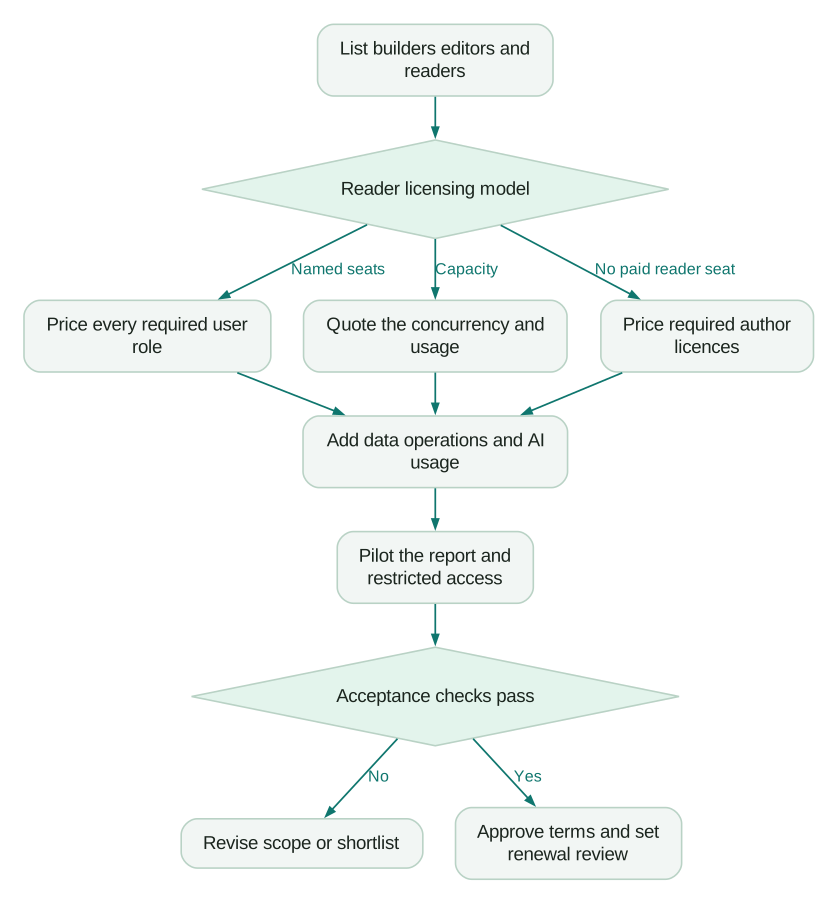
What should pass before you approve the purchase?
Rebuild one recurring decision report, reconcile its numbers and test the actual reader roles before signing. Give the pilot an owner and an end date. A two-week planning window works only if the source models and test accounts are ready.
- Fix the source period and metric definitions that survive a tool change.
- Build the report with realistic joins and refresh behavior.
- Sign in as an ordinary reader and a restricted user in isolated sessions.
- Measure warehouse activity and enumerate the accounts or capacity the vendor would bill.
- Price the selected configuration, support, migration and parallel-running period.
- Record acceptance failures and contract conditions before approving the quote.
Data Studio's 30-day Pro trial starts billing automatically afterward unless cancelled.
Metabase's billing guide makes annual payments and true-ups non-refundable. Verify renewal, unused-seat treatment and cancellation dates for the actual order, alongside the displayed monthly equivalent.
Checklist
- Builders, editors, readers and embedded customers have distinct counts.
- The selected tier passes required access and report tests.
- Existing entitlements have been checked before buying duplicate seats.
- Annual commitments and payment dates are visible.
- Warehouse, connectors, operations and AI usage have owners and estimates.
- Source totals reconcile and restricted users see only permitted data.
- Migration and parallel-running work is included where relevant.
- A dated licence review precedes renewal.
Want a second pair of eyes on your stack? Book a free audit. For a defined reporting build, request a warehouse and reporting quote with the team roles, source models and acceptance report.
Questions people ask
What happens to the budget when the original report author leaves?
Preserve ownership and continuity before removing access or a licence. Check who owns the reports, source credentials, refresh schedules and support responsibilities. Data Studio's subscription guide distinguishes ownership: Pro content belongs to the organization through its project. Test the successor's access and refresh path so an apparent seat saving does not disable a recurring business report.
How should a short-term BI consultant be counted?
List the consultant's required tasks and access period, then apply the vendor's actual role and contract rules. A person who builds models may need more than a Viewer entitlement even if the engagement lasts one week. Record who removes access afterward and whether the purchased commitment can actually be reduced. Temporary access and a temporary licence charge are not automatically the same thing.
Can you accept a capacity quote without knowing concurrent usage?
Treat it as an incomplete estimate until the workload assumptions are documented. Separate occasional registered readers from people opening or refreshing reports simultaneously, and include scheduled jobs or embedded traffic where the meter counts them. Test representative peaks and agree how over-capacity behavior is handled. A cheap quoted block is useful only if it supports the workload the business intends to run.
What if one essential report cannot move to the cheaper tool?
Keep the old licence and operating dependencies in the comparison until that report has an accepted replacement or an approved retirement decision. Price the mixed environment explicitly, including refresh work and support. A migration that moves most dashboards may still retain nearly all of the old platform commitment. Recalculate the saving from the actual removable costs rather than the percentage of reports migrated.
How should a fixed annual BI allowance be used when headcount changes?
Maintain a dated headcount and role forecast rather than multiplying today's team by twelve indefinitely. Separate additional purchases, annual true-ups, reductions allowed only at renewal and existing unused commitments. Re-run the estimate for the expected change date and retain a contingency owned by finance. The allowance is a planning boundary; it does not override the vendor's account-counting or payment terms.
Sources
- Tableau: Cloud pricing and roles.
- Tableau: Server pricing.
- Tableau Help: Licence models and Viewer capacity.
- Microsoft: Power BI US pricing.
- Microsoft Learn: Power BI licence types.
- Google Cloud: Data Studio pricing.
- Google Cloud: Data Studio Pro subscriptions.
- Metabase: Pricing.
- Metabase: Billing rules.
- Metabase: Plan comparison.
- Google Cloud: Looker pricing.
- Google Analytics: Data API quotas.
- Metabase: August 2026 security advisory.
- Google Cloud: Data Studio Pro trial.

Written by
Jafrin Akter AloData Engineer and Co-founder at Martechdevs and Growth and Analytics Partners
Jafrin writes practical guides to marketing technology, customer data, analytics and AI workflows. Martechdevs is a Growth and Analytics Partners company.