
Support AI Pricing: Compare the Unit You Pay For
Data Engineer and Co-founder, martechdevs
Last updated 9 min read
Support AI pricing usually combines helpdesk seats, AI usage and optional capabilities. The usage unit might be a session, a resolution or a broader outcome that includes a handoff or sales qualification. Compare vendors using the same support traffic, then calculate cost per satisfactorily resolved issue. Headline unit prices alone cannot tell you which system will cost less to operate.
Last updated: 4 September 2026.
A support lead can receive three quotes with three apparently simple prices and still have no defensible budget. One vendor bills each AI session, another charges for verified resolutions, and another counts certain transfers as paid outcomes. The numbers describe different work.
This comparison covers Fin with Intercom, Zendesk AI agents and Freshworks Freddy AI Agent. Prices below are public USD references checked on the update date, before taxes and negotiated terms. Account history, channel and billing model can change what applies. The implementation also matters: a connected customer context can determine whether the AI finishes a request or sends the customer to a person who must start again.
What belongs in a complete support AI budget?
Separate five cost layers before comparing offers.
Helpdesk access covers the seats and platform capabilities your human team needs. Autonomous AI usage covers the customer-facing agent's metered work. Agent assistance covers copilots used by employees. Channels and integrations cover messaging, voice, external actions or connector usage where applicable. Operations covers knowledge maintenance, quality review, escalation handling and implementation.
Keep the purchase and operating views separate. A monthly budget should include the cost incurred for that month, while procurement should also show the cash commitment for annual seats, prepaid usage and implementation. A headline “per month” amount can still require an annual payment.
Use this structure:
Monthly operating cost =
  base platform and seats
  + billable AI usage after applicable allowance
  + selected copilot and quality features
  + metered channels and external actions
  + ongoing support operations

First-year commitment =
  contracted recurring charges
  + forecast usage and overages
  + implementation and migration
Do not count a trial allowance as a recurring discount. Also avoid assuming every employee needs every AI add-on. Map each paid seat or capability to a real role and workflow.
How does Fin's outcome pricing work?
Intercom's current outcome documentation lists $0.99 for a resolution, configured Procedure handoff, disqualification or self-serve routing, and $9.99 for a qualification. These rates apply to chat and email with Intercom; voice and specialized arrangements require separate confirmation. It charges at most one outcome per conversation. A resolution can be confirmed or assumed when the customer leaves without requesting more help. The Fin outcome definitions explain the distinctions.
That detail matters because Intercom's general pricing FAQ still summarizes Fin as $0.99 per outcome, while the plan cards say “from” $0.99. For a workflow that includes sales qualification, use the detailed outcome schedule and obtain confirmation in your quote. Treating every outcome as the entry rate would understate the cost.
The Intercom pricing page separately lists helpdesk seats and optional Copilot usage. It also offers Fin with an existing helpdesk without Intercom seats, subject to a minimum commitment. Confirm the exact Fin deployment, channel and minimum before reusing a quote from another team.
Why the mix can change the bill
Consider a hypothetical month containing 800 resolutions, 100 configured Procedure handoffs and 100 sales qualifications, each in a separate conversation. At the detailed published rates, the first 900 outcomes cost $891 and the qualifications cost $999. Total AI usage is $1,890 before the other cost layers.
Applying $0.99 to all 1,000 conversations would produce $990, understating this example by $900. The difference comes entirely from the assumed outcome mix. It is not a prediction of your usage or a claim that another vendor would classify the same conversations identically.
For support-only budgeting, keep sales qualification outside the support resolution denominator. Otherwise, the report may show an increased “cost per support resolution” when the agent has started performing a separate revenue workflow.
Which Zendesk resolution model applies to your account?
Zendesk's public pricing page lists $1.50 for committed automated resolutions and $2 for pay-as-you-go resolutions. Those figures are useful reference points, but they are insufficient to model every current account. Start with the account's actual billing model and quote. See Zendesk pricing.
Zendesk introduced resolution tiers on 18 May 2026. Its current documentation distinguishes assisted escalations, contained resolutions and verified resolutions. Assisted escalations and contained resolutions do not consume the resolution allowance under the documented tier model; a verified resolution passes the vendor's evaluation of whether the request was resolved. Channel-specific end conditions affect when that classification occurs. See the resolution tier definitions.
Zendesk also documents an account transition to a currency-based resolution allowance. Its upgrade guide explicitly labels example invoice prices as placeholders and directs customers to obtain actual pricing. Do not copy those screenshot values into a purchasing model. The upgrade documentation describes the transition and account-specific commercial treatment.
Ask the billing owner to identify the model in use, the applicable allowance, the rate for each charged tier and the renewal date. Keep these fields in the comparison alongside the public reference prices. A team approaching renewal may need both a current-period forecast and a forecast under its next contract.
There is also an operational distinction between a vendor-verified resolution and your quality standard. Review examples involving incomplete advice, repeated contact and policy exceptions. A billing classification is an input to the cost model, while your own quality review determines whether the customer received an acceptable outcome.
What does Freddy AI Agent count as a session?
Freshworks' current add-on documentation lists packs of 100 sessions for $49. For Chat AI Agent in Freshdesk Omni, a session covers interactions within 24 hours from conversation start. Email AI Agent uses a 72-hour window from the customer's first email. The documentation distinguishes Email AI Agent availability from the Omni-only Chat AI Agent. See Freddy AI add-on management.
The session FAQ describes 500 introductory sessions as a one-time benefit for eligible new paid-plan customers, with different provisions possible under legacy contracts. It also says previewing agents consumes sessions, unused sessions expire at the billing-cycle boundary, and purchased packs renew unless reduced. Include testing and unused capacity in the forecast. See the session FAQ.
Freshdesk Omni's published annual-billing seat references are $29 for Growth, $79 for Pro and $119 for Enterprise per agent per month. AI session packs are additional, and selected plans list Copilot and metered integration add-ons separately. Use the Omni pricing page for the channel bundle you intend to purchase; an email-focused Freshdesk quote is a different configuration.
A session is an interaction window, so its price does not establish a cost per successful resolution. You need to measure how often those sessions achieve your agreed support result and how much human work remains afterward.
How do you compare sessions with outcomes fairly?
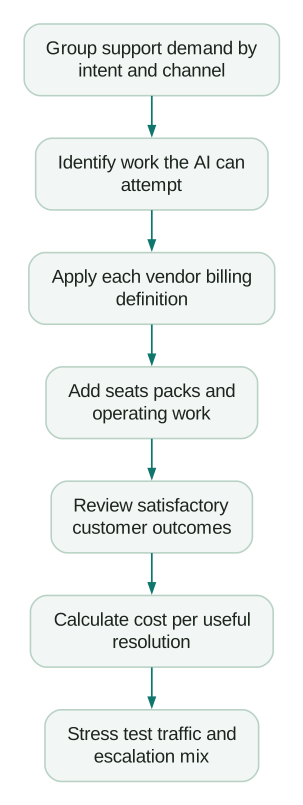
Use one representative workload, but allow each vendor to meter it differently. Take a historical sample of issues, group them by intent and channel, and identify which ones the proposed AI can actually attempt. Billing eligibility and automation eligibility are separate filters.
For each issue type, record the expected number of interactions, likely escalation path, required system access and satisfactory end state. Password guidance, an order-status lookup and a disputed refund may have very different operating economics. A single average hides that mix.
Consider an illustrative session-priced workload of 1,000 billable sessions, with no free allowance remaining. Ten packs at $49 cost $490. If 600 issues are satisfactorily resolved without human completion, usage cost per such issue is approximately $0.82. If only 300 meet that standard, the same usage bill becomes approximately $1.63 per successful issue.
An outcome-priced bill must be modelled from its actual charged categories, not by substituting those 600 successful issues automatically. The vendor might count some outcomes your quality review rejects, or bill useful handoffs separately. Reconcile a pilot usage export to your sampled conversations before treating the two denominators as equivalent.
Also include pack rounding. If a session model requires whole packs, 1,050 paid sessions would require capacity for 1,100 under a 100-session pack structure. The remaining capacity has value only if it can be used within the relevant billing period. This is why usage timing can matter as much as total annual traffic.
How do you include the human work left behind?
A useful handoff can reduce human effort even when it does not resolve the issue. Measure that separately. Did the AI identify the customer, collect the correct evidence and route the issue to the right team? Or did the employee repeat every question after correcting an inaccurate summary?
For a hypothetical operational model, suppose AI attempts 2,000 issues and fully resolves 900. The remaining 1,100 need human completion. If handling those escalations takes eight minutes each, that is about 147 hours of human work. A claim that “the AI handled 2,000 conversations” would conceal most of the remaining workload.
Now suppose better customer context reduces handling time for those same escalations from eight to six minutes. That saves roughly 37 hours while the autonomous resolution count remains unchanged. The improvement is valuable, but it belongs in a handoff-efficiency measure, not an inflated autonomous-resolution claim.
Use your own loaded labour assumptions when translating hours into money. Time saved only becomes an operating benefit if the team can use the capacity: handling growth, reducing queues, improving service or changing staffing plans. Do not subtract hypothetical salary savings from a software invoice as though cash automatically leaves the budget.
The support customer context guide explains which information should travel with the issue. Existing Zendesk teams should also inspect implementation mistakes that create routing and ownership problems before buying additional automation to compensate for them.
What should a pilot invoice prove?
Choose a manageable set of intents with clear outcomes and a known human baseline. Keep the first pilot narrow enough that the support lead can inspect failures, including conversations labelled successful by the vendor. Include at least some repeat contacts and edge cases in the review.
Build a reconciliation record that links each sampled issue to its vendor billing identifier, charged category, quality outcome, escalation reason and human handling time. Exclude customer content that is unnecessary for the financial review. The finance owner needs an auditable unit count, not unrestricted access to every conversation.
Before committing, check:
Checklist
- The quote names the exact product, channels and billing model.
- Seat charges, copilots, AI usage and external actions are separate line items.
- Included usage is classified as recurring, introductory or legacy-contract entitlement.
- A sampled usage export reconciles to billable conversation or session records.
- Repeat contacts, refunds or billing adjustments have an understood treatment.
- The team knows what happens when prepaid usage runs out or a limit is reached.
- Low, expected and high forecasts vary resolution quality and traffic mix.
- A named owner maintains knowledge, reviews outcomes and handles escalations.
Compare the offers using two results: the cost of serving the forecast workload and the quality-adjusted capacity the system creates. A cheaper billed unit can be a good purchase when the workflow succeeds frequently. A more expensive unit can still be worthwhile when it resolves harder work reliably. The pilot should show which situation your team actually has.
Questions people ask
Is a session the same as a resolution?
A session groups interactions within a vendor-defined window. A resolution describes an outcome, and its definition can differ from your internal quality standard, so the two units require separate counts in a comparison.
Is every Fin outcome priced at $0.99?
The detailed Intercom outcome schedule lists a higher rate for sales qualification than for the other listed chat and email outcomes. Confirm the categories used by your workflow and the applicable contract instead of extending the entry price to every interaction.
Can I use Zendesk's public resolution price for every account?
First confirm whether the account uses traditional automated resolutions or the newer allowance model. Obtain the applicable rates and renewal treatment from the billing owner or quote, particularly during a transition.
Should free trial sessions reduce the annual forecast?
Only include a confirmed allowance for the period in which it applies. Keep one-time trial capacity separate from recurring entitlements so the steady-state budget remains realistic.
Which metric best compares the total cost?
Use cost per satisfactorily resolved issue, together with remaining human handling time and customer-quality measures. Keep sales qualification, useful handoffs and autonomous support resolutions separate so changes in the work mix do not distort the result.
Sources
- Intercom Fin outcome definitions and pricing, accessed 4 September 2026.
- Intercom pricing, accessed 4 September 2026.
- Zendesk pricing, accessed 4 September 2026.
- Zendesk automated resolution tiers, accessed 4 September 2026.
- Zendesk transition to resolution allowances, accessed 4 September 2026.
- Freshworks Freddy AI add-on management, accessed 4 September 2026.
- Freshworks Freddy AI session FAQ, accessed 4 September 2026.
- Freshdesk Omni pricing, accessed 4 September 2026.
Written by
Jafrin Akter AloData Engineer and Co-founder, martechdevs
Jafrin Akter Alo is a data engineer and co-founder of martechdevs, where the team has delivered 74+ martech, data and growth stack implementations.