
Build or Buy Marketing AI Agents? Compare HubSpot, Agentforce and Custom Workflows
Start by configuring the AI your team already pays for, then extend it or build when a valuable requirement remains unmet. Compare every option against the same workflow, access rules and acceptance cases. Include setup, usage, review, maintenance and the person who can keep the workflow working after handover.
On this page
Start with the finished job. “Prepare next week's account-expansion review using customer relationship management (CRM), billing and product evidence” is a useful scope. “An agent that runs our entire stack” leaves too much undefined to compare quotes or judge success.
For many teams, configuring an existing platform is the sensible first test. Custom work becomes attractive when you can name a requirement the available options fail, put a value on meeting it and fund the responsibility that comes with ownership.
Does this job need an agent or ordinary automation?
Use ordinary automation when inputs, rules and outputs are predictable; use an agent when choosing the next investigation or approved tool is itself part of the job. A weekly query and a short generated explanation can be enough for a report. An agent adds value when the system needs to choose what to investigate or which approved tool to use as new evidence arrives.
Anthropic's guide to building effective agents recommends starting with the simplest suitable design and adding complexity only when it improves outcomes. It also distinguishes predefined workflows from agents that direct their own steps.
Apply that distinction to your actual bottleneck. If account IDs do not match across systems, an agent does not remove the identity work. If a report's logic is settled, letting a model reinvent the calculation on every run creates another thing to check. Use the readiness checks to fix identity and definitions before any agent is trusted with the selected workflow.
Our custom martech AI agent work starts with that boundary so the implementation solves the actual workflow rather than adding an agent around every step.
Write down which step needs interpretation. Keep stable calculations, eligibility rules and repeatable updates in components that can be tested directly. An application programming interface (API) exposes a system’s functions to software. Model Context Protocol (MCP) gives an assistant a common way to discover and call tools. The MCP-versus-API guide explains how to separate conversational access from dependable execution.
Which ownership model fits the workflow?
Choose the least demanding ownership model that passes the mandatory requirements. Configuration, extension and custom development are separate scopes, even when one supplier offers all three.
| Option | Good fit | Main advantage | Responsibility that remains |
|---|---|---|---|
| Configure a native agent | Data and daily users already live in the platform | Reuses its interface and supported controls | Definitions, configuration, evaluation and exceptions |
| Extend a native agent | One bounded tool or data gap remains | Keeps the existing workflow while adding the missing capability | Integration contract, access and recovery |
| Build a custom workflow | A valuable requirement survives the simpler tests | Control over runtime, tools and review experience | Deployment, changes, monitoring and maintenance |
| Keep simple automation or manual review | Low frequency or unstable requirements | Lower operating burden while the need becomes clear | A named owner and trigger for reconsideration |
Configure a native agent
Use the existing platform's builder, actions, permissions and interface. Your team owns the configuration and business process; the vendor operates the underlying product. This fits when the data is available, users already work there and the supported actions pass the job's acceptance cases.
You still need someone to manage instructions, field changes, evaluation cases, permissions and exceptions. Buying a platform does not give it your company's definition of an eligible expansion account.
Extend a native agent
Keep the platform interface and add a narrow tool or data service for the part it cannot do well. For example, an agent could retrieve a governed account-health record from a warehouse and leave task creation inside the CRM.
This can be a good fit when the missing piece is specific. It also creates an integration boundary to own: authentication, tool inputs, freshness, errors and version changes must be maintained.
Build a custom workflow
Choose your own runtime, context, tools and review interface. Custom can mean a small set of Claude Code skills and approved connectors, a scheduled service, or an application built for a particular team. Those are different deliverables with different operating requirements.
The advantage is control over how the work is assembled and exposed. The obligation is to support it. A repository alone is not a functioning service, and possession of source code does not mean your team can safely change it.
Keep a simple automation or manual process
Low frequency, unstable requirements or weak input data can make an agent a poor investment today. A documented monthly review may be cheaper to operate and easier to verify.
A ChatGPT analysis routine on connected data may cover the reporting job while a person retains the business decision.
Defer deliberately: record the volume, error rate or business requirement that would justify reopening the decision. That prevents the same purchasing discussion from restarting every time a new agent product launches.
Which AI features already in your stack deserve the first test?
Test an existing feature first when it covers the job and the required data already lives in that tool. Separate analysis, engineering assistance, lifecycle decisions and stack maintenance; those are different purchases.
- Snowflake Cortex, CoWork and CoCo cover different data, assistant and engineering tasks. Choose the task before selecting the feature.
- Gemini and data agents in BigQuery are relevant when the accepted models and access boundaries live in Google Cloud.
- AI analysts in Snowflake, BigQuery and Looker compared helps choose where a conversational reporting job should run.
- GA4's Ask Advisor is a candidate for an analytics question within the supported GA4 context.
- Braze AI for one lifecycle decision keeps the test close to the treatment and delivery workflow.
- AI decisioning in Hightouch, Braze and RudderStack compares learned engagement decisions and their evaluation requirements.
- Ops agents that watch and maintain the stack addresses monitoring and maintenance work without treating an observed anomaly as a proven cause or authorised repair.
Configure a fitting feature before funding a second implementation of the same job. If it fails, retain the failing case as the reason for an extension or custom build.
What does the research say about building versus buying AI?
The research supports testing customised vendor partnerships, but it cannot predict which option will succeed for your team. Project NANDA's preliminary July 2025 GenAI Divide report reports deployment in about two-thirds of external partnerships versus one-third of internal builds in its sample. Its prose says approximately 67%; the adjacent table says 66%, against 33% for internal builds.
The report's method includes interviews with 52 organisations, and the deployment outcomes are self-reported. Success definitions varied, and the authors explicitly caution that organisational capabilities and other differences may explain the association. “Buy” here includes co-developing customised tools with vendors; it is not a result about purchasing an untouched off-the-shelf subscription. The comparison does not establish that buying caused the deployment difference.
For a 20-person team, the practical question is who supplies the missing capability and who owns the result afterward. Give a partner the same difficult records, access failures and maintenance exercise as an internal team. Use the research to improve procurement questions, not to put a 67% success assumption into the financial model.
When is HubSpot Agent Hub a practical starting point?
HubSpot is a practical first test when CRM users, data and supported actions already fit the workflow. HubSpot describes Agent Hub as the place to run and manage its agents, including custom agents. The current Agent Builder product page identifies it as the successor name to Breeze studio and includes it in Starter, Professional and Enterprise editions, with custom-agent usage consuming credits. Check the feature and subscription combination you need rather than treating builder access as unlimited use of every HubSpot feature.
The current Agent Builder setup documentation allows instructions, knowledge, inputs and selected actions, including supported external MCP connections. It separates CRM read and write actions and provides agent access settings. Its built-in test process does not consume HubSpot Credits; subsequent run estimates are informational and actual consumption can differ.
Check HubSpot Agent Hub, Breeze and credits for the wider product and billing distinctions. Agent Builder access does not make Starter equivalent to the full workflow automation in Professional or Enterprise.
That makes HubSpot a candidate for more than a fixed catalogue of canned agents. Test the required external systems, custom properties and outputs before deciding it cannot handle your workflow.
A useful trial is one expansion-review account with a billing discrepancy. Can the configured agent find the right account, show the disagreement and leave the decision unresolved? Can the person who owns the process inspect why it did so? Those answers are more useful than counting the agents in a marketplace.
When does Agentforce fit an existing Salesforce team?
Agentforce fits when Salesforce is the operating environment and the required actions can run within its supported permission and extension model. Salesforce's MCP connection documentation describes registering external servers and allowlisting individual tools as agent actions. Connection and management paths differ for third-party, MuleSoft and Salesforce-hosted servers. The connection guide lists Lightning on Enterprise, Performance, Unlimited and Developer editions; add-ons vary by agent type. Verify the actual entitlement and connection route.
Use Agentforce for small Salesforce teams to check the product and operating scope before commissioning an external runtime. This matters if Salesforce is already the team's operating environment. A required warehouse lookup does not automatically mean the entire agent must live outside Salesforce.
Ask the implementation team to demonstrate the complete path: the user's identity, allowed tool, record selection, returned evidence and resulting action. Then repeat it with a user who lacks access to the account and with an unavailable external source.
If the design meets the job inside the existing platform, compare its recurring cost and maintainability with an external implementation. Choose based on observed fit rather than assuming either native or custom is inherently more capable.
What should every option prove in the same acceptance test?
Require each option to pass the same business, access and failure cases before comparing convenience. Give vendors and internal engineers the same brief. Specify the audience, input systems, record grain, timing, output and forbidden side effects. Separate requirements that must pass from preferences that can be traded against cost.
Here is an original example for a weekly expansion review. It is a planning document, not configuration that can be imported into a vendor product:
workflow: weekly-expansion-review
business_owner: revenue-operations
record_grain: one-account
inputs:
  - crm_account_owner
  - billing_subscription_state
  - workspace_usage_summary
  - unresolved_support_issues
output:
  - account_id
  - evidence_with_source_timestamps
  - missing_or_conflicting_information
  - proposed_next_step
execution_mode: prepare-review-only
must_pass:
  - use_the_approved_account_identity_map
  - distinguish_unknown_from_ineligible
  - retain_the_business_definition_version
  - respect_the_requesting_users_access
  - produce_no_customer_messages_or_record_changes
operating_owner: named_before_launch
Use acceptance cases for a marketing agent with a healthy account, conflicting billing state, a merged account, an unavailable support source and a user without access. Define the expected behaviour before the demonstration. Do not allow the team presenting the tool to quietly substitute cleaner data.
Measure whether the output is correct, complete enough for the decision and quick to review. Keep a record of unacceptable answers as well as successful ones. The AI-for-RevOps guide provides a fuller pilot method, including missed issues.
An option that fails a mandatory access or output requirement should not win through a high average score. First establish that the workflow is viable. Then compare cost and convenience among the viable options.
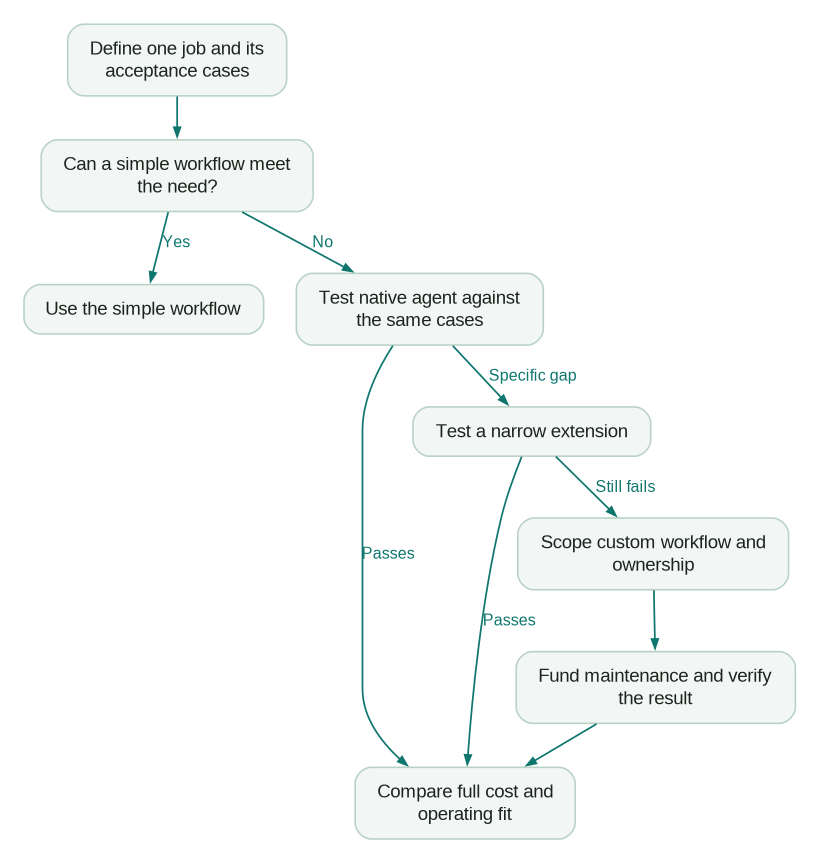
Read diagram as text
- Define one job and its acceptance cases to Can a simple workflow meet the need.
- Can a simple workflow meet the need to Use the simple workflow: Yes.
- Can a simple workflow meet the need to Test native agent against the same cases: No.
- Test native agent against the same cases to Compare full cost and operating fit: Passes.
- Test native agent against the same cases to Test a narrow extension: Specific gap.
- Test a narrow extension to Compare full cost and operating fit: Passes.
- Test a narrow extension to Scope custom workflow and ownership: Still fails.
- Scope custom workflow and ownership to Fund maintenance and test the custom workflow.
- Fund maintenance and test the custom workflow to Mandatory cases pass.
- Mandatory cases pass to Compare full cost and operating fit: Yes.
- Mandatory cases pass to Stop or redesign before comparing cost: No
Which billing units belong in the comparison?
Compare the unit billed for each completed run, including failed attempts and review. One request can generate several model calls, tool actions or data queries. “Cost per conversation” and “cost per action” are not interchangeable. Neither tells you how many outputs a reviewer will accept.
HubSpot's credit-management documentation distinguishes included credits, purchased capacity, automatic upgrades and pay-as-you-go overages. Unused monthly credits expire. With auto-upgrade selected, exceeding purchased capacity can increase the pack for the remaining commitment term. Additional-credit purchases before 16 September 2026 default to auto-upgrade; purchases from that date default to pay-as-you-go. Inspect the actual setting. Account and feature limits also need attention; a feature limit does not reserve credits for that feature.
For Agentforce, the public pricing page lists Flex Credits at USD 500 per 100,000 credits and standard Agentforce actions at 20 credits each. Other pricing models and action types exist. As an illustrative calculation, 250 runs using eight such metered actions each consume 40,000 credits, equivalent to $200 at that list rate. This is consumed usage value, not a complete quote or necessarily the amount invoiced. Included allowances, commitments, licenses, Data 360 and other services can change the bill. Verify the Flex Credits included in the applicable Salesforce edition before subtracting an assumed allowance.
For a custom Claude Code workflow, Anthropic's cost documentation distinguishes API consumption from subscription pricing and describes costs varying with model choice and usage. Measure the actual workflow, including repeated attempts and lengthy context. A subscription or an inexpensive model does not make warehouse queries, third-party services or operator time free.
Ask each supplier to map one completed run to its billable events. Include a normal run, an unsuccessful run and a retry. This gives finance something it can forecast and gives engineering something it can optimise.
How do first- and second-year ownership costs compare?
A configured platform can cost more each month and still be cheaper through the first year because it starts with less implementation work. Compare cash spending and staff capacity separately.
The following are hypothetical USD planning inputs. Both options are assumed to pass the same acceptance cases; these are not vendor or Martechdevs prices. Existing costs identical under both options, tax and discounting are excluded. Internal time is valued at an assumed USD 75/hour.
| Input | Configured platform | Custom workflow | Higher-maintenance custom case |
|---|---|---|---|
| External setup/build, one time | 2,000 | 9,000 | 9,000 |
| Additional usage/platform/hosting per month | 400 | 150 | 150 |
| Internal maintenance and review hours/month | 6 | 6 | 10 |
| Internal capacity value/month | 450 | 450 | 750 |
| Recurring resource cost/month | 850 | 600 | 900 |
The custom base case includes four maintenance hours and two review hours each month. The sensitivity increases maintenance to eight hours, retaining two review hours.
Yearly USD totals using those same constant assumptions. Year two contains no new setup or rebuild; the actual renewal and maintenance scope must be checked separately.
| Cost component | Configured platform | Custom workflow | Higher-maintenance custom case |
|---|---|---|---|
| Year-one external spending | 6,800 | 10,800 | 10,800 |
| Year-one internal capacity | 5,400 | 5,400 | 9,000 |
| Year-one total resource cost | 12,200 | 16,200 | 19,800 |
| Year-two external spending | 4,800 | 1,800 | 1,800 |
| Year-two internal capacity | 5,400 | 5,400 | 9,000 |
| Year-two total resource cost | 10,200 | 7,200 | 10,800 |
The configured first year is 2,000 + 12 × 400 + 12 × 6 × 75 = USD 12,200. The custom base is 9,000 + 12 × 150 + 12 × 6 × 75 = USD 16,200.
Custom's USD 7,000 higher initial fee takes 28 months to offset at the assumed USD 250 monthly resource saving. If maintenance rises by four hours, its extra USD 300/month removes that saving: recurring resource cost becomes USD 900, above the configured USD 850.
That sensitivity is the point. A small model bill cannot settle the purchase decision when maintenance is uncertain. Estimate a low, expected and high workload, identify the assumptions that change the winner and test those assumptions during the pilot.
Do not report recovered employee hours as cash savings unless spending actually falls. The time may instead be used for more valuable work. Name that work when presenting the business case.
Who owns the system after launch?
Assign three responsibilities explicitly. The business owner maintains definitions and decides what counts as a useful result. The system owner maintains integrations, credentials, deployments and recovery. The reviewer resolves cases the workflow cannot handle confidently or correctly.
One person may cover more than one responsibility in a small team. The responsibilities still exist.
Define who approves agent actions and releases, with the reviewed version and execution limits recorded together.
For a purchased platform, ask which configuration changes your admins can make, what requires the vendor and how releases affect existing agents. For custom work, ask for the repository, deployment instructions, dependency list, tests, operating costs and the account ownership needed to run it.
Use a handover exercise: someone who did not build the workflow changes a field mapping, reruns the acceptance cases and diagnoses a failed connection. If they cannot do that with the supplied material, identify the missing training or support before calling the handover complete.
Decide who responds when a run fails or a source becomes unavailable. A scheduled weekly process needs a clear missed-run signal and a manual fallback. A command used on demand needs understandable errors and a way to recover without repeating an unknown-outcome write.
Which assets must remain portable?
Keep the business definition, test cases and operating assets portable enough to change provider without losing the workflow. “We own it” can mean ownership of a prompt file, the source code or a complete operable system. Specify which one is being delivered.
Keep business definitions, acceptance examples and data contracts in a form your team can retain. Document platform-specific behaviour that would need rebuilding if you moved. A standard protocol can make connections more portable while leaving authentication, permissions, scheduling and UI tightly coupled to a platform.
Ask what can be exported: instructions, tool definitions, run histories, evaluation results and configuration. Ask how to revoke access, stop schedules and remove credentials at the end of the engagement. For custom software, check the rights to modify and reuse the delivered work and dependencies in the actual agreement.
The aim is an informed maintenance decision. Rebuilding everything for theoretical portability can cost more than the dependency you were trying to avoid.
What if the platform changes or closes?
Plan for product changes as part of ownership. OpenAI's Agent Builder guide says the product is being deprecated and is scheduled to shut down on 30 November 2026; ChatKit remains available. The same guide distinguishes published version snapshots from exported workflow code.
Keep instructions, context files, tool contracts, acceptance cases and approval rules versioned outside a single visual canvas where possible. Identify the replacement runtime and the work needed to preserve credentials, schedules and review controls. An export reduces rebuilding effort only if another operator can run and verify it.
What does the Martechdevs implementation include?
Our custom martech AI agent service currently includes an agent at no additional charge within a fixed-price implementation. The service centres on Claude Code skills, commands, business context and access to the agreed tools, with documentation and handover.
The implementation still has a price and an agreed scope. “Included” should not be interpreted as unlimited future workflows, included third-party subscriptions or perpetual maintenance. Put the workflows, acceptance cases, ownership, exclusions and post-handover support in the quote.
Our fixed price packages list what each plan includes, and the implementation cost guide explains what drives the cost. Keep those service prices separate from the fictional platform comparison above.
You should be able to compare that proposal with configuring your existing platform. A good outcome may be native tooling, a small extension or a custom implementation. Bring the workflow and the evidence requirements to the scope request so the comparison starts with the same job.
Which arrangement fits a small team's situation?
Choose the option that meets the job with an operating burden the team can sustain.
| Situation | First option to test | Alternative | Reason |
|---|---|---|---|
| CRM-centred review with supported actions | Native HubSpot or Agentforce configuration | A narrow extension | Keep the work near its users and access model |
| One approved warehouse lookup is missing | Native agent plus a governed tool | Custom workflow | Test the bounded gap before rebuilding the interface |
| Several platforms need a specialised review process | Custom workflow against the shared brief | A qualified implementation partner | Control can justify ownership when the requirement is valuable |
| A low-volume recurring calculation with fixed rules | Ordinary automation and human review | Reconsider an agent when the job changes | Avoid paying for an unused decision-making layer |
What should pass before you commit to an agent?
Commit after the workflow passes mandatory cases, its complete cost fits, and a named operator can maintain and stop it. Use the checklist to make those conditions reviewable.
Checklist
- Define one completed business job and its users.
- Confirm why ordinary automation is insufficient.
- Give every option the same inputs and acceptance cases.
- Test required records, external tools and permissions directly.
- Reject failures on mandatory requirements before scoring preferences.
- Price setup, incremental licenses, usage, review and maintenance.
- Test sensitivity to retries, volume and operator hours.
- Separate external spending from the value of internal capacity.
- Assign business, technical and exception-handling ownership.
- Verify handover, export, support and the ability to stop the workflow.
If the scope is still unclear, get the $99 martech audit with one workflow, its current failure and the decision you need to improve.
Keep reading
 Martech AI
Agentforce Pricing: Flex Credits, Conversations, Users and Full Cost
Calculate Agentforce costs across Flex Credits, conversations, Help Agent resolutions and employee licences. Separate included allowances from CRM and data costs.
Jafrin Akter AloLast updated 11 min read
 Martech AI
BigQuery AI: Gemini, Data Agents and AI Functions for Marketing Data
Choose BigQuery AI tools for marketing data. Understand Gemini costs, data-agent setup, AI functions, permissions and how to verify useful outputs.
Jafrin Akter AloLast updated 14 min read
 Martech AI
GA4 AI: Ask Advisor, AI Summaries and Answers You Can Check
What GA4's AI features do: Ask Advisor, homepage AI summaries and predictive metrics, with prompts and checks that make each answer hold up in a report.
Jafrin Akter AloLast updated 11 min read
AI readiness score
Check your tracking, data, context and access before connecting an agent.
Questions people ask
What evidence should a vendor provide from comparable deployments?
Ask for the workflow scope, data conditions, acceptance criteria and operating responsibilities behind the result, not just a customer logo or deployment percentage. A reference is useful when you can see how much work the buyer retained and what happened after launch. Use those details to improve your own test cases; another organisation's successful deployment does not establish that the same configuration meets your requirements.
Should several departments use one agent platform?
Share a platform when the departments can retain their own access, definitions and accountable owners within it. Shared licensing alone is a weak reason to combine unrelated workflows. Test whether one team's configuration change can affect another team's outputs, and agree who resolves competing priorities. A common platform can still run separately governed workflows; a shared conversation or unrestricted credential is not a prerequisite.
How can we evaluate vendors without sharing confidential customer records?
Begin with invented records that reproduce the decision conditions and failure cases. Keep real names, contact details and sensitive commercial terms out of the initial demonstration. If representative production data is needed later, agree the permitted fields, users, retention and deletion process before transfer. Record which behaviours the synthetic cases cannot establish, so a successful demonstration does not silently become approval for broader data access.
What if the workflow must work in several languages?
Include representative inputs and reviewer expectations for each required language in the acceptance set. Check local product terminology, dates, currency interpretation and whether evidence links still support the answer. Have a competent reviewer assess each language rather than treating a fluent English demonstration as coverage. Price the extra evaluation and maintenance work, and define when the workflow should ask for human interpretation instead of guessing.
How should an interactive agent’s response time affect the choice?
Set a time budget around the user’s decision, then measure the completed answer, including tool waits and review. Test normal load and slow or unavailable dependencies. Define what the interface says when it cannot finish in time and whether late work must stop. A fast first message is not a completed result; compare timeout recovery and full-task duration before paying for a faster model.
Sources
- Anthropic: building effective agents.
- HubSpot Agent Hub.
- HubSpot Agent Builder.
- HubSpot: create and customize agents.
- Salesforce: connect Agentforce to MCP servers.
- HubSpot credit management.
- Salesforce Agentforce pricing.
- Claude Code cost management.
- OpenAI: Agent Builder lifecycle and export.
- Project NANDA: The GenAI Divide, July 2025 original report copy.

Written by
Jafrin Akter AloData Engineer and Co-founder at Martechdevs and Growth and Analytics Partners
Jafrin writes practical guides to marketing technology, customer data, analytics and AI workflows. Martechdevs is a Growth and Analytics Partners company.