
Agentforce Pricing: Flex Credits, Conversations, Users and Full Cost
Agentforce pricing depends on the deployed agent, its billing model and the user's entitlements. The public Flex Credit rate is $500 per 100,000 credits, making a twenty-credit production action $0.10 before other charges. Conversations, Help Agent resolutions and employee licences follow different rules. Start with the actual workflow, then add its Salesforce subscription, data services, channel costs and implementation.
On this page
Agentforce prices and purchase models
USD public rates below exclude tax, implementation and separately required subscriptions; the order defines the purchased scope.
| Purchase | Public price | Scope boundary |
|---|---|---|
| Flex Credits | $500 per 100,000 credits | Metered usage across eligible functions |
| Conversations | $2 per conversation | Customer-facing conversation model |
| Agentforce User License | $5/user/month | Limited CRM access; Flex Credits required |
| Agentforce add-ons | $125/user/month | Eligible employee usage; underlying licence and conditions apply |
| Industries add-ons | $150/user/month | Industry-specific employee scope |
| Agentforce Coworker licence | $50/user/month | Coworker searches and stated indexing entitlement |
| Max Edition | From $550/user/month | Includes Agentforce add-on and 2.75M Flex Credits per org annually |
| Salesforce Foundations | $0 addition for eligible organizations | Restricted included capabilities and credits |
Source: Salesforce Agentforce pricing. A Help Agent resolution is another billing unit: the current Flex Credit rate card assigns it 400 production credits, equivalent to $2 at the displayed credit rate.
The similar dollar amount does not make a resolution and a conversation interchangeable. The customer's licence, agent type, channel and execution context determine the relevant meter. At Martechdevs, we map that boundary alongside the CRM and lifecycle workflow before estimating an AI rollout.
Flex Credits and the action calculation
A Flex Credit is a billing unit. At $500 for 100,000, each credit has a list-price equivalent of $500 / 100,000 = $0.005. The number of credits consumed depends on the usage type, rather than on a universal price per message.
| Metered operation | Production credits | Sandbox credits | Production equivalent |
|---|---|---|---|
| Standard action | 20 | 16 | $0.10 |
| Custom action | 20 | 16 | $0.10 |
| Standard or custom Voice action | 30 | 24 | $0.15 |
| Help Agent resolution | 400 | 0 | $2.00 |
These multipliers come from the Flex Credits rate card. A sandbox text action therefore has a $0.08 equivalent under the stated rate, while a sandbox Voice action has a $0.12 equivalent. A test environment is not automatically a zero-consumption environment.
An action is a function the agent runs, such as retrieving a record or performing a task. Salesforce's usage guidance distinguishes standard and custom actions, and notes that asynchronous Salesforce AI calls inside a custom implementation can create additional charges. Utilities such as variable assignments and transitions are treated differently. Billable usage definitions.
Record the observed actions for the complete accepted workflow. A request to change an appointment might require lookup, availability, confirmation and update work. Counting the customer's single message as one action would miss the actual execution path.
Worked monthly budgets
The following are hypothetical workloads at the public rates, before included credits, commitments, tax and adjacent services. Employee rows assume the $5 metered access licence is the appropriate entitlement and every counted action uses the twenty-credit production rate.
| Organization and workflow | Assumed monthly usage | Calculation | Agentforce subtotal |
|---|---|---|---|
| Small customer-service pilot | 600 requests, 4 text actions each | 600 × 4 × $0.10 | $240 |
| Twenty-person employee team | 20 licences and 6,000 text actions | 20 × $5 + 6,000 × $0.10 | $700 |
| Hundred-person employee team | 100 licences and 30,000 text actions | 100 × $5 + 30,000 × $0.10 | $3,500 |
| Customer Voice workflow | 300 calls, 4 billed Voice actions each | 300 × 4 × $0.15 | $180 |
| Resolution-based Help Agent | 1,000 billable resolutions | 1,000 × 400 × $0.005 | $2,000 |
These are consumption equivalents, not necessarily the amount invoiced in that month. A prepaid purchase can create a larger cash payment upfront, and an included eligible balance can reduce the immediate additional purchase. Keep consumed value, remaining entitlement and cash spend in separate columns.
For the twenty-person example, 6,000 actions consume 120,000 credits. The $600 action subtotal plus $100 access subtotal explains the $700 amount. If the same process doubles its action count through additional steps, its monthly subtotal becomes $1,300 even though headcount is unchanged.
Use a sample containing common requests and difficult exceptions. An average based only on the easiest successful path can understate follow-up, retries and escalation work. Estimate normal and busy-month demand separately, then reconcile the forecast against actual usage types during the pilot.
Conversations and Help Agent resolutions
The Conversations offer charges $2 for the applicable conversation unit. Its definition depends on usage type and channel. Salesforce's Conversations guide, for example, distinguishes authenticated web messaging from unauthenticated web sessions and describes separate rules for other channels. Conversation measurement. Confirm the configuration before multiplying all support tickets by $2.
At $0.10 per text action, twenty actions have the same $2 consumption equivalent as one conversation. That is an arithmetic crossover, conditional on both offers supporting the same workload and excluding other costs. Four-action requests favour the action subtotal; a thirty-action request has a $3 action subtotal. Included credits, entitlements and the conversation definition can change the purchase decision.
Help Agent has separate resolution-, login- and member-based arrangements. In a resolved session, its agent actions and Data 360 queries are bundled into the resolution. Adding ordinary action and query charges again would overstate that session's bill. The configuration and licence govern the applicable arrangement. Help Agent billing.
Resolution windows also matter: the Help Agent guide describes two-hour windows for supported chat/portal channels and ten-minute windows for Voice. Feedback and escalation affect whether a window qualifies. Test the actual billable records against the business's definition of a useful answer; a pricing label does not establish customer satisfaction.
For the Voice example in the budget table, the action-based calculation applies only to that selected meter. Eligible customers can instead have Voice Minutes, which take precedence over Voice Actions for the same activity. Confirm the purchased usage type before combining the two. Voice metering priority.
Employee access and unmetered conditions
The $5 Agentforce User License and the $125 employee add-on represent different access and consumption arrangements. The lower-priced licence requires metered Flex Credits and provides limited CRM-object access. A full Salesforce user subscription and a product add-on cannot be assumed to disappear because an Agentforce access SKU exists. Access pricing.
Unmetered employee usage depends on the licensed person, assigned permissions and execution context. Salesforce's metering guide distinguishes work performed as the appropriately entitled current user from scheduled or automated-process execution. Data 360 work can still consume credits even when the AI usage itself is unmetered. Metering conditions.
The same guide states a maximum of thirty LLM calls per minute per user for the relevant unmetered scope, even though that limit is not currently technically enforced. Treat the entitlement as a defined operating right. Do not route background company-wide work through a person's identity on the assumption that a flat fee covers it.
Assigning the required licence is also only part of setup. Salesforce describes the permission-set licence, permission set and user assignment needed for unmetered access. Validate the usage record after configuration so the commercial expectation matches the system's treatment. Unmetered permission setup.
A conditional employee crossover
If the same eligible employee workflow can use either $5 access plus $0.10 actions or a $125 add-on, the simple difference is $120 per employee monthly. Dividing by $0.10 gives 1,200 actions per employee, or 24,000 actions for twenty employees.
That comparison excludes underlying licences, additional services, included credits and any different functional rights. It is useful for screening a proposal; it does not establish that the two licences are interchangeable. Compare the exact entitled user and workflow before treating the lower arithmetic as a deployable option.
Foundations, included credits and the CRM bill
Salesforce Foundations currently advertises 450,000 Flex Credits to get started with Agentforce and Data 360, subject to restrictions. Eligibility depends on the organization edition and region, and activation adds products to the existing contract. Treat the amount as a stated starter entitlement whose actual terms must be confirmed in the account, rather than an assumed recurring monthly allowance. Foundations scope and activation.
Keep the underlying CRM bill visible. The Sales pricing page lists Pro at $100, Core at $195, Advanced at $395 and Max at $550 per user monthly, billed annually. Those are different base packages with their own scope. Sales subscriptions. Our Salesforce editions guide helps separate package choice from the rights each role needs.
For Max, the published 2.75 million annual credits are per organization, not multiplied by every paid user. Check the existing order before adding another Agentforce add-on to a package that already includes it. A budget can be overstated by double-counting entitlements as easily as it can be understated by omitting consumption.
The Salesforce cost calculator and pricing guide support the base subscription comparison. Keep Agentforce usage and any other component outside the calculator's supported scope on separate lines. Include only an approved startup or promotional benefit, with its expiry and second-year treatment written explicitly.
Other consumption and implementation costs
An accepted agent workflow can involve data preparation, retrieval, prompts, channels and external systems. Inventory those calls from the actual execution trace, then identify which are included and which have a separate meter. Preserve the special bundling rules of the selected product rather than adding every possible rate indiscriminately.
Direct prompt usage has its own definitions. Salesforce's Flex Credit guide explains that certain direct LLM requests are counted in 2,000-token chunks, rounded up. That is a different calculation from counting each standard or custom agent action. Prompt usage types. A token estimate is useful only after the actual usage type has been identified.
Implementation includes the work that makes the action safe and useful: correct identity, access, grounding content, field mappings, evaluation cases, escalation and continuing monitoring. A successful demonstration on one account does not establish that an agent can safely update every customer record.
For a hypothetical project, assume $6,000 of one-time delivery, $700 monthly Agentforce scope from the earlier example and $200 monthly monitoring/maintenance. The first-year subtotal is $6,000 + 12 × ($700 + $200) = $16,800, before the base CRM and other services. A flat-scope second year is $10,800. These are planning inputs, not Martechdevs or Salesforce quotes.
Purchasing terms and cost controls
The pricing page describes pre-purchase, pre-commit and PayGo approaches. Pre-purchase pays upfront for the contract pool; PayGo bills usage in arrears. The described pre-commit approach includes an end-of-term true-up if usage falls below commitment, and its availability should be confirmed with the account team. Buying models.
The rate card says credits must be used by the order end date and do not roll over. It also allows usage-type and multiplier changes under the applicable terms. Read the exact order, eligible products and exhaustion treatment before purchasing a large pool. Credit terms.
Digital Wallet provides consumption cards, tags and configurable threshold alerts. Assign tags and owners to meaningful workflows so an increase can be traced to the responsible process. Digital Wallet controls. Treat an alert as an instruction to act; verify actual stopping behavior separately before calling it a spending cap.
Review unusually long paths, repeated lookups and failed actions. Reducing avoidable work is useful when the accepted outcome and permissions remain intact. Compare cost per correctly completed task with freshness, escalation and correction rates, rather than optimizing solely for fewer credits.
Plan fit by deployment
| Deployment | First model to evaluate | Alternative | Decision evidence |
|---|---|---|---|
| Low-volume employee workflow | Appropriate metered access | Eligible employee add-on | Rights, action count and context |
| Frequent licensed employee assistance | Eligible unmetered add-on | Metered workload | Permission setup and additional services |
| Customer self-service agent | Flex action model | Conversation model | Full path and measured conversation unit |
| Help Agent deployment | Applicable resolution/login/member model | Revised channel or access design | Session qualification and included work |
| Existing Max customer | Included scope and shared pool | Additional approved consumption | Actual order entitlements and unused capacity |
Agentforce budget acceptance
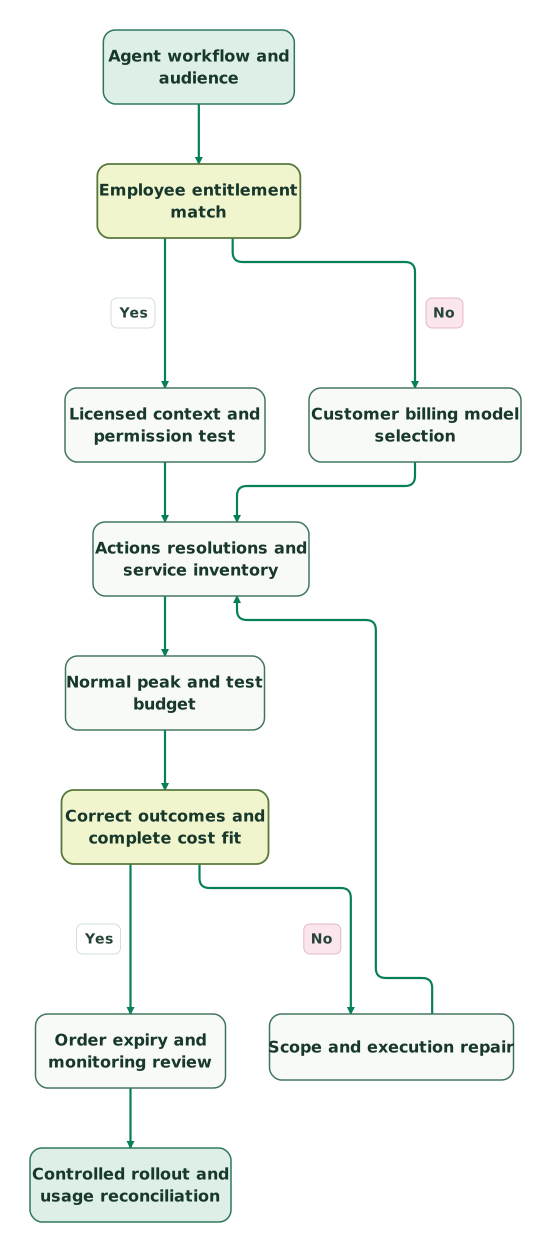
Read diagram as text
- Agent workflow and audience to Employee entitlement match.
- Employee entitlement match to Licensed context and permission test: Yes.
- Employee entitlement match to Customer billing model selection: No.
- Licensed context and permission test to Actions resolutions and service inventory.
- Customer billing model selection to Actions resolutions and service inventory.
- Actions resolutions and service inventory to Normal peak and test budget.
- Normal peak and test budget to Correct outcomes and complete cost fit.
- Correct outcomes and complete cost fit to Scope and execution repair: No.
- Scope and execution repair to Actions resolutions and service inventory.
- Correct outcomes and complete cost fit to Order expiry and monitoring review: Yes.
- Order expiry and monitoring review to Controlled rollout and usage reconciliation
Checklist
- Each workflow has an agent type, audience and applicable billing model.
- User access and base Salesforce requirements are priced separately.
- Included org-level credits and add-ons are counted once.
- The pilot records actual usage types and correct business outcomes.
- Resolution bundles, Voice priority and unmetered conditions are respected.
- Sandbox, peak demand and other services appear in the estimate.
- Commitment, expiry, invoicing and exhaustion terms are understood.
- Permission, escalation and usage controls have continuing owners.
Use the CRM audit skill to assemble permissions and data dependencies. The Salesforce implementation checklist supports release acceptance, and our AI-agent implementation guidance covers the broader operating design. Request an Agentforce and CRM scope around the specific task the agent must complete.
Keep reading
 CRM & Lifecycle
Salesforce pricing: cost per user for every edition and the full bill
Salesforce lists $0 to $550 per user per month. See what Starter, Pro, Core, Advanced and Max include, plus add-ons, renewal terms and worked budgets.
Jafrin Akter AloLast updated 16 min read
 CRM & Lifecycle
Salesforce Implementation Checklist: From Scope to a Working Release
Plan a Salesforce rollout with owners, migration rehearsals, permissions, integration tests, UAT, cutover and recovery gates before approving the release.
Jafrin Akter AloLast updated 14 min read
 Martech AI
AI agents for marketing: what to automate, what to review and where to start
Choose marketing AI agents by the work they can reliably finish. Compare workflow types, estimate review costs and design a pilot with measurable outcomes.
Jafrin Akter AloLast updated 13 min read
AI readiness score
Check your tracking, data, context and access before connecting an agent.
Questions people ask
Does one Agentforce chat message always consume twenty Flex Credits?
No. Twenty credits is the listed production multiplier for a standard or custom action. One message can cause several actions, while some activity follows another meter or a product-specific entitlement. Trace the complete workflow and inspect its usage types before forecasting cost from message count. Include the selected product's bundling rules so the estimate neither misses charges nor counts included work twice.
Can an unmetered employee licence cover scheduled company-wide Agentforce jobs?
An employee licence does not establish unmetered treatment for every execution context. Salesforce's conditions include the appropriate user permissions and execution as the entitled current user; scheduled and automated-process work can remain metered. Validate the actual usage record for the implementation, and account separately for underlying services that still consume credits. Unmetered conditions.
Should Help Agent resolution costs include every action again?
A resolved Help Agent session bundles its relevant agent actions and Data 360 queries under the documented resolution arrangement. Adding those same operations again at ordinary action rates can overstate the bill. Confirm the deployed licence and session qualification, and price activity outside that bundled scope according to its actual usage type. Resolution billing.
Are the Flex Credits included with Max multiplied by each user?
The pricing page states 2.75 million Flex Credits per organization per year for the listed Max offer. That amount is not described as a separate allowance for each seat. Read the order for the exact entitlement and allocation period, then compare the shared pool with all eligible workloads before estimating any additional purchase. Max offer.
Can Salesforce Foundations replace the full cost of an Agentforce deployment?
Foundations supplies eligible included capabilities and a restricted starting credit allocation within a compatible organization. The deployment can still need base subscriptions, additional usage, channels, data services and implementation. Confirm eligibility and the actual order, then model the normal operating bill after temporary or included capacity is used. A zero-dollar starting SKU alone does not describe the complete service.
Sources
- Agentforce official pricing and buying models
- Current Flex Credits rate card
- Flex Credits billable usage definitions
- Agentforce Conversations measurement
- Help Agent billing and session rules
- Agentforce metering conditions
- Unmetered licence permission configuration
- Salesforce Foundations
- Salesforce Sales subscription pricing
- Digital Wallet

Written by
Jafrin Akter AloData Engineer and Co-founder at Martechdevs and Growth and Analytics Partners
Jafrin writes practical guides to marketing technology, customer data, analytics and AI workflows. Martechdevs is a Growth and Analytics Partners company.