
Salesforce pricing for small teams in 2026: seats, AI and the renewal bill
Data Engineer and Co-founder, martechdevs
Last updated 9 min read
Salesforce's current US sales pricing starts at $25 per user per month for Starter Suite and $100 for Pro Suite. Core, Advanced and Max list at $195, $395 and $550 respectively, billed annually. The useful budget includes the seats people actually need, required integrations, marketing products, implementation and contract terms. A discounted first-year licence price does not establish the cost of operating or renewing the system.
Last updated: 6 October 2026. Public USD list prices before taxes; contract discussion checked against Salesforce's September 2026 Main Services Agreement.
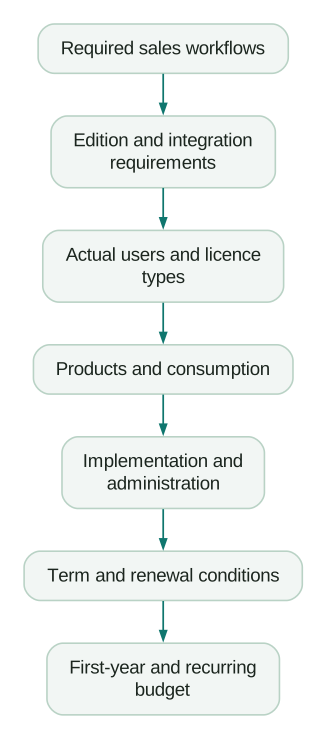
A company can buy a CRM for five sellers and later discover that the chosen integration, automation or reporting requirement changes the necessary edition. Identify those requirements before the discount conversation so the quote describes a system the team can actually use.
Which Salesforce plans should a small team compare?
Start with the current Salesforce sales pricing and the actual workflows you need. Starter is listed at $25 per user per month with monthly or annual billing; Pro is $100 billed annually. Core is $195, Advanced $395 and Max $550, each billed annually. A Free Suite is also listed for evaluating basic needs.
The price ladder does not define the right plan for a company size. A small team with specialised integration requirements may need more capability than a larger team with a simple sales process.
Martechdevs' CRM and lifecycle service connects the sales process to product and billing data. The HubSpot versus Salesforce guide helps decide whether Salesforce's operating model fits before you optimise its licence cost.
When is Starter enough, and when does Pro matter?
Starter is worth evaluating when the team needs basic account, contact, lead and opportunity management with a relatively simple process. Pro adds more customisation, automation, quoting and access to the app ecosystem described in Salesforce's small-business comparison.
Write the process as concrete tasks. Can a seller qualify a lead, associate the right account, manage the opportunity, produce the required quote and hand the customer to onboarding? Can the chosen billing or product-data integration work under that edition?
Check API access explicitly. The sales comparison lists Web Services API for Pro as an additional $25 per user per month. Confirm the required licensing scope in the order form rather than assuming a connector's existence means the base plan includes every prerequisite.
The API question can change the economics. At the published per-user amounts, Pro plus that add-on is a $125 monthly reference point per applicable user, before other features. Compare the complete requirement with the next edition's quoted package.
What are Core, Advanced and Max?
These are the current higher sales-edition labels on Salesforce's public pricing page. Their bundles include different sales, AI, collaboration, analytics and security capabilities. Use the current comparison and order form rather than mapping an old edition name to a new price by assumption.
For a small team, evaluate the specific capability that requires the upgrade. Advanced forecasting, permissions, a supported integration or a security requirement can justify a higher tier. A feature that nobody will configure or use does not become valuable because it is bundled.
Ask for a line-by-line entitlement summary when replacing existing contracts. Include which Slack, Tableau, support and AI rights are included, which users receive them and which consumption remains separately metered. A familiar product name inside a bundle may not equal your existing standalone purchase.
What might a 10-, 25- or 50-person company pay?
The following scenarios use illustrative seat needs and public list prices. They are not average customer spending and do not assume every employee needs a paid sales seat.
Ten employees, four Starter users
Assume the founder, two sellers and one operator need the selected CRM capabilities. Four users at $25 cost $100 a month, or $1,200 over twelve months at unchanged pricing.
If those four users need Pro, the licence equivalent becomes $400 a month or $4,800 annually. If the quoted configuration also requires the $25 API add-on for all four, add $100 a month, producing $6,000 annually.
That difference makes the integration specification important before purchase. A founder comparing only $25 and $100 can miss the actual capability required by a product-data sync.
Twenty-five employees, ten Pro users
Ten Pro users produce a $1,000 monthly equivalent and a $12,000 annual licence commitment. With the API add-on applied to all ten in this example, the reference becomes $1,250 a month equivalent and $15,000 annually.
Ten Core users at $195 would be $1,950 a month equivalent, or $23,400 annually. The difference is $8,400 a year against the stated Pro-plus-API scenario. Evaluate the capabilities that would earn that difference rather than choosing by the edition's label.
Fifty employees, twenty Core users
Twenty Core users produce a $3,900 monthly equivalent and $46,800 annually. At Advanced list pricing, the same seat count is $7,900 a month equivalent and $94,800 annually. At Max, it is $11,000 and $132,000 respectively.
These are licence calculations. They exclude marketing automation, third-party apps, separate consumption, implementation and ongoing administration. A negotiated discount changes the price, but the team still needs a plan for those other costs.
Is marketing automation included in the sales price?
Starter and Pro include some marketing capabilities, but a sales licence is not a universal entitlement to every Salesforce marketing product. Match the required journeys, contacts, channels and reporting to the actual product configuration.
Salesforce's current Account Engagement pricing lists Growth+ from $1,250 per organisation per month, billed annually. It also lists additional contact capacity and channel-related extras. Confirm the exact package instead of treating “Marketing Cloud” as one interchangeable product.
In the illustrative ten-Core-user scenario above, adding a $1,250 monthly Account Engagement package increases the annual software reference from $23,400 to $38,400. That is before implementation and any extras, and assumes the quoted products are compatible with the intended configuration.
If the team mainly needs event-driven product onboarding, compare the appropriate lifecycle tool as a separate option. The Braze versus Customer.io guide explains the workflow questions behind that choice.
How should you budget for Agentforce and AI?
Separate included capabilities from consumption and additional user entitlements. Salesforce's Agentforce pricing page offers several models, including Flex Credits, conversation pricing and employee-facing licences. One AI-related item on a sales plan does not make every agent action unmetered.
The public Flex Credit reference is $500 per 100,000 credits. The same page currently lists standard Agentforce actions at twenty credits, which implies $0.10 per such action at that rate. Other actions, models and services can have different consumption.
For an original planning example, assume 3,000 monthly workflows each use four of those standard actions. That is 12,000 actions, or 240,000 credits, with a $1,200 rate-based consumption equivalent before included allowances, purchase packaging or other services.
Pilot the actual workflow and inspect consumption. A task that appears to be one user request may perform several actions. Count retries, data preparation and any separately billed services when deciding whether the workflow is economical.
What do the contract terms do to the bill?
Salesforce's September 2026 Main Services Agreement, sections 5.1 and 11.2, generally bases fees on purchased subscriptions, prevents quantity reductions during the term and provides annual automatic renewal unless the order form says otherwise. It specifies at least thirty days' written non-renewal notice, promotional renewal at then-current list price unless otherwise provided, and repricing when renewal volume or term length decreases.
Your executed agreement and order form govern the purchase. Put the applicable renewal, notice and pricing terms into the commercial record before signing. A public guide can identify the questions; it cannot replace the actual negotiated document.
For planning, start the internal review sixty to ninety days before the notice deadline. That leaves time to assess usage, compare alternatives and get a written renewal proposal. An internal reminder is not itself valid notice to the vendor.
Can fewer seats still produce a disappointing renewal?
Yes, if the remaining seats are repriced or required products change. Compare the total renewed commitment and entitlements rather than multiplying the new seat count by last year's discounted unit price.
Consider an illustrative contract with twenty seats at a negotiated $150 per seat per month. Its annual licence cost is $36,000. If the next proposal offers fifteen seats at $195, the annual cost becomes $35,100. Removing a quarter of the seats saves only $900 because the assumed unit price rises.
This is a negotiation example, not a prediction of Salesforce's offer. It shows why the renewal worksheet needs quantity, unit price, term and product scope together. Ask for any agreed renewal protections to be written into the applicable document.
How much should you allow for implementation and administration?
Estimate from the work: account and contact model, data migration, permissions, pipeline, integrations, automation, reports, training and handover. A simple configuration and a multi-system revenue process require different effort.
For an original budget example, assume $8,000 of implementation, ten Pro users at $12,000 annually, a $1,200 annual integration subscription and four monthly administration hours at $90. The first-year total is $25,520 before taxes and other add-ons. The recurring annual reference after implementation is $17,520.
If API access or another product is required, add it. If internal staff perform the implementation, include their capacity cost rather than treating it as free. Keep one-time work separate from recurring work so the second-year comparison is meaningful.
How can a small team reduce Salesforce cost?
Buy for the roles and workflows you need now, with a deliberate expansion path. Avoid purchasing future seats simply because a discount is presented against a larger quantity. Calculate the total commitment at both quantities.
Use included capabilities when they fit, and remove overlapping subscriptions only after verifying replacement workflows. Check installed apps and their actual users at renewal. Keep automation and fields maintainable so administrative effort does not quietly become the largest avoidable cost.
For startup benefits, ask Salesforce and any relevant investor or partner programme about current eligibility and written terms. Do not put an unverified programme name or assumed discount into the budget. Compare the post-discount renewal year before choosing a platform around an introductory offer.
The stack audit guide provides an inventory and contract-review template that works across CRM, marketing and data tools.
A checklist before approving the quote
- Document the sales and customer workflows the CRM must support.
- Verify required APIs, connectors, automation and reporting features.
- Count users by actual role and applicable licence type.
- Separate sales licences, marketing products, apps and AI consumption.
- Record included quantities and any overage or add-on rates.
- Include migration, implementation, training and administration.
- Read the executed terms for reductions, renewal and notice.
- Compare renewal totals at realistic future seat counts.
- Confirm any startup or partner benefit in writing.
- Assign an owner and a review date before the notice deadline.
At Martechdevs, we connect CRM, product and billing data to the customer workflows your team needs to run. Start with the free martech AI audit, or explore an AI assistant built around your approved workflows.
Questions people ask
Can Salesforce cost only $25 a month for a small business?
The listed Starter price is per user per month. Multiply by the users who need it, then add any required products or operating work. Confirm that Starter supports the intended workflow before relying on that price.
Does Pro include unrestricted API access in its base price?
The current sales comparison lists Web Services API as an additional $25 per user per month for Pro. Confirm the exact licensing requirement and scope in your quote. A third-party integration may have its own subscription too.
Can we reduce seats in the middle of the contract?
The standard MSA generally prevents purchased quantities from decreasing during the subscription term unless the applicable agreement provides otherwise. Check the executed order form before forecasting an immediate saving. Removing a user and reducing a commercial commitment are different actions.
Should we buy Max because it includes more AI?
Model the actual licensed users, included capabilities and expected consumption. Compare that total with the lower edition plus the specific AI entitlement required. A pilot with observed usage gives a better answer than the size of the feature list.
What is the best way to avoid a renewal surprise?
Keep the applicable notice deadline, current entitlement list and renewal pricing provisions in one owned record. Review real usage early and obtain a written proposal for the quantities you intend to keep. Make any required notice through the contract's specified process.
Sources
- Salesforce, Sales pricing, checked October 2026.
- Salesforce, Small-business pricing, checked October 2026.
- Salesforce, Account Engagement pricing, checked October 2026.
- Salesforce, Agentforce pricing, checked October 2026.
- Salesforce, Main Services Agreement, 1 September 2026, sections 5.1 and 11.2.
Written by
Jafrin Akter AloData Engineer and Co-founder, martechdevs
Jafrin Akter Alo is a data engineer and co-founder of martechdevs, where the team has delivered 74+ martech, data and growth stack implementations.