
Braze AI: what Decisioning Studio, Predictive Churn and Operator each decide
Braze AI covers several different jobs: helping marketers build campaigns, reasoning over a customer's context, predicting behaviour and learning which action performs better. Decisioning Studio Go personalizes recurring email for clicks; Pro can optimize a wider business objective. Choose the decision first, then test whether improving its target also improves customer outcomes and contribution.
On this page
A lifecycle team can personalize effectively and still send the wrong offer. A model may find somebody likely to click while the discount gives away margin to somebody who would have purchased anyway. Accurate churn prediction is also insufficient when the real problem is a broken onboarding step that no email can repair.
Start with the decision an experienced marketer would make repeatedly. Which eligible customer needs help? What useful action is available? What result would justify its cost? If identity, consent and purchase records disagree, CRM and lifecycle implementation belongs in the project before automated decisions reach more people.
What does each BrazeAI feature actually decide?
The main distinction is between assistance that reasons over supplied context and systems that learn from measured behaviour. When you evaluate Braze AI personalization, separate the features that choose something for each customer, such as a send time, channel, item or offer, from those that help your team build campaigns or pick one winner for the whole audience. A convincing explanation from a large language model (LLM) is not evidence that a decision improved retention. Braze's feature overview separates those functions.
Dashboard assistance and user-level reasoning
Operator helps build, review and analyse campaigns and Canvases. Copy, images, Liquid and HTML assistance sit here. It uses existing dashboard permissions. Default action review asks you to approve proposed changes; mandatory-review actions remain subject to approval even when other actions are auto-approved. Review the actual change, not just the assistant's explanation. Operator action review
Braze Agents, configured in Agent Console, run inside Canvas steps or catalog fields. They reason over the context you explicitly supply; they do not search profiles for missing context or learn automatically from outcomes. Runs require Message or Action Credits. Define a usable fallback for missing inputs, invalid output, timeout and exhausted capacity before connecting generated output to delivery. Braze Agents
The Braze Model Context Protocol (MCP) server makes permitted Braze data available to compatible AI clients without personally identifiable information (PII). It is an access layer, not a churn model or decisioning engine. See Braze MCP server permissions before connecting an external assistant.
A useful boundary is: Operator assists your team while building; a deployed Agent can affect each customer's workflow. Those need different tests and approval policies.
Predictions, timing and recommendations
| Feature | Output | What the team must still decide |
|---|---|---|
| Predictive Churn | Risk score for your churn definition | Which avoidable problem an intervention addresses |
| Predictive Events | Likelihood score for a selected action | Whether the proposed message causes additional action |
| Intelligent Timing | Send-time selection using engagement history | Whether the message and fallback schedule are useful |
| Intelligent Channel filter | Channel ranking using engagement history | Which permitted channels the journey may use |
| Item recommendations | Catalog selections using the chosen recommendation method | Product eligibility, availability and fulfilment |
Predictive Churn and Predictive Events score likelihood from 0 to 100. Neither score demonstrates that a treatment will change the person's outcome. Use a churn prevention workflow that earns its cost to connect prediction to a testable intervention.
Intelligent Timing includes fallback behaviour for insufficient history, with differences between campaign and Canvas scheduling. Inspect that fallback population separately: a programme dominated by new users may largely be comparing default schedules. The overview requires engagement across at least two supported channels and three messages per channel for the Intelligent Channel filter.
Item recommendations include rules-based and AI options. Keep the catalog selection separate from generated copy: writing persuasively about an unavailable product does not make it an eligible recommendation.
Population optimisation and individual decisioning
Optimize with BrazeAI shifts campaign traffic toward a winning variant; Winning Paths does that for Canvas paths. Content Optimizer learns which combinations work across the audience. Decisioning Studio instead chooses for individual recipients.
The overview still labels Content Optimizer beta, covering email, push, SMS, MMS and RCS. Its detailed page separates optional AI-generated variant suggestions from Braze's bandit traffic allocation, and lists one active step per workspace on the feature's Free plan versus unlimited steps on its Pro plan. These are feature plan labels, not a free Braze platform subscription. Content Optimizer
The practical distinction is the question being answered. “Which subject line generally wins?” differs from “Which approved option should this person receive?” A team can use both without treating either as proof of incremental revenue.
Should you use Decisioning Studio Go or Pro?
Use Go for an eligible recurring email programme whose immediate objective is engagement; scope Pro when the decision requires other channels, offers or a custom business outcome.
Capability summary; these are product boundaries, not promises of performance.
| Decision requirement | Go | Pro |
|---|---|---|
| Delivery scope | Multiple channels | |
| Optimisation objective | Unique customers clicking daily | Configured business metric, such as revenue or conversions |
| Learning inputs | Audience, email engagement and configured creatives | Connected first-party data and custom business signals |
| Action choices | Approved content and send timing | Can include offers, products, channels and frequency |
| Setup responsibility | Self-service configuration | Scoped implementation with AI Decisioning Services |
Braze describes Pro as formerly OfferFit by Braze and documents the Go/Pro scope in its Decisioning Studio guide. A broader objective creates a broader data and measurement obligation; it does not make the implementation automatically better.
Go does not choose between send frequencies. You set one frequency, and it selects permitted days and times within it. It does not learn from custom attributes or warehouse data. It chooses among content you configure rather than writing email copy. Connected Content can render and send, but Go does not learn from what that call returns. Its configured quiet hours are not a hard delivery block; use workspace-level quiet hours for that requirement. Go FAQ
Best fit for Go: a recurring newsletter with several valid creative choices, enough eligible audience and a clear plan to evaluate downstream outcomes.
Best fit for Pro: a retention programme where offer cost, purchase behaviour and multiple channels change which action is worthwhile, and the team can maintain those inputs.
Stay with rules or a focused test: an onboarding reminder whose correct action follows directly from a missing setup step. Adding a probabilistic decision does not improve a rule that already expresses the customer need precisely.
Which platforms compete with Braze AI Decisioning Studio?
Hightouch AI Decisioning, CleverTap Decisioning Agents, Adobe Journey Optimizer and Pega Customer Decision Hub are relevant alternatives for different decisioning jobs. Compare the action being selected, the learning signal and the execution system. Replacing a decision engine can be a much smaller project than replacing every messaging channel.
| Platform | Useful comparison with Braze | First question to settle |
|---|---|---|
| Hightouch | Outcome-driven selections using your data models | Can the existing delivery system stay in place? |
| CleverTap | Individual lifecycle and campaign decisions | Are the required decisioning agents in the proposed package? |
| Adobe Journey Optimizer | Offer optimization inside Adobe's customer-data architecture | Do you need one overall ranking or one per customer? |
| Pega Customer Decision Hub | Shared next-best-action strategy across channels | Who will own the action catalogue and decision policy? |
The right comparison also includes your current rules and experiments. If a failed payment has one appropriate reminder and a clear exit event, a dependable rule may solve the job with less operating cost. Broader Braze platform alternatives become relevant when the delivery system itself is the problem.
How does Decisioning Studio compare with Hightouch, including time to value?
Braze Go offers a self-service setup path when your email audience and approved creatives already live in Braze. Pro and Hightouch need a scoped data and delivery design. Judge time to value by the first trustworthy business-outcome comparison, rather than the date an agent is switched on or a demo sends a message.
Go's self-service email setup avoids a custom warehouse integration for that narrow task. Hightouch requires customer, related and event models, then a delivery connection. Its Braze integration can reuse existing campaigns and Canvases. Pro's setup stages are covered below.
Use three dates in the project plan: first accepted data, first controlled delivery and first complete outcome window. This prevents a fast technical connection from being mistaken for proven commercial value.
| Milestone | Exit criterion | Common delay to resolve |
|---|---|---|
| Inputs accepted | Identity, consent and outcome records reconcile | Missing join keys or unclear ownership |
| Delivery accepted | Each approved variant reaches the right test recipient | Template variables, permissions or competing journeys |
| Experiment starts | Stable assignments and business-as-usual policy recorded | Changing both content quality and selection policy |
| Value assessed | Outcome window and late corrections have matured | Low conversion volume or delayed refunds |
For a hypothetical 30-day repeat-purchase metric, the first cohort cannot supply a complete 30-day result after one week. Add the actual reporting lag and the time required to enroll enough eligible people. A quote promising a fixed launch week should name which milestone it covers and who owns each prerequisite.
When should you choose an alternative to Decisioning Studio?
Choose an external decisioning layer when it solves a specific requirement around your shared data, action ownership or delivery systems. Keep the native route when it meets the required decision and is easier to operate. Use rules or an ordinary experiment when the available actions, consent or outcome data cannot yet support adaptive selection.
Before switching, give both candidates the same acceptance record: eligible customer, permitted actions, decision time, chosen action, delivery result and final economic outcome. Include the customer's later opt-out and a failed delivery. The AI decisioning comparison helps turn that evidence into a bounded platform choice.
Does Decisioning Studio beat manual segmentation and A/B testing?
It can answer a more granular decision, but no public feature description proves it will outperform your current programme. Demonstrate that with a fair comparison against the actual programme, using a complete downstream outcome window.
Choose the comparison before launching:
| Comparison | Question answered | What a positive result does not establish |
|---|---|---|
| Personalised selection versus random approved choices | Does the learned selection improve on random choice? | That it beats your existing segmentation |
| New programme versus business as usual | Is the replacement better than what you do today? | That every message creates value versus silence |
| Messaging versus eligible no-message holdout | What does the programme add beyond natural activity? | Which internal decision caused that difference |
Go's random control still receives email. Its minimum is 5%; Braze recommends the following splits. These vendor defaults do not replace a power calculation for your downstream metric. Go FAQ
Audience counts and percentages. Range boundaries are reproduced as published; confirm allocation at a shared boundary.
| Published audience range | Decisioning allocation | Random control |
|---|---|---|
| 20,000 to 100,000 | 80% | 20% |
| 100,000 to 1,000,000 | 90% | 10% |
| 1,000,000 to 40,000,000 | 95% | 5% |
How should you build the business-as-usual comparison?
Use Experiment Paths or random buckets to separate BAU from the Go audience. Braze says the decisioning group must retain at least 20,000 users after the split and random-control allocation. Match frequency, creative availability and click definitions, keep BAU stable and wait for Fully trained before interpreting its comparison. Measuring Go
For an illustrative 60,000-person eligible audience, a 50/50 BAU/Go split leaves 30,000 in Go. An 80/20 split inside that arm leaves 24,000 decisioning recipients and 6,000 random-control recipients. That clears the documented audience condition; it does not establish enough purchases to detect your minimum worthwhile commercial effect.
Keep a dedicated segment and track overlapping communications. If another programme sends an offer to only one arm, the result no longer cleanly answers your original decision question.
What should you export for independent measurement?
Go writes ds_go_agent_id, ds_go_agent_regime and ds_go_rec_id into message_extras on users.messages.email.Send. Ensure the export retains them; join sends to engagement using user_id and dispatch_id. Braze recommends ending the reporting window two days before today because reporting lags about a day. Measurement fields and delay
Preserve a separate assignment table for every eligible randomized person, including people who never receive or click a message. A send-only join cannot provide the full assigned denominator. Join orders through your customer identity crosswalk, deduplicate order IDs, and apply the same refund maturity window to all arms.
Pro supports separately designed comparison groups, including random control, BAU and holdout. Its reporting definitions are configured around the use case, and full-period business metric values need not equal an average of daily chart values. Agree the calculation before interpreting the dashboard. Pro performance reporting
How do you define a decision worth automating?
Define the eligible population, decision moment, allowed actions, outcome and constraints before choosing the configuration.
Eligible population: Describe who may enter and who must remain out. “Customers with no completed second order” is incomplete without time since first order, consent, delivery status, refunds and existing service issues.
Decision moment: State when the choice occurs. A weekly replenishment decision has different freshness requirements from a message immediately after a failed payment.
Allowed actions: Enumerate the choices the program can actually fulfill. Education, a relevant product recommendation, a service reminder and no message can be conceptually useful alternatives. Confirm which actions the selected product and configuration support; do not assume every interface exposes a no-send option.
Outcome: Define the event, measurement window and economic value. A click can be an intermediate signal, while repeat purchase margin over a complete window is the business outcome.
Constraints: Identify what the program must respect, including contact pressure, inventory, offer eligibility and service exceptions. These rules need an operational owner when the source data changes.
Use this decision brief to identify the key customer journey before expanding into multiple programs. A narrow decision with a clear alternative is easier to measure than a broad promise to personalize the entire lifecycle.
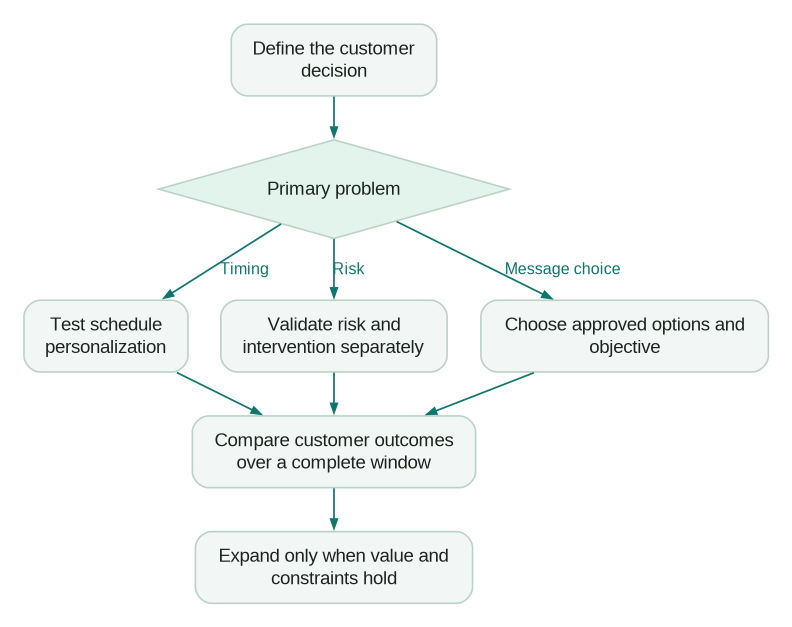
Read diagram as text
- Define the customer decision to Primary problem.
- Primary problem to Test schedule personalization: Timing.
- Primary problem to Validate risk and intervention separately: Risk.
- Primary problem to Choose approved options and objective: Message choice.
- Test schedule personalization to Compare customer outcomes over a complete window.
- Validate risk and intervention separately to Compare customer outcomes over a complete window.
- Choose approved options and objective to Compare customer outcomes over a complete window.
- Compare customer outcomes over a complete window to Expand only when value and constraints hold
What data makes the decision better?
For Pro or an explicitly configured Agent, add a feature because it distinguishes useful actions. Go does not consume these custom features. A general engagement score may describe the customer while offering little help in choosing between a setup tutorial and a replenishment message.
For the former, completed setup steps and the last successful workflow may matter. For the latter, the last product purchased, quantity, expected consumption period and a recent return may matter. These are recommendations for designing your use case, not guaranteed feature requirements of every Braze AI product.
Braze's Decisioning Studio Pro guidance emphasizes customer-level features, coverage and freshness. It recommends scheduled refreshes for features whose values change with time. Feature preparation guidance
That distinction matters for inactivity. If days_since_last_order updates only when an order occurs, an inactive customer's value can remain frozen while the person becomes progressively more overdue. A scheduled calculation can express elapsed time correctly. Keep a separate timestamp showing when the value was calculated so the receiving workflow can distinguish a current value from a stale delivery.
Use a small feature contract for every important input:
- Business definition and unit, including whether revenue excludes refunds.
- Customer identity key and treatment of merged profiles.
- Calculation window and timezone.
- Source event or system of record.
- Refresh cadence, expected delivery delay and expiry behavior.
- Meaning of zero, null and unavailable.
A missing order history must not silently become zero orders. That conversion can turn a customer whose data failed to arrive into a first-time-buyer campaign recipient. A conservative fallback is easier to operate when the system preserves the difference.
What does Decisioning Studio Pro ask of your team?
It asks for an operating integration, not just an AI feature toggle. Braze describes four stages: agent design, data preparation, audience definition and orchestration. Delivery can use API-triggered Canvases or campaigns. Its Services team gives design guidance; your team owns technical implementation, with an implementation partner an option. Pro setup
Use the following responsibility map as a proposed project design, not as a statement that Braze supplies every task.
| Workstream | Accountable team | Acceptance evidence |
|---|---|---|
| Objective and eligible actions | Lifecycle lead with finance or product | Valid offer menu, explicit exclusions and agreed economic metric |
| Identity and feature refresh | Data engineering | Traceable customer record with timestamps and missing-data behaviour |
| Delivery integration | Application and lifecycle engineering | One recommendation produces the intended tested action |
| Experiment and reporting | Analytics | Assignment, exposure and outcomes reconcile by customer |
| Ongoing operation | Named lifecycle owner | Expired offers removed, failures investigated and pause route tested |
Before launch, follow one test customer through each boundary. Inspect the feature value that arrived, the decision identifier, the delivery request and the eventual outcome record. A successful recommendation request is not proof that a campaign delivered, and delivery is not proof of a beneficial outcome.
How can an apparently better campaign reduce value?
A policy can increase orders while lowering contribution. Consider this hypothetical experiment: 1,000 eligible customers are randomly split equally between a new offer policy and the existing policy, with the same outcome window.
Illustrative USD contribution after discounts and variable order costs; not Braze performance data. Each arm has 500 assigned customers, and this example assumes one order per purchaser.
| Policy | Orders | Order rate | Contribution per order | Contribution per assigned customer |
|---|---|---|---|---|
| New offer | 130 | 26% | USD 25 | USD 6.50 |
| Existing policy | 120 | 24% | USD 30 | USD 7.20 |
The new policy produces 2 percentage points more orders but USD 0.70 less contribution per assigned customer. Its total is 130 × USD 25 = USD 3,250, versus 120 × USD 30 = USD 3,600.
These totals are a point estimate, not proof of a stable effect. A real analysis needs uncertainty, sufficient outcome volume and complete observation windows. The example is deliberately smaller than Go's audience requirement: it explains economic arithmetic, not a deployable Go pilot.
If cost and refund data arrive later than purchase events, wait for both groups' outcomes to mature. Otherwise you may compare a complete control with a treatment whose apparent margin has not yet absorbed refunds.
How much does Braze AI cost?
There is no public dollar price that covers every BrazeAI workload. Braze's current pricing page lists Operator, Agent Console, Content Optimizer and Decisioning Studio Go among features across platform tiers, while explicitly placing Agent Console and Go in Action Credit consumption. Predictive AI is listed under the Braze Pro platform edition. Feature availability and usage cost are separate questions. Braze pricing
Predictive Churn's feature documentation still distinguishes purchased production access from a preview that cannot target users by risk or regularly refresh scores. Confirm that entitlement in the order form rather than assuming a preview proves production access. Predictive Churn access
Ask for the exact SKU and credit ratio per action, the allowance period, overage treatment, and whether delivery credits are charged alongside decisioning. For Pro, include implementation and ongoing data operations in the scope. The Braze Pro platform edition and Decisioning Studio Pro are different naming layers; do not infer one purchase includes the other.
Use how Action Credits enter a Braze quote for the broader contract model. For this pilot, forecast eligible decisions, expected invocations, delivery volume and failure handling separately. Agents can consume credits on timeouts, so an expensive failing integration is not automatically a zero-cost one. Agent limits and failures
What should the first production pilot include?
Start with one repeatable decision whose outcome can be observed within a practical window. Avoid simultaneously replacing the audience definition, offer strategy, creative library and measurement system. If all four move together, diagnosing an unexpected result becomes difficult.
For a recurring educational email pilot, create genuinely different options around different customer needs. Three subject lines promising the same generic content offer less useful choice than tutorials for three distinct incomplete tasks. Each variant still needs to fulfill its promise.
Resolve Braze identity and suppression problems before widening the audience. Use this launch checklist:
Checklist
- The chosen feature's documented optimization target matches the pilot description.
- Every creative and offer is valid for every customer who can receive it, or eligibility is enforced before selection.
- Missing data, stale data and insufficient history have explicit fallback behavior.
- A complete customer record can be traced from source input to eligibility and outcome.
- The control answers the stated business question, with contamination monitored.
- Reporting includes contribution or another downstream outcome, plus contact-pressure guardrails.
- The team knows when to pause, what existing program resumes and who checks customers already in flight.
A pause threshold should reflect operational harm as well as performance. Wrong inventory, stale consent or an invalid offer needs an immediate response. A noisy early click rate usually calls for investigation against the agreed analysis plan rather than reactive daily changes.
When should you expand beyond one decision?
Expand after the team can explain both the result and the running process. That means identifying who maintains source features, retires expired content, investigates delivery discrepancies and checks whether the objective still reflects business priorities.
Add the next decision where it shares useful infrastructure but has a clear outcome of its own. For example, a working feature refresh process may support a second lifecycle program, but its control and measurement window still need separate design.
If comparing Braze with Customer.io, carry the same customer decision and acceptance cases into both products. That is more useful than counting AI feature names.
If the remaining choice is between a native Braze workflow and an external decisioning layer, use the AI decisioning comparison to evaluate where data, action selection and execution should live. If the job extends beyond lifecycle messaging, assess whether to build or buy a martech AI agent. The useful purchasing question is which arrangement makes the next decision reliable, measurable and maintainable.
For help identifying a measurable first use case, start with the free AI readiness checklist. For a defined lifecycle implementation, request a detailed Braze implementation scope with your decision brief, audience volume and source-data map.
Keep reading
 CRM & Lifecycle
Responsys to Braze Migration: Move Data, Rebuild Journeys and Cut Over Safely
Plan a Responsys to Braze migration with Connect exports, permission mapping, import checks, Canvas rebuilds, IP warming and a controlled cutover.
Jafrin Akter AloLast updated 14 min read
 CRM & Lifecycle
Braze to Customer.io migration: preserve preferences, journeys and delivery
Migrate from Braze to Customer.io with verified exports, an identity crosswalk, preference mapping, push re-registration, a safe cutover and tool checks.
Jafrin Akter AloLast updated 17 min read
 CRM & Lifecycle
6 Braze Implementation Mistakes and How to Fix Them
Fix six Braze failure points: split profiles, hidden API errors, duplicate triggers, Canvas re-entry, stale eligibility and incorrect suppression.
Jafrin Akter AloLast updated 14 min read
AI readiness score
Check your tracking, data, context and access before connecting an agent.
Questions people ask
Is Decisioning Studio the same product as OfferFit?
Braze calls Decisioning Studio Pro “formerly OfferFit by Braze.” Go is the narrower self-service email product. When reviewing a proposal, name the exact tier, action scope and business metric rather than treating older OfferFit references as interchangeable with Go. Also distinguish Decisioning Studio Pro from the Braze Pro platform edition in the contract.
Is churn prediction enough to prevent churn?
No. A score identifies a pattern associated with leaving; it does not show that the proposed treatment changes that outcome. A failed payment needs a different response from an unresolved product defect. Test the intervention within eligible risk groups and include its cost, opt-outs and product outcomes before expanding a retention programme.
What is a sensible first Braze AI pilot?
Choose one recurring decision with reliable eligibility and a visible outcome. Timing may suit an otherwise useful message; Go may suit a large recurring email audience with worthwhile creative alternatives. Keep the existing programme available as a comparison, define a pause condition and assign somebody to investigate individual customer records when behaviour looks wrong.
Does Decisioning Studio Go write the email copy?
No. It chooses from the content options you configure. Dashboard drafting belongs to Operator; user-specific generated content can use Braze Agents. Separate creative production from selection during evaluation: if the treatment gets entirely new content while the control keeps weaker old content, the observed difference cannot isolate the benefit of learned selection.
How much data do we need?
Check the selected feature, not a universal AI threshold. Go's published control guidance ranges from 80/20 to 95/5, and its BAU test requires at least 20,000 decisioning users after allocations. That audience condition does not guarantee enough downstream conversions for your experiment. Forecast event frequency and required precision before choosing a split or observation window.
Sources
- BrazeAI feature overview.
- Braze: Operator action review.
- Braze Agents.
- Braze: Predictive Churn.
- Braze: Predictive Events.
- Braze: Intelligent Timing.
- Braze: Item recommendations.
- Braze: Content Optimizer.
- Braze: Decisioning Studio Go and Pro.
- Braze: Decisioning Studio Go FAQ.
- Braze: Measuring Decisioning Studio Go.
- Braze: Pro performance reporting.
- Braze: Pro feature preparation.
- Braze: Pro setup.
- Braze pricing.
- Hightouch: AI Decisioning overview
- Hightouch: Braze integration for AI Decisioning
- Hightouch: Prepare data for AI Decisioning
- CleverTap: Decisioning Agents
- Adobe: Journey Optimizer AI features
- Pega: Customer Decision Hub

Written by
Jafrin Akter AloData Engineer and Co-founder at Martechdevs and Growth and Analytics Partners
Jafrin writes practical guides to marketing technology, customer data, analytics and AI workflows. Martechdevs is a Growth and Analytics Partners company.