Agentic marketing operations: what AI agents can watch, check and fix in your martech stack
Data Engineer and Co-founder at Martechdevs and Growth and Analytics Partners
Last updated 16 min read
Agentic marketing operations uses AI to investigate and maintain the systems behind marketing: tracking, customer records, pipelines, campaign checks and metric definitions. A useful agent gathers evidence, follows your rules and produces a reviewable result. Its authority should depend on the action and the evidence, not on how convincing its explanation sounds.
Runtime and vendor capabilities were checked on this date. Claude Code routines remain a research preview; the operating model and worked example below are recommendations, not reported client results.
What makes marketing operations agentic?
An agentic workflow lets a model choose investigative steps within a defined job. A scheduled SQL test follows a fixed rule; an agent might read that test failure, inspect upstream runs, compare a release diff and decide what evidence to request next.
Anthropic's agent design guidance distinguishes predefined workflows from agents that dynamically direct their process and tools. That distinction is useful even as runtimes change: if a rule is already clear, deterministic code often remains the better way to enforce it.
The label also covers different jobs. Gradial uses agentic marketing operations for content and campaign execution, while Etumos discusses it through marketing operations systems and automation. Here, the focus is the stack itself: whether events, records, definitions and workflows still behave as intended.
Our custom martech AI agent service builds around those operating rules and evidence sources. If your immediate need is campaign analysis, content or sales preparation, start with AI agents for marketing work. Stack upkeep needs a different success test: a reproducible finding, a controlled change and proof of the resulting state.
A plain formatting rule does not become more useful because an LLM runs it. Use the model where interpreting several pieces of evidence is the expensive part; keep validation, permissions and release controls explicit.
How much authority should an operations agent have?
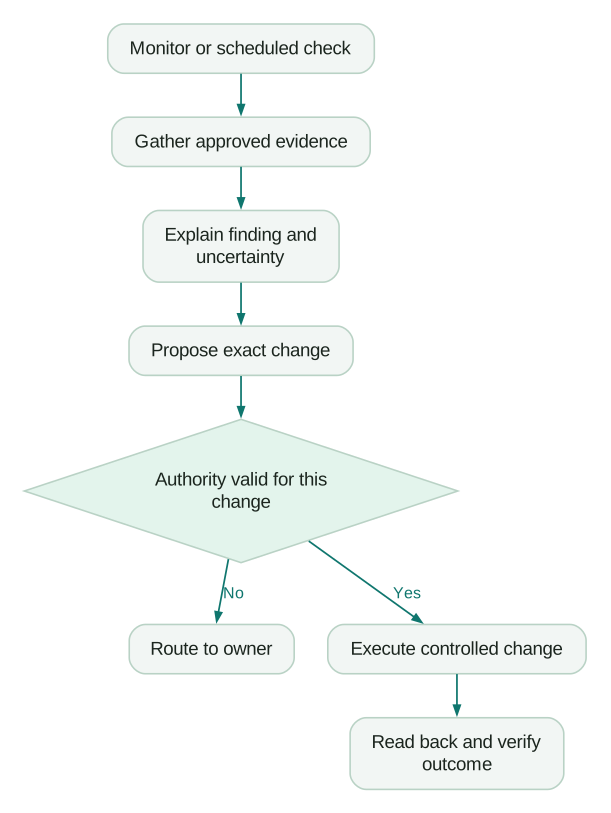
Give the agent only the authority required for the next useful result. Reading evidence, proposing a change and applying that change are separate permissions, even when one product offers all three.
This five-level model is a practical design framework, not an industry certification or a timetable every team must follow.
| Level | What the agent may do | Approval boundary | Evidence required before expanding scope |
|---|---|---|---|
| Observe | Read approved metrics, logs and configuration | No operational writes | Complete, timestamped observations with missing inputs identified |
| Explain | Investigate and rank plausible causes | Findings remain provisional | Correct distinctions between incidents, normal variation and unknowns |
| Propose | Draft a change, test or pull request | Proposal cannot deploy itself | Reviewable diff, affected objects, test plan and reversal path |
| Act with approval | Apply the exact reviewed change | Approval bound to revision and target | Execution receipt and independent readback match the approval |
| Bounded autonomy | Perform a narrow, pre-authorised operation | Enforced scope, limits and stop conditions | Replay evidence, reliable verification and a working recovery process |
A useful autonomous operation could be assigning an internal incident to the owner already listed in a maintained registry. Changing a revenue definition or merging customer identities is a different risk class. Both may be API calls, but they should not inherit the same authority.
OWASP's excessive-agency guidance identifies unnecessary functions, permissions and autonomy as separate problems. Enforce authority in the destination or execution layer. A prompt that says “ask before publishing” is not equivalent to a credential that cannot publish.
What earns promotion to the next level
Replay past incidents, quiet periods and deliberately seeded failures before adding authority. Check false escalations, unsupported conclusions, missing evidence and attempts to exceed scope. Include cases where two recent changes are plausible, and cases where the correct answer is “not enough access to decide.”
The agent evaluation guide owns the full test method. Promotion should follow evidence for a particular action class. A month of accurate summaries does not establish that the same agent can safely merge records.
Which seven upkeep jobs are useful today?
The most useful jobs reduce investigation and review effort around work your team already owns. Begin with an output someone can use, rather than an agent that is vaguely responsible for “growth.”
1. Watch tracking and pipeline state
Use existing monitors to detect freshness failures, schema violations and unexpected movements. An agent can assemble the resulting signals into a queue with affected reports and owners. It should not silently replace a deterministic test with its own opinion.
For example, Segment Protocols validates events against a tracking plan and supports controls and transformations; it is a premium Business Tier add-on. These are data-governance capabilities, not proof that a general agent diagnosed the business consequence of a violation.
2. Triage an alert into an evidenced finding
A good triage result distinguishes a late load from a tracking break, an actual change in customer behaviour and a reporting-definition change. Elementary's Triage and Resolution Agent can inspect commits, run history, lineage and permitted data, then propose a fix or pull request. Its availability does not mean the proposed fix has run.
The AI data-quality agent guide explains the investigation order, access boundaries and output format. This job is valuable when gathering evidence across tools takes longer than deciding what to do with it.
3. Check new tracking against the plan
Ask the agent to compare an implementation diff with approved event names, properties, entity IDs and consent behaviour. Return the exact mismatch and a reproducible browser test. Keep the browser test or schema check deterministic where possible.
Avo's MCP workflow gives agents tracking-plan context and puts proposed tracking changes on an Avo branch for review. That branch control is useful, but it does not prove your application emits the right event after release. Test the running journey separately.
4. Check campaign builds before launch
Have a reusable check read the campaign brief, destination links, UTM rules, audience exclusions and sample render. It should identify inconsistencies, such as a paid-customer exclusion missing from one audience, rather than rewrite the entire campaign unasked.
Use slash commands for repeatable marketing checks when a person triggers the review. Schedule only the parts whose inputs and escalation rules are stable. The content owner still approves the message and audience.
5. Review CRM hygiene and routing
A useful finding names the record, violated rule, evidence and proposed repair. Duplicate detection should produce a review queue before a merge queue. Routing checks should compare assignment with the written lead-routing rules, including exceptions and absent owners.
HubSpot's data-quality tools provide formatting and duplicate workflows. Automated formatting and duplicate-alert features have Data Hub Professional or Enterprise requirements, while other functions have different entitlements. The documentation also warns that a value corrected and then overwritten incorrectly may not be flagged again. A separate CRM hygiene review therefore needs to check what integrations keep rewriting.
6. Find documentation drift
Compare the tool inventory, owner registry and approved event definitions with recent changes. Produce a documentation diff with a source link for each proposed update. Do not let the agent “resolve” conflicting definitions by choosing whichever document is newest.
For a changed field, useful output is: old owner, current writer, evidence of the change and the person who must decide whether the documentation or implementation is wrong. That can prevent a future incident without granting any production write access.
7. Answer operational questions from governed metrics
An agent can answer “which accounts meet our expansion rule?” when the rule exists and the underlying query is authorised. It should return the definition, population, time window and computation time with the answer.
dbt's MCP documentation distinguishes remote consumption tools from self-hosted development capabilities; access to underlying Discovery and Semantic Layer APIs depends on plan. Inspect the actual exposed tools and permissions. Do not treat the name “MCP” as a promise of read-only access. Use a semantic layer and metric contracts to avoid letting the model invent the calculation.
Should you use a vendor agent, Claude or an internal service?
Use the option that can access enough evidence with the least operational burden. A vendor agent often has better context inside its own product; a custom agent earns its complexity when the investigation crosses systems.
Capabilities below were checked on 17 October 2026. Availability does not imply every plan includes every underlying data product.
| Option | Best fit | Access or operating limit | Pilot verdict |
|---|---|---|---|
| Agent inside an existing platform | Most evidence and action live in that platform | Its integrations and permissions bound what it can inspect | Test it before building the same investigation elsewhere |
| Claude Code cloud routine | Recurring repository and connected-tool work | Research preview; subscription and organisation controls apply | Use for reviewed findings when its runtime and access model fit |
| Claude Desktop scheduled task | Local files or tools on a maintained computer | App must be open and machine awake | Useful for an individual workflow, weaker as unattended team infrastructure |
| GitHub Actions with a controlled agent step | Evidence and proposed fixes belong in a repository | Team owns credentials, scheduling, dependencies and review gates | Useful when code review is already the release process |
| Internal service with narrow MCP tools | Several workflows need the same governed evidence | Team owns authentication, tool contracts, monitoring and upgrades | Build only when reusable access justifies the maintenance |
Start with the vendor that already has the evidence
Amplitude Specialized Agents analyse dashboards, replays and other product context. Its documentation requires human approval for actions affecting end users and says agents inherit account permissions. Setup guidance says agents are included across platform plans, but individual capabilities require the corresponding feature access. This is not a claim of unlimited usage or cross-stack visibility.
Databricks anomaly detection is still Public Preview. It monitors table freshness and completeness, and the current interface includes upstream root-cause pointers and impact information. Its freshness signal follows table commits; event-time freshness is not supported. A current table can therefore still contain delayed business events.
Verdict: choose native investigation when its evidence covers the problem. Choose a cross-system agent when you need, for example, GA4, the product database and a deployment diff in the same investigation. Use the build-or-buy guide for the longer procurement decision.
Understand what unattended Claude can access
Claude Code routines run on schedules, API calls or GitHub events and use fresh sessions. They are available on eligible Pro, Max, Team and Enterprise subscriptions, subject to organisational controls. Cloud schedules have a one-hour minimum. Remove unnecessary connectors: connected MCP tools are included by default and may write without an in-run prompt. A saved task is not live approval for a later action.
A green run status reports infrastructure completion, not task success. Read the transcript and check the promised artifact. Branch restrictions must also apply to the connected GitHub identity; bypass permissions can undermine an apparent review gate.
Desktop scheduled tasks can use local context and a shorter cadence, but depend on the machine and application being available. Do not give a local task a response-time promise your laptop cannot meet.
Keep the execution environment explicit
Headless Claude Code supports noninteractive runs. Without --bare, it can load repository hooks and MCP configuration without an interactive trust check. --bare removes automatic context loading, but it does not remove built-in tool powers or make credentials read-only; supply only the required context, tool permissions and credentials deliberately.
The CLI reference documents turn limits, structured output and a maximum-budget option. Its spend cap uses a client estimate and can be exceeded, so it is not an exact billing guarantee. Put infrastructure timeouts, concurrency limits and spend monitoring outside the model as well.
An internal MCP server can expose narrow operations such as “read the last completed load” instead of arbitrary warehouse SQL. The MCP overview explains the connection model. The server's tool contract and downstream permissions determine what it can do.
Which decisions should remain with a person?
People should own definitions, customer-impacting choices and acceptance of the evidence behind a consequential change. The agent can prepare those decisions without becoming their accountable owner.
| Decision | Useful agent contribution | Required human judgement |
|---|---|---|
| Change a paid, active or revenue definition | Show affected models and reports | Decide the business meaning and transition date |
| Merge customer records | Gather matching and conflicting attributes | Accept identity risk and recovery limits |
| Publish tracking or messaging changes | Prepare diff, fixtures and impact list | Approve the exact configuration and release |
| Change consent handling or customer contact | Explain current rules and proposed effect | Confirm permitted use and customer consequence |
| Increase budget or expand audience | Calculate scenarios and missing evidence | Accept financial exposure and experimental design |
| Close an incident | Collect readback and completed-window results | Decide whether evidence is sufficient and follow-up remains |
Use a martech RACI to assign that responsibility. Then bind approval to the exact change, including revision, destination, permitted operation and expiry. If the draft changes after approval, the old approval should not quietly apply to the new payload.
What would a useful nightly tracking agent actually do?
It would compare completed data windows, investigate a discrepancy and prepare a testable repair for the owner. It would not claim that opening a pull request fixed tracking or recovered revenue.
Consider a fictional 20-person SaaS team using a daily GitHub Actions job at 06:07 UTC. A deterministic pre-step queries GA4 with read access and reads completed signup counts from the product database. It saves a small, timestamped evidence file. The agent receives that file, the tracking plan, recent code changes and the owner map.
GitHub's scheduling documentation warns that scheduled runs can be delayed or dropped during high load and run from the default branch. Seven minutes past the hour avoids the busiest boundary; it does not create an SLA. A separate missed-run alert is still necessary.
Hypothetical daily counts use matching signup definitions, time zones and completed reporting windows. The baseline below is simplified to make the calculation visible.
| Evidence | Normal comparison day | Incident day | Interpretation |
|---|---|---|---|
| Backend completed signups | 122 | 121 | Aggregate business volume is similar |
| GA4 recorded signup events | 104 | 44 | Recorded coverage has changed |
| GA4-to-backend ratio | 85.2% | 36.4% | Investigate instrumentation and cohort mix |
| GA4 count expected at baseline ratio | 104.0 | 103.1 | Incident-day projection is about 59.1 above observed |
A similar backend total does not prove every acquisition channel or signup path is healthy. The agent breaks down authentication methods and consent states. In this scenario, Google sign-in behaves normally while the email path drops after a frontend refactor.
The agent finds a renamed custom event in the relevant diff and reproduces the mismatch in an isolated browser test. It checks the current published GTM version and compares saved configuration with the earlier version. Google's live-version endpoint supports read-only access. Merely finding a version header would not prove that version was published or unchanged during the incident.
The deliverable is a draft pull request restoring the agreed event on the email path, with a fixture for both authentication methods. The owner reviews the diff and tests before merging. GitHub branch protection can require reviews and checks; private-repository protection needs an eligible paid GitHub plan, and bypass permissions need explicit review.
After release, a fresh browser test confirms the event and properties. A later completed reporting window records 101 GA4 events against 119 backend signups, about 84.9%. That supports recovery toward the prior coverage ratio; it does not prove every path is fixed. Check the affected cohorts and duplicate-event rate before closing.
The estimated 59-event shortfall is a comparison against a baseline, not 59 lost customers. Do not multiply it across hypothetical future days and report “prevented losses” as an achieved result. Advertising impact also depends on which events are imported and how bidding uses them.
Price the review work as well as the model
Illustrative monthly budget in USD, prepared 17 October 2026: 30 runs, assumed API cost of USD 0.30 per run, five review minutes per run and an assumed reviewer rate of USD 75 per hour. These are planning inputs, not vendor prices or measured results.
| Cost component | Calculation | Monthly USD | Scope |
|---|---|---|---|
| Model usage | 30 × 0.30 | 9.00 | Assumed usage, replace with measured billing |
| Human review | 30 × 5 ÷ 60 × 75 | 187.50 | Two and a half hours of review |
| Subtotal | 9.00 + 187.50 | 196.50 | Excludes CI, storage, queries and maintenance |
If the agent generates long, low-confidence reports, reviewer time can dominate the bill. Track useful findings and time to a verified decision, not just inexpensive runs.
What makes these agents fail even when the run looks successful?
Most operational failures come from incomplete evidence, excessive access or treating a generated output as a verified result. Build controls around those specific failure paths.
A successful write can target the wrong account. Read the affected record back using its stable ID and compare it with the approved payload. A plausible cause can be the nearest recent change rather than the actual cause. Require a reproducible mechanism and list competing explanations.
Tool permissions also combine across the session. A read-only data tool plus unrestricted shell access and external network access can expose data through another path. The MCP maintainers explain that tool annotations are hints, not enforcement. Review the whole session with the MCP security checklist, not just the tool called “read.”
Logs, tickets and fetched pages can contain instructions the agent should not follow. Keep them labelled as evidence, constrain output destinations and enforce writes outside the model. A generic instruction to “ignore prompt injection” is insufficient as the only control.
Finally, missing data should produce “not checked,” not a reassuring conclusion. Trace each agent run with inputs, tool calls, limits, denials, output revision and verification. An empty finding list is only meaningful if the required checks actually ran.
How should a small team start over the next month?
Start with one recurring job and one owner, then decide whether the evidence justifies continued operation. This is a proposed four-week pilot, not a promised implementation timeline.
| Pilot stage | Concrete deliverable | Decision before continuing |
|---|---|---|
| Week 1 | One job contract, evidence sources, owner and forbidden actions | Can the job be done with existing deterministic checks alone? |
| Week 2 | Read-only replay against incidents and quiet periods | Does it find useful evidence without excessive false escalation? |
| Week 3 | Scheduled findings delivered to a limited review queue | Does it reduce time to a verified decision in ordinary work? |
| Week 4 | Cost, failure and review-time report | Keep, narrow, stop or add one tested action class |
Checklist
- The job has a named operator and a measurable output.
- Credentials and exposed tools match that job.
- Source freshness and missing evidence are explicit.
- Historical incidents and quiet periods are in the evaluation set.
- Proposed changes include exact targets, revisions and tests.
- Production changes require the appropriate authority outside the model.
- Execution receipts and independent readback are retained.
- Missed runs, repeated alerts, time limits and spending have external checks.
- Someone reviews whether the job remains useful after tool or schema changes.
Bring the job and a recent incident to a free martech AI audit. If you already know the evidence sources and approval path, request a scoped agent implementation quote. The useful deliverable is a maintained operating process with clear evidence, not simply a scheduled prompt.
Questions people ask
Can a small team benefit without building a multi-agent system?
Yes. One narrow investigation with reliable inputs is usually a better starting point than several agents passing conclusions to each other. Use scripts for fixed checks and one agent for interpreting evidence. Add another component only when it solves a specific limitation, such as a separately enforced execution permission or an independent verification step.
Is a scheduled prompt enough to maintain a marketing stack?
A schedule only starts work. The task also needs current context, reachable tools, credentials, an owner, a defined output and a way to notice missed runs. Treat the first unattended run as an integration test. Confirm which checks completed and where results went before relying on its silence as evidence that the stack is healthy.
How often should an agent check operational data?
Set the cadence from the action deadline and source update schedule. dbt recommends freshness checks at least twice as frequently as the tightest SLA, such as every 30 minutes for a one-hour SLA. That is a monitoring guideline, not a reason to run an expensive agent every time unchanged data arrives.
When can an agent safely stop asking about a recurring action?
When the team has authorised that precise action class and the execution layer enforces its limits. Define targets, volume, exclusions, expiry, verification and reversal before enabling unattended writes. Test ordinary cases and failure cases. A reliable explanation history alone is insufficient: the action itself needs evidence that it stays inside those boundaries.
Will agentic operations remove the need for a marketing ops owner?
No. Someone still decides what a field means, which exceptions are acceptable, who may contact customers and when a repair is complete. Agents can reduce evidence gathering and repetitive preparation. The owner remains responsible for reviewing failure patterns, updating rules after business changes and retiring automations that no longer produce useful decisions.
Sources
- Anthropic: Building effective agents
- Gradial: Agentic marketing operations
- Etumos: A marketing ops guide to AI agents
- OWASP: Excessive agency
- Twilio Segment: Protocols
- Elementary: Triage and Resolution Agent
- Avo: Tracking-plan context through MCP
- HubSpot: Data-quality tools
- dbt: MCP server
- Amplitude: Specialized Agents
- Amplitude: Agent setup and onboarding
- Databricks: Anomaly detection
- Claude Code: Routines
- Claude Code: Desktop scheduled tasks
- Claude Code: Headless operation
- Claude Code: CLI reference
- GitHub: Scheduled workflows
- Google Tag Manager: Live container version
- GitHub: Protected branches
- MCP: Tool annotations and their limits
- dbt: Source freshness

Written by
Jafrin Akter AloData Engineer and Co-founder at Martechdevs and Growth and Analytics Partners
Jafrin writes practical guides to marketing technology, customer data, analytics and AI workflows. Martechdevs is a Growth and Analytics Partners company.