
MCP vs API vs Zapier: How Marketing Ops Should Choose
Data Engineer and Co-founder, martechdevs
Last updated 11 min read
Use a fixed workflow when the trigger, rules and required actions are already known. Use an AI assistant when the question or next investigative step genuinely varies. MCP can connect that assistant to your systems; APIs and workflow platforms can execute the resulting work. The right design often combines them.
Last updated: 14 September 2026.
The practical question is where you need interpretation, who controls the action and how you recover when only half the work succeeds. A lead-routing process, a campaign investigation and a weekly export can all touch the same CRM while needing different operating models.
What These Terms Actually Describe
An API is an interface software uses to interact with another system. MDN's API definition describes the contract between the application and the software using it. In marketing operations, that may mean an endpoint to find a company, update a contact or retrieve campaign results.
MCP, the Model Context Protocol, standardises how a client discovers and calls tools and accesses context supplied by servers. Its architecture documentation separates the AI application, its clients and the servers supplying capabilities. An MCP tool can call an existing API internally. It does not have to replace that API or the business logic behind it.
Zapier is a product that can run workflows across connected applications. It also offers Zapier MCP, which exposes connected-app actions to AI clients. Comparing “MCP or Zapier” without specifying which Zapier product you mean can obscure the actual choice.
A CLI lets a person or program invoke commands from a terminal. It can be a convenient interface to the same underlying API. A script defines how commands or API calls run together.
None of these labels tells you, by itself, whether the workflow is reliable, autonomous or well authorised. That depends on the implementation around it.
Choose by the Shape of the Work
Use a Native Integration or Zap for a Clear, Repeating Process
Suppose every valid demo request should be matched to a company, assigned under a territory rule and added to an owner's queue. The business has already decided what should happen.
Start by checking whether a native integration handles the required objects, fields and error reporting. If it does, using it may be simpler than maintaining another automation layer. If it does not, a Zap can be a practical choice when its actions cover the job and your operations team can maintain it.
The benefit is an inspectable path: this trigger, these conditions, these actions. The limitation is the coverage and behaviour of the available actions. A connector called “Update Contact” may not support the association, custom property or bulk behaviour your process needs. Inspect the action and test representative records before choosing it.
Do not put a language model in charge of a territory rule that is already a lookup. If a lead's region is missing, route it to an exception queue or collect the missing fact. Having the model guess creates an invisible business rule.
Use Direct APIs When You Need Control the Connector Does Not Provide
Direct integration becomes attractive when you need substantial volume, exact field mappings, custom identity rules, specific latency or recovery behaviour that the available connector cannot express.
You also accept responsibility for authentication, rate limits, pagination, retries, changes to the API and monitoring. A short script that succeeds once does not establish those operating capabilities.
Choose this route when the benefit justifies the ownership. A daily sync of a small, straightforward dataset may not need a custom service. A process reconciling account hierarchies across several systems may need one, even at modest volume.
The martech integration design should follow the records and business rules you need to preserve, rather than a preference for building everything yourself.
Use MCP for Investigation and Contextual Actions
Consider a manager asking why qualified pipeline fell in one segment. The investigation may need to inspect definitions, compare cohorts, look at routing failures and check campaign changes. You cannot always know the next useful query before seeing the previous result.
MCP is useful when it gives the assistant well-defined tools for those steps. The host can select among them and return a source-backed explanation. Keep the initial tools limited to the data required for the investigation.
MCP does not require every tool call to be chosen by an LLM. A fixed program can call an MCP server too. Conversely, an agent can call a direct API without MCP. Choose MCP for its supported tool interface and ecosystem fit, not because it magically supplies reasoning or removes engineering work.
For an exploratory GTM research workflow, the assistant can prepare a candidate audience and explain why each account fits. The eventual enrolment should use the reviewed audience and the sending system's explicit rules.
Use a CLI or Script for a Defined Operator Job
A weekly export, a one-time cleanup assessment or a repeatable diagnostic can fit a CLI or script well. The operator knows the inputs and can inspect the output before moving on.
Look for machine-readable output, useful exit codes, pagination handling and a documented authentication method. Save the script, its parameters and its expected outputs so the job can be rerun without rebuilding a conversation.
For a concrete product example, Clay's plugin documentation distinguishes its skills and CLI from its separate MCP connection. That distinction matters: installing a CLI does not automatically install the MCP tools, and the two interfaces may expose different capabilities.
If the job becomes business-critical, move it from someone's laptop to an owned runtime with scheduling, logs and failure handling. A terminal command is an interface, not an operations plan.
Keep Judgment Separate From the Execution Contract
Take this original demo-request workflow:
- Receive a form submission with a stable submission ID.
- Validate the required fields and match the company identity.
- Apply the documented territory and account-owner rules.
- Create or update the intended CRM records.
- Create one follow-up task for that request.
- Record the result and route exceptions to an owner.
A model may help classify a free-text request into a few agreed categories. Keep that classification bounded: return a category, the supporting text and an uncertainty state. A missing category should not silently become permission to assign an arbitrary owner.
Once the category and other inputs are accepted, the execution path should be explicit. The same accepted request should not create two tasks because a retry produces a new plan.
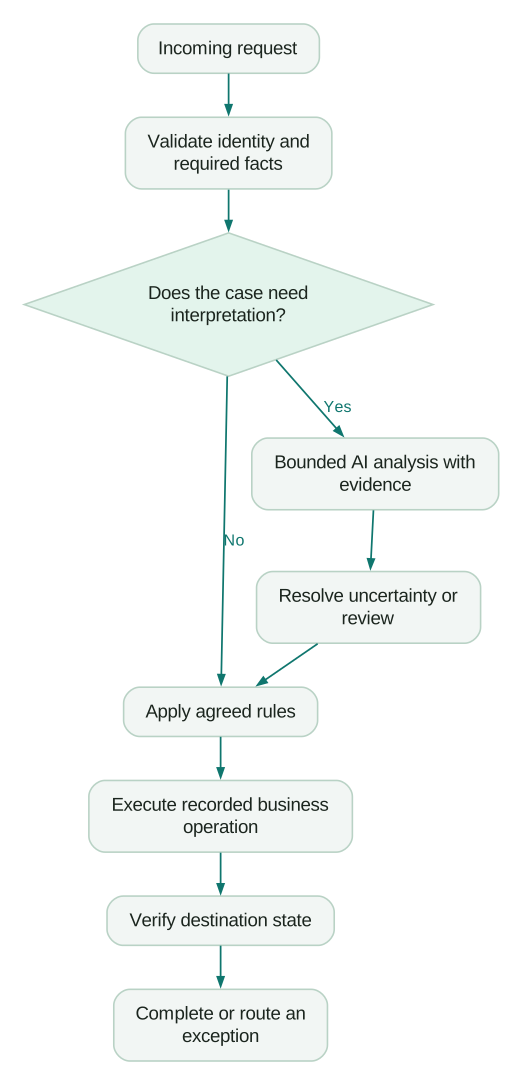
Define the business operation independently of its interface. Here is a planning contract, not a vendor configuration:
example_only: true
workflow: demo-request-follow-up
operation_identity:
  source: website-demo-form
  event_key: submission_id
  business_action: create-owner-follow-up
identity_requirements:
  - verified_company_match_or_exception
  - authoritative_owner_rule_version
execution:
  maximum_follow_up_tasks_per_submission: 1
  duplicate_delivery: reuse_existing_operation
  owner_not_resolved: route_to_review
  destination_outcome_unknown: reconcile_before_retry
completion_evidence:
  - crm_record_id
  - task_id
  - assigned_owner_id
  - verified_at
This contract can be implemented through a native workflow, a Zap or code. An MCP tool could also submit a reviewed operation to the same execution service. The point is to preserve one definition of success across interfaces.
The YAML does not enforce anything by itself. Store the operation identity in a system that can prevent concurrent duplicates, and verify the destination rather than trusting a sentence saying “done.”
Reliability Comes From Recovery Behaviour
Duplicate Delivery Is Normal Enough to Design For
Stripe's webhook documentation explicitly warns that events can arrive more than once and out of order. This is a useful reminder for any event-driven design: arrival order and delivery count are not safe substitutes for business identity and current state.
For the demo example, use the form's submission ID to recognise a repeated delivery. Do not use the person's email as the event identity. The same person may legitimately submit a second request later, and those requests can require separate follow-up.
Also define what happens if an older update arrives after a newer one. Sometimes you need to retrieve the authoritative current record; sometimes you need an ordered change history. Choose that behaviour explicitly.
A Timeout Can Leave the Outcome Unknown
Imagine a task-creation request reaches the CRM, succeeds, and loses its response on the way back. Retrying with a new operation identity can create a duplicate.
Use an idempotency mechanism where the destination supports one. Stripe's idempotent-request reference documents different behaviour for API v1 and v2, including how results and retries are handled. That is a reason to read the exact endpoint's contract. Do not assume that adding an Idempotency-Key header works with every CRM or every MCP tool.
If the destination has no suitable built-in mechanism, design an operation ledger, uniqueness constraint or reconciliation step. The implementation needs to address concurrent attempts, not just “search first, then create,” which can race when two workers search at once.
Replaying a Workflow Is Not Always Re-Evaluating It
Zapier's replay documentation distinguishes replaying failed steps from replaying an entire run. It also says Filter and Paths steps are not replayed in failed-step recovery, and autoreplay does not handle on-hold runs.
That matters when a business condition changes between attempts. Suppose a contact becomes suppressed after the first step succeeds but before a failed sending step is retried. Do not assume replay will revisit the earlier eligibility check. Enforce a critical current-state check at the action boundary or use a recovery process that revalidates it.
Document who can replay, which inputs remain fixed and what must be refreshed. “Automatic retries enabled” is not a complete answer.
Compare the Full Cost of a Completed Job
For each route, include the costs it actually creates:
- Native integration or Zap: subscription, billable actions, premium capabilities and operator maintenance.
- Direct API: application access, vendor usage, runtime, development and incident response.
- MCP with an AI host: model or seat costs, connector usage, underlying application charges and review time.
- CLI or script: underlying API costs, runtime, scheduling and the person maintaining it.
An open protocol does not make the services it invokes free. A free connector does not make enrichment, sending infrastructure or warehouse queries free either.
A Small Zapier Task Example
Zapier's MCP usage documentation currently charges two tasks per successful tool call; failed calls do not consume tasks. Its general task rules distinguish ordinary workflow actions from products with different multipliers and actions that do not count.
In an illustrative month with 1,000 records, assume each record needs two successful, separately billable app actions and nothing else:
- An ordinary Zap using two one-task actions per record consumes 2,000 tasks.
- The same two actions invoked separately through Zapier MCP consume 4,000 tasks.
This is task arithmetic, not a price quote or a claim that the two implementations do identical work automatically. Extra lookups, batching, AI steps and replay can change the count. Apply the actual plan and workflow rules to estimate money.
The current MCP billing page says pay-per-task settings determine whether tool calls continue with extra charges up to a cap or stop at the allowance. Check that setting before treating the plan's included tasks as a hard spend ceiling.
Use total cost per successfully completed business operation. A cheaper run that creates duplicate tasks and requires cleanup may be more expensive than a higher-priced run with reliable results.
MCP and RAG Solve Different Parts of the Problem
Retrieval-augmented generation supplies relevant external knowledge to a model before it answers. AWS's RAG glossary describes retrieving domain knowledge and adding it to the prompt.
MCP can expose a retrieval tool, so the two can work together. An assistant might retrieve your qualification policy from a document system, query current CRM records through another tool, and prepare a recommendation.
Keep the authority of each source clear. The policy explains how a lead should be qualified. The CRM establishes the current owner and record state. Neither should be substituted for the other.
A search index also needs refresh and access rules. An old policy retrieved confidently is still old. Relevant text is evidence for an answer; it is not automatic authority to execute an action described inside that text.
Check Compatibility Before Building Around a Protocol Label
The July 2026 MCP specification release introduced a stateless core and changed discovery and transport assumptions. Deployed vendor servers may still document older supported behaviour. Use the server and client versions that actually interoperate; do not rewrite a working vendor setup based solely on the newest protocol announcement.
Zapier can also consume a remote MCP server through its MCP Client integration, currently documented as beta. That means a fixed Zap may call an MCP tool while retaining an explicit workflow. Confirm its authentication, response shape and supported transport for your chosen server.
This combination can be useful when an MCP tool exposes a business operation unavailable through the ordinary connector. It also adds another dependency. Use it because it solves a specific coverage problem, and test the recovery path across both systems.
A Practical Evaluation Checklist
- The trigger, required result and accountable owner are written down.
- Fixed rules are separated from cases that require interpretation.
- Every required object, field and relationship is supported by the chosen route.
- Authentication and record access match the intended user or service identity.
- Duplicate delivery and concurrent attempts cannot silently duplicate business work.
- Unknown outcomes are reconciled before retries.
- Partial failure and stale eligibility are included in the recovery design.
- Costs include actual calls, actions, model usage and correction time.
- Logs identify the operation, inputs, decision, destination result and exception owner.
- A representative pilot includes missing data, duplicates and revoked access.
Choose the smallest implementation that passes those checks. For a fixed integration, establish the data contract and recovery behaviour first. For an assistant, identify the few decisions where interpretation saves real work, then scope a custom martech AI agent around them. That gives the model a useful job and the team a process it can operate.
Questions people ask
Does MCP Replace APIs?
Usually the API remains underneath the MCP tool. MCP standardises the tool-facing interface; the application still needs to expose and enforce its business capabilities. A service can offer both interfaces, with different coverage and operational requirements.
Can I Use MCP in a Fully Automated Workflow?
Yes. MCP is not limited to interactive chat. Automated execution still needs a defined trigger, durable state, permissions, recovery rules and an owner. Whether a particular server supports your authentication and runtime is a separate compatibility question.
Is an API More Reliable Than MCP?
The label alone does not establish reliability. Compare the complete path, including implementation, dependencies, input validation and handling of uncertain outcomes. A narrow MCP tool backed by a well-run service can be more dependable than a poorly maintained custom API script.
When Is Zapier Enough?
When its supported actions express the required workflow, its timing and usage model fit, and your team can operate the exceptions. Verify the specific actions rather than assuming a listed app supports every field or endpoint. Move to code when a concrete limitation justifies the added ownership.
Should I Build a CLI, an MCP Server or Both?
Start with the interface your users or runtime need. A CLI is useful for terminal and script workflows; MCP is useful for compatible tool-using clients. If both matter, share the underlying business logic and validation so the interfaces do not develop conflicting rules.
Sources
- MDN API definition
- MCP architecture, 2026-07-28
- What is Zapier MCP?
- Clay plugin, API and CLI
- Stripe webhook delivery and duplicates
- Stripe idempotent requests
- Zapier replay behaviour
- Zapier MCP usage and billing
- Zapier task usage rules
- AWS RAG glossary
- July 2026 MCP specification release
- Zapier MCP Client integration
Written by
Jafrin Akter AloData Engineer and Co-founder, martechdevs
Jafrin Akter Alo is a data engineer and co-founder of martechdevs, where the team has delivered 74+ martech, data and growth stack implementations.