
AI for RevOps: Useful Workflows, Reliable Data and a Pilot That Proves Value
Data Engineer and Co-founder, martechdevs
Last updated 12 min read
Your sales team does not need another summary of the pipeline. It needs to know which deal needs attention, what changed, whether the evidence is current and who should act. AI for RevOps earns its place when it makes that work easier to complete and easier to check.
Last updated: 13 October 2026.
Start with a decision your team makes every week. A pipeline review, an ownership exception or a renewal handoff gives you something concrete to improve. “Put an agent on our CRM” gives you a connection and an undefined job.
The useful question is how much reliable work comes out of the workflow after someone checks it. This guide covers four places to start, the data each needs, how to choose between native tools and a custom agent, and a pilot that exposes missed problems as well as good suggestions.
Separate four kinds of work before choosing AI
Rules apply an agreed policy. If a demo request has a known account owner, route it to that owner. If an amount is negative where negative values are prohibited, flag it. These are tests you can implement directly and repeat consistently.
Synthesis turns scattered evidence into something a person can use. An assistant can assemble a deal brief from notes, activity history and account context. The output should point back to the records behind it.
Prediction estimates a future outcome from historical observations. A win model needs a defined outcome, a prediction date, usable history and evaluation against later results. A language model calling a deal “promising” is not evidence that its probability estimate is calibrated.
Execution changes a system: assigning an owner, creating a task, updating a forecast or sending a message. It needs its own permissions, current-state checks and recovery behaviour, regardless of how the decision was proposed.
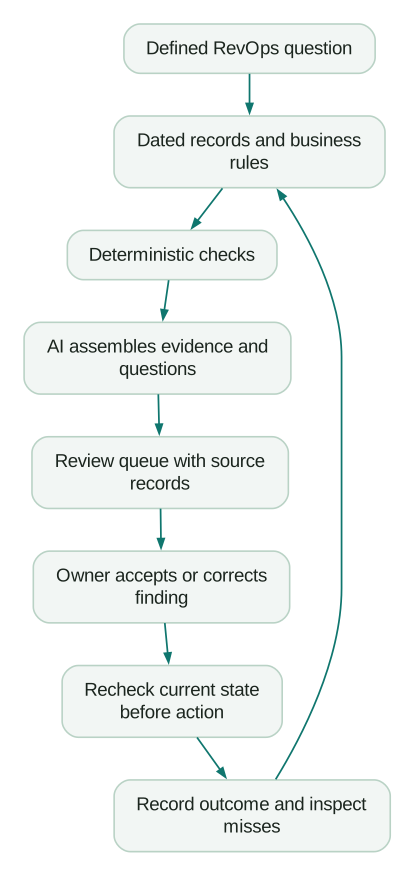
One workflow may use all four. For example, rules select overdue renewals, AI summarises the account evidence, a predictive model ranks risk, and a person approves a task. Keep those responsibilities visible. Otherwise, a persuasive explanation can quietly become an unreviewed business decision.
Four RevOps workflows worth testing
1. Prepare an evidence-backed pipeline review
Ask for a review queue with deal IDs, observed changes and unresolved questions. Useful signals include repeated close-date movement, a missing next step, an amount change without supporting notes and an opportunity that moved backwards through stages.
Calculate those signals from dated records first. Then use AI to read relevant notes and explain what a manager should investigate.
For each deal, distinguish the recorded fact from the interpretation. “The close date moved three times” is a fact if the history supports it. “The buyer has lost interest” is an interpretation that may have no supporting evidence. A missing CRM activity can also reflect incomplete logging.
Use the output to shorten the meeting: discuss the unresolved decision, assign an owner and record the next action. A longer brief that nobody acts on has not improved the review.
If you want a file-based starting point, the Claude Code marketing command guide includes a complete pipeline-change review skill. It keeps unexplained movements visible even when the totals reconcile.
2. Investigate routing exceptions
Keep territory, ownership, capacity and exclusion rules in a maintained policy. An AI assistant can explain why a record fell through that policy, find conflicting account information and prepare a resolution for an operator.
Give it the original request time, normalized company identifier, matched account, current owner, applied rule version and assignment history. Without those inputs, it may describe a plausible routing decision that never happened.
The valuable output is an exception such as “existing customer matched, but owner is inactive,” with the relevant IDs and allowed fallback. It is not a new territory policy invented from a company description.
Measure correct assignments and time spent unresolved. An automatically created task is only an intermediate event. Use the lead-routing guide to define the underlying decision rules before adding a conversational interface.
3. Turn hygiene findings into a repair queue
Start with fields used by a real process: account identity, owner, lifecycle state, next action or renewal date. Rules can identify missing or contradictory values. AI can help group the causes and assemble the evidence needed to repair them.
For a suspected duplicate, ask for both record IDs, identifiers that agree, identifiers that conflict and the downstream processes that reference each record. Similar names are a reason to investigate, not enough evidence to merge.
Keep “unknown” available. If two systems disagree about an account's active status, the output should name the conflict and the owner responsible for resolving it. Filling every blank with a guess makes the database look healthier while making it less dependable.
After a repair, rerun the checks and investigate the source that created the defect. The CRM data-hygiene workflow covers prioritisation and repair boundaries in more detail.
4. Improve forecast preparation
AI can collect account changes, explain which assumptions moved and draft the questions for a forecast review. Keep the submitted forecast, the model prediction and the manager's judgment as separate records.
Define the target first. Booked deal value, recognized revenue, recurring revenue and collected cash answer different questions. An accurate prediction of one does not validate a forecast of another.
Compare predictions made at the same point in the sales period. A forecast made near month end has more information than one made at the beginning. Mixing them into one accuracy number hides the question a founder actually cares about: how useful was the forecast when hiring or spending decisions were made?
Which AI tools should a RevOps team consider?
Choose the shortest maintainable route to the job. There is no universal stack that is best for every CRM, data model and operating team. The build-or-buy guide compares native agents, narrow extensions and custom workflows using the same acceptance cases and full operating costs.
Start with native CRM capabilities when the evidence lives there
HubSpot's current Sales Plugin for Claude offers call preparation, pipeline review and follow-up drafting. Its follow-up workflow saves a draft for sending from HubSpot. Other skills can update deal stages or create tasks, so evaluate the actual skill and its write behaviour rather than treating the whole plugin as a read-only reporting tool.
That is a reasonable candidate when the team already works in HubSpot and the relevant history is accessible there. Test it on your record types and operating questions. A product demo does not establish that custom properties, associations and local business definitions will be interpreted correctly.
For forecasting, HubSpot documents its Breeze AI projections as a beta available with qualifying Sales Hub or Service Hub Professional and Enterprise subscriptions, with seat requirements. It uses closed-won deal data from the previous three months and presents a projected range. This is a particular forecast feature, not proof that every open opportunity has been individually assessed for your team's sales motion.
Salesforce also has distinct scoring products. Its newer Opportunity Score requires Data 360 and at least 200 closed-won plus 200 closed-lost opportunities for successful training. It cannot run alongside Einstein Opportunity Scoring. Classic Einstein Opportunity Scoring documents a global-model fallback when an organisation lacks enough history for its own model. Identify the exact feature and entitlement before applying a requirement from one to the other.
Use a warehouse-backed workflow for cross-system questions
Renewal preparation often needs CRM ownership, billing state, product usage and support context. If those systems disagree about the account, adding four connectors does not resolve the disagreement.
Build an account-level view with stable IDs, defined measures and source timestamps. Expose a narrow set of useful queries, such as retrieving one account's renewal evidence or listing accounts with a defined usage decline. Give the assistant enough context to explain the result without having it reinvent the joins for every question.
This route is worth considering when the cross-system data work already supports reporting or lifecycle operations. Maintaining a warehouse solely to answer a few CRM questions may add more work than it removes.
Add MCP when it improves access to approved tools
The Model Context Protocol architecture describes how AI applications connect to servers that expose context and capabilities, including tools and resources. MCP provides a connection pattern. It does not supply your account model, revenue definition or business approval policy.
For RevOps, useful tools have narrow purposes and predictable outputs. A proposed get_renewal_evidence tool could accept an account ID and return billing, usage and support observations with timestamps. That name is a design example, not a standard MCP method or a claim that your vendor already provides it.
For a Salesforce pipeline review, the Salesforce MCP setup guide starts with its SObject Reads server and separates overdue from upcoming opportunities. Use that narrower workflow to check record access and evidence before adding writes or more systems.
If this is the missing part of your stack, an internal MCP and data foundation should start with the decisions and access boundaries you need to support.
Give every proposed action an evidence record
A weekly document is useful for a meeting. A structured review queue is more useful when several people must resolve issues and track what happened next.
The following is a fictional design example for one missing-next-step finding. It is not a vendor API payload or an instruction to update a CRM:
{
  "review_id": "review-20261013-D204",
  "deal_id": "D-204",
  "observed_at": "2026-10-13T09:00:00Z",
  "rule_version": "next-step-v2",
  "finding": "Open deal has no recorded next step",
  "evidence": [
    {
      "source": "crm.deal",
      "record_id": "D-204",
      "field": "next_step",
      "value": null,
      "retrieved_at": "2026-10-13T09:00:00Z"
    }
  ],
  "interpretation": "Owner review is needed; buyer intent is unknown",
  "proposed_action": "Ask the current deal owner to confirm the next step",
  "review_state": "pending",
  "execution_state": "not_requested"
}
The evidence establishes that the field was empty at retrieval. It does not establish that nobody agreed a next step on a call. That difference belongs in the review item, where the person deciding can see it.
Before creating a task, reread the deal. The owner may have changed or the next step may now exist. Use a stable operation identifier to detect an already-created task, and record the actual outcome. If a request times out, check whether it succeeded before repeating it.
Keep credentials and enforcement outside the generated text. A field saying pending has no protective effect unless the application actually prevents execution until its conditions are met.
Test the pilot on missed problems as well as accepted alerts
Take a frozen set of records and define what counts as a real issue before reviewing the AI output. Have a knowledgeable reviewer inspect the full set, including records the assistant did not flag. Resolve ambiguous cases consistently and record the reasons.
Consider this illustrative 100-deal pilot:
- The assistant flags 30 deals.
- The reviewer confirms 24 of those findings and rejects six.
- Among the other 70 deals, the reviewer finds seven additional issues.
- The full set therefore contains 31 confirmed issues.
Precision is 24 divided by 30, or 80%: four in five alerts were valid. Recall is 24 divided by 31, or approximately 77.4%: the assistant found about three quarters of the confirmed issues. The seven misses matter even if the written summaries are excellent.
These are invented numbers demonstrating the evaluation, not observed results or a suggested universal acceptance threshold. A missed owner on a low-priority account and a missed contract-renewal deadline have different costs. Review performance by issue type and consequence.
Run a rules-only baseline on the same set. If a field query finds the same issues, the AI contribution may be better explanation or faster review, rather than improved detection. Measure that separately.
Do not estimate recall from accepted alerts alone. In a larger ongoing workflow, inspecting a sample of unflagged records can help estimate misses, but the sampling design and uncertainty matter. A convenient handful of clean records is not evidence that the rest are clean.
Evaluate forecasts without leaking the answer
Historical CRM exports can contain information that did not exist at prediction time. A final loss reason, a revised close date or a later stage update can make a retrospective model look far better than it would have been in use.
The scikit-learn guidance on data leakage explains why information unavailable at prediction time creates misleading evaluation and why learned preprocessing must use training data alone.
For a RevOps forecast, preserve an as-of snapshot and compare it with the later outcome. Train on earlier periods, evaluate on later periods and keep the forecast horizon consistent. If historical field states are unavailable, say that the proposed backtest cannot reproduce the decision faithfully.
Compare with a simple baseline your team understands. Report errors in the business unit being forecast, and inspect persistent overprediction or underprediction. A model that improves average error while missing the largest accounts may still be unsuitable for capacity planning.
Count the work left behind
Measure the complete process: gathering inputs, reviewing output, correcting errors, resolving exceptions and maintaining the workflow. Include vendor charges and the person responsible for changes when fields or rules evolve.
For example, suppose a fictional weekly process currently takes six hours. The proposed workflow needs two hours of review, one hour of upkeep and two hours correcting or resolving exceptions. It saves one hour of recurring capacity, not four. Initial implementation and evaluation effort are additional costs.
That hour may still be worthwhile. Faster response or better evidence can also matter. Name the benefit you are measuring rather than turning every improvement into an unsupported revenue claim.
For a founder, the decision is whether this workflow improves an important operating constraint enough to justify owning it. For a RevOps manager, it is whether the team can rely on the output, diagnose failures and keep working when the assistant is unavailable.
A practical launch checklist
- Choose one recurring decision and name its accountable owner.
- Define the record grain, outcome, time window and baseline process.
- Separate rule evaluation, AI interpretation, prediction and execution.
- Verify identity, field meaning, history and source freshness.
- Require record-level evidence and explicit unknowns in the output.
- Evaluate flagged and unflagged records on a frozen pilot set.
- Compare with rules alone and inspect costly misses separately.
- Recheck current state before approved changes and record outcomes.
- Count review, correction and maintenance in the value calculation.
- Assign a fallback process and a review date for the workflow.
Start with one queue that a real operator wants to use. Once its evidence and handoffs are dependable, expand to adjacent decisions. If ownership, lifecycle definitions or cross-system handoffs are the obstacle, work on the CRM and lifecycle foundation that the automation depends on.
Questions people ask
What are the best AI tools for RevOps?
The best candidate depends on where the evidence lives and who will maintain the workflow. Test native CRM capabilities for CRM-centred work, a warehouse-backed assistant for governed cross-system analysis, and narrow automation for repeatable execution. Compare them on the same real decisions, including errors and review effort.
How do RevOps teams use AI agents?
Useful starting points include preparing pipeline reviews, investigating routing exceptions, assembling hygiene repair evidence and collecting forecast assumptions. Define the agent's inputs, permitted tools, output contract and handoff owner. Treat the ability to propose a change separately from authority to execute it.
What data does RevOps AI need?
It needs the data required for its particular decision: stable record IDs, defined fields, timestamps, relevant history and access to supporting records. Cross-system work also needs reliable account and person relationships. Predictive use cases need historical outcomes and a way to reconstruct what was known at prediction time.
Will AI replace RevOps?
Task automation does not remove the need to decide how the business operates. Someone still owns definitions, routing policy, incentives, system boundaries and exceptions. Evaluate which work can be reliably automated and how the remaining responsibilities change, rather than treating a good summary as evidence that a whole role is replaceable.
How do we know whether a RevOps AI pilot worked?
Compare it with the existing process and a simple rules baseline. Check evidence accuracy, useful findings, missed issues, review time and completed actions. Evaluate predictions on later outcomes at a consistent horizon. Continue only when the measured benefit justifies the recurring cost and the unresolved failure modes are acceptable for that specific workflow.
Sources
Written by
Jafrin Akter AloData Engineer and Co-founder, martechdevs
Jafrin Akter Alo is a data engineer and co-founder of martechdevs, where the team has delivered 74+ martech, data and growth stack implementations.