
AI decisioning compared: Braze Decisioning Studio, Hightouch and RudderStack
Braze Decisioning Studio and Hightouch AI Decisioning select customer engagement actions; RudderStack can supply the profiles, predictions and activation infrastructure those actions need. Choose by the complete workflow, the comparison group and the incremental contribution left after operating costs. A fast recommendation or a higher click rate does not establish that the program earns more than its current alternative.
On this page
Which part of the decision does each platform own?
Separate customer context, action selection and execution before comparing products. A profile score, a selected offer and a delivered message are different outputs, with different owners and failure modes.
Product capabilities. Use the final column to make the implementation work explicit in your proposal.
| Product | Principal contribution | Proposed execution route | Remaining question |
|---|---|---|---|
| Braze Decisioning Studio Go | Self-service email selection optimized for clicks | Configured options inside Braze | Is engagement the appropriate objective? |
| Braze Decisioning Studio Pro | Individual decisions for a configured business outcome | Braze, Salesforce Marketing Cloud or a custom integration | Who implements and operates the connection? |
| Hightouch AI Decisioning | Adaptive message, channel and timing selection | Managed messaging integrations or a customer-owned custom channel | Who owns delivery and experiment suppression? |
| RudderStack Profiles capabilities | Customer features, propensity scores and profile serving | Application or downstream engagement system | What selects actions and measures incrementality? |
Our warehouse and customer-data implementation work addresses identity, features and delivery between systems. Martechdevs provides implementation services; the decision here is whether a proposed operating model solves the audience's actual problem and can justify its cost.
Braze: choose the actual tier and delivery arrangement
- Best for: A team with a well-defined engagement decision and an existing Braze operating workflow.
- Pros: Go offers a bounded self-service route; Pro can use first-party data and a custom business objective.
- Cons: Go's email/click scope does not establish Pro's broader capabilities. Pro still needs technical implementation.
- Free tier and startup offer: Confirm the decisioning entitlement and commercial terms; no free production decisioning allowance is assumed here.
- Choose it if: The selected tier and connection pass the required outcome, channel and ownership tests.
- Skip it if: The proposal relies on a capability that belongs to another tier or an unpriced integration.
Braze describes Pro as formerly OfferFit by Braze. Pro operates as a decisioning layer across supported engagement platforms. Decisioning Studio scope
Pro's setup guide names native integrations with Braze and Salesforce Marketing Cloud, plus custom integrations for other platforms. Braze's AI Decisioning Services team guides design; the customer's team owns the technical connection and verification. Include that work in the quote. Pro setup responsibilities
Hightouch: separate managed delivery from a custom channel
- Best for: A team evaluating a decisioning layer over its messaging environment and warehouse-backed customer data.
- Pros: AI Decisioning uses configured audiences, goals, messages and constraints, with reinforcement learning to adjust choices from outcomes.
- Cons: A decision can still fail at identity mapping, suppression, synchronization or destination execution.
- Free tier and startup offer: Hightouch's free Reverse ETL (extract, transform, load) plan does not establish a free AI Decisioning entitlement.
- Choose it if: Its supported delivery path reduces the work needed for your actual use case.
- Skip it if: The business lacks a measurable objective, valid action options or ownership of the delivery path.
The current overview names Braze, Iterable and Salesforce Marketing Cloud as managed message sources and destinations. The agent chooses within configured options; it does not generate arbitrary new campaign content. AI Decisioning overview
For the managed Braze route, Hightouch can select actions while Braze executes campaigns or Canvases. Verify the decisioning-specific setup and permissions even if an ordinary Braze destination already works. Hightouch's Braze integration
A custom channel adds a different responsibility boundary: you create and monitor the delivery sync, and message variables are authored in Hightouch. A successful sync indicates endpoint acceptance; inspect the destination's delivery evidence separately. When evaluating Customer.io or Klaviyo, check this custom-channel route rather than inferring a managed integration from the general catalog. Custom destinations
RudderStack: evaluate the data components and the missing policy layer
- Best for: A team whose immediate need is customer context or prediction for an application or decision engine.
- Pros: Profiles can support calculated features and propensity scores; the documented Activation API v2, an application programming interface, serves profiles from Redis.
- Cons: These components do not by themselves establish a complete adaptive campaign policy, randomized test or messaging workflow.
- Free tier and startup offer: Confirm access to the required Profiles and Beta features; an event-pipeline offer does not establish those rights.
- Choose it if: A named application or platform already owns action selection and can consume the required context.
- Skip it if: The purchase assumes a profile score alone will decide, deliver and prove a profitable intervention.
The Propensity Scores Data App predicts a specified action within a chosen horizon. Its current documentation labels the feature Beta. A customer likely to purchase may have purchased without any message; likelihood and incremental response are different quantities.
The Activation API v2 documentation also labels that feature Beta and requires a working Redis instance, Profiles execution and configured feature views. An API response exposes the available profile; it does not prove the profile is recent enough for the decision. Use the warehouse-first activation architecture to define the surrounding responsibilities.
How do you compare the proposals against the same customer task?
Write one workflow specification with the same eligible population, allowed actions, outcome window and constraints. Otherwise, a click-optimization demo and a margin-based retention program can appear comparable while answering different questions.
For a fictional repeat-purchase program, specify who qualifies, which products or offers remain valid, how consent and frequency rules are enforced, what counts as contribution after variable costs, and when outcomes are mature enough to compare.
| Boundary | Evidence to request | Accountable owner |
|---|---|---|
| Customer context | Stable identifier, feature value and availability time | Data engineering |
| Eligibility | Consent, service state and offer checks at execution | Lifecycle owner with application team |
| Action choice | Approved options, selected action and reason record | Decisioning owner |
| Delivery | Destination acknowledgment, suppression and final outcome | Messaging operations |
| Evaluation | Assignment, complete-window outcomes and guardrails | Analytics with finance or product |
This is a proposed responsibility map. Confirm it against the actual contract and implementation. A vendor demonstration can establish a capability in its demonstrated scope; it does not establish access, delivery or commercial benefit in your account.
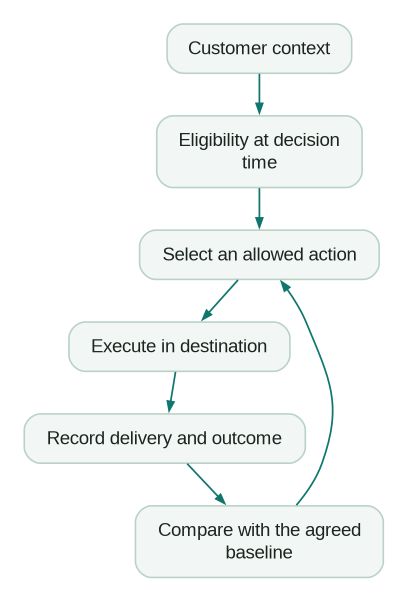
Read diagram as text
- Customer context to Eligibility at execution time.
- Eligibility at execution time to Select an approved action.
- Select an approved action to Execute in the destination.
- Execute in the destination to Record delivery and mature outcomes.
- Record delivery and mature outcomes to Compare with the agreed baseline.
- Compare with the agreed baseline to Select an approved action
The Braze AI feature guide covers choices within that product, including the detailed Go controls. This comparison focuses on which system owns each boundary and whether its complete operating cost is justified.
Which control group answers the business question?
Use business-as-usual (BAU) messaging to test whether a new policy improves the current program, and a no-campaign holdout to estimate the program's incremental effect for that use case. Random content answers a different question about selection quality.
Documented group designs; configuration and the resulting experiment still need validation.
| Product or design | Documented comparison | What the contrast can answer | What to verify |
|---|---|---|---|
| Braze Go | Optimized choices versus random combinations of the configured email options | Does personalized selection improve on random selection? | Downstream business outcome beyond clicks |
| Braze Pro | Use-case groups can include Pro, Random Control, BAU and Holdout | The question defined by the chosen experiment | Agreed group rules and orchestration |
| Hightouch AI Decisioning | Treatment, holdout and customer-managed messaging | AI policy versus current messaging or no campaign | Assignment and downstream suppression |
| Application using RudderStack context | Experiment implemented by the application or another platform | The contrast that owner explicitly designs | Durable assignment and complete outcome records |
Go's random control continues receiving email. Its built-in comparison does not prove the value of sending versus sending nothing. Go control semantics
Experiment groups in Decisioning Studio Pro are part of the design agreed with its Services team. Treat the listed groups as available design examples, not a statement that every deployment automatically includes all four. Pro experiment design
Hightouch documents deterministic assignment using a stable identifier, with group evaluation during the daily job. Newly eligible customers can therefore reach existing messaging before suppression is synchronized. Its guidance requires sending group assignments downstream and excluding treatment and holdout members from competing customer-managed campaigns. Test entry, re-entry and any allocation change. Group assignment
Keep required transactional and service messages separate from the campaign exclusion. A marketing holdout should not silently suppress receipts or necessary service communication. Record which messages remain common to every group so the comparison can be interpreted.
What should real time mean in an evaluation?
Measure the age of the evidence and the delay until execution, rather than relying on an API response-time claim. Record source-event time, feature availability, decision creation, execution and outcome arrival.
Consider a hypothetical profile refresh completed at 10:00. A customer buys at 10:05; the purchase reaches the warehouse at 10:07, but the refreshed profile is not ready until 11:02. A reminder decision is created at 10:20 and sent at 10:25 using the old profile.
The missing safeguard is a sufficiently fresh purchase check before sending. A fast lookup of the old profile cannot supply that evidence. Possible designs include an authoritative purchase event that removes the customer from the pending send, a promptly updated eligibility store, or a final application check before execution.
Test a purchase between profile refresh and send, then repeat with a delayed event and a failed refresh. Require suppression or an explicitly approved fallback, with a reason and timestamp. A weekly recommendation and an immediate post-purchase suppression need different freshness targets; forcing every feature to update at the same frequency can add cost without fixing the critical boundary.
How should Braze and Hightouch decisioning costs be compared?
Request quotes for the same decisioning scope and count every operating cost that changes. Budget Pro implementation alongside existing Braze usage. Budget Hightouch together with destination messaging and warehouse operation.
Hightouch lists AI Decisioning within its Agentic Marketing Platform offering and says products can be purchased separately. The reviewed pricing page describes usage-based plans and a set amount of personalized actions, without publishing a dollar rate for this decisioning scope. Hightouch pricing
Braze's Pro documentation directs customers to their customer success manager and Services team; the reviewed pages provide no public Pro dollar price. Ask which data, integration, design and ongoing support responsibilities the proposal actually includes. Braze Pro overview
Use Hightouch's activation pricing guide and Braze's edition and credit terms for adjacent commercial obligations. A generic activation quote and a decisioning implementation can have different scope.
| Cost line | Question for the Braze proposal | Question for the Hightouch proposal |
|---|---|---|
| Decisioning contract | Which tier, use cases and design support are covered? | Which personalized-action allowance and products are covered? |
| Delivery | Which channel charges and orchestration remain? | Which destination charges and delivery syncs remain? |
| Data and compute | Which features and outcome feeds must your team supply? | Which warehouse models and serving workloads must you maintain? |
| Implementation and operation | Who owns integration, testing and future changes? | Who owns custom channels, suppressions and incident response? |
| Retired work | Which existing work or subscriptions actually end? | Which existing work or subscriptions actually end? |
A second platform is justified by a requirement and its value. The cost comparison should record an actual avoided expense separately from time that becomes available for other work.
Which option has the better return on investment?
The better return on investment (ROI) comes from incremental contribution after the complete added cost, measured against a relevant alternative. Documentation cannot establish a universal winner for your audience.
Suppose a fictional 30-day pilot assigns 20,000 customers to an AI policy and 20,000 to the current policy. Complete-window contribution after offers and variable fulfillment costs is USD 104,000 versus USD 100,000. These invented results illustrate the calculation; no vendor or customer performance is claimed.
The observed difference is 104,000 / 20,000 - 100,000 / 20,000 = USD 0.20 per assigned customer. Count all assigned eligible customers, including those who never received or clicked a message, under the agreed evaluation rule.
What is the annual break-even point?
Assume the proposed system adds the following fictional costs. All amounts are USD per year unless marked one-time. Replace them with actual quotes before approving a purchase.
| Cost | First-year USD | Recurring-year USD | Assumption |
|---|---|---|---|
| Decisioning licence | 72,000 | 72,000 | Incremental contract cost |
| Warehouse and serving | 12,000 | 12,000 | Added compute and infrastructure |
| Ongoing people time | 24,000 | 24,000 | Valued internal operating capacity |
| Additional messaging | 12,000 | 12,000 | Net increase in delivery cost |
| Initial integration | 30,000 | 0 | One-time implementation work |
| Total economic cost | 150,000 | 120,000 | Cash costs plus the stated internal capacity |
If the people-time row uses existing salaried capacity, the cash subtotal is USD 126,000 in year one and USD 96,000 thereafter. The economic totals also value that internal capacity.
With 100,000 eligible customer-months in each of twelve months, the annual denominator is 1.2 million customer-months. It may contain repeated customers, so it is not 1.2 million independent people for statistical analysis.
Recurring break-even uplift is USD 120,000 / 1,200,000 = USD 0.10 contribution per assigned customer-month. First-year break-even is USD 0.125. If the pilot's USD 0.20 effect persisted at this scale, annual incremental contribution would be USD 240,000: recurring economic ROI of 100% and first-year ROI of 60% under these assumptions.
That is a scenario, not a forecast. Retain customer-level outcomes; group totals alone cannot establish the uncertainty of this difference. The pilot needs mature outcomes and a design that accounts for repeated exposure. Changes in audience, offers, seasonality or delivery can change the effect. Internal capacity is also different from a cash invoice; show both when finance evaluates affordability.
How much extra value must a more expensive proposal produce?
If either vendor's complete annual proposal costs USD 30,000 more for the same 1.2 million customer-months, it needs an additional 30,000 / 1,200,000 = USD 0.025 contribution per customer-month to cover that difference.
An assumed additional USD 0.02 would produce USD 24,000, leaving USD 6,000 of the gap uncovered. This is a comparison between the two policies, not each policy's separate lift over unrelated baselines. Do not compare two vendor case-study percentages whose audiences, outcomes and costs differ.
Does adding a second destination improve the economics?
Only if the extra measured value covers the extra cost. Sending the same program through another destination does not automatically increase its eligible population.
Hypothetical annual USD costs and customer-month exposure. Initial integration is excluded; the extra destination adds USD 30,000 in annual operation.
| Scope | Annual cost USD | Eligible customer-months | Break-even contribution per customer-month |
|---|---|---|---|
| Original program | 120,000 | 1,200,000 | USD 0.1000 |
| Another channel for the same program | 150,000 | 1,200,000 | USD 0.1250 |
| An additional independently measured population | 150,000 | 1,800,000 | USD 0.0833 |
The last row assumes 600,000 additional customer-months and separately attributable incremental contribution. If programs overlap or claim the same purchase, a joint experiment or another justified measurement design is needed. Dividing by every message sent would manufacture a lower break-even threshold without creating value.
What should a pilot prove before rollout?
Prove that the complete decision reaches the intended customer, respects constraints and produces an interpretable comparison. Use synthetic cases for technical checks, then an approved live experiment for business outcomes.
- Write the objective, eligible population, allowed actions and observation window.
- Assign ownership of data, suppression, delivery and measurement.
- Exercise delayed purchases, missing features, changed identities and expired offers.
- Verify experiment assignments in every system that can send competing messages.
- Reconcile decisions to delivery evidence and mature outcome records.
- Compare incremental contribution, uncertainty and the complete cost before expanding.
Checklist
- Every workflow boundary has a named owner and acceptance evidence.
- A purchase after profile refresh prevents an inappropriate pending reminder.
- Missing or stale context produces the approved fallback.
- Retired offers cannot remain eligible through old queued decisions.
- Treatment and holdout members are excluded from competing campaigns as designed.
- Decision, delivery and outcome identifiers can be reconciled.
- The cost includes destination tools, data work and ongoing operation.
- A pause and recovery procedure is approved before business traffic depends on the system.
If most of the required behaviour remains custom, compare a custom agent with these platforms. The custom martech AI agent service should be scoped against the same ownership, permissions and evaluation requirements.
Which arrangement fits your team's stage and workflow?
Choose the smallest complete arrangement that passes the task and economic tests. Keep the decision tied to the customer journey, operating capacity and economic objective.
| Team and requirement | First option to test | Runner-up | Why the order can change |
|---|---|---|---|
| Existing Braze team improving a recurring email program | Go within its documented scope | Existing rules and a focused experiment | A custom economic objective may require Pro instead |
| Braze team optimizing a cross-channel retention outcome | Pro with an agreed implementation | Hightouch using the required delivery path | Compare ownership and measured incremental value at full cost |
| Team coordinating supported messaging platforms | Hightouch's managed integrations | Pro's supported or custom connections | An existing integration or lower operating burden can reverse the order |
| Data team supplying context to its own application | RudderStack Profiles capabilities | Another context/activation design | Action selection and experimentation still need explicit owners |
If the underlying engagement platform is the open question, use the Customer.io and Braze platform comparison first. Adding a decisioning layer cannot repair a sending platform that fails the required customer journey.
Get the $99 martech audit to define the missing decision or data boundary, or request a detailed customer-data implementation scope once the workflow and acceptance criteria are agreed.
Keep reading
 Martech AI
Agentforce Pricing: Flex Credits, Conversations, Users and Full Cost
Calculate Agentforce costs across Flex Credits, conversations, Help Agent resolutions and employee licences. Separate included allowances from CRM and data costs.
Jafrin Akter AloLast updated 11 min read
 Martech AI
BigQuery AI: Gemini, Data Agents and AI Functions for Marketing Data
Choose BigQuery AI tools for marketing data. Understand Gemini costs, data-agent setup, AI functions, permissions and how to verify useful outputs.
Jafrin Akter AloLast updated 14 min read
 Martech AI
GA4 AI: Ask Advisor, AI Summaries and Answers You Can Check
What GA4's AI features do: Ask Advisor, homepage AI summaries and predictive metrics, with prompts and checks that make each answer hold up in a report.
Jafrin Akter AloLast updated 11 min read
AI readiness score
Check your tracking, data, context and access before connecting an agent.
Questions people ask
How should returns reported after the pilot closes be handled?
Define that treatment before assignment. Either choose an outcome window long enough to include material returns or report a provisional result with a scheduled adjustment. Apply the same rule to every group, preserve the original result and show the change. A purchase-based pilot can overstate contribution if one policy generates more delayed refunds than another.
What if two decisioning systems target the same customer?
Assign one owner for cross-program eligibility, priority and contact limits before enabling both. Define which system can cancel or supersede a pending action, and retain enough identifiers to trace the final choice. Test competing offers and delayed suppressions. Separate experimental assignment from operational arbitration so a customer does not switch treatment groups merely because another program runs first.
How should a subscription renewal affect the pilot timetable?
Work backward from the decision deadline, including outcome maturity, review and any migration period. A pilot that finishes sending before renewal may still lack mature outcomes when the contract decision is due. Agree a fallback commercial option if evidence remains inconclusive. Treat parallel subscriptions and transition work as explicit costs rather than assuming the new program immediately replaces the old one.
Can an agency operate decisioning while the client retains control?
Define client-owned objectives, data access, approval authority and operating records before assigning agency work. Use named access and agreed change boundaries, with a handover and credential-removal procedure. Require the client to be able to inspect decisions, costs and experiment results independently. Outsourcing execution should not leave the client dependent on an undocumented configuration or a report only the agency can reproduce.
What if the comparison group is too small to support a decision?
Keep the uncertainty visible and revisit the experiment design with the measurement owner. Depending on the objective, options include a longer observation period, fewer simultaneous variants or a revised allocation before the next test. Do not repeatedly change groups until a favourable result appears. If the expected value cannot justify a suitably precise test, retain a simpler policy while improving the evidence.
Sources
- Braze: Decisioning Studio Go and Pro.
- Braze: Pro setup and experiment design.
- Braze: Go FAQ and control semantics.
- Hightouch: AI Decisioning overview.
- Hightouch: Braze delivery integration.
- Hightouch: Custom decisioning destinations.
- Hightouch: Experiment group assignment.
- Hightouch: Pricing and product scope.
- RudderStack: Propensity Scores Beta.
- RudderStack: Activation API v2 Beta.

Written by
Jafrin Akter AloData Engineer and Co-founder at Martechdevs and Growth and Analytics Partners
Jafrin writes practical guides to marketing technology, customer data, analytics and AI workflows. Martechdevs is a Growth and Analytics Partners company.