
Salesforce Agentforce for Small Teams: Scope, Cost and Ownership
Agentforce can make sense for a small team when Salesforce already contains the context and workflow it needs. Begin by testing the assistive capabilities included in your edition, then price a custom agent only for a specific recurring job. The decision depends on reliable records, permission boundaries, measurable time saved and someone who can maintain the workflow after launch.
On this page
A five-person sales team does not need the same agent programme as a multinational service operation. It may need a dependable meeting brief, a draft follow-up or a consistent way to identify accounts that require attention. Those jobs can be valuable without giving an agent broad authority over pipeline stages and customer communications.
Before purchasing a separate deployment, write down the work you want to remove and the data it requires. If account ownership, activity capture or lifecycle stages are inconsistent, a customer relationship management (CRM) and lifecycle review may solve more of the immediate problem than adding another interface. An agent can work with recorded context; it cannot reliably reconstruct agreements that were never saved.
What can a small team use without building a custom agent?
Salesforce's current small-business announcement describes record summaries and AI email drafting across Free, Starter and Pro Suites, with Employee Agent included in Starter and Pro. That makes an internal assistive pilot a reasonable starting point for eligible teams. Confirm the delivered capabilities in your own edition. See Agentforce in Salesforce Suites.
“Included” still requires activation and appropriate access. Salesforce's setup documentation specifies an admin-led enablement process, additional permissions for custom profiles and record-page configuration for existing organizations using AI Summary. Follow the Suite setup instructions rather than assuming the interface is already configured for every user.
Salesforce lists Starter Suite from USD 25 per user per month, billed monthly or annually, and Pro Suite from USD 100 per user per month, billed annually. Keep the CRM subscription separate from custom-agent delivery and consumption. Salesforce Sales pricing.
Compare the wider CRM commitment with the AI use case before selecting an edition. Try an included feature against a real task before upgrading. For a meeting brief, compare the summary with the source records: does it preserve the latest customer commitment, distinguish an open case from a resolved one and identify an outdated next step? The benefit is the time saved reaching an accurate understanding, not the amount of text produced.
When does a custom agent become worthwhile?
A custom agent earns a trial when its task crosses records or systems, recurs frequently and has a stable completion rule. For example, a renewal review may require the opportunity, recent support issues and a verified product-usage summary before assigning follow-up work.
Choose a task where the team can explain the decision today. “Find revenue opportunities” is too open-ended for a first implementation. “Prepare the evidence required for next month's renewal review and propose missing follow-up tasks” has a population, deadline, output and reviewer.
Ask four questions:
- Does the necessary information exist in accessible, current records?
- Is the task frequent enough to justify setup and maintenance?
- Can the team define an acceptable answer or action?
- Is there a clear owner when the agent encounters an exception?
If the task follows a stable rule, a normal Flow or scheduled report may be sufficient. Use generative reasoning where interpreting varied context creates value. Our build-versus-buy guide for martech AI agents helps separate that decision from the enthusiasm around a particular product.
For work that mainly involves asking an assistant about CRM records, compare Claude through Salesforce’s hosted Model Context Protocol (MCP) server with building another agent. Judge the required data, actions and access controls in each route.
Avoid choosing a customer-facing workflow solely because it makes an impressive demonstration. Internal assistance lets the team inspect weak records and exceptions before those problems become customer experiences. Expansion should follow evidence that the workflow performs well on the cases it will actually receive.
What should the first workflow specification contain?
Consider an illustrative renewal-preparation agent for a small B2B team. Its task is to prepare an account brief and propose a next-step task for the account owner. It does not negotiate, send messages or change commercial terms.
The specification could look like this:
Population: Accounts with a renewal opportunity closing next month.
Inputs: Opportunity, account owner, recent relevant cases,
        and a dated product-usage summary.
Output: Source-linked brief plus one proposed next-step task.
Required distinctions: Confirmed facts, missing data, recommendations.
Action: Create the task only after the account owner approves it.
Exceptions: Missing owner, conflicting renewal date, stale usage,
            or multiple possible accounts go to a review queue.
Completion: Approved task exists once, on the intended account,
            with its owner, due date and evidence recorded.
Before the pilot, have the administrator map every step to the actual edition, available action, integration and permission. Assign an owner to any missing capability before committing to the design.
The specification also prevents a common product mistake: a generated narrative that never becomes usable work. If the account owner must search for the record, reconstruct the evidence and decide who should act, the workflow has saved less time than the demo suggests.
How do Flex Credits change the cost calculation?
Flex Credits make the cost depend on executed actions and the account's available entitlement. Salesforce lists USD 500 per 100,000 credits and 20 credits for a standard non-voice Agentforce action. Agentforce pricing.
The Sales comparison lists these shared allowances per organization per year. They are not monthly balances or per-user grants:
| Sales edition | Included Flex Credits/org/year | Budget implication |
|---|---|---|
| Core | 500,000 | Check the available organization balance before adding consumption |
| Advanced | 1,000,000 | Other teams and eligible workflows can use the same allocation |
| Max | 2,750,000 | An included balance still needs usage ownership |
Salesforce says AI can be added to Core and above. Its separately described built-in Suite assistance does not establish eligibility for every custom-agent product. Confirm the exact SKU and contract; use the Salesforce pricing guide for edition prices. Sales edition allocations.
Employee access also has different commercial models. These are published USD reference prices, excluding the underlying CRM subscription and other consumption:
| Route | Published price | What the price means |
|---|---|---|
| Agentforce User License | USD 5/user/month | Limited CRM-object access; Flex Credits required and usage metered |
| Sales, Service or Field Service Agentforce add-on | USD 125/user/month | Unmetered employee Agentforce usage for licensed users |
| Max Edition | Agentforce add-on included | Confirm the purchased edition and remaining consumption services |
The same page lists USD 2 per conversation and says Conversations and Flex Credits cannot coexist in one org. Unused credits do not roll into the next subscription term. Licensing and purchasing rules.
What does a small renewal workflow consume?
At the reference rate, one 20-credit action has a list-rate value of USD 0.10. Count the entire job, including branches and retries, before comparing that amount with time saved.
This fictional forecast uses 300 renewal reviews per month. The baseline averages three metered actions per review; the sensitivity uses six. Both add an explicit 10% allowance for retry and exception actions. Only standard non-voice actions are modeled:
| Scenario | Reviews/month | Total actions, including allowance | Credits/month | Reference USD/month |
|---|---|---|---|---|
| Three actions per review | 300 | 990 | 19,800 | 99 |
| Six actions per review | 300 | 1,980 | 39,600 | 198 |
The baseline is 300 × 3 × 1.10 = 990 actions. Its annual use is 237,600 credits. If those actions are eligible for an otherwise unused 500,000-credit annual balance, they leave 262,400 credits. That calculation says nothing about the subscription price or other teams' usage. A shared balance, contract period and additional Data 360 or integration charges can change the cash bill.
Use pilot logs to replace the assumed action count and retry allowance. Track the balance at organization level, then assign each workflow a usage owner. A natural-language request that repeatedly searches the same records can consume more than a well-scoped request producing the same useful result.
For customer support, compare Fin, which Salesforce now owns, on its per-outcome terms rather than equating an outcome with one Agentforce action. Salesforce confirms the completed acquisition; Fin's pricing defines its separate billing unit. Match workload, completion rules and included services before comparing totals.
Who owns access and the actions underneath it?
Salesforce's Agent Script documentation describes agents running in a user context whose permissions control access to Salesforce resources. Identify that execution identity explicitly instead of treating “the agent” as an abstract role. The access block reference describes the default agent user for applicable agents.
Then inspect the implementation of every action. Flow execution mode matters. Salesforce documents that User Mode applies user permissions, while system modes have different sharing and field-access behaviour. A narrow agent interface can still invoke a broadly privileged Flow. Review the Flow security guidance with the administrator who owns the automation.
For the renewal example, the agent should retrieve the fields needed for the brief and create only the approved task. It has no business need to export every contact, update payment details or reassign all opportunities. Test with an account the intended user cannot access and verify that the result respects the designed boundary.
Also separate permission to generate a recommendation from permission to act on it. An owner approving a follow-up task has not necessarily approved a changed close date or an outbound email. Recheck the approved record state before execution; a changed owner, renewal date or commercial state requires renewed review. Use approval rules for the actions an agent can take to make the exact record, proposed value and resulting operation visible at the decision point.
The business owner determines what the action means. The Salesforce administrator determines how it executes. A replacement administrator should be able to run a known case and diagnose a failure from the maintained record. A technical implementer may build the integration, but ongoing accountability should stay with named people in the business.
How should a lean team test the pilot?
Start with cases that represent the actual workload, including awkward ones. For renewal preparation, include a missing account owner, a stale usage snapshot, a resolved case that sounds alarming, two accounts with similar names and an already-created follow-up task. The agent should handle these differently.
Create expected outcomes before running the test. A case with missing evidence should produce a clear exception, not a confident recommendation. A repeated request should not create duplicate work. A rejected proposal should leave the record unchanged.
Use an isolated test environment and test records when actions can mutate data. Confirm that outbound integrations cannot send real customer communications during the test. These are practical controls for the workflow, regardless of whether the prompt itself looks harmless.
Since Summer '26, Salesforce's Testing Center runs do not consume Einstein Requests or Flex Credits; Data 360 queries remain metered. The help page names Enterprise, Performance, Unlimited and Developer editions, with add-ons varying by agent type. It also excludes Employee Agents from conversation-level testing. Confirm the test type and entitlement in your org instead of assuming a Suite purchase includes every testing surface. Testing Center considerations.
Use tool-provided evaluations as evidence, then inspect consequential results yourself. Compare versions against the same retained cases and record any changes to tools, permissions and instructions. Correct topic selection does not prove a commercially sensible recommendation. For the renewal brief, the account owner should judge whether the evidence is current and whether the proposed next step fits the relationship.
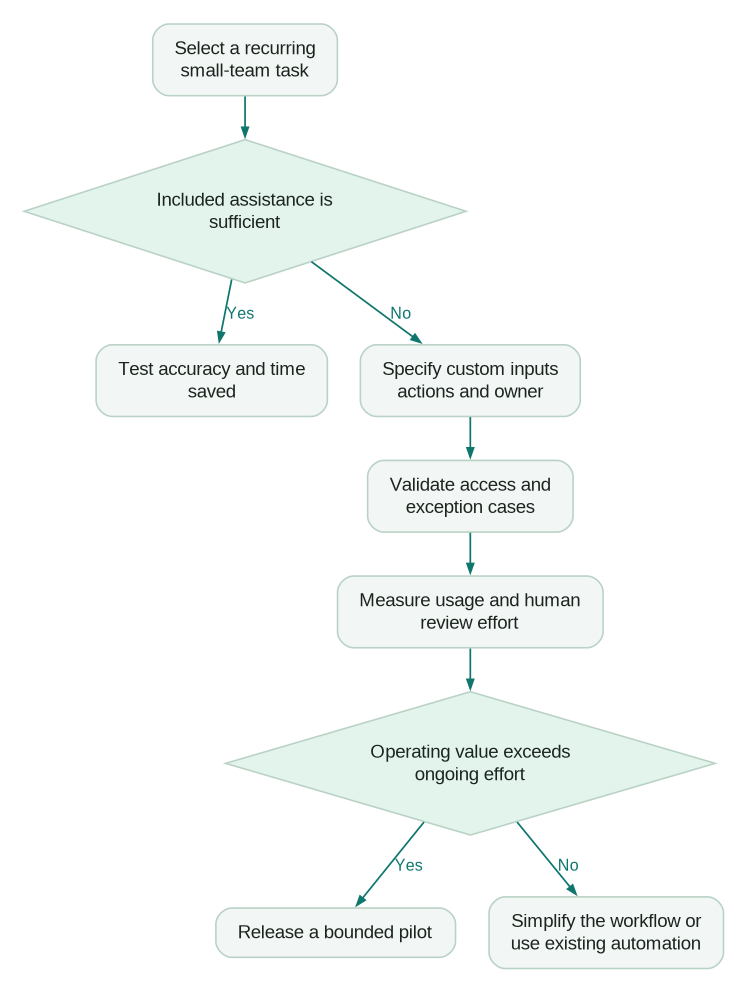
Read diagram as text
- Select a recurring small-team task to Included assistance is sufficient.
- Included assistance is sufficient to Test accuracy and time saved: Yes.
- Included assistance is sufficient to Specify custom inputs actions and owner: No.
- Specify custom inputs actions and owner to Validate access and exception cases.
- Validate access and exception cases to Measure usage and human review effort.
- Measure usage and human review effort to Operating value exceeds ongoing effort.
- Operating value exceeds ongoing effort to Release a bounded pilot: Yes.
- Operating value exceeds ongoing effort to Simplify the workflow or use existing automation: No
Which starting point fits a small team's situation?
Start with the smallest option that completes the job and can be maintained by the team. Use these scenarios to decide what to trial first:
| Situation | First option to test | What would justify more work |
|---|---|---|
| Meeting preparation inside clean Salesforce records | Included summaries or drafting | Required evidence spans records or systems the feature cannot use |
| Stable eligibility and routing rules | Existing reports or Flow | Interpreting varied context is a necessary part of the decision |
| Repeated renewal preparation across CRM, support and usage | A bounded custom workflow | The output passes exception tests and saves time after review |
| Customer-facing support across an existing helpdesk | A scoped support-agent trial | Equivalent completion rules, permissions and economics are understood |
| Missing ownership or unreliable source records | Repair the CRM process first | A named source owner can maintain the data the workflow needs |
Choose the runner-up when its operating burden is lower and the required outcome still passes. A small team does not benefit from a more capable design if nobody can explain a failure or maintain its access.
What would justify expanding the deployment?
Measure the time needed to finish the task, including review and corrections. Suppose a hypothetical 300 monthly account reviews fall from 12 active minutes each to five minutes of assisted work and three minutes of review. The gross reduction is 1,200 minutes, or 20 hours. Subtract ongoing administration and exception work before presenting that as available capacity.
Also record errors that could change the decision: wrong account, outdated issue, unsupported claim, duplicate task or inappropriate owner. A workflow that saves minutes while creating unreliable CRM records has an expensive downstream cost.
Before adding more tasks, confirm:
Checklist
- The exact edition and included versus purchased capabilities are recorded.
- A business owner accepts the output and exception rules.
- Required data has a freshness standard and accountable source owner.
- Each action's execution context and record access have been checked.
- Repeated requests do not create duplicate work.
- Pilot usage and human review time replace the original planning assumptions.
- Someone can pause the workflow, investigate failures and maintain its tests.
A small team should expand when the first workflow remains useful without constant specialist intervention. If every new customer case requires rewriting the prompt or repairing records, narrow the task and improve the underlying process. The most valuable Agentforce deployment may be a modest workflow that the team trusts and uses every week.
Bring the workflow specification, permission requirements and usage estimate to a detailed CRM implementation review. If the first uncertainty is the underlying data or process, book a free call to identify the work needed before expanding the agent.
Keep reading
 Martech AI
Agentforce Pricing: Flex Credits, Conversations, Users and Full Cost
Calculate Agentforce costs across Flex Credits, conversations, Help Agent resolutions and employee licences. Separate included allowances from CRM and data costs.
Jafrin Akter AloLast updated 11 min read
 Martech AI
BigQuery AI: Gemini, Data Agents and AI Functions for Marketing Data
Choose BigQuery AI tools for marketing data. Understand Gemini costs, data-agent setup, AI functions, permissions and how to verify useful outputs.
Jafrin Akter AloLast updated 14 min read
 Martech AI
GA4 AI: Ask Advisor, AI Summaries and Answers You Can Check
What GA4's AI features do: Ask Advisor, homepage AI summaries and predictive metrics, with prompts and checks that make each answer hold up in a report.
Jafrin Akter AloLast updated 11 min read
AI readiness score
Check your tracking, data, context and access before connecting an agent.
Questions people ask
How should a partial renewal appear in the preparation brief?
Separate the confirmed renewing scope from the part still being negotiated or ending. Keep the relevant contract or opportunity identifiers, quantities, dates and account owner visible, and avoid describing one accepted line as a complete account renewal. The proposed task should identify the unresolved portion and its next decision. A payment against one invoice does not, by itself, settle every renewal question.
How can two team members avoid creating the same follow-up task?
Give the intended operation a stable key, such as the account, renewal cycle and task purpose, and enforce duplicate protection in the action implementation. A prompt asking the agent to avoid duplicates is only an instruction. Test simultaneous requests and a retry after an uncertain response; both should resolve to the same intended task or an explicit exception for review.
What if account owners ignore the agent’s proposed follow-up tasks?
Treat unaccepted proposals as an adoption or relevance problem, not completed work. Ask whether the task reaches the right owner, arrives before the decision and contains evidence that changes what they should do. Record accepted, rejected and unanswered proposals separately. A larger queue of generated tasks is not a success measure when the team still performs the same preparation elsewhere.
What should we keep when the agent refuses a request that should be allowed?
Keep the request, intended user, relevant record identifiers, tool response and expected outcome in an appropriately restricted issue record. Separate a legitimate access denial from a missing permission, unavailable capability or misunderstood request. Fix the responsible layer and repeat the case with the same identity. Giving the whole workflow administrator access hides the cause and changes the boundary you intended to test.
How should a translated brief preserve a customer commitment?
Keep the original commitment available beside the translated summary, including amounts, dates and conditions. Have a suitably fluent reviewer check ambiguous or consequential language before the brief drives a commercial task. Record uncertainty instead of turning a tentative statement into a firm promise. The acceptance case should test preserved meaning, not merely whether the translated paragraph reads smoothly.
Sources
- Salesforce Agentforce in small-business Suites
- Set up Agentforce and generative AI for Salesforce Suites
- Salesforce Sales editions and annual Flex Credit allocations
- Salesforce Agentforce pricing
- Agent Script access block
- Salesforce Flow security considerations
- Agentforce Testing Center considerations
- Salesforce: Completed acquisition of Fin.
- Fin and Intercom: Outcome pricing.

Written by
Jafrin Akter AloData Engineer and Co-founder at Martechdevs and Growth and Analytics Partners
Jafrin writes practical guides to marketing technology, customer data, analytics and AI workflows. Martechdevs is a Growth and Analytics Partners company.