
Google Tag Manager Pricing: Free, 360 and Server Hosting
Data Engineer and Co-founder, martechdevs
Last updated 9 min read
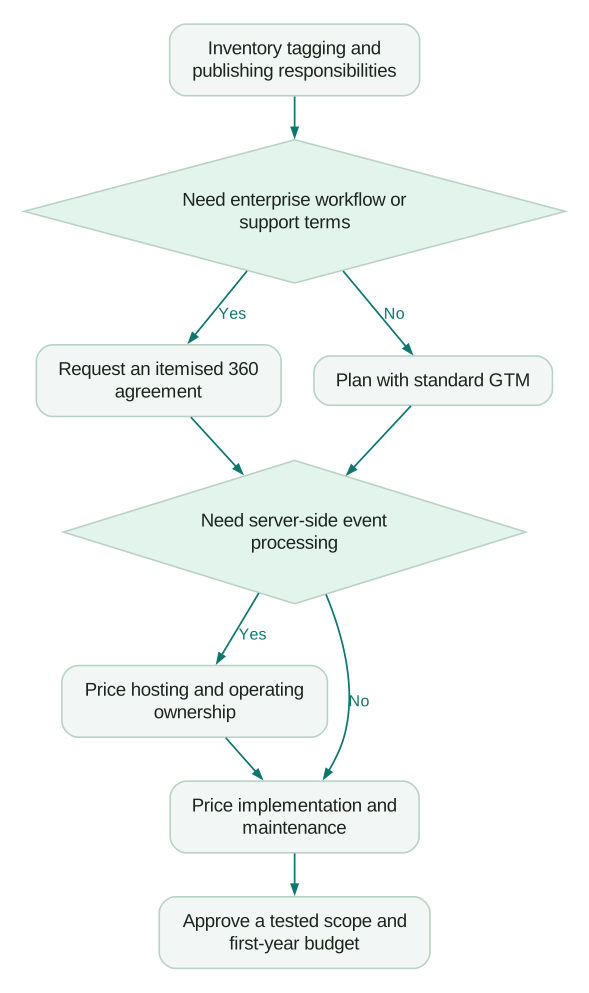
Google Tag Manager’s standard product is free. Tag Manager 360 adds enterprise workflow and support features through a sales agreement, while server-side tagging can create a separate hosting bill. Budget for three decisions: the GTM edition, the infrastructure your architecture needs, and the implementation and maintenance needed to keep measurement correct. A free licence can still require paid work.
Last updated: 9 September 2026.
A quote labelled “GTM setup” can cover anything from installing a container to rebuilding ecommerce measurement across several domains. Those deliverables have different costs, even when both use the same free product.
Start by separating the supplier’s charges. Ask which amount buys a software entitlement, which pays for infrastructure, and which buys implementation work. An analytics and tracking project should make those responsibilities visible before you compare prices.
This guide is for the marketing or operations owner approving that budget. The figures below describe documented product terms or explicitly labelled planning assumptions. They are not a claim that every company needs an enterprise licence or a server container.
What does the free version include?
Google’s edition comparison lists standard Tag Manager as free, with support for Google and non-Google tags, rule-based triggers and multiple users. It lists Tag Manager 360 through a sales conversation. Google does not publish a standard 360 price on that comparison page.
For a team managing one website with a clear publishing owner, the standard edition may cover the required workflow. Website traffic alone is a poor reason to assume that 360 is necessary. Identify the feature, contractual requirement or operating problem behind the upgrade request.
The practical constraint many teams encounter is concurrent work. Standard containers have a default workspace and up to two additional workspaces. Google documents unlimited workspaces for 360. A workspace groups a set of changes; it does not create an independent production container. All workspaces still feed the container’s version history. See Google’s workspace documentation.
Suppose your team has an ecommerce release, a consent update and an agency campaign change running at once. Three available workspaces might be sufficient if their release dates and ownership are coordinated. If abandoned workspaces occupy those slots, review and publish the completed work, or delete an obsolete workspace after preserving any needed changes before interpreting the shortage as a licensing problem.
Write down the expected concurrency over a normal month and a busy launch period. Count genuinely independent changes, identify who publishes each one, and record the delays caused by the current process. That gives an enterprise discussion something more concrete than “we are growing.”
What would justify Tag Manager 360?
Evaluate 360 when its specific governance or support features remove an identifiable constraint. Google’s documentation names enterprise support and an SLA covering container serving and configuration-interface availability. Read the actual terms in your proposed agreement rather than treating “SLA” as a promise that every measurement issue will be fixed within a particular time. See Google’s 360 overview.
Three questions make the evaluation useful:
- Do several teams need more concurrent workspaces than the standard edition provides?
- Does your release process require the product’s approval workflow?
- Do separately managed teams or agencies need constrained tagging access through zones?
A zone can load another container within defined page boundaries and restrict allowed tag types. Google documents zones as a 360 feature. For example, an agency’s container might operate only on campaign pages, with a narrower set of permitted tags. Those boundaries need a design and an owner. See Google’s zones documentation.
Buying access to zones does not automatically create a safe delegation model. Someone must decide which pages belong in each zone, which tag types are permitted, and how an agency’s change will be checked across the complete journey. The useful budget includes that setup and its ongoing review.
Describe the problem in measurable terms before requesting a quote. “Four teams frequently wait for a workspace, delaying a release by two days” is a testable operating issue if your release records support it. “Enterprise tracking will be more accurate” needs a specific mechanism before it becomes a business case.
Is server-side GTM a separate paid edition?
Server-side tagging introduces an execution environment whose hosting can cost money. Treat that infrastructure separately from the standard-versus-360 licence decision. The architecture still needs collection, event processing, destinations and operating ownership.
Google’s Cloud Run setup guide estimates about USD45 per instance per month for its stated configuration of one vCPU and 0.5GB memory with CPU always allocated. Its two-instance example therefore starts around USD90 per month for those instances. This is a configuration estimate, not a complete fixed-price hosting package.
Include network traffic, logging, routing, additional regions and other services your chosen deployment uses. Google’s infrastructure planning guide explains how those cost categories and operational responsibilities affect the total. The free or low-cost testing setup should not become the production capacity plan by accident.
A managed hosting provider uses its own billable unit and limits. A request allowance cannot be compared directly with GA4 sessions: one session can produce several events and other requests. Ask the provider which incoming requests, script delivery and additional operations count toward its allowance.
Use the separate server-side GTM hosting comparison for that decision. Keep this question first: what will the server container do that your current implementation needs? Examples include applying a documented field policy before dispatch or coordinating permitted events across destinations. An undefined promise of better tracking is too vague to price.
What belongs in a GTM implementation quote?
Price the business outcomes and technical boundaries. The number of tags is only one input because a purchase event across several checkout paths can require more work than a set of simple page-view tags.
Ask each supplier to describe these deliverables in the same format:
- Journey scope: the domains, applications, forms, checkout paths and environments included.
- Event contract: the trigger, business meaning, required values, identifiers and owner for each event.
- Implementation responsibility: who changes application code, the data layer, the consent configuration and destination settings.
- QA evidence: the accepted journeys, expected events, duplicate checks, values and destination receipts that will be recorded.
- Release ownership: who approves, publishes and reverses a change when a production check fails.
- Handover: container access, documentation, test cases, alert ownership and a defined support period.
An event contract is the written agreement about what an event means and when it should be sent. If that agreement is missing, the cheapest implementation can simply encode an unresolved argument. The tracking-plan guide gives the fields to settle before building.
Separate fixes from new scope. Repairing a form trigger does not automatically include a CRM integration that reports qualified pipeline. If the commercial goal requires that integration, put it in the quote so the event cannot be declared complete at the first browser request.
At Martechdevs, implementation projects start from USD3,000. Full warehouse, end-to-end visualization and activation work can reach USD15,000. Those are service scope anchors, not GTM software prices or a promise that every tracking change costs the same amount. A scoped quote should identify the included work before applying either figure.
How do you calculate the first-year cost?
Use a consistent period and separate cash costs from internal time. The basic structure is:
First-year cash cost =
  annual software charges
  + 12 × monthly infrastructure charges
  + one-time external implementation cost
  + annual external support cost

First-year operating effort =
  initial internal hours
  + 12 × monthly internal maintenance hours
The following is an illustrative planning example. It uses invented assumptions so you can replace them with your own estimates; it is not a vendor quote or a typical-market benchmark.
A team chooses standard GTM with USD0 licence cost. It budgets USD60 per month for a selected hosting arrangement, USD4,000 for a defined implementation and USD600 per year for external support. First-year cash cost is USD0 + USD720 + USD4,000 + USD600 = USD5,320.
The same team estimates 12 internal hours for review and acceptance, plus two hours each month for maintenance. That is 36 internal hours in year one. At its own assumed loaded cost of USD80 per hour, the planning value of that time is USD2,880. Cash plus this internal-time valuation totals USD8,200.
Keep both numbers. USD8,200 does not mean an USD8,200 supplier invoice arrives, and USD5,320 does not mean the team spends no time operating the setup. Finance can use the appropriate view without losing the assumptions.
Run a second scenario for growth. If hosting doubles to USD120 per month and maintenance rises to three hours per month, cash becomes USD6,040 and internal time becomes 48 hours, valued at USD3,840. The combined planning total is USD9,880. The increase is USD1,680 under these assumptions.
For 360, replace the software-charge input with the written quote and add any mandatory services. Do not insert a price copied from an old Analytics contract or a reseller’s unrelated bundle.
What should you ask a 360 sales partner?
Send the same brief to each supplier and request written answers. A comparable quote should make these points explicit:
- Which product and edition are being purchased, and which accounts or containers the agreement covers.
- Whether another product purchase is required, and whether the price is standalone or part of a bundle.
- The contract term, payment schedule, renewal rules, taxes and currency.
- The support provider, support hours, escalation route and relevant SLA terms.
- Which onboarding and migration work is included, with acceptance criteria.
- What changes on expiry or downgrade, including operational access and responsibility.
A bundled discount can be useful when you already need every included product. Compare the incremental cost of the actual decision, while keeping any longer commitment visible. Avoid allocating a bundle’s entire price to GTM and then using that number as a universal GTM price.
Ask the supplier to demonstrate the workflow you intend to buy. Use a representative release: an agency submits a change, an internal owner reviews it, the correct environment is tested, and an approved person publishes. Record what the product enforces and what remains a team procedure.
How do you keep the bill and the work under control?
Remove undefined scope before negotiating the price. Pick the critical journeys, agree their event contracts and stage lower-priority measurement after the first release. A smaller accepted implementation is easier to operate than a large collection of unowned tags.
Review the active container for obsolete vendors, duplicate delivery paths and unused work. Each retained component needs a reason, an owner and a test. The GTM implementation mistakes guide helps identify failures that a licence upgrade would leave untouched.
For hosted processing, track actual usage and campaign peaks. Give quota and billing alerts to someone who can act. Set the consequence of a limit deliberately: increased spending, limited capacity and paused delivery are different operational decisions.
Before approving the budget, confirm:
Checklist
- The licence choice maps to a required feature or agreement.
- Infrastructure has its own forecast and operating owner.
- Implementation includes the relevant application and destination work.
- QA checks business outcomes, identifiers, values and duplicates.
- The team has a rollback path and can access its own configuration.
- The first-year calculation separates cash, internal time and assumptions.
Use the martech business-case guide when the decision needs finance approval. Attach the measured workflow problem and the acceptance criteria to the cost estimate. That makes the spend reviewable after the project is delivered.
Questions people ask
Is Google Tag Manager free for business use?
Google offers the standard Tag Manager product for free. Your business can still incur implementation, maintenance and infrastructure costs. Budget those separately so the licence price does not hide the work required to operate measurement.
How much does Google Tag Manager 360 cost?
Google’s public comparison directs buyers to sales and does not provide a universal list price. Request a written quote for the actual agreement and required services. A price from another company’s bundle may describe a different purchase.
Do I need GTM 360 for server-side tagging?
The server-side architecture and the GTM edition are separate budgeting decisions. Evaluate hosting and operating requirements for the server environment, then assess whether you also need 360’s workflow or contractual features. Do not combine those questions into one assumed upgrade.
Is GTM pricing based on my website’s page views?
The standard product is offered free. Hosting used for server-side processing may have request-based allowances or cloud-resource charges, which need their own forecast. Page views, sessions, events and billable requests should not be treated as interchangeable counts.
Will paying for 360 fix inaccurate conversions?
A paid edition can improve specific governance and support arrangements. Conversion accuracy still depends on event definitions, triggers, identity, consent handling and destination configuration. Diagnose the failing journey and test the fix before attributing the problem to the licence.
Sources
- Google, Compare Tag Manager and Tag Manager 360, accessed 9 September 2026.
- Google, Workspaces, accessed 9 September 2026.
- Google, About Google Tag Manager 360, accessed 9 September 2026.
- Google, Zones, accessed 9 September 2026.
- Google, Set up server-side tagging with Cloud Run, updated 12 May 2026, accessed 9 September 2026.
- Google, Planning infrastructure requirements and costs, updated 9 October 2024, accessed 9 September 2026.
Written by
Jafrin Akter AloData Engineer and Co-founder, martechdevs
Jafrin Akter Alo is a data engineer and co-founder of martechdevs, where the team has delivered 74+ martech, data and growth stack implementations.