
Fintech Marketing Stack: Track the Funnel Without Leaking Financial Data
A fintech marketing stack should measure application, verification and account milestones from authoritative backend records while controlling what each destination receives. Keep identity documents, financial details and decision reasons in their approved systems. Build useful internal funnel analysis first, then review any advertising or messaging flow separately. A neutral event name, hashed identifier or server-side connection does not by itself make a financial-data disclosure acceptable.
On this page

What makes the fintech stack different?
The decisive fintech outcomes often happen outside the browser, and their underlying information can be inappropriate for general marketing destinations. An application submitted, identity verified, customer approved, account opened and payment settled are different facts with different owners.
Design two connected but separately controlled paths: an internal operational measurement path and any specifically approved external activation path. Do not assume the second path should receive every event from the first.
| Layer | Owns | Must not be inferred from |
|---|---|---|
| Application backend | Application identity and workflow state | A form button click |
| Verification system | Verification session and check results | The applicant closing a verification window |
| Risk or account-opening service | The institution's actual decision and account state | A successful identity check alone |
| Financial ledger and payment systems | Funding, settlement, reversals and balances | A marketing conversion event |
| Approved internal analytics | Defined milestone analysis | Unreviewed copies of documents or financial fields |
| CRM and lifecycle systems | Permitted operational actions and communications | An assumption that every known customer can receive marketing |
The industry-stack guide covers the wider business-model comparison. This guide focuses on implementing a measurable fintech funnel with explicit data boundaries. The legal examples are U.S. examples for qualified review, not legal advice or a determination that every fintech has the same obligations.
Start by naming the product, customer population, countries, regulated entities and service-provider roles. A B2B treasury-software seller and a consumer lender should not inherit one blanket marketing configuration because both describe themselves as fintech.
Which milestone events should the backend confirm?
Track a small set of meaningful state transitions, preserving the application or account being counted. Separate attempts, sessions, decisions and financial outcomes so retries cannot inflate the funnel.
| Milestone | Authoritative trigger | Counting unit | Detail to keep separately |
|---|---|---|---|
| Application started | Application record is created | Application | Raw form answers |
| Verification submitted | A verification attempt is accepted for processing | Verification session linked to application | Identity documents and biometric material |
| Verification resolved | The selected checks finish | Verification session and result | Detailed failure reasons and raw evidence |
| Application decision recorded | The responsible service records its decision | Application decision/version | Underwriting, fraud or compliance rationale |
| Account opened | Account service confirms creation and usable state | Financial account | Account credentials and full identifiers |
| First funding confirmed | The defined settled funding condition holds | Account plus qualifying transaction | Amount, instrument and financial history |
| First qualifying transaction | Ledger confirms the chosen eligible outcome | Account plus transaction | Raw transaction details |
These are example internal milestones, not a recommended advertising event list. Some products need different states, including manual review, pending funding or an account opened without immediate eligibility for every feature.
Stripe Identity illustrates the asynchronous boundary. Its verification-session events distinguish successful checks from a result requiring more input. The handler must verify incoming events and interpret the actual session state. A verified identity session is not itself a credit decision or proof that a financial account was opened. Stripe Identity outcomes
Define the milestone and its system in the tracking plan. Our martech integration work connects those sources to the approved CRM and analytical outputs while preserving their distinct meanings.
How should verification webhooks become reliable funnel records?
Use a verified, durable event-processing path that separates receipt from business interpretation. The browser can describe the user experience, but backend state should establish whether the milestone happened.
- Verify the source signature using the vendor's supported method and required raw request body.
- Persist the delivery identifier and processing status in the controlled environment.
- Resolve the application-to-verification-session mapping.
- Retrieve authoritative state when the event does not establish the needed current fact.
- Write the permitted internal milestone with its business identity and occurrence time.
- Reconcile unresolved deliveries and missing mappings through an owned exception queue.
Stripe's general webhook guidance warns that deliveries can repeat and arrive out of order. Event IDs help identify duplicate deliveries; timestamps alone do not establish ordering. Keep those vendor-specific guarantees separate from the business rule for one application's first successful milestone. Webhook ordering and duplicate handling
A customer may submit documents twice, producing two verification sessions. That is two attempts, not automatically two acquired customers or two completed applications. Preserve attempt-level analysis for friction while calculating the business funnel at its declared application or account grain.
Do not solve an unresolved mapping by matching the first record with a similar name or email. Hold the analytical projection and retain the operational evidence. The customer-facing system should have its own recovery process; a marketing pipeline must not decide the applicant's eligibility.
Which information belongs in each destination?
Approve data by purpose, recipient and context. Removing a field named balance is insufficient if the event name, URL, audience membership or attached identifier still reveals the same financial information.
Use an explicit destination register:
| Data class | Controlled source | Proposed marketing treatment | Release evidence |
|---|---|---|---|
| Documents, biometric checks and detailed verification reasons | Approved identity/compliance systems | Exclude from general marketing collection | Synthetic sensitive markers absent from requests and logs |
| Balances, credit attributes and transaction details | Core financial and approved analytical systems | No general forwarding to ad or lifecycle tools | Purpose-specific field and recipient review |
| Internal workflow milestone | Backend plus approved funnel model | Minimum necessary internal projection | Correct grain, access and retention controls |
| Support task | Approved operations or CRM workflow | Only the detail needed for the assigned action | Agent access and message-content tests |
| External conversion or audience membership | Separately approved derived record, if permitted | Disabled until the exact use is approved | Product, recipient, policy and permission evidence |
Pseudonymous identifiers still require control. An application key linked to an identifiable customer is not automatically anonymous. A hashed email can remain useful for matching, which is precisely why hashing alone does not settle whether the disclosure is allowed.
Include passive collection in the review: page URLs, query strings, titles, form fields, session replay, error reports, support attachments, event debug logs and reverse proxies. A carefully filtered analytics event can coexist with an error tool copying the raw application response elsewhere.
For application and verification pages, start with unnecessary replay and general advertising collection disabled. Enable a narrowly justified analytical route only after the actual payload, purpose and recipient controls have passed review.
How do advertising restrictions change the design?
Review the product category, underlying event meaning and audience criteria before configuring conversion uploads. Technical acceptance by an API is not permission to use the data, and renaming an event does not change the event's underlying meaning.
For Google, negative financial status is a sensitive interest category. Its examples include financial distress and debt-focused products or support; advertiser-curated audiences such as Customer Match cannot be used when promoting in that category. This is not a statement that every fintech product falls into it. Google negative-financial-status policy
Google's consumer-finance rules separately restrict targeting by age, gender, parental status, marital status and ZIP code in the United States and Canada. Review both categories when relevant rather than treating “financial services” as one unrestricted or universally prohibited class. Google consumer-finance targeting
For any proposed Meta or Google outcome, the review should specify the actual product, page context, event definition, payload, matching identifiers, audience use and applicable terms. A funded-account event can imply financial information even when it contains no amount. A cohort named “completed users” can still be selected from a sensitive financial condition.
If the relevant outcome cannot be shared, keep it in approved internal measurement. Compare permitted aggregate acquisition activity with internal cohorts at a suitable level, or use an appropriate experiment. Do not disguise a prohibited financial milestone as a harmless registration event to preserve an optimization signal.
The offline conversion guide, enhanced-conversion guide and Meta server-event setup describe delivery mechanisms. Their technical controls do not replace this destination-specific decision.
What do GLBA, Regulation P and security obligations add?
They add obligations that depend on the institution, information, recipient and purpose. Have the qualified privacy and legal owners map the actual flow before engineering treats a vendor integration as approved.
The FTC describes the Gramm-Leach-Bliley Act as requiring covered financial institutions to explain information-sharing practices and safeguard sensitive customer information. Its Safeguards Rule guidance describes a comprehensive security program for covered non-banking financial institutions; the rule also addresses service-provider safeguards. FTC GLBA overview, FTC Safeguards guidance, Safeguards Rule scope
Regulation P section 1016.10 generally conditions disclosure of nonpublic personal information to a nonaffiliated third party on the required initial notice, opt-out notice, reasonable opportunity to opt out and the consumer not opting out, except as otherwise authorized in the regulation. Regulation P disclosure conditions
The exceptions matter. Section 1016.13 provides a service-provider and joint-marketing exception to specified opt-out requirements when its conditions are met, including an initial notice and a contract limiting use and disclosure to the stated purposes. It is not an automatic exception for every tool called a service provider. Regulation P service-provider exception
Record the approved purpose, data categories, contract scope, recipient use, retention and security owner. A legal basis for a particular disclosure does not require an advertising platform to accept it under its own terms. Conversely, a platform offering an API does not establish that the institution's disclosure conditions are satisfied.
For other countries or regulated activities, obtain the relevant local determination. Do not apply this U.S. summary as a global clearance for email, SMS, financial promotions, customer-data sharing or application tracking.
How can the team build a minimal internal event projection?
Construct a small canonical event from approved backend facts instead of forwarding the full verification or account payload. Keep the projection separate from advertising delivery, and reject unexpected fields so schema expansion cannot silently widen the data flow.
The following original Python 3 example validates a deliberately narrow internal record for a one-account-per-application product. A product with several accounts per application needs a reviewed account identifier and counting rule too. route_approved must come from the application's approved routing configuration, not the incoming vendor payload. The function does not send anything, resolve legal permissions or authenticate a caller.
from datetime import datetime
import re

def internal_funnel_event(record, route_approved):
    if route_approved is not True:
        raise PermissionError("Internal route is not approved")
    fields = {"event_id", "application_key", "milestone", "occurred_at"}
    if type(record) is not dict or set(record) != fields:
        raise ValueError("Unexpected or missing fields")
    if any(type(record[key]) is not str for key in fields):
        raise ValueError("Every field must be a string")
    allowed = {
        "application_started", "verification_submitted",
        "verification_resolved", "account_opened",
        "first_funding_confirmed"
    }
    if record["milestone"] not in allowed:
        raise ValueError("Unapproved milestone")
    for key, prefix in (("event_id", "evt_"), ("application_key", "app_")):
        if not re.fullmatch(prefix + r"[A-Za-z0-9_-]{1,64}", record[key]):
            raise ValueError("Invalid internal identifier")
    occurred = datetime.fromisoformat(record["occurred_at"].replace("Z", "+00:00"))
    if occurred.tzinfo is None or occurred.utcoffset() is None:
        raise ValueError("Occurrence time needs a timezone")
    return {key: record[key] for key in sorted(fields)}
Use separately generated opaque identifiers. A string matching the format can still encode sensitive meaning, so the trusted producing service must control identifier generation. The milestone allowlist itself remains sensitive internal context; it is not an advertising allowlist.
Access, signature validation, durable processing, retention and outbound network controls remain outside this small projection. Test them in the actual implementation. Keep rejected payload details in the approved diagnostic system, with a minimized operational error elsewhere; logging the full rejected record would recreate the disclosure you tried to prevent.
How should consent and communication preferences travel?
Keep current channel eligibility, purpose and evidence available before each applicable message or export. Do not reduce these controls to one global consent=true property.
A customer can need an account-service notice while declining promotional email. SMS, push and email can have different permissions and delivery restrictions. Define the approved message category and necessary content with the responsible owner, then keep regulatory or service communications outside ordinary promotional journey logic.
Use the preference-center design to preserve purpose, channel, source and changes. Recheck eligibility when queued work dispatches, not only when someone first entered a journey. A preference withdrawn while a campaign waits should not remain stale in another tool.
For operational tasks, avoid exposing detailed risk or decline reasons in marketing templates. A support owner may need “review required” and a link into the authorized system, while the sensitive evidence stays behind its existing access controls.
Test profile merges, changed phone numbers, shared contact details and account closure. Reassigning one record should not transfer another person's permissions or reopen an excluded marketing route.
What does a controlled application-to-funding journey look like?
Keep each milestone in its authoritative system and project only the approved minimum into internal analysis. External delivery is a separate decision that can legitimately remain disabled.
In a hypothetical journey, a person arrives through a paid campaign, starts an application, submits verification, enters manual review, is approved, opens an account and completes the first settled funding transaction three days later.
| Journey event | Source record | Internal measurement | External advertising treatment |
|---|---|---|---|
| Acquisition visit | Permitted acquisition evidence | Retain only approved source context | Only the separately approved public-site collection |
| Application started | Application backend | One application milestone | No automatic forwarding |
| Verification submitted and reviewed | Verification and review systems | Attempt and application counts remain separate | Documents, results and reasons remain excluded |
| Account opened | Account-opening service | One confirmed account milestone | Separate destination review required |
| Funding settled | Financial ledger | First eligible funded-account outcome | No default funded-customer upload |
The three-day delay belongs in the internal time-to-funding measure. It should not become a browser conversion merely because the marketing team wants same-session reporting. Store occurrence and receipt times separately so late processing does not masquerade as customer delay.
If a future external outcome is approved, give it a separate contract and release tests. If it is not approved, preserve the internal business measure and explain the limits of the advertising view. Useful measurement does not require every system to receive the same information.
How do you calculate funnel loss without mixing attempts and customers?
Use one defined entry cohort and report pending, declined, incomplete and completed states separately. Compare accounts or applications to the matching denominator, and retain the observation window so immature cases do not look like permanent loss.
Consider an original hypothetical cohort of 1,000 applications, with at most one account opened per application. Seven hundred submit verification. At the cutoff, 500 are approved, 100 declined, 60 remain in manual review and 40 await more input. Four hundred fifty approved applications have opened an account; 270 of those accounts have completed first funding.
| Measure | Calculation | Result |
|---|---|---|
| Submission rate | 700 / 1,000 applications | 70% |
| Approval among submitted | 500 / 700 | 71.4% |
| Still unresolved among submitted | (60 + 40) / 700 | 14.3% |
| Account opening among approved | 450 / 500 | 90% |
| First funding among opened accounts | 270 / 450 | 60% |
| First funding from application start | 270 / 1,000 | 27% |
The 300 unsubmitted applications, 100 declines and 100 unresolved submissions are different populations. A resend or second document session should not add another application to the denominator. The fifty approved-but-not-opened cases also deserve a separate operational explanation.
These figures describe the cohort at a cutoff, not a forecast that every pending applicant will fail or succeed. Review age buckets and processing time before assigning a drop-off cause. A delayed review queue needs a different intervention from a confusing submission form.
Which stack additions are justified at each operating stage?
Start with the systems that establish outcomes and enforce data boundaries. Add analytics, lifecycle and warehouse capabilities only with a named owner and a demonstrated use case.
| Operating need | Capability to evaluate | Selection gate |
|---|---|---|
| Understand application friction | Approved internal funnel analytics | Minimal event contract, access controls and reliable source reconciliation |
| Coordinate support and review tasks | Scoped CRM or case-management workflow | Necessary fields only, appropriate access and no automatic marketing enrollment |
| Deliver eligible customer communications | Lifecycle or service-message platform | Purpose, permission, content and cancellation behavior |
| Join application, decision and ledger history | Governed warehouse models | Defined relationship keys, retention and repeatable reconciliations |
| Improve acquisition decisions | Approved measurement and experiments | Destination-policy fit and clear visibility limits |
Do not choose a product solely because its website lists financial-services customers or a broad certification. Review the actual feature, hosting arrangement, subprocessors, contractual purpose, access, retention and exports that your implementation would use.
A data warehouse can make controlled internal analysis easier to govern, but it does not automatically make every resulting audience or export permissible. Maintain the same destination register for reverse ETL, AI tools and downloaded reports.
What should pass before this fintech stack goes live?
Require both business-state correctness and demonstrated data boundaries. A complete funnel chart is not sufficient if raw application details escape through a second collection route.
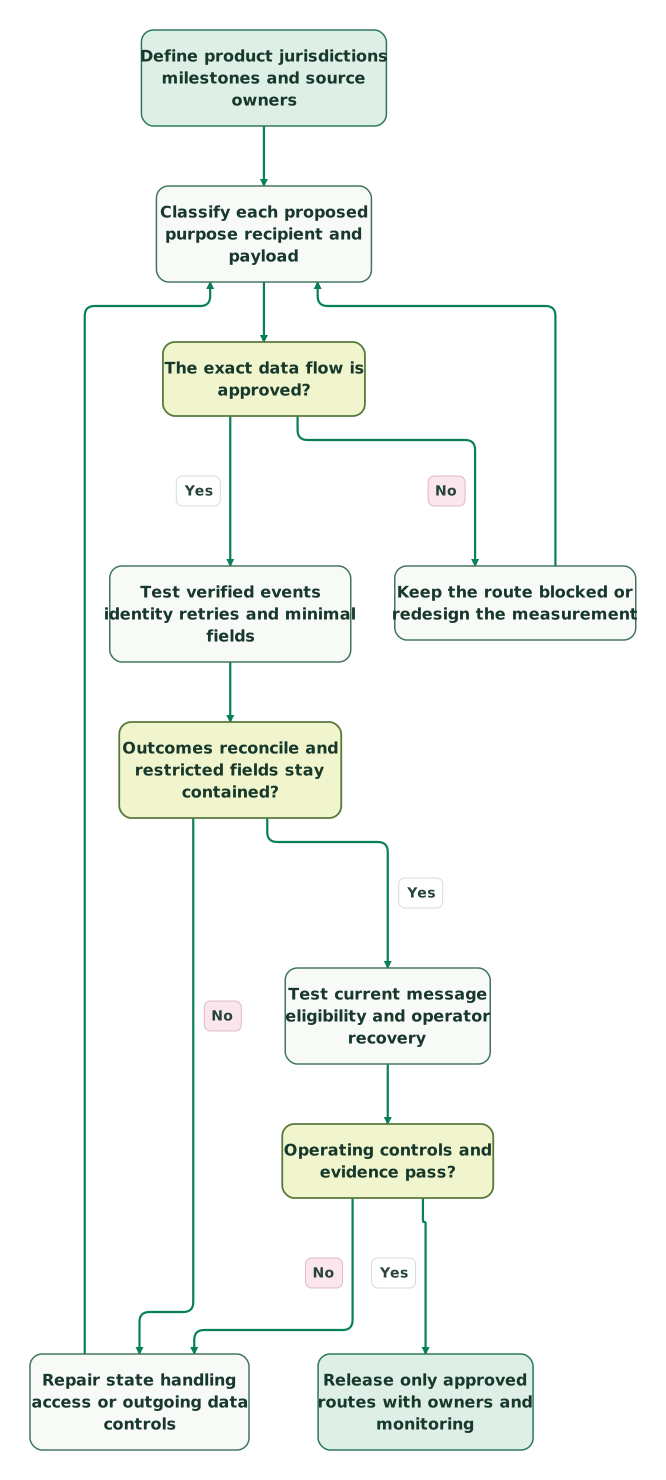
Read diagram as text
- Define product jurisdictions milestones and source owners to Classify each proposed purpose recipient and payload.
- Classify each proposed purpose recipient and payload to The exact data flow is approved?.
- The exact data flow is approved? to Keep the route blocked or redesign the measurement: No.
- Keep the route blocked or redesign the measurement to Classify each proposed purpose recipient and payload.
- The exact data flow is approved? to Test verified events identity retries and minimal fields: Yes.
- Test verified events identity retries and minimal fields to Outcomes reconcile and restricted fields stay contained?.
- Outcomes reconcile and restricted fields stay contained? to Repair state handling access or outgoing data controls: No.
- Repair state handling access or outgoing data controls to Classify each proposed purpose recipient and payload.
- Outcomes reconcile and restricted fields stay contained? to Test current message eligibility and operator recovery: Yes.
- Test current message eligibility and operator recovery to Operating controls and evidence pass?.
- Operating controls and evidence pass? to Repair state handling access or outgoing data controls: No.
- Operating controls and evidence pass? to Release only approved routes with owners and monitoring: Yes
Checklist
- Application, verification, decision, account and funding states have distinct owners.
- Repeated attempts and webhook deliveries do not multiply customers.
- Unknown mappings and incomplete source evidence remain visible.
- Sensitive fields, URLs, replay and diagnostic logs are included in the data-flow review.
- Every external destination has an approved purpose and exact payload scope.
- A neutral name or hashed identifier is not treated as disclosure approval.
- Relevant legal, contractual and platform conditions are reviewed separately.
- Current channel eligibility is evaluated before applicable delivery.
- Synthetic boundary tests cover unexpected fields and denied routes.
- Another operator can reconcile, stop and recover the workflow.
Start with the $99 martech audit to map the current recipients and gaps. For a defined implementation, request a detailed integration scope covering the source systems, approved projections, permission controls and acceptance evidence.
Keep reading
Browse all Martech Strategy guides
 Martech Strategy
B2B SaaS Martech Stack: Connect Product, Sales and Billing
Design a SaaS stack around accounts, activation and billing. Compare sales-led, product-led and hybrid workflows with qualification and reconciliation checks.
Jafrin Akter AloLast updated 14 min read
 Martech Strategy
Mobile App Marketing Stack: Subscription Data, Tools and Release Tests
Build a subscription app stack around store state, identity, revenue and lifecycle messaging. Includes pricing context, reconciliation code and release tests.
Jafrin Akter AloLast updated 17 min read
 Martech Strategy
Ecommerce Martech Stack: Shopify Events, Consent and Margin
Build a Shopify stack with clear purchase ownership, consent controls, lifecycle rules and margin reporting. Trace one order through an upsell and refund.
Jafrin Akter AloLast updated 15 min read
Martech integration
See the implementation scope, deliverables and acceptance checks.
Questions people ask
Can a successful identity check automatically trigger an account-opened conversion?
No. Identity verification and the institution's account-opening decision are separate states. The responsible backend must confirm that the actual account exists and satisfies the intended milestone. Keep any additional review, eligibility or provisioning steps visible. Even after the internal milestone is confirmed, whether it may be sent to an advertising destination requires a separate review of the underlying information and intended use.
Should an unresolved manual review count as a declined application?
No. Keep unresolved review separate from a final decision and include the observation cutoff. Measure queue age and processing time so the team can distinguish operational delay from applicant abandonment or a confirmed decline. If historical reporting needs a mature cohort, use an explicit maturity rule rather than recoding pending records into failures to make the percentages easier to present.
Is a server-side event automatically more private than a browser event?
No. Server-side delivery changes where the request originates and can improve field control, but it can still disclose the same restricted information or send data to an unapproved recipient. Inspect its payload, identity, purpose, logs and permission handling. A route that bypasses a browser limitation is not thereby authorized to bypass the customer's choices, the institution's obligations or the destination's terms.
Can a CRM user see that a customer needs help without seeing the reason?
Often the operational task can use a minimized status and a link to the authorized system. Define what the assigned role needs to do, then provide only the information needed for that action. Keep detailed verification, risk or financial evidence behind its existing access boundary. Test templates, exports and automation so the minimized status does not become a route for broader disclosure.
What should happen when a new vendor adds fields to its webhook payload?
Treat the change as an input-schema change requiring review. A strict projection should reject or quarantine unexpected data instead of forwarding every new field automatically. Preserve enough controlled diagnostic evidence to identify the change, then assess purpose, sensitivity and mapping before modifying the approved schema. Re-run both positive and prohibited-field tests so a routine vendor update cannot silently expand external collection.
Sources
- Stripe Identity verification outcomes
- Stripe webhook ordering and duplicates
- Google negative-financial-status targeting policy
- Google consumer-finance targeting restrictions
- FTC GLBA overview
- FTC guidance on the Safeguards Rule
- FTC Safeguards Rule scope
- CFPB Regulation P disclosure conditions
- CFPB Regulation P service-provider exception

Written by
Jafrin Akter AloData Engineer and Co-founder at Martechdevs and Growth and Analytics Partners
Jafrin writes practical guides to marketing technology, customer data, analytics and AI workflows. Martechdevs is a Growth and Analytics Partners company.