
Hightouch Pricing: Count Activation Work Before You Compare Quotes
Hightouch offers a free entry point for basic Reverse ETL, while its broader activation products require a quote. To estimate your cost, inventory the syncs and journeys you will actually run, identify required features, and add warehouse compute and operating work. A destination count alone will not tell you what the system costs to buy or maintain.
On this page

A founder asking for Hightouch pricing usually needs a more practical answer: can this replace fragile exports and manual audience work at a cost the business can justify? That decision depends on how the company activates data, not just how many customers it has.
Start with what reverse ETL is for: a short list of useful actions. Perhaps sales needs an account health score, lifecycle marketing needs an eligibility flag, and paid media needs a suppression audience. Each action needs an owner, a reliable source model and an acceptable delay. Buying activation software before those decisions creates a subscription attached to unfinished data work.
Our warehouse and CDP implementation work starts with those requirements. They also make a software quote much easier to challenge: the vendor and your team are pricing the same workload.
What does Hightouch publicly disclose about pricing?
Hightouch publishes a free Basic Reverse ETL plan and quote-based usage pricing for Composable CDP and Agentic Marketing Platform. The public page names the products; it does not provide a universal paid rate card.
What are the three current packages?
Hightouch pricing lists Basic as free; paid USD rates, billing periods and commitments are not published in this table and must come from the quote.
| Package | Published commercial basis | Listed scope | Confirm in the quote |
|---|---|---|---|
| Basic Reverse ETL | Free, up to 2 active syncs | Unlimited destinations and user seats | Required sync behaviour and documented usage limits |
| Composable CDP | Usage-based, quote required | Reverse ETL, Events, Customer Studio, real-time personalisation, Identity Resolution and Match Booster; Data Agents listed | Purchased modules, meters and entitlements |
| Agentic Marketing Platform | Usage-based, quote required | Ad Studio, Lifecycle Studio and AI Decisioning; preset monthly personalised actions | Action definition, included volume and expansion terms |
The feature documentation still uses labels such as Business tier. Do not assume a package name establishes every documented entitlement. Have the order form map each required feature to the plan you are buying. No startup discount is published on the pricing page checked here; confirm any offered programme and its expiry directly.
Do not treat an old starting-price figure from a comparison article as a current offer. A price without a product, meter, commitment and feature list is not usable procurement information.
Separate your request into three layers:
- Required outcome: the business action, such as excluding current customers from acquisition campaigns.
- Required capability: the model, destination behavior, refresh frequency and controls needed to deliver it.
- Commercial package: the vendor's proposed products, limits and contract terms.
This prevents an impressive bundle from becoming the definition of your requirements. It also helps identify capabilities you already operate successfully elsewhere.
How do the documented self-serve limits work?
Hightouch's self-serve documentation lists two active syncs for Free and ten for Self-serve, an hourly maximum sync frequency, one workspace per organization and a monthly cap of 100 million operations. It does not impose separate limits on destination types, user seats or the number of sync runs. That document was last updated in September 2025, so confirm the availability and commercial terms of the named Self-serve package for your account rather than assuming an older package is offered to every new buyer. Self-serve pricing documentation
Those limits answer different questions. A workspace restriction affects how you separate environments. A frequency restriction affects freshness. An operations cap affects workload size. None is interchangeable with a customer count.
For a small pilot, choose a use case that produces a useful business result within the permitted limits. Two carefully chosen syncs can establish whether the source model is trustworthy, whether matching works and whether someone acts on the output. They cannot prove the cost or operational suitability of your eventual production setup.
For a competing activation quote, use Hightouch versus Fivetran Activations pricing with the same required jobs and controls. If your first use case needs a faster response, say so before building around an hourly schedule. A payment failure intervention and a weekly sales prioritization list do not have the same timing requirements.
What counts as an active sync?
The Business pricing documentation describes a platform fee, potentially including active-sync consumption, plus optional features. It defines an active sync using execution in the previous calendar month. A sync that ran successfully still counts for that month if it was subsequently disabled or deleted; the count resets for a new calendar month. Business pricing documentation
The practical consequence is that your current screen of enabled syncs is not necessarily the billable inventory for the period.
Consider this hypothetical calendar month. Counts are distinct syncs that executed successfully, not destination logos or total runs.
| Cohort | Distinct syncs | End-of-month state | Included in executed inventory |
|---|---|---|---|
| Production | 6 | Still enabled | 6 |
| Migration tests | 2 | Deleted after testing | 2 |
| Total | 8 | Six remain enabled | 8 |
Keep execution history when reconciling usage. Deleting experimental work does not erase its execution from that period.
Create a register with a stable sync identifier, business owner, model, destination object, first execution date, last execution date and reason for retirement. This is more useful than a spreadsheet containing destination names alone.
Why can one destination need several syncs?
A sync connects a model to a particular destination object, list or table, with matching and field mappings. Hightouch supports several sync families, so the ordinary batch-sync mental model should not be assumed to describe every journey or real-time workflow. Syncs overview
Your CRM might receive company attributes, contact attributes and opportunity updates. Those are different jobs even if the destination logo is the same. Conversely, dozens of mapped fields do not automatically mean dozens of separate syncs.
Draw the intended jobs before requesting a quote. Combine work when it has the same grain, ownership and failure behavior. Keep it separate when combining would make an error harder to detect or a rollback harder to perform. Artificially compressing unrelated work to reduce a meter can increase engineering cost.
Which usage meters belong in the quote?
Hightouch's explanation of its pricing describes a base license plus product-specific consumption, including monthly active syncs, event volume and AI actions. It also explains that sync frequency or row volume does not change the active-sync count within the committed tier. This is a description of meters, not a promise of unlimited capacity or a replacement for the order form. Hightouch's pricing explanation
Ask for each meter to appear separately. A combined annual total is difficult to forecast if the contract contains several unrelated forms of usage.
For each one, request:
- The exact unit and the event that makes it billable.
- The measurement period and reporting delay.
- Included volume, committed volume and overage treatment.
- How tests, failures, retries and retired resources are handled.
- What happens at a limit: an alert, a charge, a throttle or a stopped workflow.
- Whether unused commitment transfers between products or periods.
These are questions to resolve in your agreement, not assumptions about the vendor's defaults. Keep the answers beside the accepted quote so the person operating the system can reconcile them later.
Why does warehouse cost still matter?
The destination might receive only changed rows while the warehouse still has to evaluate the model that identifies them. Hightouch's compute guidance identifies query complexity, execution frequency, concurrency, warehouse sizing and idle time as cost drivers. It recommends a dedicated warehouse so Hightouch's cost is visible, a dedicated user and role so its queries can be audited, and reusing prepared models rather than repeatedly rebuilding expensive logic. Warehouse compute guidance
A hypothetical thirty-day schedule makes the distinction clear. These are scheduled-run counts, not USD costs or a forecast of successful operations.
| Schedule | Active syncs | Runs per sync/day | Scheduled runs/month |
|---|---|---|---|
| Hourly | 8 | 24 | 5,760 |
| Daily | 8 | 1 | 240 |
Both schedules contain eight active syncs, but hourly scheduling creates twenty-four times as many runs. Actual warehouse cost depends on the queries, cache, execution and warehouse behaviour; multiplying a run count by an invented unit price would give a false estimate.
Assign freshness according to the decision:
- A daily campaign exclusion may tolerate a daily model refresh.
- A sales prioritization score may need to reflect the previous completed business day.
- A transactional intervention may require a different delivery architecture entirely.
Do not run every model at the fastest available cadence. Equally, do not save a small amount of compute by making a time-sensitive business action ineffective.
Measure the source-query duration and warehouse spend during the pilot. Record a normal day, a busy day and a backfill. A quiet test with a few records does not establish production economics. Keep the same correctness checks while comparing schedules; a cheaper cadence is only useful if the destination becomes current in time. Add those measurements to the total warehouse and activation cost, alongside ingestion, transformation, reporting and upkeep.
What operating work belongs beside the subscription?
Your budget needs a named owner for source models, mappings, failure alerts, credentials and destination verification. The same person does not have to own all five, but an incident should not begin with a search for responsibility.
Include the recurring work you expect to retain:
- Investigating rejected records and correcting source data.
- Reviewing changes to destination fields and workflows.
- Maintaining eligibility and consent rules.
- Checking that the business still uses each output.
- Retesting integrations after schema or authentication changes.
Also budget implementation separately. A field mapping can take minutes when the identity and metric definitions are already correct. Reconciling three conflicting customer identifiers can take much longer. The latter is data architecture work, even when it is discovered during a sync setup.
Martechdevs sells fixed price packages: Starter is USD 4,800, and Growth, which includes warehouse models, dashboards and audiences synced back to your ads and CRM, is USD 12,150, both after 25% off the list price (compare packages). Those are our service prices, not Hightouch license prices. Builds with more sources, models and destinations get a custom plan.
How can you calculate a sensible budget ceiling?
Use benefits you can defend before adding speculative revenue uplift. Here is an illustrative internal break-even calculation, not a vendor price estimate.
Value released staff capacity at an agreed internal rate, then subtract the warehouse, maintenance and setup work the new workflow adds. Use a representative month rather than assuming every hour spent exporting data disappears.
The following hypothetical budget uses USD per month and a twelve-month first-year allocation. All rates and benefits are planning assumptions, not Hightouch prices. Setup is assumed to cost USD 3,600 once; warehouse and maintenance workload stay unchanged in year two.
| Component | Calculation | Year one USD/month | Year two USD/month |
|---|---|---|---|
| Released staff capacity | 20 hours × USD 75 | 1,500 | 1,500 |
| Warehouse usage | Assumed monthly amount | -120 | -120 |
| Maintenance | 4 hours × USD 75 | -300 | -300 |
| Setup allocation | USD 3,600 ÷ 12 in year one | -300 | 0 |
| Remaining licence ceiling | Capacity less stated costs | 780 | 1,080 |
The first-year ceiling is USD 780 per month under these assumptions. The year-two ceiling rises only because the illustrative setup allocation ends; it does not predict a vendor renewal price or a discount.
That number is your internal decision threshold. It is not a claim that Hightouch costs USD 780 or that the vendor will sell at that amount. It also represents capacity value, not necessarily cash savings: payroll does not fall merely because a team stops exporting CSV files.
If the quote exceeds the threshold, examine the assumptions honestly. Perhaps the benefit is more valuable than labor savings, such as preventing customers from receiving an unsuitable offer. Estimate that separately, with evidence and a conservative success rate. Do not inflate an unsupported revenue forecast to make a preferred tool fit.
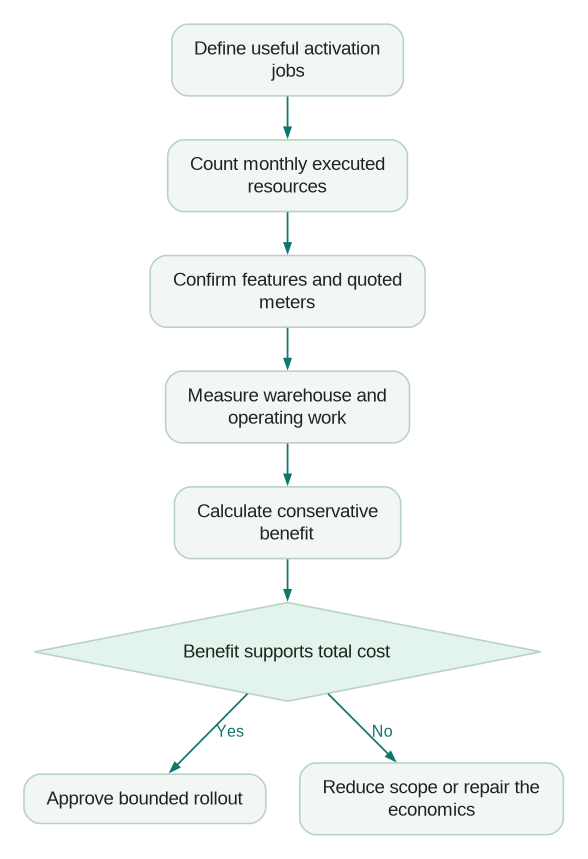
Read diagram as text
- Define useful activation jobs to Count monthly executed resources.
- Count monthly executed resources to Confirm features and quoted meters.
- Confirm features and quoted meters to Measure warehouse and operating work.
- Measure warehouse and operating work to Calculate conservative benefit.
- Calculate conservative benefit to Benefit supports total cost.
- Benefit supports total cost to Approve bounded rollout: Yes.
- Benefit supports total cost to Reduce scope or repair the economics: No
What should you confirm about Hightouch’s claims before buying?
Confirm the required feature entitlement, data path and failure behaviour with a representative pilot. Ask for the contract to name what you can use, then prove that the destination receives the right state under normal and exceptional inputs.
Does “warehouse native” mean no data leaves the warehouse?
No. Hightouch's security overview qualifies its claim: it does not create a separate long-lived primary customer-table copy for standard use cases, but keeps configurable state and logs. Its detailed storage guide describes query results, execution plans and request/response log data; Business-tier self-hosted storage and warehouse-based Lightning diffing change where that data rests. Confirm the selected engine, bucket, region and retention in the deployment configuration and agreement. The CDP and warehouse comparison helps separate those responsibilities. Warehouse query logs show warehouse activity; external storage and retention need their own evidence.
Do not approve a procurement statement that merely says “zero copy”. Record which data is read, staged, retained and delivered, and who controls each location. The destination will also receive the customer fields you deliberately activate.
Can marketers build audiences without ongoing engineering work?
They can use an established schema, but someone must first make its grain, relationships and permissions correct. Customer Studio is documented as Business-tier-only and lets marketers build warehouse audiences without writing SQL. The schema guide starts from a stable, unique parent model with related records and events.
Test marketer self-serve audiences with a real request: active accounts with an approaching renewal and no unresolved critical ticket. Have the intended marketer build it, then compare membership against independently expected records. Record which steps still require the data team. Use the Segment vs Hightouch pilot to compare that same audience against a complete alternative package.
Which identity-resolution work happens inside the warehouse?
Identity Resolution is documented as Business-tier-only. Deterministic matching runs in the warehouse; probabilistic matching processes some data outside it while using the warehouse and configured external storage for data at rest. Treat those as separate deployment choices.
Use identity-resolution test rules for ambiguous emails, shared domains, household or account membership and identities that must remain separate. Define a false merge as an error even when it improves the apparent match rate. Ask how an incorrect linkage is detected, reviewed and repaired before relying on unified profiles for targeting.
What do Agents and AI Decisioning actually authorise?
Hightouch's Agents overview says agents respect user access and require explicit approval before changes; drafted audiences and reports must be reviewed and saved. The pricing page lists Data Agents within Composable CDP and AI Decisioning within Agentic Marketing Platform, but your quote should specify the actual features, usage and limits rather than treating every AI label as one entitlement.
Test a permitted question and an access-denied case. Separately ask for the AI decisioning holdout design: eligible population, randomisation unit, excluded actions, outcome window and stopping rule. Drafting a useful audience and causing incremental revenue are different claims and need different evidence.
Will alerts stop bad data from reaching the CRM?
An ordinary alert is not automatically a stop control. The alerting guide defaults rejected rows to WARNING and fatal errors to CRITICAL; those outcomes are evaluated after the run. It separately documents a pre-send STOP control for unexpected volume in journey trigger syncs. Verify which mechanism applies to your workload.
Sequences, documented on Business tier, can stop subsequent syncs when a member has fatal errors or exceeds a rejected-row percentage. A member sync's own schedule can run independently, so the docs require Manual scheduling for sequence members. Stopping a later sync does not undo writes the earlier sync already made.
Use the Hightouch implementation checks to test the boundary. Include a rejected record, a bad upstream model and a changed eligibility condition. Verify destination readback and skipped dependent work, rather than accepting an alert screenshot as proof of prevention.
What should a B2B SaaS buyer test?
Use an Accounts parent model when the business action targets accounts, with people and subscriptions related at their own grains. Define the commercial account key and the CRM company or account it must match. The schema should preserve a customer with several workspaces and a contact associated with more than one business context.
For Salesforce upserts, Hightouch's destination guide requires a matching field marked External ID and Unique, with appropriate edit access. Update mode can instead match existing Salesforce IDs. A field informally named “external ID” is insufficient for the external-ID route.
Test one account with two contacts, one account whose CRM key is missing and two legal customers sharing a domain. Check that the intended account receives the right score and that ambiguous records are visible exceptions. Define which account owner acts on the output and how quickly they need it.
What should a consumer subscription buyer test?
Use a Users parent model when people are the audience members, with billing and app-store subscription state reconciled to that identity. Make trial, renewal, refund, grace-period and cancellation eligibility explicit. One customer can hold several subscriptions; a subscription cancellation does not always mean the person has no active entitlement.
Measure the trial audience at three stages: eligible warehouse members, accepted destination records and the ad platform or messaging tool's usable audience. Use your own trial evidence for match rates and lift. Do not equate a successful API write with every member becoming targetable.
Test a cancellation arriving after audience creation and a consent change while a sync is delayed. Confirm removals and the intended message eligibility in the destination. Apply the holdout design above to decisioning rather than reusing a vendor's published lift claim as your forecast.
What should a retail or media and entertainment buyer test?
A head of martech at a retailer or a media and entertainment company should test Hightouch's claims on real shopping or viewing data: how orders, returns and identities shape audiences, and what event volume and refresh times do to cost and freshness. Treat an industry case study as a lead to check, not as a forecast.
For a retailer:
- Orders and products: relate orders to a customers parent model. The schema guide supports one-to-many relationships and calls through relationships more brittle than direct joins, so put the product category on the order row where you can. Compare a "bought from one category in the last 90 days" audience with an independent SQL count.
- Store and online identity: join store and online purchases through a loyalty ID or email. Identity Resolution, a Business-tier feature, lists loyalty IDs and email addresses among its example identifiers. Test a store shopper who later signs up online with the same loyalty number, and two family members who share one email.
- Returns and offline purchases: include both in the audience rules. Test an online order returned in a store, and confirm the return reaches the warehouse before the audience refreshes.
- Customer Match match rate: measure it in your own trial. Hightouch's Google Ads guide divides matched users by the rows queried in the latest sync run and says Google's own match rate is a different measure, so compare like with like. Rates can take up to 48 hours to settle after the first sync, per the Match Booster guide, which documents Match Booster as a Business-tier add-on. If the quote includes it, compare the same audience with it on and off.
For a media and entertainment company:
- Anonymous and logged-in viewers: the schema guide gives users, households and devices as parent-model examples and supports many users in one household. Test a viewer who watches anonymously, then signs in on a second device, and check whether the earlier viewing joins the profile.
- Household and device targeting: Match Booster's Household and CTV targeting levels each need their own option enabled on the model. If the pitch relies on household or connected-TV reach, get those options named in the quote and confirm that your consent terms cover household-level targeting.
- Content-affinity traits: a trait such as most-watched genre can use the "most frequent" Occurrence method on a viewing-event model. Build it on a month of production events and record query time and warehouse cost. Hightouch's compute guidance recommends partitioning event tables by timestamp and filtering audiences and traits on that partition.
- Real-time refresh: realtime audiences evaluate live events as they arrive but check warehouse-backed conditions against a cache refreshed every 4, 6, 8, 12 or 24 hours, every 24 hours by default. The Personalization API, a Business-tier add-on, serves a cache that updates on its sync schedule. Change a warehouse trait such as subscription tier and time how long the personalised experience takes to reflect it.
Which package fits a small team's workload?
Headcount provides context; it is not the published seat meter. These hypothetical scenarios compare implementation needs, not vendor quotes. Sync counts are planning inputs and omit event/AI consumption unless specified.
| Team size | Example work | Distinct planned syncs | Package question |
|---|---|---|---|
| 10 people | One CRM trait update and one suppression audience | 2 | Can Basic meet the required cadence and control needs? |
| 25 people | Account, contact and lifecycle outputs across destinations | 8 | Which quoted package includes self-serve audiences and dependent-run controls? |
| 50 people | Several brands, subscription journeys and decisioning | 15 | Which products and action/event commitments cover the full scope? |
Use a custom script as a valid comparison only when its maintenance, retries, access controls and handover are costed too. Prefer the route your team can operate at the required reliability; an extensive package can be a weaker fit than a simple integration for one stable export.
Checklist
- Every proposed sync or journey has a business owner and a documented outcome.
- The inventory includes test and migration activity within the billing period.
- The quote identifies every product, meter, limit and optional feature.
- Required freshness is demonstrated with production-like data.
- Warehouse costs are attributable to the pilot workload.
- Maintenance time is included in the operating budget.
- Matching, removal and failure cases have acceptance criteria.
- Renewal, expansion and overage terms are retained with the quote.
The best starting scope is small enough to inspect and valuable enough that someone notices if it stops working. Once that workflow is reliable, expanding it becomes an evidence-based decision. For a comparison of a different event and activation model, see RudderStack pricing. Bring the proposed workload to the $99 martech audit, or request a detailed Hightouch implementation scope.
Keep reading
Browse all Data Warehouse guides
 Data Warehouse
Hightouch Alternatives for Warehouse Activation, Audiences and Cost
Compare Hightouch alternatives Fivetran Activations, RudderStack Lookout and Segment by audiences, matching, billing units and destination behavior.
Jafrin Akter AloLast updated 11 min read
 Data Warehouse
Segment vs Hightouch: Choose the CDP Around Your Customer Model
Compare Segment and Hightouch on customer models, complete CDP costs and activation. Use a 25,000-user budget, one-audience pilot and controlled migration plan.
Jafrin Akter AloLast updated 16 min read
 Data Warehouse
Hightouch vs Census, now Fivetran Activations: pricing and migration decisions
Compare Hightouch with Census, now Fivetran Activations. Check free tiers, MAR pricing, migration deadlines and the sync tests that should decide your choice.
Jafrin Akter AloLast updated 17 min read
Hightouch implementation
See the setup scope, acceptance checks and handover.
Questions people ask
Is Hightouch free?
Basic Reverse ETL is free for up to two active syncs, with unlimited destinations and user seats on the public pricing page. Check the documented cadence and operations limits against the intended use case. Compare free reverse ETL options from other vendors using the same identity, failure and removal tests; a free pilot does not establish the production package's total cost.
Does the number of destinations determine the price?
Destination count alone is not an adequate budget model. Several jobs can write different objects inside one destination, while product families can use separate consumption meters. Inventory the actual work and reconcile it to the quoted package. Confirm how tests, journeys, retired syncs and event or AI activity are counted before comparing two headline annual totals.
Can deleting a sync lower the current month's count?
Do not assume deletion reverses previously executed usage. Hightouch's active-sync documentation counts successfully run syncs even when they are later disabled or deleted. Reconcile the calendar period from execution history and the applicable agreement. Keep a retirement record so the next period's expected inventory is clear, and separate experiment usage from the ongoing production workload.
Which Hightouch features need a Business plan?
The documentation uses Business-tier gates for Customer Studio, Identity Resolution, Sequences and customer-hosted storage. The public pricing page uses different package names, so have the quote map those entitlements explicitly. Verify the exact Agents features and limits as well. A feature shown in a demo or product menu is not evidence that your contracted plan includes it.
How do I know whether the quote is worth it?
Compare total operating cost with conservative benefits demonstrated in a bounded pilot. Separate cash savings, released staff capacity and possible revenue effects to avoid double counting. Include the cost of maintaining a custom script if that is the alternative. Recheck the renewal-year scope and workload before assuming the first year's commercial or implementation terms continue unchanged.
Sources
- Hightouch: Public packages and free tier.
- Hightouch: Self-serve limits.
- Hightouch: Business pricing and active syncs.
- Hightouch: Sync types and setup.
- Hightouch: Pricing meters explained.
- Hightouch: Warehouse compute.
- Hightouch: Security overview.
- Hightouch: Storage and retention.
- Hightouch: Customer Studio.
- Hightouch: Schema and parent models.
- Hightouch: Identity Resolution.
- Hightouch: Agents and approval.
- Hightouch: Sequence behaviour.
- Hightouch: Alert triggers and stopping behaviour.
- Hightouch: Salesforce matching requirements.
- Hightouch: Google Ads match rate.
- Hightouch: Match Booster setup and plan.
- Hightouch: Match Booster targeting levels.
- Hightouch: Trait calculation methods.
- Hightouch: Realtime audience cache schedule.
- Hightouch: Personalization API cache and plan.

Written by
Jafrin Akter AloData Engineer and Co-founder at Martechdevs and Growth and Analytics Partners
Jafrin writes practical guides to marketing technology, customer data, analytics and AI workflows. Martechdevs is a Growth and Analytics Partners company.