When Does a Startup Need a Product Analytics Tool? Signals, First Tools and When to Pay
Data Engineer and Co-founder at Martechdevs and Growth and Analytics Partners
Last updated 13 min read

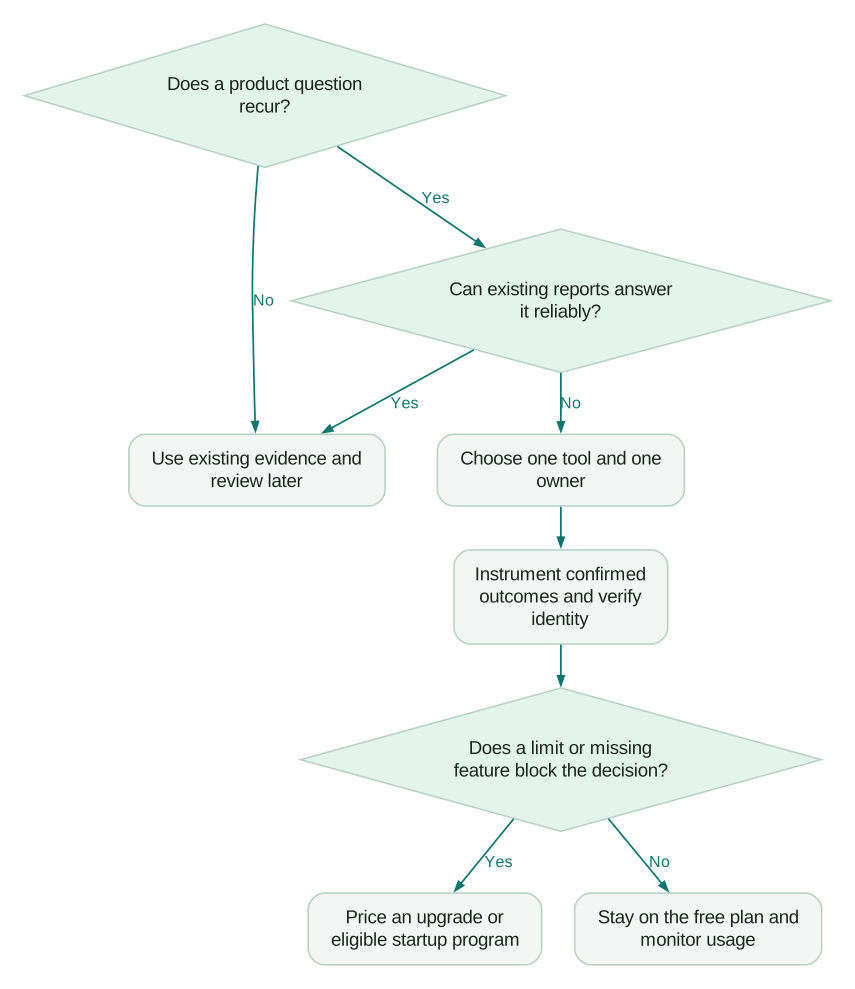
A startup needs a dedicated product analytics tool when a recurring product question is slowing a decision and its database queries or GA4 reports cannot answer it reliably. Start with one tool, one owner and a small set of confirmed outcomes. Pay when a measured volume limit or a necessary capability blocks that work, rather than when the company reaches a funding round.
Free-plan limits and startup terms checked against the vendors' current pages.
When does a startup need a real product analytics tool?
Install one when understanding activation, repeat use or account behaviour has become a recurring job. Product analytics follows people and accounts through events over time, using funnels, retention cohorts and paths to answer how the product is used.
You have a practical reason to start when a launch needs a baseline, the same onboarding question reaches engineering every week, or several people need to explore product behaviour without waiting for another custom query. A self-serve product often reaches this point early because the team cannot observe each trial directly. In B2B, it can happen when individual activity needs to be connected to a shared workspace and commercial account.
You can wait when a handful of customer conversations and a reproducible database query answer the question. There is little value in a dashboard nobody owns, or a retention chart for a product that has not yet established what repeat value means. Keep essential operational records while you learn; decide when to revisit the tool question.
Our default is to name the decision first: “Which setup step should we fix this week?” is better than “We need product analytics.” The product analytics tool comparison helps choose the destination, while Mixpanel versus GA4 explains when both have distinct jobs. If the missing piece is instrumentation, get help setting up your first product analytics events with the developers who own the product.
What can you use before installing a dedicated tool?
Use the evidence you already have until a specific question exceeds it. A missing event history cannot be fixed by buying a more elaborate chart.
| Existing source | What it can answer | Where to check its limits |
|---|---|---|
| Production database or read replica | Accounts created, current subscriptions, persisted jobs and payments | A current-state table may not preserve the transitions between states |
| GA4 | Acquisition, landing pages and collected signup or purchase journeys | Identity, account analysis, retention settings and collection quality |
| Customer calls and support tickets | Why customers got stuck, what they expected, and which workaround they used | Qualitative examples do not establish how often a problem occurs across the population |
Use read-only reporting access or a replica when exploratory queries could load a production database. If you already keep an append-only audit log, SQL may answer much more than a table containing only the latest subscription status. Inspect the actual schema before assuming history is missing.
Standard GA4 offers two- or fourteen-month user/event retention settings for the relevant data; these settings affect explorations and funnel reports, rather than standard aggregated reports. Its standard daily BigQuery export has a one-million-event daily limit. Those are different limits with different units. Google retention guidance, BigQuery export limits.
A shared account's adoption is also a different question from one person's page visits. You can model accounts outside GA4, but estimate the work needed to maintain that model. Move to a dedicated product workflow when the repeat analysis, identity requirements and handoff cost justify it.
What should an early-stage startup use first?
Choose for the person who will use the reports and the decision they need to make. Run one small pilot before expanding the stack.
| Situation | Our starting choice | What would change that choice? |
|---|---|---|
| B2B SaaS with a product manager running funnels and retention | Pilot Mixpanel | Account-level analysis requires checking Group Analytics and its plan cost; compare Amplitude if its workflow suits the team better |
| Engineering-led product with analytics, replay and flags to maintain | Pilot PostHog | Consider Statsig when experiment operation is the central requirement |
| Marketing-site-led or ecommerce acquisition questions | Start with GA4 and verified business outcomes | Add a product tool when behavioural or account questions exceed the existing reports |
| Mobile application | Use GA4 through Firebase for app measurement; pilot a product tool for the unresolved behavioural question | Offline delivery, release versions and identity may determine the implementation |
These are starting recommendations, not universal rankings. Mixpanel's pricing places Group Analytics outside Free; Amplitude's current comparison also excludes group behaviour analysis and behavioural cohorts from Free. A free account is not proof that an account-level reporting requirement is covered.
Firebase documents its GA4 app measurement integration. Keep acquisition and product questions explicit if you run two tools. Send each one a maintained contract instead of installing overlapping SDKs and discovering their disagreements during a board report.
How do you validate product assumptions with your first events?
Write the population, observation window, outcome and possible decision before choosing an event name. “Inviting a teammate predicts conversion” becomes useful only after you specify who is eligible, when the invitation must occur and which paid outcome counts.
For a reporting product, the following ten event types are a starter subset of the 20-event SaaS setup. Reuse existing approved names when your product already has a plan. First value and repeat value are definitions calculated from the success and viewing history, rather than browser events that guess whether a user is retained.
| Event | Confirmed trigger | Source of truth |
|---|---|---|
user_registered | New person record committed; exclude login and retries | Account service |
workspace_created | New workspace persisted | Workspace service |
integration_connection_succeeded | Connection becomes usable after validation | Integration service |
integration_connection_failed | Connection attempt ends in a defined failure | Integration service |
report_generation_succeeded | A usable report is completed | Reporting service |
report_viewed | A person sees the report under a documented visibility rule | Application client |
member_invitation_sent | An invitation is created and handed to delivery | Membership service |
member_invitation_accepted | The invited person's membership is committed | Membership service |
subscription_started | Billing confirms the agreed subscription-start state | Billing integration |
payment_succeeded | Payment is confirmed; exclude attempts and failed charges | Billing integration |
Include a stable occurrence ID, person ID when known, workspace/account ID, occurrence time and controlled outcome properties. A subscription may start on a free trial, so it does not prove payment. A generated report may never be viewed, so it does not automatically prove customer value.
A useful first-value definition might require a report generated from real customer data and subsequently viewed by a member. Repeat value could require that qualifying action on another day. Adapt the window to the product's natural usage cycle and document exclusions such as demonstration data and internal staff. The SaaS activation metrics guide explains how to keep the denominator and account unit consistent.
Does inviting a teammate early predict conversion?
Consider a hypothetical cohort of 120 eligible trial workspaces that remain unpaid at the end of day three. All have completed the same 30-day observation window. Split them by whether an invitation was sent during the first three days, then measure first payment during days four to thirty.
| Day-three group | Workspaces | First payments by day thirty | Conversion rate |
|---|---|---|---|
| Sent an invitation | 48 | 18 | 37.5% |
| Did not send an invitation | 72 | 9 | 12.5% |
The difference is 37.5% − 12.5% = 25 percentage points. It is an association in this example. Larger teams or customers with stronger buying intent may both invite earlier and convert more often. An invitation sent after payment should not be used to explain that earlier payment.
Inspect the individual journeys and compare relevant account characteristics. If the mechanism still looks plausible, test an onboarding change that helps suitable teams collaborate. Assign the experience consistently at workspace level, keep a control, and watch payment, activation and unwanted invitations. The observational gap alone does not tell you the revenue lift that change would produce.
When should a startup move from a free tier to a paid plan?
Upgrade when a necessary capability or a measured limit constrains a useful decision. First check whether unnecessary collection, duplicate events or an unsuitable identity model is consuming the allowance.
The limits below were checked on 17 October 2026. Events, sessions, recordings and active users are different billing units; compare your expected workload in the unit each vendor uses.
| Free plan | Main allowance | Other relevant limits | Upgrade signal |
|---|---|---|---|
| Mixpanel | 1M events/month | 5 saved reports per seat; 10K replays; 1K experiment MEU/month | Required account analysis, scheduled Data Pipelines exports, warehouse connectors or allowance limits |
| Amplitude | 2M events/month | 10 saved charts per organisation; 1 year of data access; no behavioural cohorts or experiment results | Shared reporting, longer history or unavailable analytical features |
| PostHog | 1M events/month | 5K recordings; 1M flag requests; free event retention 1 year and recording retention 1 month | Approaching data loss at the free limit, or a needed paid capability |
| Heap | Up to 10K sessions/month | 6 months of data history | Sessions, history or a feature needed for the decision |
| Pendo | 500 monthly active users | Visitor IDs over a 30-day period; limitations apply above the allowance | Sampled trends or blocked new guides/segments prevent the intended work |
| Statsig Developer | 2M events/month | 1-year analytics retention; unlimited flag/config checks | Event volume or capabilities outside Developer |
Mixpanel's Free plan includes ingestion and raw export API access. Scheduled Data Pipelines exports are a paid add-on; distinguish that recurring delivery service from a raw API download. Mixpanel's access comparison.
What happens at the ceiling matters as much as the number. PostHog says excess events on its free plan are permanently dropped. Pendo describes sampled reporting and limits on creating certain objects after 500 MAUs. These are consequences for evidence you may need later.
Mixpanel's Free analytics plan can lose report access above its event allowance until reset or upgrade. Separately, its Free Experiments allowance pauses experiment creation, editing and viewing, while feature flags continue serving. An experiment limit and an analytics-event limit should have separate owners and alerts. Mixpanel billing behaviour.
Estimate monthly events before adding autocapture
Suppose a hypothetical product has 1,200 weekly active users, each with three sessions a week and twenty planned events per session. Assuming steady usage across the year:
Monthly events = weekly active users × sessions/user/week
                 × events/session × 52 / 12

Planned events: 1,200 × 3 × 20 × 52 / 12 = 312,000/month
With 60 extra captured interactions per session:
1,200 × 3 × 80 × 52 / 12 = 1,248,000/month
The second scenario exceeds a one-million-event allowance by 248,000 events. It remains below a two-million-event allowance, assuming these are all qualifying events and there are no other sources. Add backend jobs, test traffic, imports and separate products before treating it as a budget.
A larger free allowance can be less useful than a smaller one that supports the reports you need. Use worked product analytics pricing examples for the actual paid configuration, including account analysis, replay and export requirements.
Which startup programs change the first-year bill?
Apply against each vendor's own eligibility rules. Treat credit as a temporary budget with an expiry, and keep your post-program forecast separately.
| Program | Current offer | Main published eligibility |
|---|---|---|
| Mixpanel Startup Plan | First year free, up to 1B events/year | Incorporated less than 5 years ago; no more than USD 8M raised; no previous paid plan or redeemed offer |
| Amplitude for Startups | First year of Growth free; current page specifies up to 100M events/month | Under USD 10M raised and fewer than 20 employees |
| PostHog for Startups | USD 50,000 credits for 12 months | Company under 2 years old, under USD 5M raised, eligible signup date and company email domain |
Mixpanel requires participants to begin sending data within 90 days. Its current documentation describes moving to Free, Growth or Enterprise after the program. Amplitude sends a usage-based quote sixty days before expiry and advertises 40% off an annual Plus plan in year two. Recheck any Growth-only features against that next plan and quote; the discount does not promise a second year of Growth at the same scope.
PostHog requires a paid-plan signup to apply credits and says eligibility requires signing up from 1 January 2023 onward. Its current terms exclude specified AI tools from credit coverage from 14 September 2026. Credits and free allowances therefore do not guarantee that every feature you activate is covered.
How do you set it up in the first week?
Treat the first week as a focused pilot with a clear owner, not a promise that every integration will fit that schedule.
- Founder or product owner: write the recurring question, population, outcome and decision. Select events using the tracking-plan template and event naming rules.
- Engineer: define stable person and workspace IDs. Apply the chosen tool's identify, merge and reset behaviour at signup, login, account switching and logout; test a shared browser explicitly.
- Engineer: send confirmed outcomes from the backend or billing integration and interface observations from the client. Keep credentials, email addresses and sensitive free text out of ordinary event fields.
- Analytics owner: build a setup-to-value funnel, a weekly return-use cohort and an account activation view. Write the entity, denominator, window and exclusion rules beside each report.
- Founder and engineer: reconcile known journeys and business records, then approve a small rollout with a volume alert and a documented next review.
Mixpanel recommends server-side tracking where possible and estimates client-side loss for 30–50% of users due to ad blockers. That is the vendor's estimate, not a forecast for your audience. Measure your own coverage, and keep consent requirements in the delivery design. Server-side collection improves control over confirmed outcomes; it does not make missing permissions disappear.
At Martechdevs, we set up the first events, identity rules and reports with your developers and hand over a tracking plan your team owns. Want a second pair of eyes on the setup? Start with a free martech audit.
How do you check the numbers are right?
Reconcile a defined population and time window against records you can inspect. A green SDK status alone does not prove that a funnel measures the intended journey.
Run successful, failed and retried test journeys. Verify the received event, its account, occurrence time and identifier. Compare signups and payments with the database for the same window, then explain excluded staff, consent-limited traffic and late deliveries. Compare users with users and workspaces with workspaces. Test logout and account switching before trusting per-account cohorts.
Set a volume or billing alert before the allowance is exhausted. Keep a short decision log: what the report showed, the action taken and what evidence will confirm its effect. If nobody can name an action after several reviews, revise the questions before expanding collection.
Which mistakes make early analytics unusable?
The expensive mistakes are usually ambiguous outcomes, broken identity and silent loss of needed history. Adding more dashboards cannot resolve them.
Autocapture without confirmed outcomes gives you clicks around an unknown result. A missing identity call can split one person across records, while a missing logout reset can join different people on a shared browser. Account questions answered with user counts can reward inviting seats rather than creating value. Unnoticed free-plan limits can remove the history needed to evaluate a later change.
Choose an owner who can review new collection after releases. Preserve event definitions and export options before switching tools. A funding round can change your budget; it does not, on its own, change the question your product analytics must answer.
What should be ready before the pilot is accepted?
- A recurring question and a decision owner are named.
- The limitations of existing SQL or GA4 analysis are written down.
- One destination is selected for the product question.
- Person, account and workspace identifiers have explicit meanings.
- Starter events include successful and failed outcomes, with non-triggers.
- Signup, login, account switching and logout pass identity tests.
- Signups and payments reconcile for the same completed time window.
- Forecasts include autocapture, backend events and one-off imports.
- Allowance limits, data-loss behaviour and alerts have an owner.
- Startup program expiry and the next paid configuration are recorded.
- Each of the first reports supports a specific decision.
Use the tool comparison to narrow a pilot and the pricing guide to cost the required configuration. If you need the work carried through to accepted reports, request a product analytics implementation quote. Scope sets the quote; the useful deliverable is a measurement system your team can operate.
Questions people ask
Do we need product analytics before product-market fit?
A small setup can help test a recurring product assumption before product-market fit. Begin with customer conversations and existing records, then instrument the outcomes whose history you would otherwise lose. Choose a dedicated tool when it removes a specific analytical bottleneck and somebody will act on its results.
How many active users make product analytics useful?
There is no universal threshold. With very small cohorts, inspect individual journeys and explain how one extra outcome changes the rate. As repeat decisions involve more people or accounts, funnels and cohorts become more useful. A fixed user count does not establish that your events, population or decision are ready.
Can we backfill the history we missed?
Only reconstruct events supported by retained records. Mixpanel's Import API and Amplitude's batch upload accept event timestamps, but require the vendor's identity and payload rules. Persisted signups and payments can support a controlled import. Unrecorded clicks and page views cannot be recovered by adding an SDK later.
Who should own analytics at a five-person startup?
Name one maintainer, often the founder or engineer closest to the product. That person coordinates definitions, reviews new events, checks releases and records the decisions supported. Engineering still owns implementation and the business owner still owns the outcome. Put a recurring review on the calendar rather than relying on spare time.
What happens when a startup program ends?
Budget before credits or the free year expire. Amplitude describes a year-two quote and a free-plan fallback. Mixpanel documents a move to Free, Growth or Enterprise; PostHog directs participants to another plan after the credit or term ends. Ask for your next configuration and price in writing. Retain only the collection and features that support useful decisions.
Sources
- Mixpanel, Pricing, accessed 17 October 2026.
- Mixpanel, Billing and event limits, accessed 17 October 2026.
- Mixpanel, Experiments allowances, accessed 17 October 2026.
- Mixpanel, Startup Program, accessed 17 October 2026.
- Amplitude, Pricing and plan comparison, accessed 17 October 2026.
- Amplitude, Startup Program, accessed 17 October 2026.
- PostHog, Pricing and free-plan behaviour, accessed 17 October 2026.
- PostHog, Startup credits and eligibility, accessed 17 October 2026.
- Heap, Pricing, accessed 17 October 2026.
- Pendo, Pendo Free, accessed 17 October 2026.
- Statsig, Pricing, accessed 17 October 2026.
- Google Analytics, Data retention, accessed 17 October 2026.
- Google Analytics, BigQuery Export, accessed 17 October 2026.
- Google Firebase, Analytics for apps, accessed 17 October 2026.
- Mixpanel, Choosing a tracking method, accessed 17 October 2026.
- Mixpanel, Import Events, accessed 17 October 2026.
- Amplitude, Batch Event Upload API, accessed 17 October 2026.

Written by
Jafrin Akter AloData Engineer and Co-founder at Martechdevs and Growth and Analytics Partners
Jafrin writes practical guides to marketing technology, customer data, analytics and AI workflows. Martechdevs is a Growth and Analytics Partners company.