
Do you need a cookie banner for GA4? A six-country decision guide
Data Engineer and Co-founder, martechdevs
Last updated 11 min read
Do not decide whether GA4 needs a banner from your company's address alone. The applicable rules, visitor population, information collected and actual uses of that information matter. Separate analytics consent, advertising permission, privacy notices and sale or sharing opt-outs. Then configure the website to enforce the decisions. A banner that appears without controlling the underlying data flows solves very little.
Last updated: 28 September 2026.
Start with what your GA4 setup actually does
“We only use GA4” is not a complete description. A property used for aggregate website reporting is different from a setup connected to advertising audiences, user-level CRM records and campaign activation.
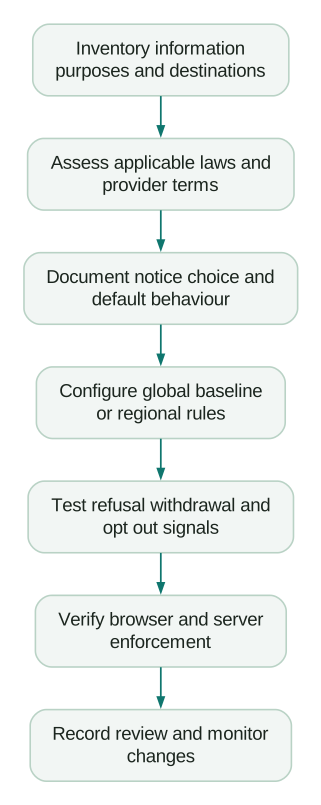
Inventory the browser tags, identifiers, page URLs, event parameters, advertising integrations and backend forwarding. Include hardcoded scripts and embedded tools outside GTM. Record the purpose of each flow and who receives the information.
Then have the organisation's privacy adviser confirm the rules that apply to that configuration. This guide summarises regulator and platform guidance for implementation planning; it is not a legal opinion approving an individual website. Sector-specific rules, children, sensitive information and cross-border activities require their own assessment.
Give the adviser concrete facts rather than a vendor name. “This tag sends a browser identifier, visited URL and purchase event to these recipients for these purposes” is a question they can assess. “Is Google Analytics legal?” hides the decisions you need them to make.
Use the outcome to define four things separately: information shown to visitors, choices offered, behaviour before a choice and behaviour after refusal or withdrawal. The tracking-plan guide helps document the events and destinations behind those requirements.
Ireland: obtain consent for analytics cookies
Ireland's Data Protection Commission explicitly answers yes to whether analytics cookies need consent. Calling an analytics tool first-party does not remove that requirement. DPC analytics-cookie guidance.
The DPC's broader guidance distinguishes technologies strictly necessary for a service the user requested from other uses. It also requires clear information and a valid affirmative choice where consent is needed. A marketing team's desire to measure conversion rates does not make its analytics essential to delivering the page. DPC cookie guidance.
For a conventional GA4 cookie-based implementation, build and test the consent flow before enabling analytics storage. Keep essential services working when analytics is refused. A banner with a single acknowledgement button should not be treated as evidence that the visitor agreed to every downstream purpose.
Do not copy the UK's statistical exception into the Irish configuration. Similar language and neighbouring markets do not make the rules interchangeable.
UK: the statistical exception is conditional
The ICO finalised its updated storage-and-access guidance on 29 April 2026 following the Data (Use and Access) Act changes. Use that current guidance when assessing the exception, rather than assuming a 2025 headline describes every implementation. ICO guidance and update history.
The statistical exception concerns aggregate information used solely to improve the service or website. It requires clear information and a simple, free objection mechanism. Individual-level information must not be retained beyond what is necessary for aggregation. It does not cover identifying or profiling visitors for other purposes, or online advertising.
A third-party provider must act on your behalf for that improvement purpose, without combining the information for other uses. The ICO specifically distinguishes linking a purchase journey to an earlier ad interaction. UK GDPR obligations remain relevant where personal data is involved. ICO exception conditions.
For GA4, assess the actual retention, identifiers, reporting uses, advertising connections and provider terms against those conditions. Turning off one advertising setting does not establish eligibility. Keep consent-based operation unless your assessment supports the exception and you can enforce its limits.
United States: check state applicability and the processing purpose
A US rule cannot be reduced to “show the European banner” or “no banner required.” Start with the laws that apply to the business, the relevant state populations and the way information is used or disclosed. This section gives two implementation-critical examples, not a fifty-state legal survey.
California's CCPA applies to covered businesses and provides rights including opting out of sale or sharing. Sharing includes the relevant cross-context behavioural advertising uses; applicability and contractual roles still matter. Do not assume every GA4 configuration is automatically a sale or that no GA4 configuration could be involved in regulated sharing. California Attorney General's CCPA guide.
The current California regulations explicitly say a cookie control alone is not an acceptable sale/sharing opt-out method: the mechanism must address sale and sharing. Covered online businesses must also handle qualifying opt-out preference signals. Test the Global Privacy Control path as well as the visible choice interface. CCPA regulations, sections 7025–7026.
Colorado provides another reason not to use one vague “US cookies” rule. Businesses meeting its applicability conditions must honour GPC for covered sale and targeted-advertising opt-outs; the regulator dates that requirement to 1 July 2024. Colorado Attorney General's guidance.
Ask the reviewer to map the relevant states and purposes, then map those decisions to each destination. Hiding a banner after someone opts out is not enforcement if browser tags or backend advertising uploads continue the prohibited use.
Canada: assess meaningful consent and provincial requirements
The federal privacy regulator's meaningful-consent guidance says the form of consent depends on context. Express consent is generally required for sensitive information, unexpected uses or meaningful residual risk of significant harm. Clear explanations must support the choice. OPC meaningful-consent guidance.
The OPC's behavioural-advertising guidance allows opt-out consent only under stated conditions, including clear timely information, an easy and persistent opt-out, limits on sensitive information and appropriate retention or de-identification. That is not a universal permission to load all analytics and advertising tags without an assessment. OPC advertising guidance.
Quebec needs explicit attention. Its regulator explains that technologies collecting personal information through identification, location or profiling functions must be disclosed beforehand, with those functions inactive by default and activation left to the person. Quebec CAI's Law 25 guidance.
For implementation, classify the actual GA4 and advertising functions under the applicable federal and provincial rules. Do not take a general Canadian opt-out template and assume it settles Quebec profiling, sensitive pages or unexpected third-party disclosure. Record the chosen default and the reason for it.
Australia: evaluate Privacy Act coverage and the information flow
First establish whether the Privacy Act covers the organisation. The OAIC says many small businesses are exempt, but lists important exceptions, including health service providers and businesses trading in personal information. A low turnover figure alone does not settle the question. OAIC small-business guidance.
For covered organisations, the OAIC's tracking guidance focuses on necessary and fair collection, transparent notices, permitted use and disclosure, overseas handling and direct-marketing controls. Sensitive information generally needs consent; the regulator advises preventing its disclosure through pixels and generally seeking express opt-in where such collection or disclosure is likely. OAIC tracking-pixel guidance.
That makes “Australia does not need cookie banners” an inadequate implementation specification. Identify what GA4 receives, what linked advertising services receive and whether the context reveals sensitive information. A page path can reveal more than the event name suggests.
Choose notices and controls that meet the assessed obligations and commitments. A generic consent button does not make unnecessary collection appropriate, and a privacy-policy link does not explain a hidden advertising flow by itself.
New Zealand: work from collection, notice and disclosure obligations
New Zealand's Privacy Act framework requires personal information to be collected for a lawful purpose connected to the organisation's activities and to be necessary for that purpose. OPC Principle 1 guidance.
Its privacy-statement guidance requires people to be informed about collection, purposes, recipients and relevant rights. The appropriate notice depends on the collection context, including whether information is obtained directly or indirectly. OPC privacy-statement guidance.
Also assess disclosures to overseas recipients. Principle 12 addresses safeguards and the circumstances in which authorisation is needed; it is not a rule that every international data flow is automatically permitted or always needs the same consent button. Establish the provider's role and use the regulator's assessment guidance. OPC overseas-disclosure guidance.
For a NZ website, document the GA4 collection and purpose, the notice people receive, provider arrangements and any advertising uses. Have the reviewer decide whether an active choice is needed for those facts. The regulator guidance above does not provide a blanket approval of every GA4 setup without a banner.
Do not copy the regulator's own website banner as a legal template. Its technologies, purposes and arrangements may differ from yours.
Keep Google's requirements in a separate part of the decision
Google's EU User Consent Policy applies where incorporated into the relevant product agreement and addresses users in the EEA, UK and Switzerland. It requires valid consent for cookies or local storage where legally required and for collecting, sharing and using personal data for ad personalisation. It also addresses consent records, revocation and identifying recipients. Google's policy.
This is separate from deciding whether a particular law applies to your business. Passing a Google diagnostic does not establish compliance with all regional obligations, and a local-law exception does not answer every contractual or advertising-use question.
Consent Mode is a way to communicate choices and adjust supported tags. Basic mode blocks Google tags before consent; advanced mode can send consent signals and measurements without cookies while consent is denied. That difference must be included in the review. Google's Consent Mode overview.
Do not interpret analytics_storage: denied as a promise that nothing leaves the browser. Equally, do not assume a refusal must stop security or essential functionality. Define the expected behaviour per purpose and service.
Outside the regions named in Google's EU policy, the relevant legal and contractual assessment still determines the correct choices. The absence of an EEA visitor does not supply a universal granted default for the rest of the world.
Choose a global baseline or maintain regional rules deliberately
A small team has two practical operating approaches.
One is a common opt-in experience for optional analytics and advertising, with the additional notices, opt-outs and controls required for relevant uses. This can reduce configuration variation. It still needs appropriate wording, enforcement and review; one banner is not a substitute for all local obligations.
The other is a regional policy configuration that distinguishes the reviewed rules. That can support different lawful uses but creates more branches to test and maintain. Include the behaviour when location is unknown or incorrect. Location detection is an implementation input, not the whole legal applicability assessment.
Choose based on the value of the distinction and your team's ability to operate it. If nobody owns updates or can explain the default for an unknown location, the regional setup is unfinished.
The CMP comparison helps assess whether Cookiebot, Usercentrics or OneTrust can support those requirements. Select the tool after defining the behaviour, so a plan's default settings do not quietly become your privacy policy.
Give the implementation team a reviewable specification
For each rule, record the covered audience, purpose, data fields, recipients, applicable requirement, approved default, choice interface, withdrawal behaviour, owner and review date. Attach the relevant source and configuration version.
Here is an original planning example, not a legal determination: a SaaS company has a marketing site, an application and a hosted demo scheduler. The marketing site records page visits; the scheduler sends a completed-booking event; the backend forwards qualified opportunities to an ad platform.
A homepage-only banner test covers only the first piece. The team must determine what happens when someone rejects advertising on the marketing site, books through the scheduler and later becomes a qualified opportunity. The approved preference must affect every relevant use, with an explicit rule for missing or unresolved permission.
Separate this from the operational need to fulfil the person's booking. Consent to marketing measurement and the ability to request a demo are different decisions. Document them at the points where information moves.
Avoid sending sensitive form contents or identifiable URL parameters into a general analytics event. Keep the event specification narrow enough to answer the business question. Better measurement does not require copying every field the application knows.
Test choices and downstream effects before launch
Test a clean first visit, rejection, acceptance, a granular selection, reopening preferences and withdrawal. Include browser opt-out signals where applicable. Repeat across the important regional configurations and the unknown-location fallback.
Inspect cookies and other storage, tag state, network requests and backend destinations. A consent log showing “denied” is insufficient if the request being prohibited still reaches an advertising platform.
Check reloads, cross-domain navigation, embedded forms, checkout completion and delayed backend events. Make the expected behaviour part of the test record. In an approved advanced Consent Mode setup, cookieless requests may be expected; in another approved design, tags may remain blocked. Test against the reviewed specification.
Keep a release record with the rules, source dates, reviewer, configuration version, test evidence and unresolved items. Revisit it when a new purpose, vendor, market or law changes the assumptions. Do not reuse a legal conclusion for a materially different data flow without checking it.
Checklist
- Actual data fields, storage, purposes and recipients are documented.
- Applicable country, state, province and sector requirements are assessed.
- Any claimed exception is justified for the specific configuration.
- Google requirements and local legal obligations are checked separately.
- Notices, choices, defaults and withdrawal behaviour match the assessment.
- Browser signals and server-side forwarding are included in tests.
- Review ownership, evidence and the next review trigger are recorded.
An analytics and tracking implementation should translate the reviewed requirements into working controls and reliable permitted measurement. The useful deliverable is an explainable data flow with evidence that choices are honoured, not simply a banner that disappears after a click.
Questions people ask
Does every GA4 website need the same cookie banner?
No. The applicable rules and actual processing differ. Determine the notice, consent, objection and opt-out requirements for the relevant configuration, then choose an interface that implements them.
Can I remove the UK banner after the analytics-rule change?
Only after assessing the specific use against the exception and implementing its required controls. The change is not automatic approval of GA4 or advertising-linked analytics.
Does server-side tracking remove consent requirements?
Changing where an event is processed does not settle whether its collection or use is permitted. Review browser collection, backend forwarding and recipients together, and enforce the relevant choices throughout the flow.
Do I need Consent Mode outside Europe?
Consent Mode is a technical mechanism. Decide its configuration from the applicable laws, Google requirements and approved data uses. Geography alone does not justify sending every consent signal as granted.
Is a cookie notice the same as a sale or sharing opt-out?
No. A notice describes collection; an opt-out must address and stop the relevant processing. California's rules explicitly distinguish cookie controls from an acceptable sale/sharing opt-out mechanism.
Sources
- Irish DPC: Consent for analytics cookies
- Irish DPC: Cookies and other tracking technologies
- UK ICO: Current storage-and-access guidance
- UK ICO: Statistical-purpose and other exceptions
- California Attorney General: CCPA overview
- California privacy regulations: 2026 published text
- Colorado Attorney General: Universal opt-outs
- Canadian OPC: Meaningful consent
- Canadian OPC: Online behavioural advertising
- Quebec CAI: Law 25 changes
- Australian OAIC: Small-business coverage
- Australian OAIC: Tracking pixels and privacy obligations
- New Zealand OPC: Purpose and necessity of collection
- New Zealand OPC: Privacy statements
- New Zealand OPC: Overseas disclosure
- Google: EU User Consent Policy
- Google: Consent Mode overview
Written by
Jafrin Akter AloData Engineer and Co-founder, martechdevs
Jafrin Akter Alo is a data engineer and co-founder of martechdevs, where the team has delivered 74+ martech, data and growth stack implementations.