
Server-side tracking: when it is worth the cost for a small company
Data Engineer and Co-founder, martechdevs
Last updated 9 min read
Server-side tracking routes measurement through a server you control or operate through a provider. It can improve event validation, destination-specific data control and delivery of backend outcomes. It also adds hosting, monitoring and maintenance. It is worth considering when you can identify a concrete collection or data-control problem whose value exceeds those operating costs.
Last updated: 9 September 2026.
An order can succeed even when its thank-you page never loads. A CRM deal can close weeks after the website visit. Those are useful reasons to collect confirmed outcomes from your backend.
Moving an unreliable button-click event through a server, however, leaves you with an unreliable button-click event. Before buying infrastructure, decide which event becomes more trustworthy and how you will prove it.
What actually changes in the event path
In a browser-only implementation, browser code sends measurement requests to the destinations you configure. With a server container, some requests first reach your collection endpoint. The server interprets them, applies rules and sends selected data onward.
Google Tag Manager uses clients to interpret incoming requests and tags to deliver events to destinations. A server container can run in your cloud environment or another supported hosting environment. Google's server-side tagging introduction.
There are two distinct patterns to evaluate:
- Browser-to-server routing: browser activity is sent through a controlled endpoint. The initial event still depends on the browser successfully collecting and delivering it.
- Backend event delivery: an application, payment system or CRM produces an event after a confirmed business state change. Its delivery can be independent of the visitor keeping a page open.
Many useful implementations combine both. Browser events explain the journey; backend events confirm outcomes. Their identity, consent and deduplication rules need to agree.
Martechdevs' tracking implementation service covers this event design, the server configuration and the validation against business records. The acceptance test should describe the measurement improvement, not merely confirm that a server is running.
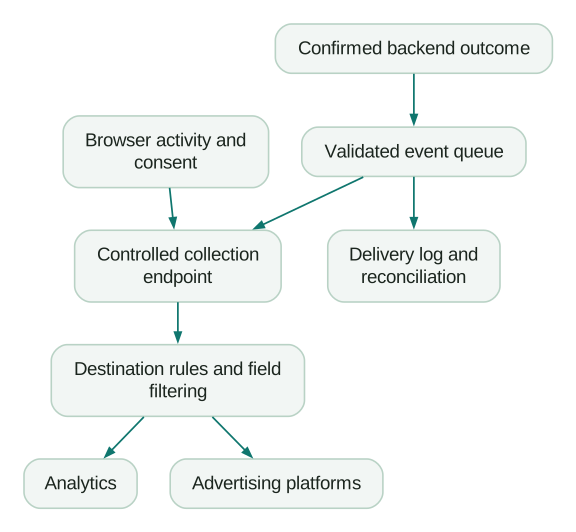
The queue and reconciliation log in this design are deliberate engineering components. Do not assume a basic server container automatically provides durable retries and an audit ledger for every destination.
The benefits worth paying for
Confirmed events can replace weak proxies
For an asynchronous checkout, the backend knows whether payment was authorised, captured, failed or refunded. Choose the state that matches your reporting definition and produce an event from that transition.
For lead generation, a server can distinguish a valid submission from a failed validation attempt or a spam rejection. Later, the CRM can produce a qualified-lead or won-deal event.
This improves the meaning of the signal. It does not automatically establish advertising attribution; the relevant permitted identifiers and destination requirements still matter.
You can control the fields each destination receives
A central routing layer gives you a place to inspect, transform and limit event data. In GTM server containers, transformations can allow, exclude or augment event parameters available to selected tags. Server-side transformations.
For example, an internal event may contain a detailed product configuration. An advertising destination may need only a category and purchase value. Define that smaller payload explicitly.
Prefer an allowlist for sensitive workflows. If the application adds a new field next month, it should not automatically flow to every external destination just because the server forwards the whole event object.
Also inspect URLs. Query strings can contain email addresses, internal tokens or other values that were never intended for analytics. Redacting a dedicated email field does not help if the same value remains in page_location.
You may reduce browser work
Moving eligible destination processing to a server can reduce the amount of vendor code running on a page. The actual performance benefit depends on what you remove and what remains. Google identifies reduced client-side tag execution as a potential advantage. Server-side tagging overview.
Measure page performance before and after. If the browser still loads all original scripts plus the new collection path, the migration may add complexity without delivering the expected reduction.
What a server does not automatically fix
It does not guarantee longer cookie lifetimes
A custom domain can support server-set cookies and improve the collection context. Google's documentation distinguishes a same-origin path, a subdomain and the cloud provider's default domain. Those deployment details affect the available benefits. Custom domain configuration.
Browser rules still apply. WebKit documents expiry restrictions for third-party CNAME and IP-address cloaking, including cookies set in HTTP responses. A tracking subdomain is therefore not a universal promise of indefinite identity persistence. WebKit tracking prevention.
Evaluate the actual architecture and browser behaviour. Avoid basing the business case on an unsupported claim that every first-party cookie will now last for years.
It does not recover an event that never reached it
If a browser script is blocked before it generates a page-view event, routing that script's requests through a server cannot recreate the missing event on its own. A backend can confirm an order it processed, but it cannot honestly manufacture every preceding browser interaction.
Ad blockers and browser protections can also change their behaviour. Test the supported collection path, respect user choices and describe the measured coverage rather than promising complete visibility.
It does not make the implementation compliant by itself
Server-side describes where processing happens. Compliance also depends on the data, purpose, applicable rules, user choices, recipients and retention.
Google's server-side Consent Mode implementation passes the browser's consent signals to consent-aware Google tags in the server container. Third-party tags need their own appropriate controls; do not assume a Google-specific signal automatically governs every integration. Server-side Consent Mode.
For a UK implementation, the ICO's guidance on cookies and similar technologies is a relevant starting point for the device-access requirements. The full design still needs to follow the requirements applicable to your users and processing. ICO guidance.
The Consent Mode v2 guide explains the technical options without treating a banner or server as a compliance certificate.
Compare three implementation routes
A managed platform integration
An ecommerce or CRM platform may already provide an official integration that sends the required outcomes. Start by examining it. A supported native route can be easier to operate than a custom container.
Check the event definitions, identifiers, consent support, deduplication and diagnostic access. The convenience is valuable only if the integration measures the outcome you actually need.
A server-side tag manager
A server container is useful when several destinations share event inputs and the team needs configurable routing. It gives marketing operations a familiar deployment model, but still requires infrastructure ownership and disciplined template selection.
Ask who maintains the runtime, templates, domain, access permissions and billing. A container with no operational owner becomes a fragile dependency.
A direct backend integration
A direct integration can be appropriate when the application already produces reliable business events and engineers own the delivery pipeline. It offers precise control over validation, retries and observability.
The tradeoff is ongoing code ownership. API changes, authentication, destination limits and data-policy changes become part of the application's maintenance work.
The Meta Conversions API guide compares these choices for Meta. For sales outcomes that occur later in the CRM, use the offline conversion guide.
What does server-side tracking cost?
Separate four categories: initial implementation, recurring infrastructure, ongoing maintenance and incident or change work.
As a reference point, Google's Cloud Run setup guide estimates approximately $45 per month for each instance in its described configuration. That guide recommends at least two instances for resilience, while the broader overview recommends three for live traffic. Capacity, configuration and network usage change the bill. Treat those as deployment references, not a universal managed-service price. Cloud Run setup and cost guidance.
A small implementation budget should also include:
- Preview and production environments.
- Logging, retention and access controls.
- Network and any load-balancer charges.
- Event queues or storage used for recovery.
- Monitoring and alerting.
- Someone's time to review failed deliveries and changes.
The first month can look cheap if engineering labour is hidden inside a general salary budget. Count that time when comparing alternatives.
A useful break-even calculation
Here is a fictional model, not a vendor quote or promised performance improvement.
Assume infrastructure costs $100 per month, maintenance takes two hours at an internal cost of $75 per hour, and a $1,200 implementation is evaluated over 12 months. The monthly equivalent cost is:
Infrastructure                         $100
Maintenance: 2 × $75                    $150
Implementation: $1,200 ÷ 12             $100
Total monthly equivalent               $350
If an additional sale contributes $100 after the relevant variable costs, the project needs the equivalent of 3.5 incremental sales per month to cover that cost. In practice, four such sales would exceed it.
The crucial word is incremental. Recovering visibility of ten sales that already happened does not create ten new sales. The commercial benefit comes from better decisions, better bidding signals, reduced manual work or another measurable improvement enabled by that visibility.
For a team spending $5,000 monthly on ads, $350 is 7% of spend. At $50,000, it is 0.7%. This explains why spend matters, but it does not establish a universal threshold. A low-spend business with expensive lost lead reconciliation may have a stronger case than a higher-spend business whose existing integration works well.
Run a pilot that can disprove the business case
Choose one high-value outcome and one destination. Write down the baseline coverage, duplicate rate, delivery delay and time spent investigating discrepancies.
For a purchase pilot, use backend paid orders as the reference cohort. Restrict the comparison to outcomes eligible for the intended advertising use and collection rules. Compare browser and server coverage by stable transaction ID where the destination supports it.
Do not turn every parallel test route into an active bidding signal. Confirm deduplication and goal configuration before the additional stream affects optimisation. The Google Ads and GA4 reconciliation guide explains why matching totals alone can hide offsetting errors.
Agree on a decision date. Continue if the pilot produces a worthwhile, maintainable improvement. Simplify or stop if the existing native integration already meets the requirement or the new route creates more operating work than value.
Production acceptance checklist
- Each event has a defined business trigger and stable identifier.
- Browser and backend copies use the destination's supported deduplication method.
- Consent decisions reach every relevant destination correctly.
- Payloads use explicit field rules and exclude unintended sensitive data.
- Credentials remain on the server and access is restricted.
- Retries preserve event identity and original occurrence time.
- Failed events can be inspected and recovered where appropriate.
- Capacity and billing alerts reflect expected peak traffic.
- A rollback path has been tested.
- A named person owns ongoing maintenance and reconciliation.
The most useful operating report is small: expected events, accepted events, rejected events, duplicates and delivery delay. A large dashboard cannot substitute for those basics.
At Martechdevs, we implement tracking from the customer action through the records used in reporting and optimisation. Start with the free martech AI audit, or explore an AI assistant built around your approved workflows.
Questions people ask
Is server-side tracking worth it for a small business?
It can be, especially when confirmed backend outcomes are missing or data needs tighter destination controls. Establish the defect, estimate the full operating cost and test one workflow. Company size alone is a weak buying criterion.
Does it bypass ad blockers?
Some delivery paths are less dependent on browser scripts, particularly backend outcomes. That does not guarantee complete collection or remove browser and user controls. A browser-origin event still has to reach the collection endpoint.
Do I still need browser tracking?
Often yes. Browsers provide interaction and navigation context that a backend may not observe. Choose the appropriate source for each event, and connect duplicated outcomes using the destination's documented rules.
Is server-side tracking automatically GDPR compliant?
No deployment location establishes compliance on its own. The implementation must follow the applicable requirements for collection, processing, user choices and disclosure. Review the actual event and recipient design rather than relying on the label “first-party.”
Can I run it for free?
A test deployment may fit a provider's free allowance, but production requirements can add infrastructure and maintenance costs. Use a realistic traffic and resilience estimate, and include the time required to keep the integration reliable.
Sources
- Introduction to server-side tagging. Accessed 9 September 2026.
- Server-side transformations. Accessed 9 September 2026.
- Server-side tagging overview. Accessed 9 September 2026.
- Custom domain configuration. Accessed 9 September 2026.
- WebKit tracking prevention. Accessed 9 September 2026.
- Server-side Consent Mode. Accessed 9 September 2026.
- ICO cookies and similar technologies guidance. Accessed 9 September 2026.
- Cloud Run setup and cost guidance. Accessed 9 September 2026.
Written by
Jafrin Akter AloData Engineer and Co-founder, martechdevs
Jafrin Akter Alo is a data engineer and co-founder of martechdevs, where the team has delivered 74+ martech, data and growth stack implementations.