
Customer.io Pricing: Count Profiles, Objects and Messages Correctly
Customer.io bills for the plan, people and objects present during the billing cycle, messages and optional usage. Deleted profiles can still count. Forecast the data model and its changes across every workspace before comparing subscriptions; today’s contact count can miss part of the bill.
On this page
A business-to-business (B2B) application might have 8,000 people, 1,000 customer accounts and 1,500 subscriptions. Its marketing team sees 8,000 contacts. Its messaging platform can see 10,500 profiles. Add a development workspace and the difference grows again.
That is why the useful buying question is how your production data will be represented. If your team is deciding which people, accounts and events should enter messaging, that decision belongs in the lifecycle messaging implementation scope before the first import.
What are the current public starting prices?
Essentials starts at USD 100/month; Premium starts at USD 1,000/month billed yearly; Enterprise requires a quote. Customer.io pricing.
USD list starting prices. Tax, usage above allowances and negotiated terms are excluded; a monthly equivalent does not change an annual commitment.
| Plan | Starting platform price | Published profile/email basis | Object types |
|---|---|---|---|
| Essentials | 100/month, monthly billing | 5,000 profiles and 1 million monthly emails | 2 |
| Premium | 1,000/month, yearly billing | Custom volumes and pricing | 10 |
| Enterprise | Quote | Custom volumes and pricing | Custom |
Employee count is not the licence meter: the page lists unlimited user seats. Access controls, workspace needs and support can still change the appropriate plan. Compare Customer.io with Braze using the same journeys and operating scope.
The Essentials selector shows these monthly USD starting amounts. Additional profiles beyond the 5,000 base use the published USD 0.009/profile rate; additional usage remains separate.
| Selector profile volume | Displayed starting USD/month | Profiles above the 5,000 base |
|---|---|---|
| 5,000 | 100 | 0 |
| 10,000 | 145 | 5,000 |
| 20,000 | 235 | 15,000 |
| 30,000 | 325 | 25,000 |
| 40,000 | 415 | 35,000 |
| 50,000+ | 505+ | 45,000+ |
The plus signs matter: 50,000+ is an open-ended selector, not a flat USD 505 allowance for any larger database. Use the actual billable profile count when estimating above it.
Keep the signed allowance, rate and commitment beside your forecast. A custom quote can change these inputs; do not combine one plan's base fee with another plan's overage rate.
Is Customer.io free for startups?
Eligible startups can receive up to 12 months with 30,000 profiles included, all Essentials features and limited support. The Startup Program requires less than USD 10 million total funding, appropriately collected rather than purchased lists, and no current or former customer relationship. Approval and term length are not automatic.
Startup requires a card. Profiles above 30,000 cost USD 0.007 each, billed monthly; the program page says the card is charged for overages or continued paid use after the term. Keep this requirement separate from the ordinary 14-day trial's no-card offer.
Can objects and development data exceed the startup allowance?
Yes. The original 8,000 people, 1,000 accounts and 1,500 subscriptions total 10,500 profiles. Duplicating that model in a development workspace produces 21,000. Importing another 14,000 otherwise uncounted subscription objects raises the hypothetical total to 35,000, even without another person entering the audience.
The 5,000 excess profiles add 5,000 × USD 0.007 = USD 35 for that cycle. This example assumes those are the only additional billable profiles and all required features fit the approved program. Check which records count before importing history or cloning a workspace.
The program promises reminders around 60 days before graduation and a discounted graduation offer before standard pricing. Its discount rate is not published. Get the offer and effective dates before forecasting the transition.
Hypothetical USD profile-only comparison. The account maintains 35,000 billable profiles, receives a full 12-month program term and has no other charges. The standard-rate row is a reference, not a promised graduation invoice.
| Phase | Monthly profile-only amount | Twelve-month amount | Assumption |
|---|---|---|---|
| Approved Startup term | 35 | 420 | 5,000 excess profiles at 0.007 |
| Standard Essentials reference afterward | 370 | 4,440 | 100 base + 30,000 extra profiles at 0.009 |
| Actual graduation offer | Obtain offer | Obtain offer | Published discount amount unavailable |
Compare other martech startup programs and their step-downs before committing. Before approval, use the available trial or existing tools within their limits; do not plan a subsidised production launch on an unaccepted application.
Which records belong in the profile count?
Count people and objects across all workspaces, including development. The same person in two workspaces counts twice. How Customer.io bills.
Start with the records the journeys require. A person might receive messages. An account object might provide a shared renewal date. A subscription object might explain which product is renewing. Each can serve a valid purpose, but each needs a reason to exist in the messaging system.
An object type and an object instance are different. “Account” is a type. Each individual account is an instance. A limit of two object types does not mean only two object records can be stored. For the example above, accounts and subscriptions use two types while their 2,500 instances contribute to the profile count.
Avoid modelling every source-system table as a messaging object. A warehouse may hold invoice lines, payment attempts, feature usage and historical plan changes. The lifecycle platform might need only the current subscription state and a small number of events. Decide from the message's eligibility and personalisation requirements rather than the available database schema.
Our guide to a single customer view explains why preserving the relationships matters. Flattening everything into a person's properties can also fail when that person belongs to multiple accounts. Reducing billable records by destroying the meaning of the data is a false saving.
Why can deleted records still appear on the bill?
Profiles deleted during a cycle remain billable. Recreating them adds new billable records in that cycle. Profile billing.
Track the movement ledger for the same billing cycle. This hypothetical example distinguishes records currently stored from profiles counted during the cycle.
| Step | Movement | Current profiles | Profiles counted in the cycle |
|---|---|---|---|
| Start | Existing profiles | 10,000 | 10,000 |
| Add | 2,000 previously uncounted profiles | 12,000 | 12,000 |
| Delete | Remove 3,000 profiles | 9,000 | 12,000 |
| Recreate | Re-add 1,000 deleted profiles | 10,000 | 13,000 |
The closing database count is 10,000, while the example's billable count reaches 13,000. This assumes each addition meets the billing definition and no special contractual adjustment applies.
The mistake is trying to explain the invoice using only a month-end screenshot. Preserve the starting count, additions, deletions, recreations and workspace breakdown. These movements tell you whether the increase came from genuine audience growth, a migration or an integration loop.
If someone proposes a cleanup, ask what will prevent the records from returning. Deleting profiles while leaving an unconditional daily import in place produces churn in the database without solving the source of the cost.
What would a realistic Essentials estimate look like?
The example below totals USD 179.50/month for 10,500 profiles and 1.25 million emails, assuming the stated account terms and exclusions.
Essentials overages are USD 0.009/profile and USD 0.12 per 1,000 emails above the included allowances.
Assume a small software-as-a-service (SaaS) business needs:
- 8,000 people, 1,000 accounts and 1,500 subscription objects.
- No additional billable profiles in other workspaces or from deletion and recreation during the cycle.
- 1.25 million emails in the cycle.
- Two object types and no requirement that forces a higher plan.
- No separately charged text messaging (SMS), AI usage, taxes or contractual adjustments.
The following hypothetical USD monthly estimate uses the published rates; tax and other channel/AI charges are excluded:
Total profiles = 8,000 + 1,000 + 1,500 = 10,500
Profiles above allowance = 10,500 - 5,000 = 5,500
Profile overage = 5,500 × $0.009 = $49.50

Emails above allowance = 1,250,000 - 1,000,000 = 250,000
Email overage = 250 × $0.12 = $30.00

Illustrative monthly platform cost = $100 + $49.50 + $30 = $179.50
This is a planning calculation, not a quote. It also shows why a seat-based comparison can mislead. Growing from ten employees to twenty-five does not change this particular calculation. Growing the represented audience, object population or message volume does.
Now stress the model. A migration adds 4,000 otherwise uncounted profiles during the cycle. At the assumed rate, that adds $36 to the profile component even if the team removes them before month-end. A new object type can introduce a separate plan-entitlement question. Both changes should be visible before the migration is approved.
For a fair comparison with an enterprise engagement platform, use the same audience, journeys and channel volumes in the Braze pricing worksheet. Different billing units should not hide different workload assumptions.
Which message costs need their own forecast?
Emails reaching the provider count, including later bounces or suppressions. Email billing.
Put Iterable's contract model next to Customer.io's using the same profiles, messages, events and operating scope.
| Meter | Forecast from | Reconcile against |
|---|---|---|
| Eligible journey sends | Activity reaching the email provider | |
| SMS | Segments, destination mix and replies | Provider and platform billing records |
| AI automation | Eligible model-action executions | Actual credits by model and input/output |
Keep each allowance and unit rate attached to its own meter rather than combining all activity into one message total.
For operational planning, forecast messages from journey entries and eligibility. A five-step onboarding flow does not necessarily produce five sends per entrant. Customers can exit, miss a condition or become ineligible. Conversely, repeated entry or overlapping campaigns can produce more messages than a simple subscriber multiplier predicts.
SMS requires a separate model. Customer.io's billing documentation distinguishes message segments, inbound replies, multimedia messages and provider-related charges. A long message or different character encoding can require more than one segment. Preview representative copy with the actual sending setup and price the segments, destination mix and replies. Customer.io SMS billing.
Keep AI usage separate. AI credits apply to large language model (LLM) actions in live automations, are shared across workspaces and vary by model and input/output. Test prompt does not consume them; other AI features do not use this meter.
Additional credits are USD 10 per 100,000 for Essentials/Premium; Enterprise credit pricing is negotiated. Pricing.
Test the action's configured fallback when credits run out so the journey handles missing AI output deliberately.
For an AI step, estimate eligible journey executions first. Then measure representative input and output sizes in a controlled pilot. A long account history attached to every request can change consumption without any increase in customer count. Set a maximum useful context and require the output to serve an actual message or decision.
Can a monthly email allowance still leave you unable to send?
Yes. Commercial allowance and operational sending limits are different. Customer.io documents daily warmup limits for new Essentials accounts, with increases related to account age and sending health. Reaching the daily limit can stop additional messages even when the monthly allowance has room. Plan features and sending limits.
Build the migration calendar around that distinction. Identify transactional messages that cannot wait, the first campaign's audience and the sequence for introducing other sends. Confirm the account's actual limits before scheduling a launch-day announcement to the entire database.
Warehouse connections also need precise wording. Sending data into the messaging platform and exporting its data to a warehouse are different capabilities. Check the direction, destination and plan entitlement for your required connection. “Integrates with our warehouse” is too vague to sign off.
Our Customer.io versus Klaviyo comparison is useful when the decision concerns product events versus commerce-centred workflows. Pricing should follow that operating decision, while still exposing the cost of the data model it requires.
How can you reduce cost without breaking lifecycle messaging?
Begin upstream. Define which records become eligible for the messaging platform and what must remain in the source system. Then document when an object or profile is no longer needed. Customer.io specifically recommends checking integrations that could recreate deleted data and reviewing unnecessary objects. Reducing billing overages.
Retention decisions must preserve the records the business still needs. Keep subscription and consent history in the designated system of record, prevent removed contacts from being reintroduced incorrectly, and check whether active journeys depend on an object before removing it. A cheaper invoice is not a successful cleanup if renewal notices lose their account context. If the required journeys still cost more than the business can support after that review, compare Customer.io alternatives worth testing using the same audience and channel workload.
For a paid subscription, check the actual service order's renewal and cancellation terms. Customer.io's published terms default to automatic renewal without 30 days' prior written notice, unless the order says otherwise, and retain fees for the current term. Do not treat a monthly price equivalent as month-to-month cancellation.
Use this acceptance checklist before the next billing cycle:
Checklist
- Reconcile people and objects across every workspace.
- Explain the difference between current profiles and profiles counted during the cycle.
- Identify which imports can recreate removed records and change those rules first.
- Verify object relationships used by active journeys before deletion.
- Separate email, SMS and AI forecasts, including their own allowances and limits.
- Confirm required features, contract rates and sending capacity against the planned launch.
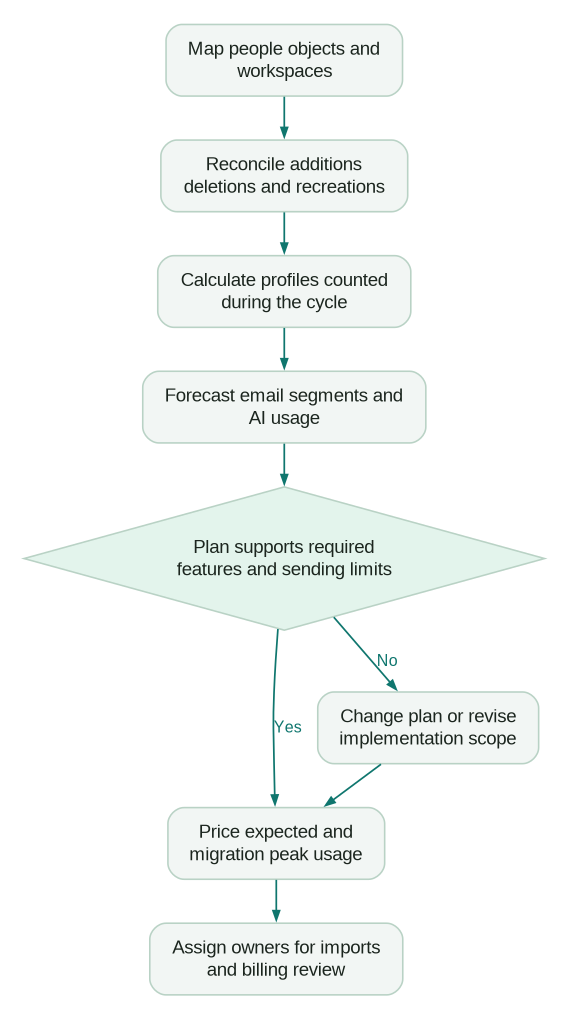
Read diagram as text
- Map people objects and workspaces to Reconcile additions deletions and recreations.
- Reconcile additions deletions and recreations to Calculate profiles counted during the cycle.
- Calculate profiles counted during the cycle to Forecast email SMS segments and AI usage.
- Forecast email SMS segments and AI usage to Plan supports required features and sending limits.
- Plan supports required features and sending limits to Price expected and migration peak usage: Yes.
- Plan supports required features and sending limits to Change plan or revise implementation scope: No.
- Change plan or revise implementation scope to Map people objects and workspaces.
- Price expected and migration peak usage to Assign owners for imports and billing review
Give finance the resulting estimate with a named owner for each uncertain input. Audience growth belongs with acquisition planning. Recreated records belong with the integration owner. Journey volume belongs with lifecycle operations. That makes the forecast something the team can manage rather than a number copied from a pricing page. Get the $99 martech audit or request a detailed Customer.io implementation scope with the data model, journeys and billing-cycle movements.
Keep reading
Browse all CRM & Lifecycle guides
 CRM & Lifecycle
Customer.io vs ActiveCampaign for Product Events and Marketing Automation
Compare Customer.io and ActiveCampaign through product events, contact creation, relationships, plan-specific actions and a reproducible operating budget.
Jafrin Akter AloLast updated 11 min read
 CRM & Lifecycle
Customer.io vs Mailchimp for Campaigns, Product Events and Customer State
Compare Customer.io and Mailchimp by billable audiences, product events, store-dependent exits, automation limits and the full cost of changing platforms.
Jafrin Akter AloLast updated 11 min read
 CRM & Lifecycle
Intercom vs Customer.io: Choose Who Owns Support and Lifecycle Messages
Choose Intercom, Customer.io or both for SaaS support and lifecycle messaging. Compare three-year startup costs, profile billing and duplicate-send controls.
Jafrin Akter AloLast updated 16 min read
Customer.io implementation
See the setup scope, acceptance checks and handover.
Questions people ask
Can we join the Startup Program if we already started a trial?
Yes. Apply using the same email address as the trial account. Customer.io's current program instructions say approved benefits begin after the 14-day trial; starting a trial does not itself approve the application. Current and former customers do not qualify under the published eligibility rule. Keep the approval and term in the billing record before treating the subsidy as available. Startup eligibility.
How should we compare a custom quote that bundles several usage meters?
Ask for the included quantity, counting rule, reset period, excess rate and commitment for each meter, then apply the same workload to every proposal. Keep any bundled concession explicit rather than assigning its value arbitrarily to profiles or email. A lower combined headline can conceal a different allowance or term. Use the written order to reproduce both the expected month and a plausible peak.
Why can an invoice combine a new plan fee with earlier overages?
Monthly invoices combine the next period’s plan fee with the previous period’s overages. Reconcile each line to its service window. Premium or Enterprise plan fees can follow another schedule while usage remains monthly; retain both periods in the forecast. Billing timing.
Can unused budget for one channel offset another channel’s charges?
Keep commercial allowances separate unless the signed agreement explicitly makes them interchangeable. An internal SMS budget left unspent does not establish an entitlement to extra profiles or email. Finance can reallocate its own budget, but the vendor still applies the purchased units and terms. Record both views so a management allocation does not become an unsupported assumption about the next invoice.
Could a linked Customer.io account explain an unexpected profile total?
Yes. A previously linked child account can contribute to the parent’s bill, and Customer.io says Account Settings does not identify that relationship. Ask your account manager or billing support to confirm it. Reconcile the linked accounts and workspaces before deleting records: an unexpected total can reflect billing scope rather than an import defect. Billing structure.
Sources

Written by
Jafrin Akter AloData Engineer and Co-founder at Martechdevs and Growth and Analytics Partners
Jafrin writes practical guides to marketing technology, customer data, analytics and AI workflows. Martechdevs is a Growth and Analytics Partners company.