Marketing Data Quality: How to Monitor, Alert and Fix What Breaks Over Time
Data Engineer and Co-founder at Martechdevs and Growth and Analytics Partners
Last updated 15 min read
Marketing data quality monitoring checks whether the records behind reports and customer actions remain complete, valid, current and consistent after launch. Combine collection tests, warehouse checks and reconciliation with an independent source. Give each failure an owner and a response, and block unsafe activation until the relevant output has passed its checks and reached the destination correctly.
What does good marketing data quality mean in practice?
Good marketing data is fit for the decision or customer action it supports. A growth team needs to know which numbers are usable, which are provisional and which actions should wait.
Start with the output that matters: a daily acquisition report, an eligible renewal audience or a product-activation cohort. Write down its entity, period, currency, exclusions, expected sources and deadline. These choices give a quality check something concrete to enforce.
| Dimension | Marketing example | Useful check |
|---|---|---|
| Accuracy | Purchase value agrees with the eligible paid order | Compare IDs and amounts with the payment ledger |
| Completeness | Every required account and reporting day is included | Check against an expected account-date inventory |
| Consistency | Campaign and customer definitions agree across outputs | Apply the same versioned mapping and definition |
| Timeliness | Yesterday's reconciled figures are ready before a budget review | Check the source cutoff and final publication deadline |
| Validity | Currency and lifecycle stage belong to approved sets | Reject or quarantine unexpected values |
| Uniqueness | One payment creates one payment fact | Test the business key at the model's declared grain |
These dimensions are a practical review framework. They should produce separate failure reasons; a high average score must not conceal a missing suppression field.
Two dashboards disagreeing is a useful investigation trigger. First align their scope. Google Ads and GA4 can report different conversions by design, so equality is not always the acceptance condition.
Our warehouse and data quality implementation service starts with the outputs people act on, then adds checks and ownership around their actual dependencies.
Why does marketing data break after a successful launch?
Data breaks because the systems producing, transforming and consuming it keep changing. A passing launch test establishes a baseline; monitoring checks whether that baseline still holds.
| Change | Example failure | First useful signal |
|---|---|---|
| Website or app release | A successful-payment event loses its order identifier | Synthetic journey and required-field validation |
| Consent configuration | A changed default alters which sessions are measured | Consented and denied release tests, segmented capture rates |
| API or connector change | An endpoint sunsets or a credential loses access | Version calendar, connector error and missing-source check |
| Schema or allowed values | A new CRM stage falls outside the model's mapping | Schema comparison and unmapped-value count |
| Campaign naming | New UTM variants split one channel into several rows | Approved naming registry and unknown-value report |
| Duplicate delivery | Browser and server both create the same purchase fact | Business-key duplication and source reconciliation |
| Identity change | Login joins the wrong person or creates another profile | Known-user journey fixtures and identifier mapping checks |
Treat consent changes, UTM naming changes and identity merges as different failure classes. Their repairs require different evidence. A fall in measured users after a consent release cannot be resolved by increasing collection until the number looks familiar.
Maintain a version inventory for custom API jobs. Checked on 17 October 2026, Google's policy describes roughly twelve-month major-version lifespans, while Meta supports the previous Marketing API version for at least ninety days and releases versions approximately every four months. Use the actual sunset schedule for your selected version. Google Ads API lifecycle, Meta Marketing API versioning.
For managed ingestion, route the provider's operational signals too. Fivetran distinguishes errors that prevent syncing from warnings that allow it to continue. A running connector can therefore still require investigation.
Which checks catch failures at each layer?
Use checks at collection, processing and the business output. Each layer sees a different part of the failure, so one green dashboard cannot certify the whole path.
Google SRE's pipeline guidance separates freshness, correctness and coverage. For marketing data, extend that distinction through the destination where a report is read or a customer is contacted.
Collection checks
Run known journeys after releases and on a suitable schedule: permitted purchase, denied collection, failed checkout, repeat callback, duplicate browser/server delivery and a logged-in user changing account. Confirm the expected event, identifiers, consent behaviour and destination response. The tracking plan supplies those expectations. Apply the cases during tracking implementation and release QA.
GA4 custom insights can flag a received metric falling or behaving unusually and send email. Google currently documents up to fifty custom insights per property, with hourly evaluation limited to web data. Configure a meaningful segment and test the notification. GA4 Analytics Insights.
An analytics-side anomaly is a symptom. It cannot tell whether the cause is lower demand, a collection failure, a consent change or an ingestion delay without another observation.
Warehouse checks
Validate required source slices, usable cutoff, stable keys, allowed values and relationships before publishing the dependent model. A recent maximum timestamp can hide one missing account; a valid schema can contain entirely wrong business values.
dbt includes unique, not_null, accepted_values and relationships data tests. Use them at the right grain and add a business-specific assertion where the built-in checks do not express the requirement. dbt data tests.
Use an anomaly detector for behaviour without a stable absolute threshold. Elementary's volume test normally evaluates completed time buckets, with fourteen training days and two detection days by default. A daily-bucket test therefore cannot be treated as an immediate intraday outage alarm. Elementary volume anomalies.
Reconciliation and destination checks
Compare eligible business records with an independent source using the same cutoff, status, currency and grain. Include missing IDs, unexpected IDs, duplicates and amount differences. The Stripe and CRM reconciliation guide explains why deals, invoices and payments require separate comparisons. For ecommerce, the GA4 versus Shopify purchase guide helps separate collection gaps from differences in order scope.
Then verify the consumer. A correct warehouse audience can be rejected by a destination, overwritten by another writer or remain stale in a dashboard cache. Capture the intended input, accepted operation and resulting state separately.
What would a useful week-one monitoring setup look like?
Start with a small set of checks protecting one important report and one activation workflow. Give every check a response that the team can actually execute.
The following example is hypothetical: a twelve-person SaaS company uses GA4, GTM, HubSpot, Stripe, BigQuery and dbt, with Fivetran ingestion and Hightouch activation. A CDP adds a schema-validation check if the company already uses that capability. These are proposed operating rules, not vendor defaults or universal targets.
| Check and layer | Proposed condition | Owner | Initial response |
|---|---|---|---|
| Collection journey | The permitted successful-payment fixture lacks its agreed event or key | Engineering | Investigate the release before expanding it |
| GA4 trend | Completed-day purchases fall beyond a chosen weekday baseline | Growth analytics | Compare eligible orders and consent segments |
| Source freshness | Required Stripe or HubSpot cutoff misses the report contract | Data | Mark dependent outputs incomplete |
| Payment keys | Any null or duplicate payment key in the published payment model | Data | Fail payment-model acceptance |
| CRM validity | A lifecycle stage has no approved mapping | RevOps | Quarantine affected records and review the new value |
| Check and layer | Proposed condition | Owner | Initial response |
|---|---|---|---|
| CRM relationship | A deal needing company attribution has no valid company relationship | RevOps | Open a record-level exception |
| Event volume | A completed bucket breaches a tuned anomaly or fixed-volume rule | Data | Check release, lateness and traffic changes |
| Payment reconciliation | Closed-period IDs or minor-unit amounts disagree | Finance and data responder | Hold the affected financial output |
| Destination delivery | Hightouch reports rejected rows or an unexpected model size | Integration operator | Inspect scope and destination evidence |
| Ingestion operation | Fivetran reports a sync-blocking error | Data | Restore the source path and estimate missed cutoff |
Give the payment report a specific freshness and coverage agreement. For the example's closed daily ledger, assume source completeness is established before reconciliation and require exact payment-ID and amount agreement. Other sources may restate history or round currency; define their tolerance and explain it rather than copying this exact rule.
During the first week, inventory the two outputs, implement the checks, route a test alert and deliberately break a safe copy. Include a missed schedule: a monitor that never ran must appear as overdue. End the week with evidence that someone received, acknowledged and resolved the simulated failure.
If the team lacks a warehouse, start with the collection journey, connector notifications and a controlled export comparison. Add infrastructure when maintaining those checks becomes a real recurring burden.
Can equal counts and revenue totals still hide bad records?
Yes. A missing payment and a duplicate payment of the same amount can cancel out in aggregate. Reconciliation must check record identity as well as totals.
This hypothetical closed-period example uses USD minor units: 10,000 means USD 100.00. Source payments are A at USD 100.00, B at USD 200.00 and C at USD 200.00. The faulty warehouse contains A, B and another B. Both sides show three rows and USD 500.00, but C is missing and B is duplicated.
The standalone Python fixture below tests that failure without accessing a real billing account:
from collections import Counter

expected = {
    "A": {"amount_minor": 10000, "currency": "USD"},
    "B": {"amount_minor": 20000, "currency": "USD"},
    "C": {"amount_minor": 20000, "currency": "USD"},
}

def reconcile(rows, source):
    counts = Counter(row["payment_id"] for row in rows)
    actual_ids = set(counts)
    issues = {
        "missing": sorted(set(source) - actual_ids),
        "unexpected": sorted(actual_ids - set(source)),
        "duplicates": sorted(k for k, n in counts.items() if n > 1),
        "wrong_values": sorted({
            row["payment_id"] for row in rows
            if row["payment_id"] in source
            and (row["amount_minor"], row["currency"]) != (
                source[row["payment_id"]]["amount_minor"],
                source[row["payment_id"]]["currency"],
            )
        }),
    }
    return {"ready": not any(issues.values()), **issues}

good = [{"payment_id": key, **value} for key, value in expected.items()]
bad = [good[0], good[1], good[1]]
assert len(bad) == len(good)
assert sum(r["amount_minor"] for r in bad) == 50000
assert reconcile(good, expected)["ready"]
assert reconcile(bad, expected) == {
    "ready": False, "missing": ["C"], "unexpected": [],
    "duplicates": ["B"], "wrong_values": [],
}
The fixture assumes the expected ledger is complete and every row already passes schema validation. In production, establish that source evidence independently, scope the IDs to the relevant account and retain failed records in a restricted exception store. Comparing two models derived from the same faulty extraction may reproduce the same omission twice.
After repair, verify the exact A/B/C set and USD 500.00 total, then check the downstream report or sync. Aggregate agreement becomes supporting evidence rather than the sole pass condition.
How should alerts reach the right person without overwhelming everyone?
Route alerts according to business impact, required action and available response coverage. Group related symptoms under the first failing source, while keeping each affected consumer visible.
The following severity model is a proposed small-team policy. Set actual response windows with the people providing coverage. PagerDuty's incident guidance recommends treating uncertain severity as the higher level until the incident is understood.
| Severity | Example impact | First recipient | Operating response |
|---|---|---|---|
| Critical | Wrong recipients or suppression states may trigger customer messages now | On-call operator and lifecycle owner | Contain the action immediately; escalate if unacknowledged |
| High | A report used for today's budget decision is incomplete | Data responder and report owner | Mark it unusable for that decision; give a recovery estimate |
| Routine | An unused campaign label is unmapped | Assigned steward | Resolve in the agreed queue before the next affected use |
An alert should carry the output, source scope, affected period, last usable cutoff, failed assertion, current value, expected condition, owner, runbook and next update time. Keep raw customer payloads out of broadly visible channels.
For example, write “Renewal eligibility is incomplete for the 08:00 UTC cutoff; billing source missing since 07:20; journey paused; data operator investigating; next update 08:15.” That is enough for the campaign owner to decide what to do while the engineer follows the restricted evidence link.
Check the last mile of each notification route:
- The dbt platform can notify on job outcomes; its Slack app currently supports public channels. Model notifications can email configured owners with consolidated results. Job notifications, model notifications.
- Elementary supports owner and subscriber context on alerts, including test, model-run and source-freshness failures. Elementary alerts.
- Slack's dedicated email addresses for channels and DMs require a paid plan. Confirm the recipient and content exposure before forwarding operational email. Email to Slack.
Acknowledgement and resolution are separate. Acknowledgement says someone is handling the issue. Resolution requires the output to pass its acceptance checks again, including the consumer where applicable.
An AI data-quality triage agent can gather evidence and propose a next step once these monitors and owners exist. Keep permission to change data or resume a workflow in the operating policy.
Who owns a marketing data quality failure?
Assign one operating owner to the affected output, then involve the people who own the source and the business meaning. The alert recipient coordinates the response even when another team must repair the cause.
For a wrong account tier, the CRM steward may correct source input, the data engineer may repair a transformation and the growth owner may settle the tier definition. The martech RACI keeps those decisions separate. The CRM property register identifies the permitted writer.
Every critical output also needs a backup and a documented authority to pause or resume automation. Avoid routing an incident to a team name with no acknowledgement responsibility.
How do you repair a failure without creating another one?
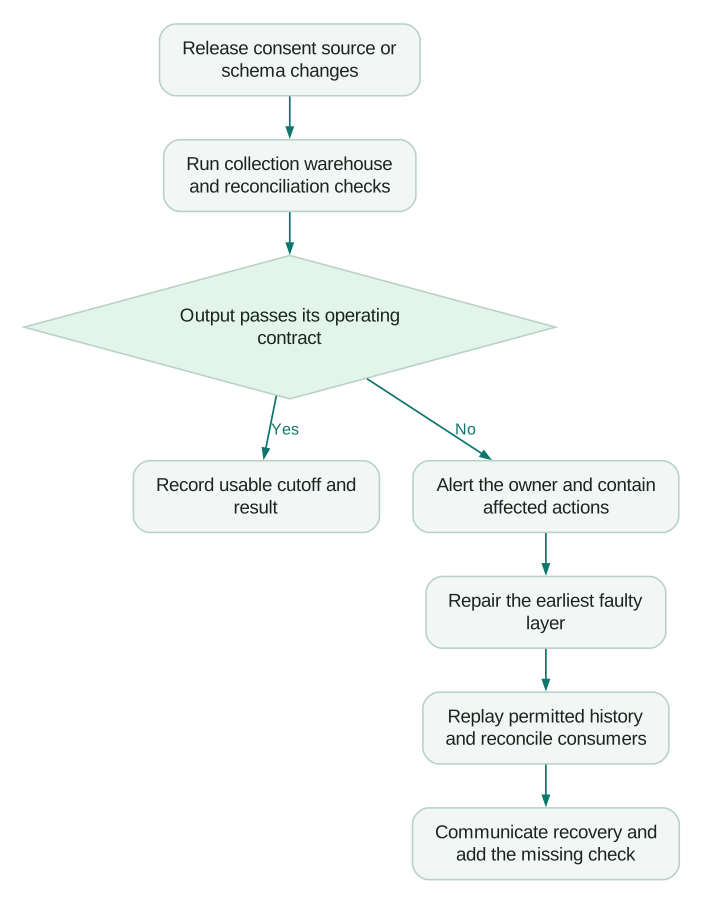
Contain the affected business action, repair the earliest faulty layer and reconcile downstream effects before reopening it. A warehouse backfill cannot undo an email already sent.
- Contain: pause affected writes or customer actions and mark reports stale or incomplete. Check whether an already-enrolled journey can continue using old data.
- Scope: identify affected accounts, records, dates and consumers. Preserve the last trustworthy cutoff and change evidence.
- Trace: follow one known record through collection, extraction, transformation and destination. Find the earliest place where expected and actual state diverge.
- Repair: fix the cause and run the smallest valid replay or scoped dbt backfill. Preserve stable business identities across retries.
- Reconcile: check coverage, values and destination state, then obtain the business owner's permission to resume.
- Communicate: tell users what periods changed, what remains uncertain and whether earlier decisions need review.
Recovery windows matter. Checked on 17 October 2026, GA4 Measurement Protocol supports backdating up to seventy-two hours; older timestamps may be adjusted or rejected depending on validation behaviour. Its documentation separately recommends receipt within forty-eight hours of the original client-side event timestamp when MP events must join client-collected Firebase or gtag events. This is not a promise that any replay within seventy-two hours will restore attribution. GA4 event timing.
Google Ads' offline-import guidance excludes uploads more than ninety days after the associated last click, or sixty-three days for enhanced conversions for leads. The applicable conversion window and other eligibility rules still matter. Offline import guidelines. Use the offline-conversion guide for that delivery path.
When source history is unavailable, preserve the gap in the report. Recreating events from guessed totals gives the system invented evidence.
How do you stop a failed model feeding customer automation?
Make publication of the eligible output and permission to sync it depend on the same successful run and freshness evidence. In dbt build, failed upstream error-level tests can skip downstream resources; source freshness is a separate check. A previously built relation may still exist, so an independent destination schedule must not assume that the table's presence proves a new successful publication. dbt build behaviour, source freshness deployment.
Also distinguish notification from prevention. Hightouch alerts cover rejected rows, model size and other symptoms, often after a run. Its documented journey-trigger “Unexpected sync volume” check can stop sending when configured at STOP. Muting that specific trigger also lets the next run proceed, so treat it as a controlled resume decision, not just notification suppression. Prove your selected gate with a failed safe-copy run and a stale previously published model. The reverse ETL guide covers field policy, exits and destination recovery; Hightouch implementation mistakes covers its operating checks. Hightouch alert semantics.
For the wider choice of delivery route and downstream acceptance, use the data activation guide.
When should you add another monitoring tool?
Add a tool when it closes a demonstrated detection or operating gap. More tools are useful only if their signals reach someone who can act.
Collection QA tools inspect events, tags and journeys before or as data is collected. Warehouse tests check the data that arrived. Observability platforms add broader baselines, history, lineage and incident workflows. The data observability comparison helps choose among dbt, Elementary, Soda, GX and managed platforms without repeating their pricing here.
Native options deserve a look too. Snowflake's managed data-quality feature requires Enterprise Edition and consumes serverless resources. Google Cloud's Knowledge Catalog supports BigQuery data-quality scans, including SQL assertions and email reports. Their availability does not eliminate compute or operating costs. Snowflake data quality, Knowledge Catalog scans.
At Martechdevs, we can implement a small monitoring scope around the reports and audiences your team relies on. Get a scoped warehouse quote with the affected outputs, their deadlines and the sources involved.
How can you tell whether monitoring is improving?
Measure detection and recovery against actual incidents and scheduled checks. A growing number of alerts is not a success measure on its own.
Track the share of incidents first found by monitoring, detection delay, time until the output is usable, repeat incidents and overdue unresolved warnings. Count missed monitor runs separately. For a hypothetical month with ten known incidents, seven detected before a stakeholder report gives 70% monitoring-first detection; it says nothing about failures nobody discovered.
Review each incident for a missing check, badly tuned threshold or unclear response. Re-run its fixture after fixing the monitor. The cost of bad data guide helps decide which repeated failures justify further work.
What should pass before relying on the monitoring setup?
The setup is usable when a known failure reaches an owner and prevents or clearly labels the affected business use.
Checklist
- Critical reports and audiences have a defined grain, period, source inventory and owner.
- Collection fixtures cover permitted, denied, failed and duplicate paths.
- Freshness checks inspect the required source scope and final output.
- Business keys, required values and source-to-output reconciliation have separate checks.
- A missed monitor schedule becomes an overdue condition.
- A failed build cannot silently authorise a sync of yesterday's output.
- A test notification reaches the primary responder and the escalation route is documented.
- One safe-copy incident has been contained, repaired and reconciled through the consumer.
- Recovery notes identify changed periods and any unrecoverable history.
Want a second pair of eyes on your stack? Book a free audit with one recurring reporting discrepancy or failed customer workflow.
Questions people ask
What can a team monitor before it has a warehouse?
Start with known website or app journeys, required event fields, connector errors and a controlled comparison between accepted business transactions and analytics records. Give those checks an owner and a schedule. A warehouse becomes useful when recurring cross-system reconciliation needs shared history or logic; it is not a prerequisite for noticing a broken form or missing purchase event.
How should a low-volume event be monitored?
Combine a known synthetic journey with a window long enough to contain meaningful activity. A percentage drop from two events to one is large but provides little evidence of a collection defect. Use expected operating hours, completed source records and release context. Define how zero expected activity differs from a monitor that failed to run.
Can a consent release look like a tracking outage?
Yes. A changed consent default or banner experience can alter the measured population even when the implementation follows its new policy. Compare permitted and denied test paths, consent rates and eligible source outcomes. Preserve the privacy decision while investigating. Reverting collection rules merely to restore an old analytics total would confuse measurement coverage with business demand.
Does a successful connector run prove the report is complete?
It proves only the success conditions that connector evaluates. The report can still omit an account, contain unmapped values or read a stale transformed table. Verify the expected source slices, business-key coverage and final publication cutoff separately. For operational audiences, also inspect destination receipt or state because successful extraction does not establish that the CRM accepted every intended update.
When is replaying historical events unsafe?
Replay is unsafe when event identity, permission, destination timing or downstream side effects are unknown. A repeat event can enrol a customer twice or change attribution even if the warehouse becomes correct. Identify the affected scope, preserve original identifiers and timestamps, check destination limits and use a safe sample. Record irrecoverable gaps rather than manufacturing a complete-looking history.
Sources
- Google SRE: Implementing SLOs. Accessed 17 October 2026.
- Google: Google Ads API deprecation and sunset. Accessed 17 October 2026.
- Meta: Marketing API versioning. Accessed 17 October 2026.
- Fivetran: Alerts. Accessed 17 October 2026.
- Google: Analytics Insights. Accessed 17 October 2026.
- dbt: Data tests. Accessed 17 October 2026.
- Elementary: Volume anomalies. Accessed 17 October 2026.
- PagerDuty: Severity levels. Accessed 17 October 2026.
- dbt: Job notifications. Accessed 17 October 2026.
- dbt: Model notifications. Accessed 17 October 2026.
- Elementary: Alerts. Accessed 17 October 2026.
- Slack: Send emails to Slack. Accessed 17 October 2026.
- Google: Send Measurement Protocol events. Accessed 17 October 2026.
- Google: Guidelines for importing offline conversions. Accessed 17 October 2026.
- dbt: Build command. Accessed 17 October 2026.
- dbt: Source freshness. Accessed 17 October 2026.
- Hightouch: Configure sync alerts. Accessed 17 October 2026.
- Snowflake: Introduction to data quality checks. Accessed 17 October 2026.
- Google Cloud: Auto data quality overview. Accessed 17 October 2026.

Written by
Jafrin Akter AloData Engineer and Co-founder at Martechdevs and Growth and Analytics Partners
Jafrin writes practical guides to marketing technology, customer data, analytics and AI workflows. Martechdevs is a Growth and Analytics Partners company.