
Ecommerce Martech Stack: Shopify Events, Consent and Margin
Build an ecommerce martech stack around the order, its later adjustments and the permissions governing each destination. Give purchase collection one clear owner, keep fulfillment and financial records authoritative, and choose lifecycle tools from the journeys the business needs. A useful stack explains what happened to an order, who may act on it and how much value remains after discounts, refunds and variable costs.
On this page
What should the ecommerce stack do before you add more apps?
The ecommerce stack should turn a confirmed business event into the appropriate report, operational action and permitted message without duplicating the outcome. For a Shopify brand, start with order and customer records, supported collection, purpose-specific permissions and a shared financial definition.
| Layer | Main job | Evidence that it works |
|---|---|---|
| Shopify and payment operations | Record orders, payment state and later adjustments | A known order and its payment/refund history agree |
| Privacy and preferences | Determine permitted collection and messaging | Accepted, rejected and partial choices reach the intended systems |
| Analytics and advertising delivery | Send approved outcomes with consistent identity and value | One business purchase is not multiplied by competing senders |
| Lifecycle, support and reviews | Act on current customer and order state | Fulfilled, canceled and returned orders enter the right journeys |
| Reporting | Explain sales, cash and contribution | Adjustments and costs reconcile at the intended grain |
The industry-stack comparison explains why these records differ from SaaS accounts or marketplace payouts. Within ecommerce, a brand selling one-time products has different renewal and fulfillment questions from a subscription brand, even if both use Shopify.
Before adding another app, name its missing job, source records, writer permissions, usage meter and operating owner. An app that repeats an existing purchase sender can make a low-conversion report look larger while reducing its reliability.
Which identifiers and records hold the stack together?
Keep customer, checkout, order, payment, fulfillment and adjustment identities separate. The order joins commercial activity, but it does not replace every event or financial record attached to it.
| Record | Stable key to preserve | Why it stays separate |
|---|---|---|
| Customer | Store plus customer ID, where available | A customer can place several orders or check out as a guest |
| Checkout | Checkout identifier or token from the actual integration | An abandoned checkout is not a paid order |
| Order | Store plus canonical order ID | Displayed order numbers can overlap across stores |
| Fulfillment | Fulfillment ID linked to order lines | Two parcels do not necessarily mean two purchases |
| Refund or reversal | Distinct adjustment ID and affected lines | A later partial refund is not a replay of the original sale |
Write the expected purchase outcome explicitly. Is it a completed online checkout, confirmed payment capture or another defined event? The collection and reconciliation must use the same condition. Do not silently compare a checkout count with a payment-settlement count.
Preserve raw identifiers before normalizing them. A sender's transaction_id may be an underlying order ID, a displayed name or a transformed value. Prove the mapping with known examples; stripping punctuation until two columns join can conceal a collision.
For events, record the source occurrence, delivery ID, business timestamp, ingestion timestamp, currency and schema version. Separate delivery retries from new business adjustments. The tracking-plan guide helps maintain that contract; the GA4 refund guide covers the adjustment path in more detail.
How should a Shopify store collect customer events now?
Use a supported app pixel or maintained custom pixel for the required customer events, and verify the actual checkout configuration. An old script remaining visible in an admin screen does not establish that it still executes.
Shopify's non-Plus upgrade deadline for the new Thank you and Order status pages was 26 August 2026. Upgrading replaces the old pages and incompatible customizations; the guide directs merchants to compatible blocks and pixels. Shopify upgrade guide
The separate developer timeline says Order status script tags stopped for Plus stores on 28 August 2025 and other stores on 26 August 2026. That scope is distinct from storefront script tags. Do not remove unrelated storefront behavior merely because an Order status implementation retired. Order status script-tag retirement
App pixels and custom pixels
App pixels run in Shopify's strict sandbox and can access settings supplied through the Admin API. Custom pixels run in a lax sandbox, are configured in the admin and do not expose the same settings property. A script written for the top-level storefront environment may therefore need more than a different paste location. Web Pixels API
Choose an app implementation when it supports the required events, fields, permissions and maintenance path. Choose a custom pixel when a specific requirement justifies owning its code and tests. Record which implementation owns each destination's purchase event.
Shopify's GA4 setup guide uses the Google & YouTube channel and says certain ecommerce events are collected automatically after setup. Confirm the connected property and inspect what the chosen integration actually emits before adding another GA4 sender. Shopify GA4 setup
The checkout event is not a final financial ledger
Shopify's checkout_completed fires once per checkout, normally on the Thank you page. With a post-purchase offer it fires on the first upsell page instead, not again on the Thank you page. If the triggering page fails to load, the event can be absent. Checkout event behavior
That matters when an upsell changes the order after the initial event. Keep the checkout measurement and later order adjustments visible, rather than assuming the first browser payload contains the final commercial value.
Our tracking and attribution implementation work starts with this event ownership and order reconciliation. The Shopify purchase-mismatch guide handles diagnosis when the existing collection already disagrees.
How should consent control the destination routes?
Evaluate the permission required by each purpose and implementation. A single “accepted cookies” flag cannot reliably describe analytics, advertising, preferences, data sharing and channel subscription state.
Shopify's Customer Privacy API exposes permissions for preferences, analytics, marketing and sale of data. Its regional defaults depend on the merchant's configured regions. Consent should be recorded through a visitor interaction, not granted automatically. In configured opt-out regions, Global Privacy Control is honored for the sale-of-data state. Customer Privacy API
Shopify's pixel manager loads an app pixel only when all its declared required permissions are satisfied. Custom pixels have their own configured requirements. The pixel APIs support checking initial permissions and responding to later changes. Pixel privacy controls
Test the actual routes, including custom server senders that a storefront banner may not control automatically:
| Test state | Question to resolve | Evidence to retain |
|---|---|---|
| No choice recorded | What does the approved regional configuration permit? | Initial API state and actual requests |
| Analytics accepted, marketing declined | Can the analytics-only route work without advertising delivery? | Required permissions per pixel and downstream request log |
| All optional purposes declined | Which nonessential destinations remain silent? | Browser and server egress evidence |
| Later withdrawal | Does the new state stop future ineligible processing? | Updated state, queued-work behavior and suppression evidence |
| Data-sharing opt-out | Does that separate restriction reach affected routes? | Sharing state and destination-specific decision |
An analytics-only pixel can require different permissions from a pixel bundling analytics and advertising. Do not assume that accepting analytics guarantees every installed GA4 implementation loads. Inspect the app's declarations and the intended purpose.
Keep email and SMS subscription evidence separate from browser tracking permissions. A completed order is not a universal marketing subscription. Use Consent Mode v2 for the Google-specific signaling path, and the customer preference center for channel and purpose records.
Which tools fit each layer and stage?
Choose the smallest arrangement that supports the required journeys and controls. Add another platform only when its incremental capability is clear and someone can maintain the connection.
| Situation | Starting arrangement | Next capability to evaluate | What must be proven |
|---|---|---|---|
| Small single-store brand | Shopify, supported acquisition measurement and one lifecycle tool | Better post-purchase or repeat-purchase journeys | Clean order state, current eligibility and manageable operations |
| Brand with several paid channels | Named sender per destination and order reconciliation | Shared server routing or specialized integration | Consistent identity, permission handling and recovery |
| Subscription commerce | Order model plus subscription and renewal state | Account lifecycle and payment-recovery journeys | Renewal versus new-customer outcomes remain distinct |
| Multi-store or omnichannel brand | Store/channel-qualified order records | Warehouse models and reporting | No cross-store ID collision or duplicated revenue joins |
For lifecycle, compare Klaviyo, Omnisend, Attentive, Customer.io or another candidate against the actual channels and event model. The Klaviyo alternatives guide and Customer.io-versus-Klaviyo comparison keep that product evaluation separate from the stack design.
Run a controlled order through the integration before judging the editor. Can it distinguish placed, paid, fulfilled, canceled and refunded states? Does a suppressed customer remain suppressed after an order update? Can a post-purchase upsell change the relevant journey without creating a second welcome or review request?
For server delivery, compare the supported channel app with a maintained server container or specialist integration. The Stape-versus-Elevar guide frames that choice. A server route can improve controlled delivery; it does not convert an ineligible destination into a permitted one or eliminate duplicate business events by itself.
Review, support and loyalty apps need the same ownership discipline. A review request should reflect fulfillment and any unresolved return, not merely a checkout timestamp. Support needs enough order context to help the customer, without becoming another uncontrolled copy of every analytics or financial field.
Budget subscriptions, active profiles, message units, orders processed, usage overages and operating time separately. Use the active-profile billing guide when modeling lifecycle cost. An inexpensive app can still add substantial maintenance or a second writer to a critical field.
How do you preserve purchase identity without freezing an order forever?
Keep the original purchase occurrence stable and model later business changes separately. Retry handling must not erase a real refund, and order updates must not manufacture new customers or checkouts.
Use this original event-ledger design as a starting contract:
store_key: example_store
purchase_unit: completed_online_checkout
purchase_business_key: store_plus_order_id
delivery_retry_key: source_event_id
adjustment_business_key: store_plus_adjustment_id
order_updates: revise_order_state_without_new_purchase_count
refunds: retain_each_distinct_adjustment_once
currency: preserve_original_currency
destination_routing: evaluate_current_approved_permission
unknown_mapping_or_permission: hold_and_investigate
This is a design record, not a Shopify app configuration. The actual integration must implement durable duplicate handling, reconcile uncertain deliveries and support its destination's event semantics.
Google's ecommerce guidance uses a transaction ID for purchases and refunds, with item IDs and quantities supporting item-level refund measurement. Purchase collection alone does not establish that the refund path exists. GA4 ecommerce events
Do not resend a purchase with a new transaction ID simply to force a higher order value into a report. Decide whether the destination measures the initial checkout, a later confirmed order state or separately represented adjustments, then test its supported behavior. Preserve a reconciliation bridge for differences that are intentional.
What does one order look like across the whole stack?
Run one order through the GA4 ecommerce journey, then reconcile its permission state, initial checkout, post-purchase changes and later refunds across the stack. The same record can legitimately have different values at different points in time.
Consider an original hypothetical order in USD. A visitor accepts analytics and declines marketing. The approved setup has an analytics-only sender requiring analytics permission; advertising routes remain disabled for this journey. The order contains items priced at USD 60 and USD 40, with a ten-percent discount on those two items, then a USD 20 upsell with no discount.
| Stage | Order merchandise value after discounts | Expected behavior |
|---|---|---|
| Initial checkout | USD 90 | The checkout event represents the initial purchase under this contract |
| First upsell page | USD 90 before offer acceptance | Shopify emits checkout_completed on this path |
| Upsell accepted | USD 110 | Backend order state records the extra USD 20; no second checkout is invented |
| One original USD 40 item returned | USD 74 retained merchandise | Record its USD 36 discounted refund as a distinct adjustment |
The original checkout analytics value of USD 90 and the later order value of USD 110 do not automatically indicate a defect. Under this example's initial-checkout contract, the upsell needs a separately designed reporting path. If no supported upsell path is implemented, the analytics report's scope excludes that extra USD 20 and the reconciliation should say so.
When the USD 36 refund is represented against the original checkout, the initial-checkout merchandise view becomes USD 54; the retained full-order merchandise value is USD 74 including the upsell. Do not hide the USD 20 difference by changing identifiers or pretending the initial event contained a later decision.
The lifecycle tool receives the permitted operational order updates needed for its assigned purpose. Marketing enrollment remains governed by the separate channel eligibility record. A transaction update should not silently change a declined marketing preference.
How should revenue and contribution margin be defined?
Define sales, payments and contribution as separate measures, then reconcile each to its source. A single “revenue” field across every app usually hides different components and timing.
Shopify defines gross sales before discounts and reversals, with pending, canceled and unpaid orders included. Net sales deduct discounts and sales reversals; total sales also includes components such as taxes, shipping, duties and fees. Its sales reports do not measure cash movement. Reversals are recorded on the date processed. Shopify sales definitions
For the hypothetical order, the merchandise calculation is 120 gross − 10 discount − 36 refunded merchandise = USD 74. Avoid subtracting the same canceled or refunded amount once as a status exclusion and again as a reversal unless the model explicitly accounts for that treatment.
Now define an original contribution model. Assume USD 5 shipping revenue, USD 60 original product cost, USD 20 of cost recovered because the returned item is resalable, USD 7 outbound shipping cost, USD 4 payment fees that remain charged and USD 6 return-processing and return-shipping cost. Taxes, advertising and fixed overhead are excluded from this particular contribution measure.
| Component | Calculation or assumption | Amount, USD |
|---|---|---|
| Retained merchandise sales | 120 − 10 − 36 | 74 |
| Shipping revenue retained | Assumed unchanged | 5 |
| Product cost retained | 60 − 20 recovered | −40 |
| Outbound shipping cost | Assumed incurred | −7 |
| Payment fees | Assumed not refunded | −4 |
| Return handling and shipping | Assumed incurred | −6 |
| Contribution before advertising and fixed overhead | 74 + 5 − 40 − 7 − 4 − 6 | 22 |
The corresponding contribution percentage on retained merchandise plus shipping revenue is 22 ÷ 79 = 27.85%. Name that denominator. If the returned item cannot be resold and no product cost is recovered, contribution falls to USD 2 under the same other assumptions.
This is not Shopify's gross-profit metric or a universal accounting policy. Finance should approve cost recovery, allocation, currency and timing. Use the multi-currency reporting guide when amounts cross currencies; do not add USD and EUR simply because both columns are called revenue.
Keep both an order-cohort view including later adjustments and a period-activity view showing reversals when processed. They answer different questions and will not always have matching monthly totals.
What can attribution tell you after the order data is reliable?
Attribution can allocate observed outcomes under a selected model; it does not by itself prove how many purchases a channel caused. Establish order coverage and value definitions before treating an attributed return as a budget decision.
Keep these views separate:
- Store and financial records explain the business outcomes and adjustments.
- GA4 describes its observable acquisition and event scope under its settings.
- Ad platforms attribute eligible outcomes under their own windows and rules.
- Lifecycle reports associate outcomes with the platform's message-attribution model.
The Meta-versus-GA4 guide explains common differences. Neither a larger number nor a smaller number automatically makes one channel report authoritative for total store sales.
Use incrementality, attribution and MMM according to the decision, available data and experimental constraints. A holdout can answer whether a lifecycle journey adds useful orders; a platform-attributed revenue total cannot answer that alone.
When does the brand need a warehouse or broader reporting layer?
Add a warehouse when recurring joins, historical adjustments or multi-channel reconciliation need maintained models that the current reports cannot provide reliably. The trigger is the operating problem, not an arbitrary store-revenue threshold.
Examples include joining order lines with cost history, combining several stores with overlapping order numbers, allocating fulfillment costs without multiplying sales, or tracking acquisition cohorts through later refunds and renewals.
Before buying, identify the source tables, refresh requirement, reconciliation owner and decision that will use the model. A dashboard that updates quickly but joins one order to three fulfillment rows and repeats its revenue three times is still wrong.
Our warehouse and reporting implementation should leave those definitions, joins and checks visible to the team. Preserve the original source records and transformations so a later cost correction can be explained rather than overwritten without history.
What should pass before a Shopify stack change goes live?
Require successful customer journeys, correct business counts and visible permission decisions, including the important negative cases. A tag firing once in a debugger is only one part of the evidence.
- Inventory current senders and name the owner of each destination event.
- Freeze the purchase definition, identifiers and monetary components.
- Test ordinary, failed and post-purchase checkout paths.
- Test no-choice, accepted, rejected, partial and withdrawn permissions.
- Reconcile the order, later update and refund without multiplying purchases.
- Verify lifecycle suppression and operational message behavior.
- Save the results, rollback steps and ongoing monitoring owner.
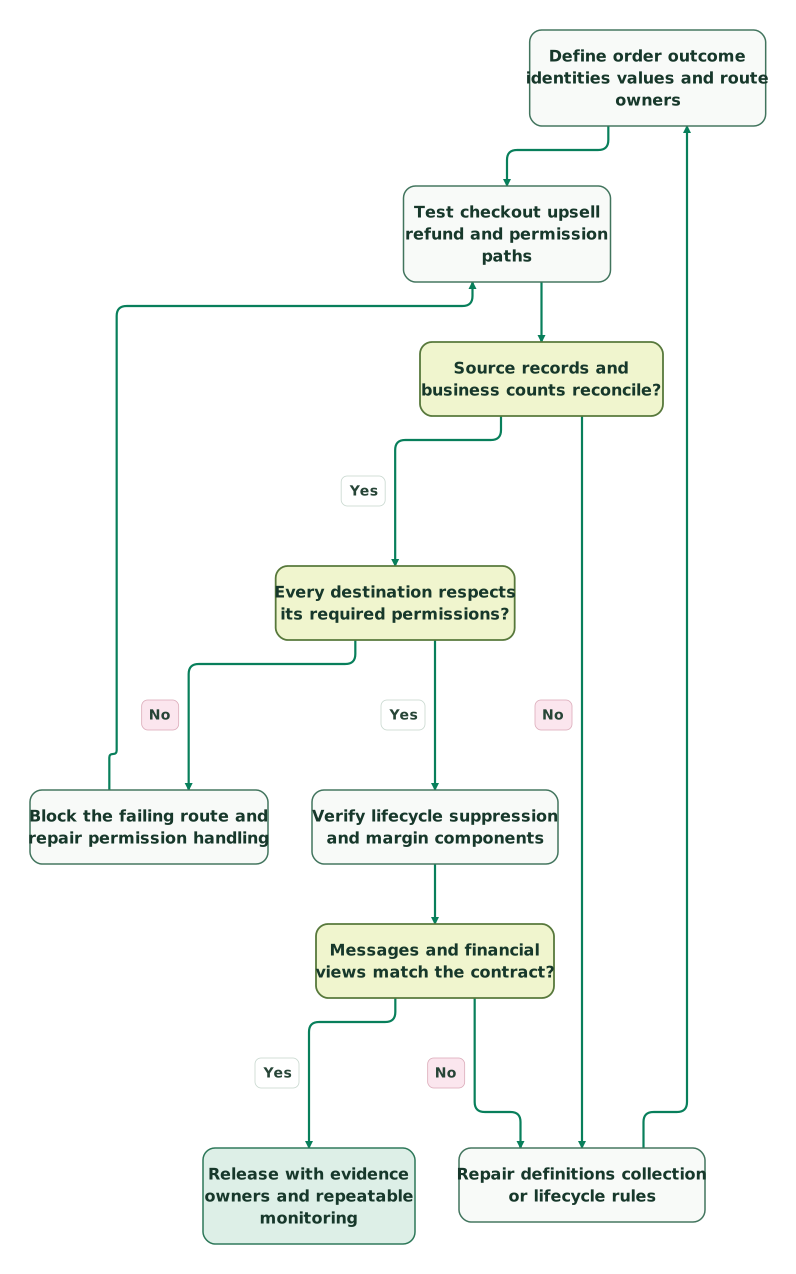
Read diagram as text
- Define order outcome identities values and route owners to Test checkout upsell refund and permission paths.
- Test checkout upsell refund and permission paths to Source records and business counts reconcile?.
- Source records and business counts reconcile? to Repair definitions collection or lifecycle rules: No.
- Repair definitions collection or lifecycle rules to Define order outcome identities values and route owners.
- Source records and business counts reconcile? to Every destination respects its required permissions?: Yes.
- Every destination respects its required permissions? to Block the failing route and repair permission handling: No.
- Block the failing route and repair permission handling to Test checkout upsell refund and permission paths.
- Every destination respects its required permissions? to Verify lifecycle suppression and margin components: Yes.
- Verify lifecycle suppression and margin components to Messages and financial views match the contract?.
- Messages and financial views match the contract? to Repair definitions collection or lifecycle rules: No.
- Messages and financial views match the contract? to Release with evidence owners and repeatable monitoring: Yes
Checklist
- Each purchase destination has one deliberate collection owner.
- Checkout customizations use supported implementations.
- Order, checkout, customer and refund identifiers are not interchangeable.
- Upsell acceptance does not create an accidental second checkout.
- Permission changes reach browser and server paths.
- Tracking consent and marketing-channel eligibility remain distinct.
- Refunds and repeated deliveries have separate handling.
- Margin includes defined costs and an explicit denominator.
- Platform-attributed revenue remains separate from causal evidence.
- Another operator can reproduce the reconciliation and recovery steps.
Get the $99 martech audit to locate gaps in the current arrangement, or request a detailed tracking implementation scope with the checkout paths, destinations and financial definitions the brand needs to support.
Keep reading
Browse all Martech Strategy guides
 Martech Strategy
B2B SaaS Martech Stack: Connect Product, Sales and Billing
Design a SaaS stack around accounts, activation and billing. Compare sales-led, product-led and hybrid workflows with qualification and reconciliation checks.
Jafrin Akter AloLast updated 14 min read
 Martech Strategy
Fintech Marketing Stack: Track the Funnel Without Leaking Financial Data
Design a fintech stack around verified application and funding milestones. Control destination data, model pending cases and test internal event boundaries.
Jafrin Akter AloLast updated 14 min read
 Martech Strategy
Mobile App Marketing Stack: Subscription Data, Tools and Release Tests
Build a subscription app stack around store state, identity, revenue and lifecycle messaging. Includes pricing context, reconciliation code and release tests.
Jafrin Akter AloLast updated 17 min read
Analytics & tracking
See the implementation scope, deliverables and acceptance checks.
Questions people ask
Can a refunded order remain part of the original acquisition cohort?
Yes, if the cohort represents when the customer or order was acquired. Retain the later refund as an adjustment to that cohort's value while also recording it in the period when the adjustment occurred. Do not move the acquisition date simply to align monthly totals. Keep the cohort and period-activity views labeled so readers can understand why their values differ.
Should a guest checkout create a permanent marketing profile automatically?
Only under the approved purpose, retention and eligibility rules for that system. The order may need a contact record for fulfillment or support without authorizing a marketing journey. Preserve guest and customer identifiers deliberately, avoid merging people solely because a name resembles another record, and test whether later account creation links the correct history without changing the customer's preferences.
What should happen when an app is removed but its server integration remains active?
Treat removal as a complete integration retirement, including credentials, scheduled jobs, queues, webhooks and destination settings. Confirm which components actually stop and which still have dependencies. A storefront uninstall does not prove every separately operated sender has stopped. Run the relevant purchase and suppression tests afterward, then verify there is no stale writer or repeated event stream from the retired arrangement.
Can we compare two campaigns before every order has a known source?
You can compare clearly defined observable populations while retaining the unattributed portion and its limitations. Keep inclusion rules consistent and inspect whether missingness differs by device, permission state or checkout flow. Do not assign unknown orders to a campaign merely to complete the table. For a causal budget question, use an appropriate experiment or broader measurement method rather than treating partial attribution as complete evidence.
Does a return always reverse the original product cost?
No. Cost treatment depends on what physically happened and the accounting policy. A resalable return can have a different economic effect from a damaged item, goodwill refund or product the customer keeps. Record the relevant inventory and fulfillment evidence, then apply the approved cost treatment. A refunded sales amount alone is insufficient to determine the product-cost recovery or final contribution margin.
Sources
- Shopify checkout-page upgrade guide
- Shopify Order status script-tag retirement
- Shopify Web Pixels API
- Shopify GA4 setup
- Shopify checkout_completed behavior
- Shopify Customer Privacy API
- Shopify pixel permission requirements
- Google Analytics ecommerce purchases and refunds
- Shopify sales and reversal definitions

Written by
Jafrin Akter AloData Engineer and Co-founder at Martechdevs and Growth and Analytics Partners
Jafrin writes practical guides to marketing technology, customer data, analytics and AI workflows. Martechdevs is a Growth and Analytics Partners company.