
Lead scoring model for SaaS: fit, engagement and product signals
Data Engineer and Co-founder, martechdevs
Last updated 13 min read
A useful SaaS lead-scoring model helps sales choose which eligible prospects to work next. Keep customer fit separate from recent engagement, use product behaviour only when its meaning is clear, and validate the ranking against a defined commercial outcome and the team's capacity. Start with an explainable rules-based model. Add predictive scoring when the data and evaluation show that it improves the decision.
Last updated: 1 October 2026.
A score of 85 is meaningless without an explanation of what it predicts, when it was calculated and what the team should do with it. It is also not an 85% chance of becoming a customer unless the model has been designed and validated to estimate that probability.
For an early SaaS team, the immediate problem is usually concrete: more accounts need attention than sales can handle, and the current work list mixes strong prospects with weak or stale signals. The scoring model should improve that queue while preserving a useful response to direct requests.
This guide builds an illustrative model, explains how to implement its logic in a CRM and shows how to check whether the ranking earns its place.
Define the decision before choosing points
Specify who will use the score and what happens when it changes. An SDR choosing accounts for outreach, an account executive prioritising open opportunities and a customer success manager reviewing renewals need different models.
For the example here, the decision is: which eligible new-business trial accounts should sales review for proactive help this week? Existing customers and active opportunities use their own ownership and follow-up workflows.
Choose the scoring unit. In a team SaaS product, account-level prioritisation may be more useful than independently scoring every contact. Five active users from one account should not automatically consume five separate sales slots.
Define an evaluation outcome and window. For example, the account becomes a sales-accepted opportunity within 30 days of the scoring snapshot, using documented acceptance criteria. This is a process outcome, not proof of future revenue. Continue checking later wins, value and retention where the sales cycle makes those outcomes available.
Record the weekly capacity. If sales can meaningfully review 100 accounts, evaluate the first 100 in the ranking. A model that looks impressive across the whole database can still perform poorly where the team actually draws the line.
Put eligibility and communication rules outside the score
Some conditions should determine the route directly. They should not be small negative weights that enough page views can cancel out.
Examples include employee and test accounts, confirmed spam, an existing-customer relationship, a product use case you cannot serve, or a contact channel that must not be used. Keep the reason visible and send legitimate requests to the appropriate response path.
Treat missing information differently from a confirmed disqualification. An unknown company size can trigger research or clarification. It should not silently become evidence that the company is too small.
An explicit demo or contact request also needs its own handling rule. Do not leave a person waiting because an enrichment service has not yet populated enough fields to cross a score threshold.
Keep one accountable follow-up owner across the direct-request and proactive-review paths. If sales is already working the request, a score change should not create a second outreach task from another rep.
The lead-routing guide covers how to preserve account ownership, assign the request and handle exceptions after these decisions are made.
Keep fit and engagement visible as separate dimensions
Fit describes whether the account has a problem you can solve and a context your product can support. Useful inputs may include a confirmed use case, the relevant business segment and required technical compatibility.
Engagement describes recent behaviour that suggests the account is exploring or receiving value. Relevant signals might include a direct request, a qualifying product outcome or several people participating in the intended workflow.
Two accounts can have the same combined total and need different treatment. Strong fit with little recent activity may belong in a permitted nurture path. High activity with unknown fit may need qualification. Strong fit and recent useful activity may justify immediate review.
HubSpot's lead-scoring documentation supports fit, engagement and combined scores, with availability depending on the object and subscription. The combined approach can expose component values as well as the total. Preserve that interpretability even if you calculate the score outside HubSpot.
A starting model with explicit limits
The following weights are illustrative hypotheses for a collaborative reporting SaaS. They are not benchmark weights or a model proven for every business.
Use a fit score from 0 to 50:
- 20 points for a confirmed target business segment.
- 20 points for a confirmed reporting use case the product supports.
- 10 points for confirmed compatibility with the required data source.
Use a recent-engagement score from 0 to 50:
- 25 points for at least one valid demo request in the past 14 days.
- 15 points for at least one qualifying product outcome in the past seven days.
- 10 points for at least two distinct human members completing qualifying activity in the past seven days.
Each condition contributes once, regardless of repeated deliveries or repeated occurrences during its window. Define the snapshot timestamp and include events from the window start through that timestamp; exclude future-dated events. Keep unresolved timing errors visible for investigation.
For this example, a qualifying outcome is a human viewing a successfully generated, non-empty report from a supported live data source. Replace that definition with the actual value event in your product. The SaaS activation-metrics guide explains how to test whether such an event is useful.
The windows provide an explicit expiry rule. Once an event falls outside its window, it stops contributing. Do not assume this has the same behaviour as a CRM's percentage-decay feature.
Do not award fit points for an unknown field. Store a separate completeness indicator so users can distinguish an incomplete record from a confirmed poor fit. If enrichment changes a field, retain the source and update time.
Work through accounts before turning the model on
Consider four illustrative accounts:
- Account A: confirmed segment, supported use case and compatible source produce 50 fit points. A recent product outcome and two active members produce 25 engagement points. It is a strong candidate for proactive review.
- Account B: confirmed target segment produces 20 fit points; use case and technical compatibility are unknown. All three engagement conditions produce 50 points. Its total of 70 hides the qualification gap, so route it for prompt clarification rather than treating the total as complete evidence of fit.
- Account C: all fit conditions are confirmed, producing 50 points. It has 100 recorded email opens but none of the defined engagement conditions, so its engagement score is zero. It does not jump ahead merely because an email system recorded many opens.
- Account D: the account needs a capability the product definitively cannot provide. It follows the appropriate non-sales or explanatory response path before any numeric threshold is considered.
For an initial policy, you might classify fit of at least 35 and engagement of at least 20 as a proactive-review band. Those thresholds are assumptions to test against queue size and outcomes. A valid direct request continues through its own response path regardless of that band.
Rank within a band using a documented tie-breaker, such as the recency of a qualifying signal, then a stable account ID. Deterministic ties make the queue reproducible and easier to investigate.
Be selective about marketing and product signals
Email opens are weak evidence of buying intent. Apple's Mail Privacy Protection documentation explains that remote content can be downloaded in the background when a message is received. A recorded open therefore should not be treated as reliable evidence that a human read the message.
Clicks and page visits also need context. A careers-page visit and a pricing-page visit answer different questions. Repeated technical requests can inflate an event count. Inspect how the event is produced before deciding that more of it means stronger intent.
Product signals deserve the same scrutiny. A background sync, a failed report job or a support-driven troubleshooting session can generate activity without indicating a sales opportunity. The tracking-plan guide helps distinguish successful outcomes, attempts and system activity.
Account aggregation needs rules too. Include the contacts or members relevant to the account and the use case. Counting every associated contact's historical activity can inflate scores for large or poorly maintained accounts.
Validate using what was known at the scoring time
Build historical snapshots with the fields and events available at each decision point. A final deal stage, a later sales note or a billing record created after the outcome must not enter the earlier score.
The scikit-learn guidance on data leakage explains how unavailable future information and test-data contamination produce overly optimistic evaluation. For predictive models, learn preprocessing and feature selection from training data only. Keep the evaluation period separate from the data used to choose the model.
For a rules-based score, the same discipline applies to tuning. If you repeatedly change weights to improve one historical test cohort, it becomes development data. Reserve a later period for a fresh check.
Define how repeated accounts are handled. A model evaluated on brand-new accounts needs a split that supports that claim. A weekly operational ranking can legitimately revisit existing eligible prospects, but its evaluation should reflect repeated observations and avoid counting one eventual opportunity as many independent successes.
Compare like with like: the same eligible population, snapshot rules, outcome window and available sales capacity. Keep cohorts whose outcome window is incomplete out of a simple completed-outcome comparison.
Evaluate the part of the ranking sales can use
Suppose an illustrative completed evaluation contains 1,000 eligible accounts, of which 60 reach the defined opportunity outcome within 30 days. The top 100 ranked accounts contain 20 of those outcomes.
The useful calculations are:
- Precision at 100: 20 / 100 = 20% of the selected accounts reach the outcome.
- Recall at 100: 20 / 60 = 33.3% of all observed outcomes are captured in the selected group.
- Population outcome rate: 60 / 1,000 = 6%.
- Ranking lift over the population rate: 20% / 6% = 3.3 times.
That is an illustration of concentration in a ranking. It does not mean the score created 20 opportunities or increased revenue by 3.3 times. Forty observed opportunities are outside the top 100, so review what the model missed and whether a different capacity or rule would be more useful.
Compare the new model with your existing prioritisation policy at the same capacity. Include the staff time required to research missing fields and the proportion of selected accounts sales rejects for a concrete reason.
Historical labels can reflect historical attention. Accounts that received more sales effort may be more likely to have recorded opportunities, while neglected accounts may have little outcome evidence. Track that exposure and avoid treating “not worked” as equivalent to “cannot convert.”
A controlled rollout can test the operating policy: assign comparable eligible work to the existing and proposed prioritisation approaches, provide the planned follow-up capacity and compare outcomes over the full window. Continue responding to direct requests in both groups. The question is whether using the score improves the workflow, not merely whether the score correlates with its own training labels.
Implement the model in HubSpot without hiding its meaning
Confirm the object and score type available in your subscription, then configure the eligible population, property rules, event rules, limits and thresholds. Use separate component properties or a combined score that retains component visibility.
HubSpot's score-building instructions include record-level tests and a distribution preview before activation. Use both. A single example can show that a rule works while hiding the fact that nearly the entire database qualifies for the same band.
Check whether a rule adds points once or repeatedly, how associated contacts contribute and how time filters behave. HubSpot's scoring overview documents rule logic and event-level decay. Its documented percentage decay is linear against the original event points; it is not an assumed exponential half-life. Test the actual dates and scores rather than relying on the label.
Keep scoring and routing separable. Turning on a score should not automatically launch an unreviewed message campaign. First inspect the resulting population, then enable the intended owner assignment or review workflow with exclusions and re-entry rules.
Understand what predictive scoring is predicting
Rules-based scoring expresses your current hypothesis in visible conditions and weights. Predictive scoring learns patterns from historical labelled data. Both need an outcome definition and an operating policy.
Salesforce's Einstein scoring overview describes Einstein Lead Scoring as using historical Lead data and conversion patterns. Lead conversion is not automatically equivalent to a won customer or collected revenue in your process. Confirm the product's target, supported records and current entitlement before adopting its score as your business priority.
A predictive model becomes worth evaluating when you have enough representative history, reliable outcomes and a stable decision process to compare it with a simpler baseline. There is no universal lead-count threshold that makes a model useful regardless of data quality or sales cycle.
Ask for performance at your capacity, stability across relevant segments, data freshness, explanation of important factors and how the system behaves when inputs are missing. If the vendor exposes a probability, check whether observed outcomes align with its probability bands before using it in forecasts.
Keep a score specification and a reason code
Give sales a short explanation of why an account is in the queue. “Strong fit; first useful report yesterday; two active members” is more actionable than a number alone.
This copyable specification records the example's operating contract. It is not a HubSpot import format or a Salesforce model definition.
model_id: trial_account_priority_v1
unit: New-business trial account
decision: Prioritise proactive sales review
capacity: 100 accounts per week
owner: Revenue operations owner

eligibility:
  exclude: Employee, test, confirmed spam and existing-customer accounts
  unsupported_use_case: Route to an appropriate response outside sales priority
  unknown_fit: Retain an explicit missing-information flag
  direct_request: Handle through the response workflow regardless of score

fit_points:
  confirmed_target_segment: 20
  confirmed_supported_use_case: 20
  confirmed_source_compatibility: 10

engagement_points:
  valid_demo_request_14d: 25
  qualifying_product_outcome_7d: 15
  two_distinct_active_human_members_7d: 10

counting:
  each_condition: Once per account at the snapshot
  lower_time_bound: Inclusive window start
  upper_time_bound: Snapshot timestamp, inclusive
  future_events: Exclude and flag for investigation
  delivery_retries: Deduplicate before scoring

proactive_review_band:
  minimum_fit: 35
  minimum_engagement: 20
  tie_breaker: Latest qualifying signal, then stable account ID

evaluation:
  outcome: Sales-accepted opportunity within 30 days
  baseline: Existing prioritisation policy at the same capacity
  checks: Precision, recall, outcome value and sales rejection reasons
  limit: Points are not conversion probabilities

audit:
  - Model version and snapshot timestamp
  - Component scores and contributing reason codes
  - Data completeness and source freshness
  - Assigned action and eventual outcome
Store the score version used for each decision. A later rule change should not silently rewrite the explanation for an earlier sales action.
Review the model when the business changes
Monitor missing fields, score distributions, queue size, selected-account outcomes and rejection reasons. A broken product feed can reduce engagement scores across the whole population without any change in customer intent.
Set a regular review cadence, such as a quarterly model review, and investigate sooner after a major product, pricing, channel or sales-process change. Do not wait for a calendar meeting to address a visible data failure.
Inspect segments where the model performs poorly. Distinguish a real difference in fit from uneven data coverage or a process that gives some groups less attention. Remove signals that cannot be explained, maintained or connected to the decision.
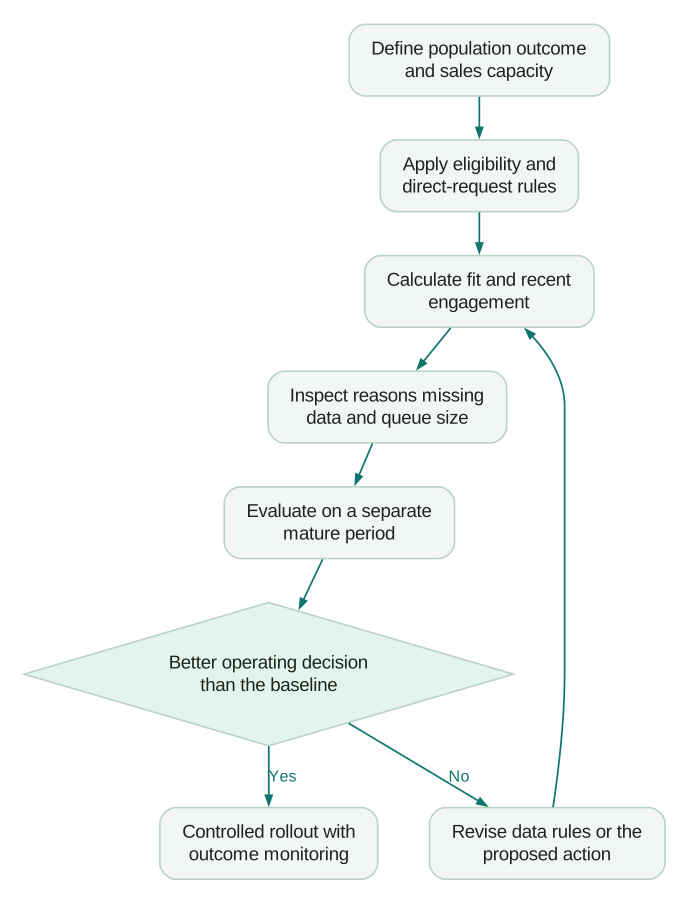
Lead-scoring acceptance checklist
- The user of the score and the action it supports are named.
- The unit is appropriate for the sales motion.
- Eligibility, direct requests and communication restrictions sit outside numeric points.
- Fit and engagement remain separately understandable.
- Every signal has a defined source, window and counting rule.
- Missing fields remain distinguishable from confirmed poor fit.
- Repeated events and associated contacts cannot inflate the score unexpectedly.
- Historical snapshots exclude information unavailable at decision time.
- Evaluation uses completed outcomes and the same capacity as the baseline.
- Observational ranking lift is not presented as incremental revenue.
- Sales can see the reason, freshness and version behind a priority.
- The model has an owner, monitoring and a review process.
Start by scoring a representative sample without changing live ownership or sending messages. Ask sales to explain which recommended accounts deserve attention and which do not. Combine those reasons with the measured outcomes before expanding the policy. Our CRM and lifecycle implementation service can help connect the data, scoring logic and follow-up workflow.
Questions people ask
What is a lead-scoring model?
It is a set of rules or a predictive model used to prioritise eligible prospects for a defined action. A useful model specifies the scoring unit, inputs, outcome, time window and response policy. The number alone does not establish qualification or permission to contact someone.
Should fit or engagement receive more weight?
Keep them separate first. Fit determines whether the product can serve the account; engagement helps establish whether there is a timely reason to act. Tune their role in the queue using outcomes and capacity rather than copying a universal weighting ratio.
Which product signals should a SaaS company use?
Use behaviours tied to the customer's actual value journey, such as reaching a useful result or adopting a relevant collaborative workflow. Exclude technical noise and define the account, window and success conditions. Test whether the signals improve prioritisation in your own data.
Is predictive lead scoring better than a rules-based model?
It can be, when representative history and reliable outcomes support it. Compare it with a simple model at the same sales capacity and on a separate evaluation period. Confirm what the prediction target means in your business and whether the improvement survives operational use.
How often should we update the model?
Review performance on a regular cadence and after material changes to the product, audience or sales process. Investigate data failures immediately. Change weights when evidence justifies the change, retain a version history and test the new ranking before altering live actions.
Sources
- HubSpot, Overview of the lead scoring tool, documentation accessed 1 October 2026.
- Apple, Change Privacy settings in Mail on Mac, documentation accessed 1 October 2026.
- scikit-learn, Common pitfalls and recommended practices, documentation accessed 1 October 2026.
- HubSpot, Build lead scores to qualify contacts, companies, and deals, documentation accessed 1 October 2026.
- Salesforce Trailhead, Einstein Scoring in Account Engagement, accessed 1 October 2026.
Written by
Jafrin Akter AloData Engineer and Co-founder, martechdevs
Jafrin Akter Alo is a data engineer and co-founder of martechdevs, where the team has delivered 74+ martech, data and growth stack implementations.