
Braze vs Customer.io: choose by the journeys you need to run
Data Engineer and Co-founder, martechdevs
Last updated 9 min read
Customer.io is a strong starting point for a small product team that wants event-based messaging with a public entry price. Braze deserves a close evaluation when orchestration, mobile experiences and coordination across teams create harder requirements. Both support email, push and in-app messaging. Choose by testing your actual journeys, then price the audience and channel usage those journeys produce.
Last updated: 6 October 2026. Prices are USD before taxes and additional services.
A trial-expiry email is straightforward until the customer has two workspaces, one paid subscription, an unresolved support issue and a push notification scheduled for the same afternoon. The useful comparison starts there: which system lets your team make the correct decision for that person, in that account, at that moment?
The old email-versus-mobile comparison is misleading
Customer.io's pricing page lists mobile SDKs, push and in-app messaging across its plans. Braze lists a broad set of channels alongside Canvas journey orchestration. Neither product can be reduced to a single channel. Customer.io plans, Braze packaging.
The distinction to investigate is operational depth. How do you coordinate competing journeys? How do you target a message to the correct workspace? Can marketers diagnose an unexpected exclusion without asking an engineer to inspect logs? What happens when an app is closed or a push token is missing?
For a small SaaS business, I would usually evaluate Customer.io first when one marketer and an engineer own lifecycle messaging. That is an implementation judgment, not a claim that Braze cannot serve startups. Braze now explicitly offers a Go edition for early-stage teams.
For a mobile business with several teams, complicated channel priorities and a large experimentation programme, I would put Braze on the shortlist early. A larger feature catalogue still needs a capable team to operate it.
Martechdevs' CRM and lifecycle service connects product events, customer identity and messaging rules. The 25 lifecycle journeys guide gives you concrete scenarios to use in either platform's evaluation.
Compare the billing units before comparing the prices
Customer.io Essentials starts at $100 a month with 5,000 profiles and one million monthly emails. Premium starts at $1,000 a month billed annually; Enterprise is quoted. Essentials lists extra profiles at $0.009 each and extra email volume at $0.12 per 1,000. People and custom objects both count as profiles. These are public starting terms, not a complete quote for every channel or requirement. Current Customer.io pricing.
Braze currently prices through a combination of Platform Edition, monthly active users and profile allowances, Action Credits, services and any additional products. Its page does not publish a universal dollar price. Obtain the credit consumption schedule and overage terms with the quote. Current Braze pricing.
One important correction to older comparisons: Braze's data-point billing is now described as a legacy model for older contracts. Sending fewer unnecessary attributes remains sensible engineering, but it does not automatically reduce a new customer's bill. Braze's legacy data-point explanation.
Do not compare 100,000 Customer.io profiles with 100,000 Braze MAU as though they measure the same audience. A database can contain 100,000 people while only 18,000 use the app in a month. It can also contain account objects, anonymous visitors and duplicate identities that change the calculation.
A small SaaS cost example
Assume, illustratively, 8,000 people, 1,000 account objects and 150,000 monthly emails on Customer.io Essentials. If all 9,000 profiles are billable and the listed rates apply:
Base plan                         $100
Additional profiles: 4,000 × .009   $36
Email overage                       $0
Illustrative monthly subtotal     $136
That subtotal excludes SMS, other paid usage, implementation and any requirement that forces a higher plan. Two allowed object types may fit accounts and subscriptions; a more complex model may require a different package. Buying a cheap entry plan that cannot represent your customer model is a false saving.
Customer.io counts profiles that existed during the billing cycle, including deleted profiles, and counts across workspaces. Deleting and recreating records can increase billable volume. Its unlimited push, in-app and webhook allowance also has a documented fair-use policy. Billing mechanics.
For Braze, send the same audience model to the vendor: total stored people, expected MAU, anonymous tracking policy, channels and monthly actions. Request a base case and a case with twice the active audience. A quote without an explicit usage scenario cannot be compared fairly with the $136 illustration.
The integration is the first meaningful product test
Build one shared event contract before implementing two competing integrations. Otherwise, you may accidentally compare clean data in one platform with incomplete data in the other.
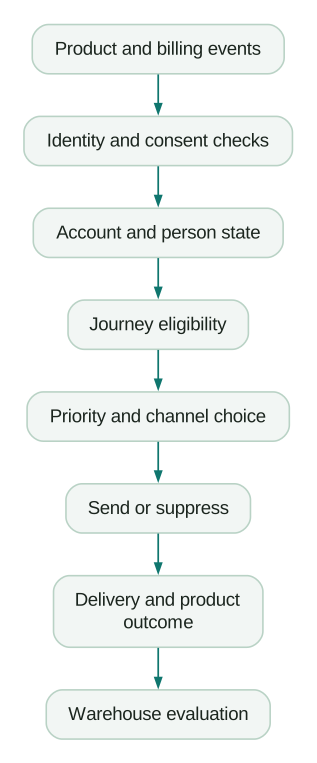
Use a stable internal person ID, an account or workspace ID, the event timestamp and a unique event ID. Include the smallest set of attributes needed for the decision. Keep billing truth in the billing system and calculate account-level eligibility in a controlled place.
An event such as trial_started should identify the trial and workspace. An attribute such as is_trial_user=true loses that context when someone belongs to multiple workspaces. This is why the product-data-to-CRM guide separates people, accounts and activity rather than flattening everything onto a contact.
Test account-based journeys with two workspaces
Create a test person who belongs to Workspace A and Workspace B. A is paid; B is on trial. The correct message should refer to B, link to B and stop when B converts. It should not announce that the person's entire account will expire.
Customer.io supports object relationships in automation. Its documentation distinguishes relationship or object triggers from segment conditions that can match any qualifying relationship. That distinction matters when a person is already in a segment because of another workspace. Relationships in automations.
Run the same test in Braze using the model proposed for your implementation. Ask the demonstrator to show the actual object or event context throughout the journey, including after a delay. A successful demo must preserve the workspace association, not simply display an attractive message preview.
Then cancel the trial, convert it, remove the person's membership and replay the original event. Each action should produce a predictable result. Record those results as acceptance criteria.
Push and in-app require application work
Both platforms need more than a marketing dashboard to deliver a complete mobile experience. Your application must implement the SDK or supported integration, identity handling, permissions, device registration and the destination opened by the message.
Customer.io's push setup documents the need for an identified person, registered device tokens and platform credentials. An email address alone does not make a person reachable by push. Customer.io push setup.
Test an expired token, a person with two devices, an app reinstall and a user who logs out before another user logs in. Verify that a deep link opens the correct screen and account. For in-app messages, test the targeting context and the point in the experience when the message can actually render.
Measure delivery, display and the intended product action separately. A successful API response only proves that an upstream request was accepted. It does not prove the customer saw the message or completed anything useful.
Journey behaviour matters more than canvas appearance
Suppose a person reaches an upgrade email but has already received the maximum number of promotional messages. Should the journey wait, skip that step, use another channel or exit? Write your preferred behaviour before testing the platform.
Braze documents that a frequency-capped message can be aborted while the user continues through Canvas. A cap is therefore not a universal pause button. Rate limiting, which controls sending speed, solves a different problem. Braze frequency capping.
In Customer.io, explicitly configure the exit conditions that correspond to conversion or loss of eligibility. Defining a conversion goal and stopping a journey are separate choices. Inspect the journey at each action boundary, especially after waits. Customer.io exit conditions.
The most valuable evaluation is often deliberately inconvenient: change the subscription state five minutes before a scheduled message, then inspect whether the message still sends. That exposes stale attributes, poorly scoped exits and assumptions hidden behind a polished workflow.
Measure incremental results at the account level
If a journey targets multiple people in one company, randomising individual contacts can contaminate the experiment. One employee receives a message and tells another employee in the control group. Assign whole accounts when the outcome is account activation or subscription conversion.
In an illustrative test, 200 of 1,000 treatment accounts activate, compared with 170 of 1,000 control accounts. The observed difference is three percentage points, or 30 additional activations per 1,000 accounts. It is not proof of a reliable lift without uncertainty analysis and sufficient sample size.
Use a fixed observation window, record assignment before sending, and include eligible accounts whose messages were not delivered. Analysing only people who clicked selects a more engaged group and overstates the programme's effect.
Braze provides Canvas experimentation and control-group capabilities. Your implementation still has to define the assignment unit, exclusions and outcome. Creating a Canvas.
Budget implementation by workstream
Avoid a universal “live in two weeks” claim. A simple existing event feed and one email journey are different from a mobile SDK rollout, preference migration and dozens of active automations.
Estimate identity design, event instrumentation, channel setup, consent migration, journey rebuilding, quality assurance and reporting separately. Identify which steps depend on an application release or a third party. Those dependencies usually determine elapsed time more than the visual editor does.
During migration, transfer subscription preferences and suppression records before activating campaigns. Decide whether people already partway through a journey will finish in the old platform, start at an equivalent position or be excluded from the new version. Running both platforms without that decision can double-send messages.
Evaluation checklist
- Price the same people, objects, MAU and channel scenarios.
- Document overages, fair use, annual commitments and support scope.
- Test a person associated with two accounts.
- Test conversion, cancellation and consent withdrawal during a delay.
- Verify push tokens, deep links and in-app rendering in the actual app.
- Inspect frequency caps, quiet hours, priorities and failed sends.
- Reconcile journey membership with warehouse records.
- Assign a named owner for data, deliverability and campaign operation.
- Plan preference migration and prevent overlapping sends.
At Martechdevs, we connect CRM, product and billing data to the customer workflows your team needs to run. Start with the free martech AI audit, or explore an AI assistant built around your approved workflows.
Questions people ask
Which is better for a startup?
Customer.io is a practical first evaluation for a small team with straightforward event-based journeys and limited procurement capacity. Braze Go also targets early-stage businesses. Choose the platform your team can operate after launch, using a pilot and a complete quote rather than company-size stereotypes.
Is Customer.io cheaper than Braze?
Customer.io publishes a lower-friction starting price; Braze requires a quote. That does not establish the cheaper option for every business. Compare billable profiles, active users, channels, support and the implementation work needed to meet the same requirements.
Which handles push and in-app messaging better?
Both support them. Evaluate identity transitions, rendering, deep links, channel priority and debugging inside your application. Braze merits particular attention for complex mobile programmes, but “Customer.io does not support push” is an incorrect reason to reject it.
Should we compare Iterable too?
Yes, if you are making a substantial platform decision and its proposed implementation fits your requirements. Use the same event contract, migration scenario and acceptance tests. Adding vendors is useful only when you can evaluate them against a consistent operating model.
Can we change platforms later?
Yes, but journeys, templates, preferences and historical reporting all require migration work. Keep stable customer IDs, event definitions and outcome reporting outside the messaging tool where practical. That makes a later migration less dependent on reconstructing business logic from campaign screens.
Sources
- Customer.io pricing. Accessed 6 October 2026.
- Customer.io billing. Accessed 6 October 2026.
- Braze pricing and packaging. Accessed 6 October 2026.
- Braze legacy data points. Accessed 6 October 2026.
- Customer.io relationships in automations. Accessed 6 October 2026.
- Customer.io push setup. Accessed 6 October 2026.
- Braze frequency capping. Accessed 6 October 2026.
- Customer.io campaign exits. Accessed 6 October 2026.
- Braze Canvas creation. Accessed 6 October 2026.
Written by
Jafrin Akter AloData Engineer and Co-founder, martechdevs
Jafrin Akter Alo is a data engineer and co-founder of martechdevs, where the team has delivered 74+ martech, data and growth stack implementations.