
PostHog Pricing: Estimate Each Product Separately
PostHog charges by product usage, so estimate analytics events, recordings and feature flag requests separately. Apply each monthly free allowance and marginal pricing tier, then add enabled products and operating work. For analytics, distinguish anonymous from identified events. Also budget the consequence of a hard limit: stopping spend can permanently lose new data your team expected to analyse.
On this page

What does PostHog charge for?
PostHog meters the work each product performs. Analytics events, replay recordings and flag requests are separate units, so a single user count cannot predict the bill.
Start with the journeys your team intends to measure. A form submission might produce a click, a submit event, a confirmed success and a pageview. A returning user can create several recordings. A server can request flag definitions even when no customer is actively using the application.
A product analytics implementation should include that usage model alongside the event definitions. Otherwise the team can explain its reports or its invoice, but not how the two connect. For PostHog itself, see our PostHog implementation services.
The selected public rates below are in USD per captured unit. Free allowances renew monthly; the paid rates apply only to units within the stated band. Taxes, other products and add-ons are excluded.
| Product | Monthly free units | First paid band | Marginal USD per unit |
|---|---|---|---|
| Anonymous analytics events | 1,000,000 total analytics events | Above 1 million through 2 million events | 0.0000500 |
| Web replay recordings | 5,000 | Above 5,000 through 15,000 recordings | 0.0050 |
| Native mobile recordings | 2,500 | Above 2,500 through 15,000 recordings | 0.0100 |
| Feature flag requests | 1,000,000 | Above 1 million through 2 million requests | 0.000100 |
The analytics allowance is shared by anonymous and identified events. The first row's rate is the anonymous headline schedule; it is not a complete price for identified traffic. Web and native mobile replay have separate counters. Analytics pricing, replay pricing, flag pricing. Identified events have their own published rates: USD 0.000198 per event from 1M to 2M and USD 0.0000697 from 2M to 15M, up to about four times the anonymous rate.
Crossing a threshold does not reprice every unit. For example, only the events beyond two million enter the next analytics band. Use marginal tiers instead of multiplying the whole month by whichever rate looks lowest.
What does the free plan stop doing at its limits?
The free plan stops accepting usage beyond its limits. PostHog states that additional events are permanently dropped and feature flags return a quota-limited default response. These are product behaviors to design around, not merely a warning on an invoice.
Selected free-plan boundaries. Event and recording retention are different measures.
| Free-plan boundary | Included amount or period | Decision it affects |
|---|---|---|
| Projects | 1 | Separation of environments or products |
| Analytics event and metadata retention | 1 year | Historical comparisons |
| Recording retention | 1 month | How long an investigation can wait |
| Error tracking | 100,000 exceptions/month | Error collection capacity |
| Surveys | 1,500 responses/month | Research volume |
The main pricing page also lists community support. Pay-as-you-go retains monthly free allowances and lists seven-year event retention and 90-day recording retention. Confirm any add-on retention separately. PostHog pricing and free-plan rules.
Choose a free tier by the complete requirement. A workload can fit the event count but fail the historical-retention or project-separation requirement. The startup product analytics guide explains when the need for a clearer operating model matters more than another free allowance.
Why does the anonymous-versus-identified distinction matter?
Identified events use a person profile and a different billing treatment. The first million analytics events are free across both types together; there is no second million-event allowance for identified activity.
PostHog's documentation says the invoice's person-profile line counts identified events, while the events line counts anonymous events. It is not an additional charge per person on top of the same event line. Identification affects future event treatment, and the model supports capabilities that anonymous events cannot provide. Anonymous and identified events.
Record total events, identified share and the actual billing line in your forecast. Use the current organization pricing view for that mix. The worked anonymous estimate below should not be copied unchanged into a signed-in application budget.
The distinction is about the configured analytics identity model. Removing an email property from an identified event does not establish that it became anonymous. Conversely, preserving person and account context may be essential to answer activation or retention questions.
Compare the workload with Amplitude's event and monthly tracked-user pricing only after defining the same journeys. Per-user and per-event quotes measure different things: a small group of heavy users can generate more events than a large group of occasional visitors. The per-user and per-event billing comparison turns those distinct populations into explicit quote scenarios.
How do you turn journeys into a usage estimate?
Measure representative journeys and count the units they create. Include a quiet visit, a normal active session and a heavy operation such as importing or editing data.
For each sample, retain the period, environment, relevant product, measured units and expansion assumption. Separate production customers from internal testing. A single release incident is useful for a stress case but unsuitable as the ordinary monthly baseline.
Use these questions during a short measurement period:
- Which analytics events answer a decision, and which are incidental interactions?
- Which sessions satisfy the replay recording rules?
- Which browser actions trigger flag requests?
- How many application instances poll flag definitions?
- Which exports, enrichment jobs or additional products are enabled?
PostHog's usage estimation guide distinguishes browser evaluations from server-side polling. Keep those sources separate in the model so an infrastructure deployment does not look like customer growth.
What does a worked monthly PostHog estimate look like?
For a narrow anonymous web workload, the selected public tiers produce an illustrative USD 80 monthly estimate. The result applies only to the declared volumes and products.
Assume anonymous analytics, web replay and remote feature flag requests. Exclude identified events, native mobile replay, group analytics, pipelines, warehouse usage and AI products. The volumes are hypothetical, not a client result or a vendor quote.
Monthly USD calculation, using rates, before tax and excluded products.
| Product | Monthly usage | Charged usage in first band | Estimated USD |
|---|---|---|---|
| Anonymous analytics | 1,500,000 events | 500,000 events | 25.00 |
| Web replay | 12,000 recordings | 7,000 recordings | 35.00 |
| Feature flags | 1,200,000 requests | 200,000 requests | 20.00 |
| Total for these products | 80.00 |
The three calculations are 500,000 × 0.0000500, 7,000 × 0.0050 and 200,000 × 0.000100. Each product receives its own applicable allowance.
What changes when usage grows unevenly?
At higher volume, apply the next marginal band to the units that actually reach it. The next selected bands are USD 0.0000343 per anonymous event from two to fifteen million, USD 0.0035 per web recording from fifteen to fifty thousand, and USD 0.000045 per flag request from two to ten million.
Monthly hypothetical USD growth case, using those rates. It has the same exclusions as the first example.
| Product | Monthly usage | Paid-band calculation, USD | Estimated USD |
|---|---|---|---|
| Anonymous analytics | 2,400,000 events | 1,000,000 × 0.0000500 + 400,000 × 0.0000343 | 63.72 |
| Web replay | 24,000 recordings | 10,000 × 0.0050 + 9,000 × 0.0035 | 81.50 |
| Feature flags | 2,400,000 requests | 1,000,000 × 0.000100 + 400,000 × 0.000045 | 118.00 |
| Total for these products | 263.22 |
These product rates come from the separate analytics, replay and flag schedules. Doubling the original USD 80 would miss both uneven growth and the effect of free allowances.
Add native mobile recordings separately. For example, a hypothetical 4,000 mobile recordings uses 1,500 paid recordings at USD 0.0100, adding USD 15. It does not consume the web-recording allowance.
Use low, expected and high cases based on different assumptions about actual usage. A forecast should show which product drives the difference, so the owner knows what to investigate.
Which add-ons and architecture choices change the bill?
Group analytics, server polling and additional products can change an apparently cheap estimate. Verify each enabled feature against the analytical job it performs.
Group analytics
PostHog documents group analytics as a paid add-on covering all captured identified events after enablement, including events without group properties. Billing begins when enabled on the billing page and stops when unsubscribed there. Removing group code alone is not the billing control. Group analytics billing. Its published rates are 1M events free, then USD 0.000071 per event from 1M to 2M and USD 0.00003 from 2M to 15M.
A business-to-business team should therefore measure the identified workload before pricing account-level analysis. A count of workspace-tagged events alone is insufficient. Decide whether you need aggregation by account or simply a user cohort; those are different analytical requirements.
Server-side flag evaluation
Local evaluation reduces remote decisions, but definition polling can still create billable requests. In the current guide, an unchanged response with ETag support counts as one request; changed definitions count as ten. Versions without ETag support count ten per poll. Confirm the supported software development kit (SDK) and polling interval. Flag usage estimation.
Consider twenty continuously running SDK instances polling every thirty seconds for a hypothetical thirty-day month. Each makes 86,400 polls. If each instance receives changed definitions on ten polls, its request equivalent is:
Unchanged polls: 86,390 × 1 = 86,390 requests
Changed polls:       10 × 10 = 100 requests
Per instance:                    86,490 requests
Twenty instances:             1,729,800 requests
At the stated flag tiers, that is USD 72.98 after the shared million-request allowance, assuming there is no other flag usage. With ten requests charged for every poll, the same polling workload becomes 17.28 million requests and USD 642 across the applicable bands. These are calculated scenarios, not observations from a production deployment.
The number of instances matters even when customer activity is stable. Measure the actual responses and SDK behavior rather than assuming that moving evaluation to the server makes it free.
Retention, healthcare and other products
Inventory every enabled product, including exports, surveys, errors, logs and AI features. Give each one a status such as “not enabled,” “within measured allowance” or “quoted separately.” A missing budget line is not evidence of zero cost.
For healthcare, review HIPAA analytics requirements before purchasing a package. The agreement and permitted feature scope must fit the approved use. A startup credit balance does not settle that review.
Does PostHog have a startup program?
PostHog offers USD 50,000 of credits for twelve months, subject to eligibility and product exclusions. Treat the credit as a temporary funding source, with a separate forecast for ineligible usage and the period after it ends.
Terms: the company must be under two years old, have raised under USD 5 million, use a company email domain and meet the signup-date requirement from January 2023. Apply through the form after joining a paid usage plan.
From 14 September 2026, credits exclude PostHog Desktop, the Slack app, Replay Vision, PostHog AI and Inbox. Earlier members may use credits for eligible usage before that cutoff. AI observability and the context warehouse remain covered. Credits also cannot obtain a Boost business associate agreement.
The offer lists roughly USD 12,000 in partner perks, normal-priority/community support and no dedicated account manager. The separate Y Combinator offer does not stack; obtain its terms before budgeting that offer. At twelve months or credit exhaustion, plan for ordinary billing. PostHog startup terms.
A hypothetical eligible workload costing USD 300 monthly would use USD 3,600 in twelve months. That does not convert the unused balance into cash or extend its validity. A USD 5,000 monthly workload would exhaust USD 50,000 in ten months if all usage qualified. Budget excluded usage from the start.
Compare PostHog's credits with Mixpanel's and Amplitude's startup years, then inspect how PostHog compares with Amplitude at month thirteen. A discount is useful when the ongoing product and operating requirements still fit afterward.
Which PostHog setup fits your operating stage?
Choose the configuration from the measured workload and the consequence of losing data, rather than from employee count. The following are planning recommendations for hypothetical teams, not price bands or vendor performance claims.
| Team context | First configuration to evaluate | Alternative | Deciding evidence |
|---|---|---|---|
| Ten-person team piloting one product | Free for a bounded, noncritical evaluation | Paid usage if the pilot needs more capacity or history | The complete pilot fits the documented project, retention and usage boundaries |
| Twenty-five-person team running a live product | Paid usage with named budget and limit owners | Keep a narrower collection scope while requirements stabilize | Normal and peak journeys fit the budget, and interrupted collection has an agreed response |
| Fifty-person company with several product teams | Paid usage with a shared meter inventory and team allocation rules | Separate a specific investigation into a simpler existing reporting path | Each enabled product has a consumer, an owner and an explainable invoice contribution |
These teams could produce the same event volume or very different volumes. Apply the worked calculations to measured events, recordings and requests; multiplying a ten-person bill by five is not a valid forecast for fifty people. An eligible startup award changes who funds covered usage temporarily, not which configuration the team needs after expiry.
What happens when a billing limit is reached?
PostHog stops ingestion and processing for the affected product at its billing limit, and additional data is lost. The owner receives alerts at 80% and 100% of the limit; the documentation also describes these thresholds for free allowances. Billing limits and alerts.
A hard cap can create a missing analytics period or a feature fallback during a busy launch. Raising the cap later cannot be treated as recovery of the lost data. Keep the spend decision connected to the customer and reporting consequences.
For each limit, record an owner, a deputy and the action they may take before the threshold. Mark interrupted periods in reporting. Test the application's response to unavailable flag results in a controlled environment. Avoid discovering which default variation the application uses during a production traffic spike.
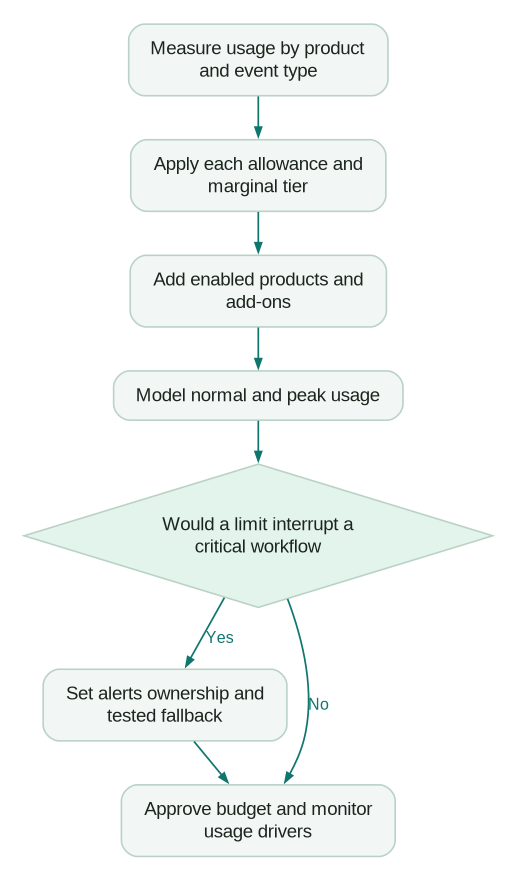
Read diagram as text
- Measure usage by product and event type to Apply allowances and marginal tiers.
- Apply allowances and marginal tiers to Add enabled products and operating work.
- Add enabled products and operating work to Model normal and peak usage.
- Model normal and peak usage to Could a limit interrupt a critical workflow.
- Could a limit interrupt a critical workflow to Assign alert owners and test fallback: Yes.
- Could a limit interrupt a critical workflow to Approve budget and monitor drivers: No.
- Assign alert owners and test fallback to Approve budget and monitor drivers
How do you reduce waste without losing useful evidence?
Investigate events or requests per completed journey before disabling whole categories. Accidental duplicate initialization, repeated low-value interactions and unnecessary reloads are better starting points than the business outcomes used to judge activation.
Compare what Mixpanel charges at the same volume after fixing the event scope and billing term.
If visits stay stable while events per visit double after a release, inspect the capture path. If recordings grow without more eligible sessions, inspect the recording rules. If flag requests follow server count, inspect polling. Keep a small acceptance journey after each change so removing noise does not remove the only signal of an onboarding failure.
The PostHog implementation guide develops those checks. The product analytics pricing guide explains how to normalize different billing units, while PostHog versus Mixpanel adds the workflow trade-offs.
Checklist
- Measure anonymous and identified events without doubling the free allowance.
- Separate web and mobile recordings.
- Include browser evaluations and server polling in flag usage.
- Apply marginal rates only to the units in each band.
- List group analytics and every other enabled product.
- Assign owners to limits and verify the fallback behavior.
- Separate ordinary spend, credit-funded usage and excluded charges.
- Forecast the month after the startup benefit expires.
- Repeat a useful customer journey after reducing collection.
Want a second pair of eyes on your stack? Get the $99 martech audit. For a defined implementation, request a detailed product analytics scope covering event meaning, identity, collection controls and the usage budget.
Keep reading
Browse all Product Analytics guides
 Product Analytics
PostHog vs Fullstory: Replay, Product Analytics and the Cost of Useful Evidence
Compare PostHog and Fullstory for replay, product analytics and experiments. Includes usage costs, retention, privacy controls and a practical evaluation checklist.
Jafrin Akter AloLast updated 11 min read
 Product Analytics
PostHog vs Heap: Autocapture, Event History and Product Costs
Compare PostHog and Heap by autocapture, historical properties, identity and product costs. Review free limits, replay scope and a practical validation method.
Jafrin Akter AloLast updated 11 min read
 Product Analytics
PostHog vs Matomo: Product Analytics, Web Reporting and Data Control
Compare PostHog and Matomo for product analysis, web reporting and data control. Includes billing examples, hosting responsibilities, consent and measurement checks.
Jafrin Akter AloLast updated 11 min read
Product analytics
See the implementation scope, deliverables and acceptance checks.
Questions people ask
Is PostHog free?
Yes, up to its free allowances. Every month PostHog includes 1 million analytics events, 5,000 web session recordings, 2,500 mobile recordings and 1 million feature flag requests at no charge, and the pay-as-you-go plan has no base fee. You pay only for usage above those allowances, and billing limits can stop ingestion before a spike raises the bill.
Is PostHog cheaper than Mixpanel?
Usually, for anonymous events. At 5 million events a month, PostHog's published rates come to about USD 153, while Mixpanel's 5M Growth tier is USD 613 billed monthly or USD 438 a month billed annually. If all 5 million events are identified, PostHog rises to about USD 407. Compare replay, flags and the features your team needs at your real volume.
How should we compare a startup-credit offer with a smaller cash discount?
Calculate the eligible workload you will actually use during the offer period. A large credit balance can have little economic value when usage is low or the needed products are excluded. Compare cash payable, implementation effort and the expected bill after expiry under both options. Keep unused credits out of the saving calculation and confirm the conditions before accepting either offer.
Can a staging environment distort our PostHog cost forecast?
Yes, if test runs create events, recordings or flag requests that are mixed with production usage. Separate the environment in both collection and reporting, then inspect which billing counters include that work. A report filter can hide test activity from a dashboard without removing the underlying captured usage. Budget realistic testing and investigate automated loops before projecting customer growth.
How can a team investigate a surprising bill without exposing customer data?
Start with product totals, event names, environment, SDK version and deployment timing. Those fields can often isolate the changed usage path before anyone opens individual customer records. Use the smallest redacted sample needed to reproduce the issue, restrict access and retain the calculation. The goal is to explain which operation multiplied, then verify the repair against a representative journey.
Sources

Written by
Jafrin Akter AloData Engineer and Co-founder at Martechdevs and Growth and Analytics Partners
Jafrin writes practical guides to marketing technology, customer data, analytics and AI workflows. Martechdevs is a Growth and Analytics Partners company.