
PostHog vs Fullstory: Replay, Product Analytics and the Cost of Useful Evidence
Pick PostHog when your product team needs event analysis, session replay and experiments in one workflow. Pick Fullstory when diagnosing digital experience problems across product, engineering and support is the main job. Both provide analytics and replay. The useful PostHog vs Fullstory comparison is whether your team can connect a reported problem to a reliable business outcome within the required budget and retention window.
On this page
PostHog and Fullstory at a glance
Published usage prices below are in USD; paid Fullstory terms require a quote.
| Decision | PostHog | Fullstory | Selection consequence |
|---|---|---|---|
| Free entry | 1 million analytics events and 5,000 web recordings monthly | 30,000 sessions monthly and up to 10 users | Events and sessions need separate forecasts |
| Paid pricing | Separate product usage meters | Business, Advanced and Enterprise quotes | Request the complete feature and allowance schedule |
| Main evaluation workflow | Events, funnels and retention connected to replay and experiments | Experience investigation with replay, behavioral analytics and debugging | Use the same real product question in both trials |
| Replay history | Free up to 30 days; pay-as-you-go up to 90 days | Free one year; paid replay and analytics retention specified separately | Match history to the team's investigation cycle |
| Evaluation owner | Product analyst and an engineer responsible for events and releases | Product or experience lead with engineering and privacy owners | Include the people who will maintain collection |
The allowances and plan boundaries come from the PostHog analytics rate card, replay pricing, replay retention policy, Fullstory Free offer, paid plans and Fullstory retention policy.
At Martechdevs, we frame product analytics implementation around the decision a team needs to make. A useful evaluation ends with a reproducible finding, an agreed metric and an owner for the change. A library of recordings has value when someone can use it to resolve a specific problem.
Product decisions and investigation depth
PostHog's event-to-experiment workflow
PostHog supports trends, funnels, paths and retention analysis using captured events and identity. Those insights connect to relevant recordings and feature exposure. This suits a team asking whether a new onboarding step improves activation, which accounts adopt an important capability, or where a release changed behavior. PostHog product analytics.
Its experiment workflow can assign variants, record exposure and analyze outcome metrics. Replay provides context for what people did inside a variant. The event definition still matters: a successful invitation should represent the accepted business action rather than every attempt to press the invite button. PostHog experiments.
- Best for: a product team with engineering support for instrumentation, stable identity and controlled releases.
- Pros: analytics, replay and experiments can connect investigation with a measured product change.
- Cons: separate usage meters and capture rules require an accountable owner.
- Free plan and startup offer: recurring analytics and replay allowances support small workloads; separately approved credits belong outside the steady-state budget.
- Choose it if: the team can maintain the event contract and evaluate the downstream business outcome.
- Skip it if: nobody will maintain identity, capture or the route from a finding to a release.
Our tracking plan guide covers the event-contract foundation.
Fullstory's experience investigation workflow
Fullstory combines replay with product analytics, heatmaps, developer tools and experience signals. A support case about a failed checkout can become a review of the affected interaction, its surrounding behavior and the wider population experiencing similar symptoms. Paid feature access varies by plan and add-on. Fullstory plans.
Its conversion-opportunity workflow relates friction and technical events to funnel outcomes. The documented feature is available on Advanced and Enterprise, so a trial must include the actual edition under consideration. A demonstration using a different edition can establish capability without establishing what your contract includes. Fullstory conversion opportunities.
- Best for: an experience or product team sharing repeatable investigations with support and engineering.
- Pros: replay, debugging and wider behavioral analysis can contribute to one incident investigation.
- Cons: paid capabilities and the required retained history need an explicit quote.
- Free plan and startup offer: the continuing Free plan covers a bounded workload; its data-rights terms need review and no additional startup offer is assumed.
- Choose it if: the team can locate the relevant journey and connect its diagnosis to the affected population.
- Skip it if: the accepted edition cannot answer the aggregate question needed to prioritize the repair.
For a web-reporting and hosting decision, the PostHog and Matomo comparison covers a different shortlist. Campaign attribution also deserves its own evaluation in GA4 vs PostHog.
Replay evidence and business impact
Friction signals and the affected population
A replay can show a repeated click, an error message or a confusing interaction. It cannot directly establish the user's intention. Fullstory documents that repeated-click heuristics can fire on controls where repeated clicks are expected, such as next and previous buttons. Console capture settings also affect whether errors are available. Fullstory frustration signals.
A practical investigation separates four pieces of evidence:
| Evidence | Example | Decision supported |
|---|---|---|
| Observed interaction | Repeated payment-button clicks before an error | A reproducible symptom for engineering |
| Eligible population | People who reached payment during the release window | The denominator for the problem's frequency |
| Business outcome | Confirmed payment success from the application | The outcome associated with the symptom |
| Change evaluation | Comparable exposed and control populations | Evidence about the effect of the repair |
Consider an illustrative checkout investigation. Of 1,000 eligible sessions, 200 contain the suspected symptom and 80 of those complete payment. The other 800 produce 480 payments. The observed conversion rates are 40% and 60%, a 20 percentage-point gap.
That gap is a prioritization clue. Differences in devices, customer intent, payment methods or account status may influence both the symptom and conversion. Review those dimensions, reproduce the problem and measure the repair with an appropriate experiment or controlled release. Multiplying the gap by all affected sessions would produce a speculative recovery estimate unless those assumptions hold.
A complete incident handoff
An actionable ticket contains the approved replay link, affected release, reproduction steps, expected outcome, observed outcome and the size of the eligible population. Use an internal customer identifier permitted by your data policy. Keep sensitive customer text out of ticket summaries and screenshots.
Separate a display failure from a transaction failure. A payment can succeed in the backend while the confirmation screen fails to load. Reconcile the transaction against the system responsible for it before classifying the session as lost revenue. This also prevents a UI event from becoming an unreliable financial metric.
Pricing and retention under the same workload
PostHog's separate usage meters
PostHog charges analytics events separately from session recordings. Analytics includes the first million monthly events free, followed by $0.00005 per event through two million. Web replay includes 5,000 free recordings, with the next 10,000 at $0.005 each. Analytics pricing, web replay pricing.
These are illustrative monthly web workloads, excluding taxes, other products, paid platform packages and implementation work:
| Monthly workload | Analytics calculation | Web replay calculation | Usage subtotal |
|---|---|---|---|
| 800,000 events and 4,000 recordings | Within free allowance | Within free allowance | $0 |
| 1.5 million events and 10,000 recordings | 500,000 × $0.00005 = $25 | 5,000 × $0.005 = $25 | $50 |
| 2 million events and 15,000 recordings | 1,000,000 × $0.00005 = $50 | 10,000 × $0.005 = $50 | $100 |
One person can generate many events and multiple sessions. Build the forecast from measured traffic and capture rules rather than multiplying registered users by a guessed universal event count. Mobile recordings have their own allowance and rates, so these web examples should not be reused for a mobile app. PostHog replay pricing.
Our PostHog pricing guide separates the other product meters. Include feature flags, group analysis or other services only when your implementation requires them.
Fullstory's quote and free-plan boundaries
Fullstory's paid plans do not publish a universal dollar rate. Request the session allowance, users, sites, mobile scope, replay history, analytics history, exports, support and add-ons in the same written quote. Ask how excess sessions, renewal and cancellation work in that specific agreement. The published plan names alone do not establish those commercial terms. Fullstory plans.
The free plan pauses new capture after its monthly allowance until the next cycle or an upgrade. Its published terms also distinguish rights to anonymized non-PII data from the paid-plan ownership position, including potential uses such as model training and partner sharing. Review those terms with your privacy and procurement owners before using a free production deployment. Fullstory Free terms and limits.
Investigation windows and missing history
PostHog's replay policy currently allows up to 30 days on Free, 90 days on pay-as-you-go, one year on Boost or Scale, and five years on Enterprise. A changed retention setting applies to newly captured recordings; existing recordings keep their original period. Select the period before the evidence you need is captured. PostHog replay retention.
Fullstory separates analytics and replay retention on paid plans. Historical funnel data can remain available after its associated recordings expire. Specify both periods when a quarterly investigation needs to move from a trend to individual sessions. Fullstory plan retention.
PostHog billing limits can stop ingestion and processing, with additional data lost after the cap is reached. Assign an owner to usage alerts and decide the permitted collection trade-off before a launch creates a spike. PostHog billing limits.
Privacy and capture acceptance
Masking, exclusion and sensitive surfaces
Fullstory's Private by Default setting masks text unless it is explicitly allowed. Masked elements can retain interaction events, while excluded elements and their children lose those interaction events. Web images need exclusion rather than text masking. A profile image, uploaded document or payment image therefore needs its own review. Fullstory privacy controls.
PostHog masks inputs by default, but sensitive text can also appear elsewhere on a page. Its replay controls support masking and excluded elements; its documentation separately addresses URL redaction and network request or response content. Test the settings for your SDK and framework rather than treating masked form fields as a complete review. PostHog replay privacy.
Use synthetic test values for the acceptance run. Inspect an approved page containing an email address, a hidden field, an uploaded image, a URL parameter and an error response. Verify what reaches the collection endpoint as well as what appears in playback. Privacy review should also cover consent behavior, roles, deletion and the applicable processing agreement.
Coverage and identity
PostHog recording rules support sampling, URL or event conditions, feature-flag conditions and minimum duration, with behavior dependent on the SDK and configuration. A recording absent from the UI may have been deliberately excluded by those rules. PostHog recording controls.
Use a controlled journey to test anonymous browsing, login, logout and a second account on the same device. PostHog's identity documentation describes identification and reset behavior; apply that deliberately so one customer does not inherit another person's events. PostHog identity.
For backend outcomes, confirm how the browser session and backend event become associated. PostHog's replay troubleshooting guidance explains that backend events without the relevant session identifier cannot automatically support the same session filtering. It also covers blocked capture, late initial snapshots and inaccessible assets. PostHog replay troubleshooting.
Best fit by team scenario
| Team situation | First trial | Runner-up | Decisive evidence |
|---|---|---|---|
| Product team evaluating a new onboarding flow | PostHog | Fullstory plus the existing experiment system | Valid assignment, exposure and outcome with relevant replay |
| Support team reconstructing difficult customer incidents | Fullstory | PostHog with accepted replay scope | Searchable customer context and a reproducible engineering handoff |
| Existing PostHog customer adding replay | Current PostHog scope | Fullstory after a demonstrated gap | Required capture, privacy and history within the accepted package |
| Existing Fullstory customer needing cohort analysis | Current Fullstory analytics | PostHog after a demonstrated analytical gap | The required population and metric available in the proposed edition |
| Small team with limited implementation capacity | A bounded trial of the simpler accepted workflow | Current setup with focused repair | A maintained decision process and complete operating budget |
Selection workflow
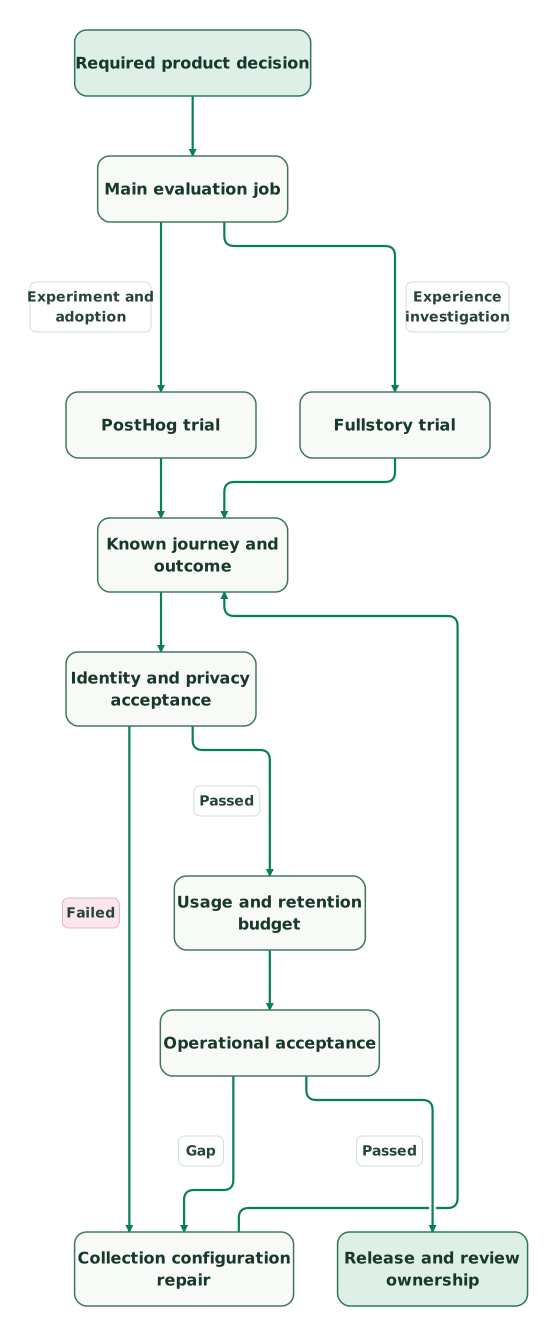
Read diagram as text
- Required product decision to Main evaluation job.
- Main evaluation job to PostHog trial: Experiment and adoption.
- Main evaluation job to Fullstory trial: Experience investigation.
- PostHog trial to Known journey and outcome.
- Fullstory trial to Known journey and outcome.
- Known journey and outcome to Identity and privacy acceptance.
- Identity and privacy acceptance to Collection configuration repair: Failed.
- Collection configuration repair to Known journey and outcome.
- Identity and privacy acceptance to Usage and retention budget: Passed.
- Usage and retention budget to Operational acceptance.
- Operational acceptance to Collection configuration repair: Gap.
- Operational acceptance to Release and review ownership: Passed
Use the same accepted journey in both products. An attractive replay cannot compensate for missing business events, and an accurate funnel needs enough context to explain a failure. The return path represents an implementation repair followed by another test of the original question.
Evaluation checklist
- One product decision with an agreed success event and population.
- The required paid edition, add-ons and user permissions in the trial.
- A synthetic journey spanning anonymous activity, login, logout and a second account.
- Approved masking and exclusion rules for text, images, URLs and network content.
- A known successful transaction and a known failed transaction reconciled against the backend.
- Expected recording coverage after consent, sampling, triggers and billing limits.
- Separate analytics and replay retention sufficient for the investigation cycle.
- A monthly usage forecast with web and mobile meters separated.
- A reproducible incident handoff and an owner for ongoing collection changes.
The tracking plan audit skill helps turn the metric and event checks into a repeatable review. For implementation support, our product analytics service covers measurement design and rollout. The $99 audit includes a written assessment and a one-hour specialist call.
Keep reading
Browse all Product Analytics guides
 Product Analytics
PostHog vs Matomo: Product Analytics, Web Reporting and Data Control
Compare PostHog and Matomo for product analysis, web reporting and data control. Includes billing examples, hosting responsibilities, consent and measurement checks.
Jafrin Akter AloLast updated 11 min read
 Product Analytics
PostHog Implementation Mistakes: Capture, Identity and Replay
Diagnose duplicate pageviews, identity mistakes, replay privacy gaps and missing recordings with an explicit export journey and synthetic QA probes.
Jafrin Akter AloLast updated 13 min read
 Product Analytics
PostHog vs Google Analytics: Product Decisions, Acquisition and Cost
Compare PostHog and GA4 for acquisition, product analysis and cost. See event pricing, identity checks, export limits and a practical selection checklist.
Jafrin Akter AloLast updated 11 min read
Product analytics
See the implementation scope, deliverables and acceptance checks.
Questions people ask
Which product better connects a replay finding to a controlled experiment?
PostHog is the more direct starting point when the team wants analytics events, variant exposure, replay and experiment analysis in one product workflow. The setup still needs a stable outcome event and a valid assignment design. Evaluate Fullstory when experience investigation is the primary job and confirm how findings will connect to your existing experimentation system.
Does a Fullstory frustration signal prove that a customer abandoned a purchase?
A frustration signal identifies an interaction worth inspecting. It does not establish a completed or abandoned transaction on its own. Compare the recording with the confirmed purchase event and backend order status, then calculate the affected population. Repeated clicks can also occur on controls where that behavior is expected, so context matters before an issue becomes a revenue estimate.
Can a longer analytics history preserve expired session recordings?
Analytics and replay can have separate retention periods. A historical conversion trend may remain available while the underlying replay is no longer playable. Select both retention periods before collection and confirm how changes affect existing recordings. Keep any approved exports under the same access and deletion rules as the source system, especially when they contain customer information.
Why can a PostHog event exist without a usable recording?
Event collection and replay collection have different controls. Sampling, consent, recording triggers, a minimum duration, blocked uploads or retention can affect a replay while an analytics event remains available. Check the event's recording status and the project's capture configuration. Also confirm that the event has the browser session association required for the filter you are using.
What should a support team compare during the trial?
Give both products the same synthetic support case and approved permissions. Measure whether the agent can find the correct journey, identify the failure and hand engineering a reproducible ticket. Include account switching and a masked sensitive page in the exercise. The acceptance record should describe missing context and required setup work, rather than relying only on how easy playback feels.
Sources
- PostHog product analytics
- PostHog experiments
- PostHog analytics pricing
- PostHog session replay pricing
- PostHog replay retention
- PostHog billing limits
- PostHog replay privacy
- PostHog recording controls
- PostHog identity
- PostHog replay troubleshooting
- Fullstory Free offer and terms
- Fullstory plans and add-ons
- Fullstory plan retention
- Fullstory privacy controls
- Fullstory frustration signals
- Fullstory conversion opportunities

Written by
Jafrin Akter AloData Engineer and Co-founder at Martechdevs and Growth and Analytics Partners
Jafrin writes practical guides to marketing technology, customer data, analytics and AI workflows. Martechdevs is a Growth and Analytics Partners company.